Feeds:
Posts
Comments

TheAlphabetOfTheTrees9780915924639 The problem most students seem to have is that they see nature as “Other.” Nature is a tourist destination, a place on a map, something saved by buying and selling crunchy candy. They rarely understand that they themselves might actually be part of it.

— Christian McEwen & Mark Statman


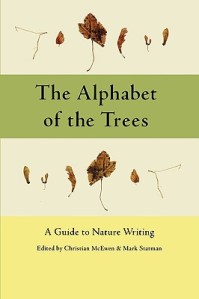
The Alphabet of the Trees: A Guide to Nature Writing
is a collection of twenty-nine essays by nature writers, poets, fiction writers and educators. More than simply a collection of essays about nature, The Alphabet of the Trees is a wonderful collection of ideas for the classroom and the field.

In their respective essays, contributors share their experiences teaching students how to write about nature. Contributors provide clear instruction, examples of student work and plenty of inspiration to last an entire school year.

McEwen & Statman (2000) published this book for teachers because they wanted to change how the subject of nature is approached in the classroom. They explain that they want nature to be more than a collection of facts. Their book has so many wonderful ideas and so many different ideas, it is impossible to summarize them. Instead of attempting a blanket summary, I would like to offer a glimpse into the type of nature writing activities contributors share with teachers. Listed below is the name of each contributor and the lessons and inspiration they invite teachers to bring into their classrooms.


Nature Writing Activities
:

  • Gary Snyder – The power of language and observation.
  • Matthew Sharpe – Ideas about how to lead a conversation about nature in an urban classroom.
  • Susan Karwoska – Using children’s literature to explore nature in the city.
  • Joseph Bruchac – Teaching the value of listening to connect with, and write about, nature.
  • Sam Swope – How to write about common objects in many different ways.
  • Eleanor J. Bader – How to write an advocacy essay.
  • Kim Stafford – Recording the thoughts and words of children.
  • John Tallmadge – Looking for wildness in the city.
  • Mary Oliver – How to keep a notebook of felt experiences.
  • Barbara Bash – Field sketchbooks in the city.
  • Sarah Juniper Rabkin – Seeing through the eyes of a scientific illustrator.
  • Clare Walker Leslie and Charles E. Roth – Nature journaling with school groups.
  • Christian McEwen – Using the five senses to write about nature. Also, how to set up an ode to nature or any topic.
  • Suzanne Rogier Marshall – How to transition from looking to writing.
  • Holly Masturzo – How to encourage observation through discovery.
  • Ann H. Zwinger – How to write a natural history essay.
  • Carolyn Duckworth – Tools for exploring an animal and an issue.
  • Mary Edwards Wertsch – How to write nature poems (specifically question poems).
  • Michael Morse – Writing about nature using the senses and observing transformations in nature.
  • Penny Harter – Lessons that address how to write about animals (grades 4-12).
  • William J. Higginson – How to write haiku and linked poems (includes renku topics and guidelines for teachers)
  • Cynde Gregory – A garden writing exercise that is a good lead-in to a unit about plants.
  • Jordan Clary – Using nature imagery in poetry.
  • Jack Collom – A wonderful collection of writing ideas for poetry.
  • Terry Hermsen – An exercise in creative memory (poems to help humans recall what they have forgotten about Earth, Wind, Air and Fire.
  • Margot Fortunator Galt – Nature as teacher and guide (circle poems, writing about landscapes, seasons).
  • Janine Pommy Vega – How to help students speak for something in nature (persona poems).
  • Barry Gilmore – Exercises in naming things, observing and describing.
  • Carol F. Peck – An idea to incorporate writing with social studies curricula.

Contributors each include a list of resources at the close of their essays. Editors McEwen & Statman reorganize these resources and provide teachers with a rich bibliography of nonfiction books, fiction books, books about poetry and books for children. They also provide a list of resource organizations and a short biography of each contributor.

The ideas in this collection can be used in many ways beyond the traditional classroom. Outdoor educators, naturalists and interpreters will also enjoy this book.

The Alphabet of the Trees: A Guide to Nature Writing is available at www.christianmcewen.com.


Reminder

It’s Back-to-School time.

This month the focus will be on Classroom Resources. I have been reorganizing to get ready for a new school year and to make ArtPlantae a helpful resource for teachers preparing to take on the Common Core State Standards and the Next Generation Science Standards. While classroom resources will receive special attention this month, bringing such resources to you will be an on-going effort as I continue to encourage an interest in plants and continue to connect artists, naturalists and teachers.

Centered around home, school and community, the month of August begins with a special exhibition celebrating the importance of home and information about a resource that should be in every educator’s toolbox. Read about the Habitat for Humanity Artist Showcase in the next article. Come back tomorrow for the teaching and learning column to learn about a resource offering a year’s worth of thoughtful activities designed to connect students with nature.

As this month progresses, I hope you will take a moment to respond to
“Tips & Tools” inquiries and participate in conversation with fellow readers.

Let’s get ready for a new school year!


Spread the News, Create a Richer Resource, Learn Even More

Share articles, interviews, conversations with fellow readers and the carefully curated collection of resources at ArtPlantae Books with friends and colleagues by using the “Share This” buttons below.

Today is the first Thursday of the month and this means that this evening the streets of downtown Riverside will be filled with people enjoying a warm summer night at ArtsWalk.

Tonight ArtsWalk will be especially memorable for Habitat for Humanity Riverside which has been celebrating its 25th anniversary and the 15th anniversary of the Riverside ReStore this year. Their celebration takes a very public turn as Habitat’s “Homes” tour kicks off in front of the Main Public Library on Mission Inn Blvd, across the street from the Riverside Metropolitan Museum and the historic Mission Inn.

This tour will showcase the work of 46 local artists and their interpretation of what home means to them. This exhibition will be on view inside the library
August 4-22, 2013. Beginning August 27, the twenty-five dollhouses and fifteen plaques will be auctioned off to raise money for housing projects in Riverside, Jurupa Valley, Moreno Valley, Corona and Norco — areas served by Habitat for Humanity Riverside. This auction will be held at the Riverside ReStore. Bidding will also occur online, allowing individuals in neighboring communities the opportunity to participate. The auction ends on September 27, 2013. Winning bidders will be announced on September 28, 2013.

Participating artists will be in attendance during ArtsWalk tonight to answer questions about their work. I will be there with my educational/interactive piece titled, Garden Journal: Sunflower. It is a “home herbarium” piece designed to ignite a curiosity about plants and offers gardeners a way to begin recording what grows in the home garden.

Showcase artists will serve as docents while the exhibition is on view inside the library from August 4-22, 2013. If you can’t make it out tonight, we hope to see you while the exhibition is at the library or when the exhibition returns to the Riverside ReStore for the auction.

I invite you to attend the ArtsWalk launch of this special “Homes” tour tonight from 6:00 – 8:30 PM to admire the thoughtful creativity of local artists and their presentation of the showcase message, Home is where our story begins…


Vote for Your Favorite

After viewing the 25 amazing dollhouses and 15 creative plaques, go online to vote for your Fan Favorite at the Riverside ReStore. A Fan Favorite Award will be presented at Habitat’s 25th Anniversary Gala in September.

A new adventure awaits at Classes Near You > Florida!


Mindy Lighthipe

www.botanicalartpainting.com
Custom classes, art tours, and self-published instructional books can be found at Studio 16, the classroom and art studio of natural science illustrator, Mindy Lighthipe. To register for classes, contact Mindy.

    Bugs, Beasts & Botanicals Artistic Adventure Tours
    Costa Rica 2014

    February 4-13, 2014
    Download Itinerary

    Imagine this…

    Upon arriving in Costa Rica, you are greeted by a driver who takes you to Hotel Bougainvillea to join up with fellow artists and instructors Mindy Lighthipe and Nancy Richmond. After a tasty dinner, you retire for the evening in this exciting garden paradise.

    The next morning you awake to begin your Costa Rican adventure and go all-in to enjoy one amazing experience after another. One-of-a-kind adventures include a visit to a toucan rescue ranch, a rainforest and a waterfall garden. They also include bird walks, drawing in the field, painting and learning about photography.

    Sound like fun?

    Learn more about this unique opportunity and download an itinerary on Mindy Lighthipe’s website, BotanicalArtPainting.com.

    Save $250 if you register before September 1, 2013!

New at Classes Near You > New York!


Gretchen Kai Halpert

www.gretchenhalpert.com
Gretchen Halpert is a scientific illustrator and biologist with many years of experience creating illustrations for the medical field, for scientific research, and for commercial clients. Gretchen also teaches classes in the book arts and leads journaling classes.

    Gardens and Villas of the Italian Lakes
    June 21-30, 2014
    Join Gretchen on an eight-day tour of northern Italy! Enjoy two travel days plus eight days exploring lush gardens and ancient villas in the Italian lakes region of northern Italy (plus a pop over to southern Switzerland). Visit Venice, Murano, Doge’s Palace, Giusti Giardino, Como, Lugano (Switzerland), Bellagio, Stresa, Lake Maggiore, Villa Cicogna, Isola Madre and Isola Bella. This botanical tour is presented by Botanical Travel Tours and operated by the Royal Horticultural Society in conjunction with Collette Vacations.

    Gretchen will offer botanical sketching and travel journaling tips and demos for those interested. Contact Gretchen by email or at 607-767-6936 if you have questions about this tour.

    View complete itinerary

There is no shortage of drawing, sketching and painting apps for iPads, iPhones and other gadgets. Which apps are the best? Which will help you draw, paint and match colors in a way resembling how you work with pencil, paper and paint?

Today I want to bring attention to a selection of apps created by Adobe and, specifically, to the interesting series of videos published last month about creating botanical illustrations on mobile devices.

Broadcasting from The Creative Cloud Classroom, instructor Mike McHugh demonstrates how to use Adobe’s Creative Cloud products to turn a botanical drawing into a finished painting. The products he demonstrates are Adobe Ideas (sketching), Adobe Kuler (color matching) and Adobe Illustrator CC (painting).

The color-matching app Adobe Kuler is especially interesting. Many of you are familiar with the color chart by the Royal Horticultural Society (RHS). Well, Adobe Kuler essentially functions like the digital version of the RHS color chart. This interesting app enables you to point your iPhone camera or iPad camera at a subject and instantly establish a color palette. It is fascinating to watch it work.

Now, in just these two paragraphs I have laid the foundation for some very lengthy discussion. I know a discussion like this can turn into as heated a debate as those about religion and politics. My objective today is not to stir the pot, but to share thoughts. To facilitate the sharing of opinions, I created a short survey where opinions can be cast as anonymous clicks. If you would like to post more extensive commentary, please feel free to do so in the Comment box below. All I ask is that you keep passionate commentary friendly.

Before you visit the anonymous survey, take a moment to view the wonderful tutorials in Adobe’s Creative Cloud Classroom. Each video runs about 12 minutes. Here are the links:


Here is the survey

You’ll be able to see how your opinions compare with other readers at the end.


Also See

Adobe Touch Apps for iPhone and iPad. Adobe Ideas and Adobe Kuler are FREE.


University of Oxford Botanic Garden

www.botanic-garden.ox.ac.uk
The University of Oxford Botanic Garden is a collection of 13 distinct gardens and seven display greenhouses featuring over 5,000 species of plants. The garden offers educational programs for the public and for teachers. Together with the Harcourt Arboretum, the University of Oxford Botanic Garden forms the Museums and Collections department at Oxford University.

    Drawing plants with Kate Houghton
    
A day exploring plants from the Botanic Garden collection 

    Saturday, August 17, 2013
    10 AM – 4 PM
    Tuition will be given through demonstration and simple exercises designed to build up speed and confidence in capturing some of the essential features of these incredible structures. Kate Houghton MA started out as a sculptor and it is perhaps this which drives her interest in the structure of plants. She is committed to the role drawing can play in gaining a deeper understanding of the natural world.

    An exhibition of Kate’s paintings are on view at the Oxford Botanic Garden through August 30, 2013.

    Cost: £60 (includes a sandwich lunch)

    View Details/Register

    Registering online allows force secure payment and immediate confirmation of your place(s). No tickets are sent out. Your email confirmation acts as a ticket. 


    Flower and Plant Portraits in Watercolour with Liz Sherras-Clark

    September 28-29, 2013
    10 AM – 4 PM
    This will be an intensive and enjoyable weekend when students learn to develop flower painting skills and will have the chance to complete two of their own paintings under the expert guidance of Liz Sherras-Clark. Trained at the Ruskin School of Fine Art, Liz has been inspired by John Ruskin:

    “…great art should communicate an understanding and appreciation of nature – only by means of direct observation can an artist through form and colour represent nature in art”.

    Cost: £120

    View Details/Register

    Registering online allows force secure payment and immediate confirmation of your place(s). No tickets are sent out. Your email confirmation acts as a ticket. 

This information has been posted at Classes Near You > England.