Feeds:
Posts
Comments

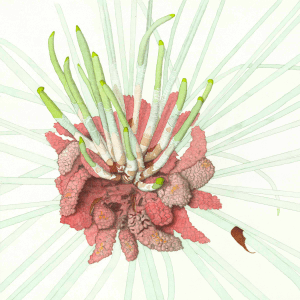
Red Pine New Growth, © Debra Greenblatt, all rights reserved. Courtesy MacRostie Art Center.

Red Pine New Growth, © Debra Greenblatt, all rights reserved. Courtesy MacRostie Art Center

Art from the Edge of the Boreal Forest: Reflecting Biodiversity
September 6-30, 2013
MacRostie Art Center
Grand Rapids, MN

MacRostie Art Center has announced its exhibitions for September, including
Art from the Edge of the Boreal Forest featuring the work of ten Minnesota-based botanical artists. These artists have created an exhibition of artwork based on the trees, plants, birds, and insects of the boreal forest to help educate the public about the disruptive factors – such as fire, invasive species, and stressful climate conditions – that are affecting this ecosystem. Boreal forests cross most of the upper parts of North America. The forests of Minnesota are uniquely positioned on the edge of the boreal forest ecosystem, which makes them especially susceptible to ecological disturbances.

The artists launched their studies of boreal forests in 2010 and have consulted with Dr. Lee Frelich, a forest ecologist with the University of Minnesota, Dr. Gerald Niemi of the University of Minnesota-Duluth, and Jana Albers, DNR Forest Health Specialist. The artists have created work featuring botanically accurate images of trees, plants, birds, and insects. The species depicted were identified as most at risk for disappearing from the northern woods of Minnesota.

The artists used the following media to create their work: watercolor, gouache, pastels, acrylic, graphite, colored pencil, pen and ink and scratchboard.

The work in this exhibition distinguishes itself from most floral art in its botanical and scientific accuracy. It also separates itself from descriptive botanical and scientific illustration in its reverential and artistic spirit.


Climate Change Project

In partnership with University of Minnesota Extension and the Itasca Private Woodland Committee, MacRostie Art Center is presenting two special events in conjunction with the opening of this exhibition. On Saturday, September 7, there will be a bus tour to the SPRUCE climate change project at the Marcell Experimental Forest. This project is a partnership between the US Forest Service and Department of Energy and is examining the effects of climate change on peatlands and forests. The tour will be given by scientists working on the project. The bus will leave MacRostie Art Center at 8 AM and return at 12 PM. Pre-registration and a fee of $10 are required to attend the bus tour.

At 1 PM, after the bus tour, there will be a presentation by Dr. Lee Frelich at MacRostie Art Center about the current and projected effects of ecological disturbances on the forests of Minnesota. There is no cost to attend the talk with Dr. Frelich.

Both events are open to the public. For more information contact MacRostie Art Center at 218-326-2697.


You’re Invited!

Downtown art galleries and businesses are open 4-8 PM on Friday, September 6, 2013 for First Friday Art Walk. MacRostie Art Center will have food, wine, a demonstration by botanic artist Vicki Barth and artist talks at 6 PM. The First Friday reception is sponsored by Children’s Mental Health Service and is free and open to the public.


About the MacRostie Art Center

MacRostie Art Center is a nonprofit organization dedicated to community growth through the arts in northern Minnesota. The MAC exists to support and advance the work of professional artists in the region and build a community that recognizes, appreciates and celebrates art. They believe that art is central to the quality of life in northern Minnesota – as it is everywhere – and that the artists who create, sell, and exhibit art play a vital role in society.

MacRostie Art Center presents exhibitions, workshops, classes, festivals, lectures, and other activities to engage the community in the arts. They support artists by providing a well-established venue for exhibition and sale of work and they work to keep the arts visible as a defining part of the community.

Learn more about the MacRostie Art Center
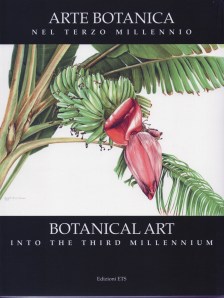
BotanicalArtIntoThirdMillenium The last five copies of Botanical Art Into the Third Millenium are available for purchase at ArtPlantae Books. These are the last five “hurts”. Photos are included with each listing.

Catalogs are available for $32 plus USPS Standard Post (Reg. $45). These last five copies make good “traveling copies”. If you like to share examples of contemporary botanical art with students, each of these copies will serve you well and will enable you to keep your personal copy at home in your library.

There is a new learning opportunity at Classes Near You > England.

Spend a weekend at the Eden Project!


Eden Project

www.edenproject.com
Located in Cornwall, England, the Eden Project is a non-profit whose focus is connecting people to the natural world through educational programs, social programs, music and art. See how the Eden Project was transformed from a clay pit to an international institute for learning.

    Introduction to Botanical Illustration
    October 11-13, 2013
    10 AM – 4 PM
    In this course for beginners, participants will learn from horticulturists and artists at the Eden Project in Cornwall, England. On the first day, horticulturists will help participants learn about plants. Participants will then spend the remaining two days with some of the artists working on the Eden Florilegium. Included in the cost of this three-day workshop are lunch, refreshments and entry to the Eden Project. Hotel accommodations are not included. Cost: £180 per person

    View Details/Register

How many ways can you paint plants?

Judy Thomas has some ideas for you. Read below about the new class she will teach in the Art in the Garden program at Lewis Ginter Botanical Garden.

Here is what’s new at Classes Near You > Virginia:


Lewis Ginter Botanical Garden

www.lewisginter.org
In 1884, Lewis Ginter purchased some property and built a gathering place for Richmond bicyclists. One hundred years later, the Lewis Ginter Botanical Garden was established on this same piece of property and soon became one of the top five destinations in Virginia. The Garden is home to Artbase a searchable database containing 2,500 botanical watercolor paintings by Alexandre Descubes. The Adult Education program at the garden includes workshops in botanical drawing and painting and a certificate program in botanical illustration.

The program also includes an Art in the Garden series that encompasses drawing, sketching, knitting and this new class with artist Judy Thomas:

    Felt Painting with Botanical Subjects
    Saturdays, November 2, 9, 16, 23, 2013
    9:30 AM – 2:30 PM
    Felt painting uses a combination of wet and dry (or needle) felting techniques with wool, along with beading, embroidery, and lace, to produce lovely works of three-dimensional art. Students in this four-day class will learn the fundamentals of both wet and dry felting to produce their own design, using themes from botany. See a sample felting project on the registration page for this class. The techniques learned can be used to create decorative items for the home, pillows, bags, and clothing.
    Cost: $180 members, $219 nonmembers.

Owens Community College in Maumee, OH will offer botanical art classes this Fall. Deborah Kopka of DK Designs will teach both classes.

Here is more information:


Deborah Kopka, DK Designs

www.dkdesigns.org
Botanical illustrator, Deborah Kopka is the principal artist at DK Designs. Deborah licenses her artwork, creates illustrations for publishers, and teaches botanical art classes through her design studio. Visit her website to read the latest issue of her newsletter, Botanically Speaking.

    Botanical Illustration: Drawing in Graphite
    Owens Community College
    Owens Arrowhead Campus, Maumee, OH
    Saturdays, September 14, 21, 28 and October 5, 12, 19, 2013
    9 AM – Noon
    In this introduction to botanical illustration, participants will learn about drawing techniques used by contemporary botanical artists. Plant specimens are provided for the first class meeting. A supply list will be mailed to registered participants.
    Limit: 10
    Cost: $249
    Course Number: 56211

    View Non-Credit Continuing Education Catalog (see page 8)


    Botanical Illustration: Painting in Watercolor

    Owens Community College
    Owens Arrowhead Campus, Maumee, OH
    Mondays, October 21, 28 and November 4, 11, 18, 25, 2013
    Learn painting techniques used by natural science illustrators and how to use watercolor with other media. Plant specimens are provided for the first class meeting. A supply list will be mailed to registered participants. Limit: 10
    Cost: $249
    Course Number 56212

    View Non-Credit Continuing Education Catalog (see page 8)

This information has also been added to Classes Near You > Ohio.

Jennifer Landin is a biology professor at North Carolina State University. She is also a scientific illustrator and a member of the Guild of Natural Science Illustrators (GNSI). She attended the University of Georgia and University of Montana for her undergraduate degree in Forestry & Wildlife Management. She received her Master’s degree in biology from Marshall University in West Virginia.

I first met Jennifer last year at the GNSI conference in Savannah, Georgia. It wasn’t until after the conference, when we were working on an article for the Guild’s journal, did I learn of Jennifer’s dissertation research about the use of perceptual drawing in the classroom. I have since read her dissertation and am excited that we have the opportunity to learn more about Jennifer’s research this month.

In her research, Jennifer addresses the use of drawing to improve observational skills and increase understanding in the biology classroom. To help you understand her project, here are her research questions as they appear in Landin (2011):

    1. Do students who participate in weekly drawing activities demonstrate a higher level of biology content knowledge when compared to students who participate in weekly writing activities?

    2. Do students who participate in weekly drawing activities show a more positive attitude toward biology when compared to students who participate in weekly writing activities?

    3. Do students who participate in weekly drawing activities display improved observational skills when compared to students who participate in weekly writing activities?

    4. What are student perceptions of drawing activities in relation to biological understanding?

    5. Are there correlations between the gains in content knowledge related to drawing activities and student cognitive processes?

Jennifer hypothesized that students who participated in weekly drawing activities would:

  • Demonstrate a higher level of biology content knowledge.
  • Demonstrate a more positive attitude toward biology.
  • Demonstrate a higher level of observational skills when compared to students who participated in weekly writing activities only.

Did the data support these hypotheses?

We’ll find out as this month progresses.

Please welcome Dr. Jennifer Landin as our special guest for September!


Literature Cited

Landin, Jennifer. 2011. Perceptual Drawing as a Learning Tool in a College Biology Laboratory. Dissertation. North Carolina University, Raleigh, North Carolina. 


Update October 2016

See Jennifer and her students at work in a video produced by North Carolina State University at https://youtu.be/MFuDDLqajVA.

Today I have announcements instead of the usual Friday column.

On Sunday, September 1, we’ll launch a month that will include much discussion about drawing, learning, and research. Watch your inbox for an email announcement or your Twitter, Facebook or LinkedIn timelines if you follow through these channels.

During August, the focus was on classroom resources. As this month comes to a close, I want to make you aware of changes at the store. The Classroom category has been updated and resources are now organized by age groups. The subcategories Activity and Reference have also been added. I hope you find these new categories helpful and the reviews relevant to your teaching whether you teach in a traditional classroom, teach as an informal science educator or teach at home. The new categories are expanding quickly.

Enjoy the long holiday weekend.