Feeds:
Posts
Comments

Download flyer

Download flyer

Scholars Emanuela Appetiti and
Alain Touwaide
will discuss their research into the medical traditions of the Mediterranean at the National College for Natural Medicines in Portland, Oregon on October 30 and November 1. Alain Touwaide will also present a special lecture entitled, The Legacy of Greece to Modern World Medicine at the Hellenic-American Cultural Center and Museum on Saturday, November 2, 2013.

Emanuela and Alain founded the Institute for the Preservation of Medical Traditions. The Institute is a research and education organization with non-profit 501(c)(3) status hosted by the Smithsonian. Through the Institute, Emanuela and Alain pursue their research activities, including research for the PLANT program. The acronym PLANT stands for PLantarum Aetatis Novae Tabulae (meaning in Latin Renaissance botanical illustrations).

The research Emanuela and Alain conduct is fascinating. If you have an interest in medicinal plants, herbals or history, their lectures are not to be missed.

Please welcome Mt.Cuba Center to the Classes Near You section!

You can view their classes here and at Classes Near You > Delaware.


Mt. Cuba Center

www.mtcubacenter.org
Mt. Cuba Center is a botanical garden in Hockessin, DE dedicated to the conservation, display, and research of native plants. Their woodland wildflower gardens are recognized as the area’s finest. The Center hosts many interesting classes related to plants, gardening and the arts. View their full schedule of on-site classes and distance learning classes on their website.

    Fall Photography Free Stroll
    Saturday, October 26, 2013
    7:30 am – 11:30 am

    Enjoy this early morning opportunity to photograph the gardens of
    Mt. Cuba Center!

    Chris Starr will offer advice, tips, and ideas as well as answer your photography questions. Photographers of all experience levels, from novices to experts, will receive personal guidance. Stroll the gardens while capturing the visual glory of autumn. Be sure to bring your lenses, camera manual, and dress for the weather. Tripods are welcome. Garden admission is included with registration. Chris Starr is an experienced photographer who has played many roles at Mt. Cuba Center since 1984. Currently he is a member of the grounds team. View Details/Register


    Hidden Treasures

    November 5-7, 2013
    10:00 am to 3:00 pm

    Create botanical art from a new perspective!

    Primarily using graphite pencil, but including watercolor and colored pencil, create a drawing with a range of texture and tone. Our focus will be more on the sculptural and textural qualities of our plant source than on color. Learn how to capture nature from a different vantage point and see the art you can create from spent flowers, dried up leaves or spindly stalks. John will augment his group instruction with individual coaching. Basic drawing ability needed and a materials list is provided upon class registration. Please bring your lunch.

    John Gist is an acclaimed artist who worked as an illustrator after graduating from the Philadelphia College of Art (now the University of the Arts) with a degree in Illustration. He has taught art for over 15 years including at Bartram’s Garden and the Philadelphia Society of Botanical Illustrators. His work has been displayed in several exhibitions, including the exclusive International Exhibition of Botanical Art and Illustration at the Hunt Institute, the Philadelphia Society of Botanical Illustrators Exhibition at the Philadelphia International Flower Show, the Woodmere Art Museum, and with the American Society of Botanical Artists annual shows. View Details/Register


    Multiply Your Natives from Seed

    Saturday, November 9
    9:00 am – 2:00 pm

    Learn how to identify, collect, and sow native seeds. Join Bill McAvoy, Delaware’s state botanist, and Phil Oyerly, Mt. Cuba Center’s greenhouse manager, as they share their joint expertise in growing native plants from seed. Bill will teach you how to correctly identify seeds, explain the ethics of collecting seed from the wild, and demonstrate sustainable seed collecting practices. Clean the seed you harvest, learn seed scarification and stratification techniques, and find out the best ways to store seed. This is a hands-on workshop so be dressed for the weather and able to walk the rugged terrain of our Natural Lands. Students will take home wildflower seeds. Please bring a bagged lunch.

    William McAvoy has been the Delaware state botanist for the last 23 years, while serving in the Delaware Division of Fish and Wildlife. He is the primary author of the 2001 publication The Flora of Delaware, an annotated checklist, which has been revised as an online database. Phil Oyerly is the greenhouse manager at Mt. Cuba Center and has worked in the plant propagation area for many years. Phil and his staff grow native plants in support of the landscape and research activities of
    Mt. Cuba Center. View Details/Register


    Winter Tree Identification

    Saturday, January 18, 2014
    (Snow date: February 1, 2014)
    9:00 am – 12 Noon

    Learn the basics for identifying woody plants in winter. Don’t let the leafless trees of winter scare you! Eileen Boyle, Director of Education and Research at Mt. Cuba Center, will teach you distinguishing characteristics for identifying native trees and shrubs during the austerity of winter. Examine bark, study habit, inspect buds, and collect twigs then put them through a dichotomous key. Dress for winter conditions since this class will be held both outdoors and in the lab. Eileen Boyle is the Director of Education and Research at Mt. Cuba Center. Previously she was the director of horticulture at the Philadelphia Zoo and the New York Botanical Garden. She has also worked as a horticulture professor, an administrator for the New York City’s parks, and for the USDA. View Details/Register


    Why We Need More Natives in Our Gardens

    Tuesday, January 28, 2014
    (Snow Date: Feb. 4, 2014)
    7:00 pm – 9:00 pm

    Garden for life – ours and theirs!

    Specialized relationships between animals and plants is the norm in nature, rather than the exception. Plants that evolved in concert with local animals provide for their needs better than plants that evolved elsewhere. Doug will explain why this is so, why it is important to restore biodiversity to our residential properties, what we need to do to turn our landscapes into functioning ecosystems once again, and what we will gain by doing so. Doug will sign copies of his book, Bringing Nature Home. Doug Tallamy is Professor and Chair of the Department of Entomology and Wildlife Ecology and Director of the Center for Managed Ecosystems at the University of Delaware in Newark, DE. He has authored 73 research articles and taught Insect Taxonomy, Behavioral Ecology, and other courses for 30 years. Chief among his research goals is to better understand the many ways insects interact with plants and how such interactions determine the diversity of animal communities. His book, Bringing Nature Home: How Native Plants Sustain Wildlife in Our Gardens, received the 2008 Silver Medal by the Garden Writers Association.
    View Details/Register


The Lloyd Library & Museum invites you!

You are invited to the dedication of the Lloyd Medicinal and Johnny Appleseed Memorial Garden at The Ohio Governor’s Residence on October 23, 2013.

The Friends of the Ohio Governor’s Residence and Heritage Garden is pleased to announce its latest addition to the Heritage Garden — the Lloyd Medicinal and Johnny Appleseed Memorial Garden. This new medicinal garden, named after early 20th-century pharmacist John Uri Lloyd, of Cincinnati, Ohio, surrounds a descendant of one of Johnny Appleseed’s famed late 18th century apple trees planted in Ohio and the surrounding area. These highlight the multiplicity of uses of plants, and those that were especially important to the early families and individuals residing in the state.

The dedication ceremony begins at 1:30 p.m., with special appearances by First Lady Karen W. Kasich, and John Uri Lloyd and Johnny Appleseed impersonators. Light refreshments will be provided. The dedication will be held in the
Heritage Garden at the Ohio Governor’s Residence.

Attendees MUST register in advance by October 16, 2013.
Please go to the Lloyd Library website to RSVP and to get more information.

The Heritage Garden was established in 2000, under the guidance of Former First Lady Hope Taft. The garden was designed to showcase the variety of Ohio’s natural history and environment to the thousands of yearly visitors to the Ohio Governor’s Residence. It has continued to grow and flourish since that time. The idea for the Lloyd Medicinal and Johnny Appleseed Garden was first conceived in 2009. The garden was completed this year.

The Lloyd Medicinal and Johnny Appleseed Garden was made possible through support of the following: Friends of the Lloyd Library and Museum,
Ohio Pharmacists Association, Meisner & Associates Land Vision, Friends of the Ohio Governor’s Residence and Heritage Garden, Greenscapes: Excellence by Design, and Larry Owen.


About The Friends of the Ohio Governor’s Residence and Heritage Garden

The Friends of the Ohio Governor’s Residence and Heritage Garden was established in 2006 as a non-partisan, non-profit 501(c)3 organization to help preserve, enhance and promote the Ohio Governor’s Residence and Heritage Garden. Our Board of Directors consists of business and cultural leaders from across the state who value the significance of this historic landmark and are committed to ensuring its legacy for generations to come. For more information, visit the Friends’ website.

Download flyer

Download flyer

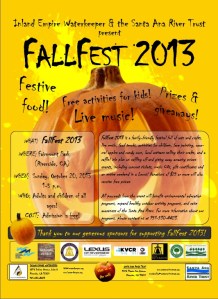
FallFest 2013
Fairmount Park, Riverside, CA
October 20, 2013
1-5 PM

Inland Empire Waterkeeper and the Santa Ana River Trust will host FallFest 2013, a family-friendly festival of arts and crafts, live music, food trucks, activities for children, artisans selling crafts and a raffle. Visit ArtPlantae to learn about plants and botanical illustration. All proceeds benefit environmental education programs, outdoor activity programs and raise awareness of the Santa Ana River.
Get directions


Learn More

aureaVista_Closes The Aurea Vista marketplace in downtown Riverside has announced it will close by the end of the year. The retail areas of the historic Aurea Vista hotel will become a nightclub.

ArtPlantae’s retail section dedicated to plant-based education and botanical art will merge with its retail space on Aurea Vista’s ground floor. The teacher trunk show will continue through October 31 as planned. Pick up an in-store coupon at each section to save $5 on purchases of $20 or more. Coupon valid only for ArtPlantae merchandise and must be presented at the register during checkout. Use the coupon on a wide selection of books under $10 or on the holiday gift ideas now available at the store.

Thank you to all who visited this unique boutique marketplace and to all who supported ArtPlantae during its one-year tenure at Aurea Vista.

You can continue to buy resources from ArtPlantae by shopping online at ArtPlantae Books or by visiting ArtPlantae at educational events. Proceeds support this site and help to cover the cost of materials for outreach activities.

Aurea Vista is located at 3498 University Avenue, on the corner of Lemon Street and University Avenue. Free parking is in the parking lot with the ballet mural. Street parking is free after 5 PM on weekdays and is free all day on weekends.


Store Hours
:

    Monday (closed)
    Tuesday – Saturday (11-7)
    Sunday (11-5)


Get directions

If you have taken drawing classes or browsed through books about drawing, you have no doubt seen or experienced the drawing exercise requiring you to copy an inverted line drawing. This technique is practiced because it is thought that inverting a subject while drawing it enhances drawing accuracy (Edwards, 1999).

Researchers Dale J. Cohen and Holly Earls (2010) designed an experiment to investigate if drawing inverted images leads to improved accuracy or if it leads to drawing errors. They hypothesized that interfering with an artist’s spatial perception would not result in more accurate drawings. They based their hypothesis on the research of Cohen and Bennett (1997) who determined that the foundation of drawing errors is rooted in an artists’ perception of a stimulus. Cohen and Earls (2010) hypothesized that, if an artist’s perception of a stimulus is distorted, then this would be evident in their drawing of this stimulus.

In their study, Cohen and Earls (2010) used human faces as the drawing stimulus because of the extensive drawing research involving human faces. The investigators assigned a drawing task to 121 students. Their sample population was composed of non-artists and artists. Half were assigned the task of drawing inverted faces and half were assigned the task of drawing faces in their normal upright orientation. Participants’ drawings were evaluated for the accurate representation of spatial relationships between facial features, the accurate representation of selected facial features, and the accuracy of whole-face drawings. Four critics rated the drawings. Two of the critics were art history professors and two were studio art professors.

The independent ratings of each critic were analyzed statistically. Data revealed that drawing inverted subjects had a significant negative effect on the drawing of spatial relationships. Rating data also indicated that orientation had no significant effect on the drawings of specific facial features or on the accuracy of whole-face drawings (Cohen and Earls, 2010). Because orientation had a negative effect on the drawing of spatial details, Cohen and Earls (2010) concluded that drawing an inverted stimulus does not improve drawing accuracy.

That is to say, drawing accuracy when one is drawing faces.

Can the same be said about the drawings of inverted images of plants?

For more information about Cohen and Earls’ investigation of this popular art technique, see Inverting an Image Does Not Improve Drawing Accuracy.


Literature Cited

    Cohen, Dale J. and Susan Bennett. 1997. why can’t most people draw what they see? Journal of Experimental Psychology: Human Perception and Performance. 23(3): 609-621. Read Review

    Cohen, Dale J. and Holly Earls. 2010. Inverting an image does not improve drawing accuracy. Psychology of Aesthetics, Creativity and the Arts. 4(3): 168-172. Web. http://people.uncw.edu/cohend/research/papers/cohen%20and%20earls%202010.pdf [accessed 11 October 2013]

    Edwards, Betty. 1999. Drawing on the Right Side of the Brain. See eBook

By Bonnie Driggers


Botanical Artists for Education & The Environment
is happy to announce the completion of our book, American Botanical Paintings: Native Plants of the Mid Atlantic, which was more than three years in the making. It contains 60 reproductions of original paintings and drawings of plants and 40 original paintings of butterflies, moths, and other pollinators. For each plant, we briefly describe the plants and their habitats, provide relevant information about the plant families, and relate ways in which Native Americans or early settlers used the plants. For plants unsuitable for home gardens, we mention their environmental importance, such as food and habitat for birds and animals.

Tuliptree by Marsha Ogden. Image courtesy Starbooks.

Tuliptree by Marsha Ogden. Image courtesy Starbooks.

    Dr. Shirley Sherwood OBE, Botanical art collector
    This is a delightfully illustrated book, beautifully designed and with lots of variety in the choice of plant subjects. I admired the standard of painting and the fresh, appealing studies, which will be attractive to both naturalists and gardeners.


    Holly Shimizu, Executive Director, U.S. Botanic Garden

    The U.S. Botanic Garden was thrilled to be a part of this book as it embodies what we know to be vital — our world is better and richer with fine botanical art, and the plants in our backyards, in our woods, and along the roadsides are amazing!


    Peggy Cornett, Curator of Plants at Monticello

    Like the exquisitely illustrated floras from past centuries, this volume carries on a rich tradition of detailed and deftly created botanical artistry. Each painting portrays the abundance and diverse beauty of the natural world around us, from early spring ephemerals to the towering monarchs of our deciduous forests.


    Derek Norman, President, American Society of Botanical Artists

    Native Plants of the Mid Atlantic – a beautiful book on botanical art that speaks to the mind, the heart, and the environment.

    Winged Sumac by Rose Pellicano. Image courtesy Starbooks.

    Winged Sumac by Rose Pellicano. Image courtesy Starbooks.

Botanical Artists for Education & the Environment (BAEE) created American Botanical Paintings: Native Plants of the Mid Atlantic for lovers of art and plants. We hope to foster a particular appreciation not only for the beauty of native plants and their artistic representations but also for their importance to the environment and to encourage, where practical, the use of native plants in home gardens.

Publication costs come from donations. BAEE will donate proceeds from the sale of the book to nonprofit organizations supporting native plant education, conservation, and horticulture.

Native-Plants-Mid-Atlantic-New Botanical Book-Inglett Publishing Custom American Botanical Paintings: Native Plants of the Mid Atlantic is now available to order from Starbooks ($39.95) with free shipping within the United States through December 31, 2013.

The book is expected to ship by February 1, 2014. An exhibition of the paintings will open on February 15, 2014, at the U.S. Botanic Garden in Washington, DC.


Bonnie S. Driggers, President, BAEE

www.baeecorp.org
baee.info@gmail.com


Also Available at Starbooks