Feeds:
Posts
Comments

See Val Webb’s online workshop about herbs. It’s art, history and folklore!

Here is what’s new at Classes Near You > Alabama:


The Illustrated Garden, A Studio Blog

http://valwebb.wordpress.com
Val Webb is the 2013 Artist-in-Residence at the Mobile Botanical Gardens. This year Val will work at the gardens and encourage others to sketch the garden’s collections to learn about plants, gardening and all that the Mobile Botanical Gardens has to offer. Visit Val’s website to view her online tutorial, Botanical Drawing with Pencil and Watercolor. Connect with The Illustrated Garden on Facebook.

    Birds in Colored Pencil – Starting January 6, 2014
    Learn how to paint colored pencil portraits of birds using Val Webb’s “gentle pencil” drawing technique. Then learn how to layer color to create detailed colored pencil images. This online course is composed of nine lessons. Work at your own pace. No experience necessary. Pre-registration required. Cost: $50
    View Details/Register


    Drawn & Decorated Watercolor Lettering
    – Starting January 13, 2014
    Create decorated letters using watercolor, Pigma Micron pens, pencils and brush. No experience necessary. Participants have four months to complete 10 projects. Work at your own pace. Pre-registration required. Cost: $50
    View Details/Register


    Draw & Paint Six Culinary Herbs
    – Starting March 3, 2014
    Not your typical botanical drawing course. Participants will create pencil studies, spirited ink-and-wash sketches, mixed media paintings and learn about the history and folklore of the six herbs that are the focus of this course. Ten lessons. Work at your own pace. Pre-registration required. Cost: $50
    View Details/Register

Also see Val’s online workshop about drawing dogs and cats in pencil and charcoal that begins on January 27, 2014.

Are miniature gardens and fairies your passion? Then don’t miss Val’s class, Draw & Paint Fairies in Nature.

View all online workshops at The Illustrated Garden

fsc2014 The Field Studies Council in England has announced its schedule of classes for 2014. Click on the image to view their 52-page brochure listing 350 classes about plants, art and nature.

This is what’s new at
Classes Near You > England.


Field Studies Council

www.field-studies-council.org
Founded in 1943, the Field Studies Council (FSC) provides learning opportunities about the environment for all ages and abilities. Visit their website to learn more about interdisciplinary fieldwork opportunities, classes for individuals and families, publications and profession development courses. Courses are held across the FSC network of UK Centers, from the Scottish Highlands to the south Devon coast. The extensive schedule of classes for 2013 includes:

Botany Courses – Courses include studies of flowers, trees, grasses and grasslike plants, ferns, freshwater and wetland plants, lichens, fungi, general plants, mosses and liverworts. View Details/Register

Natural History Courses – Courses include studies of the natural world, birds and other animals, habitats and conservation. View Details/Register

Art Courses – Courses include painting, drawing, crafts (e.g. bookbinding), traditional skills (e.g., basketry), photography, archeology and botanical illustration. Get information about FSC botanical illustration courses online.

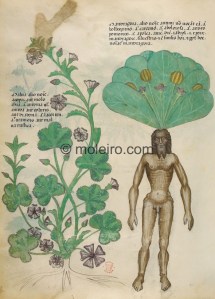
Mandrake. Image courtesy of M. Moleiro Editor, S.A., all rights reserved

Mandrake. Image courtesy of M. Moleiro Editor, S.A., all rights reserved

The historic Tractatus de Herbis, codex Sloane 4016 can now be enjoyed by anyone with an interest in the history of botany, botanical illustration or the history of medicinal plants.

The new facsimile reproduction has been published by Spanish publisher Moleiro Editorial whose specialty is the reproduction of codices, maps and works of art made on parchment, vellum, paper and papyrus between the 8th and 16th centuries.

The reproduction of Tractatus de Herbis features 218 illuminated pages and is bound in embossed dark green leather. It is an exact replica of the original and is accompanied by a volume of commentary written by Alain Touwaide, Smithsonian scholar and co-founder of the Institute for the Preservation of Medical Traditions.

Institute co-founder, Emanuela Appetiti, explains the significance of this historic work:

The manuscript Sloane 4016 is a large album of botany made sometime around 1440 in Italy. Although it is traditionally identified as a copy of the well-known Tractatus de herbis (Treatise on medicinal plants), it does not contain the text of this treatise, but only its illustrations. The major question posed by this manuscript is why it abandoned the text of the Tractatus, giving birth to the new genre of the botanical album. Significantly enough, the captions of the illustrations provide the names of the plants in the different languages used in the 15th century, all written with the Latin alphabet, however. They hint at the function of the botanical album as an international work that could be used by all the different linguistic groups, whereas the text of the Tractatus could be used only by those who understood Latin. In this view, the development of the botanical album is an unsuspected very modern phenomenon that sheds a completely new light on the history of botanical illustration and highlights a process of internationalization and, at the same time, of linguistic specialization coupled with a principle of economy that had not been uncovered so far.

Alain Touwaide explains more about the history of botanical albums in the description of the Tractatus de herbis, codex Sloan 4016 viewable on the publisher’s website.

Also available for viewing are 18 images showing the contents of this album. After reading Alain’s description, click on one of the images above his text. This will take you to a page where you can view all sample images.

Only 987 copies of this historic album are available for purchase worldwide. Alain’s commentary has been published in separate editions available in English, Spanish and French. To inquire about purchasing this limited edition reproduction at a special discounted price, contact the publisher.


You Might Also Like

Caring for Trees

WhyWouldAnyoneCutATreeDown We walk past trees all the time. They line sidewalks, grow in the backyard and are celebrated during seasonal activities like apple picking.

The tree on the sidewalk or in your yard probably doesn’t demand too much of your time. However trees, like annual flowers, require proper care and sometimes they need to be cut down. Why cut down a tree?

Author Roberta Burzynski explains the reasons why in Why Would Anyone Cut a Tree Down?. Published by the USDA Forest Service’s Northeastern Area State and Private Forestry in Newton Square, Pennsylvania earlier this year, Burzynski wrote her book in response to what students were telling her during classroom visits. While students were aware of the benefits of trees and the products they provide, they repeatedly told her that trees could never be cut down. As she explains in the preface of her book, she wrote her book to address their “gap in knowledge and understanding” about this subject.

Burzynski wrote Why Would Anyone Cut a Tree Down? for children, adults and families. It is an informative book illustrated with the peaceful, thoughtful and moving watercolor paintings of scientific illustrator, Juliette Watts. Burzynski discusses the ecological benefits of trees and the products derived from trees (e.g., pencils and paint brushes) in the first part of her book and then eases into the reasons why trees might need to be cut down in the second part. She closes her book with instructions about how to care for trees and supplies readers with resources about the following topics:

  • How to recognize hazardous defects in trees.
  • How to prune trees.
  • How to get help identifying tree pests.
  • How to use fire-resistant plants in the landscape.
  • How to buy trees and plant them in appropriate locations.
  • How to find wood markets in addition to commercial sawmills.

Burzynski’s text and Watts’ illustrations provide many talking points and learning opportunities for both children and adults. This wonderful book is available for purchase from the U.S. Government Printing Office for $10 (US) and $14 (International). It is also available as a free PDF from the USDA Forest Service. My personal recommendation is to purchase a print copy. This is a resource you will want on your shelf.

A sixteen-page curriculum guide is available for teachers and parents. This resource-rich guide includes 17 activities that can be completed in 15-60 minutes. Links to Web-based resources and books are also included.


Literature Cited

Burzynski, Roberta. 2013. Why Would Anyone Cut a Tree Down?. Newtown Square, PA: USDA Forest Service, Northeastern Area State and Private Forestry.


Also See

Updated October 29, 2014

Botanical Illustration Intensive Workshop
The National Tropical Botanical Garden on Kaua’I Hawaii

    February 2 – February 15, 2014 (Session 1)
    February 15 – 28, 2014 (Session 2)
    February 2 – February 28, 2014 (One-month Intensive)

    Time: 10 AM to 4 PM, daily

Study the fundamentals of botanical drawing using graphite pencil, colored pencils, watercolor pencils and watercolor. Drawing plants and flowers starts with observation.

Under the supervision of Wendy Hollender, illustrator, author, and instructor from The New York Botanical Garden, students will learn about plant structures and their importance through dissection and comparison.

Students will create detailed botanical drawings and sketchbook pages of flowering plants, fruits and seedpods, working directly from the wide variety of tropical plants growing at the National Tropical Botanical Garden (NTBG).

There will be opportunity to work on large compositions and detailed paintings for those staying the entire month. Lessons in composition will facilitate the development of larger compositions.

Participants will study historical botanical illustrations spanning four centuries as a way of understanding the tradition and techniques still in use today.

Dr. David Burney and other NTBG botanists will be available to help with understanding botany and other aspects of plant ecology.

This class is appropriate for advanced students as well as beginners because everyone works individually. No previous art background required.

Instructional classes will be conducted four days each week at The National Tropical Botanical Garden, with one day per week allotted for field trips or working in other locations on the island. Participants will have a large indoor-outdoor classroom for use, with time to draw outside anywhere in the garden.

Instructor is available in the classroom and does daily demonstrations. There will be a demonstration about drawing in the garden to introduce participants to techniques used when drawing outside. The weekends are free where by students can visit the island, relax at the beach or continue to draw in the garden classroom.

Workshop Fees:
Two-week workshop: $950 includes sumptuous fresh lunch on class days featuring local produce and tropical fruits. Other meals are not included with the exception of a once a week beach dinner barbeque.

Accommodations are available at the National Tropical Botanical Garden in shared housing for an unbeatable price or in nearby Kalaheo and Poipu or other locations in the area. For those staying in shared housing there is a kitchen for shared use. Bed and Breakfasts options are also available.

For additional information and to register, visit www.DrawingInColor.com or contact Wendy.

This information has been added to the Classes Near You sections for New York and Hawaii.

More Than Plant Parts

While at a science education conference, I learned about a resource that may interest you as you build that “big picture” about plants for students.

The Nutrients for Life Foundation is a nonprofit organization educating students and the public about the role fertilizers play in feeding the world. They created lesson plans for elementary, middle and high school students that can be used by classroom teachers and homeschool teachers. The foundation was created in 2004 by leaders in the fertilizer industry. According to the information in the Fall 2013 issue of Nutrients for Life, the Foundation’s magazine, representatives from the following companies serve as board members or as members on the advisory board: PotashCorp, Transammonia, The Fertilizer Institute, Intrepid Potash, Simplot, Koch Fertilizer LLC, Yara North America, Inc., The Mosaic Company, International Plant Nutrition Institute, Agium Inc., CF Industries, Inc., Florida Fertilzer & Agrichemical Association. The Foundation has regional representatives in Colorado, Louisiana, Nebraska, Iowa, Florida, Illinois and the Northwest. 

The Nutrients for Life Foundation’s campaign to educate the public about fertilizer is extensive. They have placed ads on trains, created recipe cards and have taken their message to the radio. They also sponsored a traveling exhibition about soil science that began its run at the Smithsonian’s Natural History Museum (July 19, 2008 – January 10, 2010).

The Foundation’s curriculum, Nourishing the Planet in the 21st Century, is aligned to state standards and is available for free online. When downloading the lessons for your grade level, select your state to download the proper curriculum. Downloadable materials include lesson plans, pre- and post-tests and supply lists. Posters, bookmarks and other materials can also be ordered at no charge.

Visit the Nutrients for Life website to learn more about their soil science curriculum. You can view videos complementing their curriculum on YouTube. Here is a link to a video about a seed sorting activity for elementary school students. When you visit YouTube directly, search for videos by “Nutrients4Life”.


Related

Botanical artist and botanical art collector, Tania Norris, has generously donated 41 rare books to The Getty Research Institute (GRI). The collection includes
Der Rupsen Begin (Birth of the Butterfly), a book published by Maria Sibylla Merian. Published in 1717, this book is the first book to depict insect metamorphosis and is one of the few surviving copies hand-colored by Merian’s daughter.

With the acquisition of the Tania Norris Collection of Rare Botanical Books,
The Getty Research Institute can provide future generations with a unique in-depth look at the history of botany and botanical art.

David Brafman, curator of rare books at the GRI, said “The Norris Collection offers inestimable rewards for scholars researching global botanical trade and the ensuing stimulus of cultural exchange to the trend of collecting curiosities spawned in Renaissance and Baroque European culture. Other books in the collection document the codependent progress of technologies in the history of medicine, pharmacology, and the color and textile industries from the sixteenth to nineteenth centuries. No less important are the opportunities to study the complex artistic relationship between physiognomy and ‘naturalism’ in visual representation, as well as developments in urban planning and landscape architecture. Ms. Norris’ generous donation enhances significantly GRI’s existing collections in such subjects and promises to transform the way art historians examine the past in the future.”

In particular, the unique hand-colored copy of Maria Sibylla Merian’s
Der Rupsen Begin (Birth of the Butterfly) from the Norris Collection will find a companion in the GRI vaults: Merian’s stunning Metamorphosis of the Insects of Surinam (1719), the self-published book which documented the watercolors, drawings, and scientific studies she executed and conducted while exploring the wildlife of the South American jungles. The GRI copy was featured prominently in the Getty Museum’s exhibition, Merian and Daughters, which celebrated the extraordinary pioneering contributions of the artist-naturalist, the first European woman to travel to America expressly for artistic purposes.

The Norris Collection will also prove an invaluable complement for research in landscape and still-life painting, as well as insights it will provide to conservators and conservation scientists about recipes and global trade in color-pigments and other preparations in the decorative arts.

In addition to being a botanical artist and collector, Tania Norris is a founding member of the Getty Research Institute Collections Council and also serves on the J. Paul Getty Museum Disegno Drawing Council and Paintings Conservation Council.

On the Getty accepting her books, Ms. Norris said:

It was one of the proudest moments of my life when the Getty Research Institute accepted my books for their library. I never collected expecting anyone else to think my books of interest. But now at the GRI, anyone can view them; some have been or will soon be in exhibitions and programs. More importantly, they will be preserved for generations to come.

Learn more about this wonderful contribution to botany and botanical art education at The Getty Research Institute.