Feeds:
Posts
Comments

On occasion, ​ you come across an opportunity to combine a good story with the technical side of a subject. Such an opportunity presented itself recently and it allows me to weave the technical language botanists use into a fascinating story.

TheDiscoveryOfJeanneBaret_150

Today we revisit the story of Jeanne Baret, the herb woman and experienced field botanist who traveled on the Bougainville expedition (1766-1769) and who disguised herself as a man so she could join her boyfriend, expedition botanist Philibert Commerson. This historic journey made Jeanne (or “Jean” as she was known on board) the first woman to circumnavigate the globe.

Together Baret and Commerson collected more than 6,000 specimens; seventy of these specimens were named after Commerson while none were named after Baret (Tepe et al., 2012). Fortunately, this oversight was corrected two years ago. The plant honoring Jeanne Baret and her accomplishments is described in A new species of Solanum named for Jeanne Baret, an overlooked contributor to the history of botany by Eric J. Tepe, Glynis Ridley and Lynn Bohs.

The naming of Solanum baretiae Tepe, sp nov. was completed as part of an ongoing worldwide project to revise the genus Solanum. In Tepe et al. (2012), you’ll find detailed taxonomic information about the plant, information about Jeanne Baret, pen and ink illustrations by Bobbi Angell, color photographs of
S. baretiae, and GPS location data identifying where living specimens were examined.

The article by Tepe et al. (2012) serves as an example of how botanical illustration and botany work together to describe the diversity of plant life on earth. It is a good classroom example of how new plant species are described by botanists. Teachers might be interested in pairing this article with the book, The Discovery of Jeanne Baret: A Story of Science, the High Seas, and the First Woman to Circumnavigate the Globe by Glynis Ridley. Pairing the article with the book would help teachers link Baret’s life story to subjects related to plants, geography, ​and history.

To learn more about Jeanne Baret, read my interview with Glynis Ridley.

This article by Eric J. Tepe, Glynis Ridley and Lynn Bohs is available for free online.


Literature Cited

Tepe, EJ and Glynis Ridley, L. Bohs. 2012. A new species of Solanum named for Jeanne Baret, an overlooked contributor to the history of botany. PhytoKeys. 8: 37-47. doi: 10.3897/phytokeys.8.2101


You May Also Enjoy

Angiosperm Phylogeny Website
International Code of Nomenclature for Algae, Fungi and Plants

Left, Passiflora [Passiflora serratodigitata Linnaeus, Passifloraceae], watercolor on paper by John Tyley (Antigua/England?, early 19th century), ca.1802, 42 × 27 cm, HI Art accession no. 0849.36 and right, Passion flower [Passiflora Linnaeus, Passifloraceae], watercolor on paper by Martin J. Allen (England), 2006, 51 × 73 cm, HI Art accession no. 7862, © 2006, Martin J. Allen, All Rights Reserved.

Left, Passiflora [Passiflora serratodigitata Linnaeus, Passifloraceae], watercolor on paper by John Tyley (Antigua/England?, early 19th century), ca.1802, 42 × 27 cm, HI Art accession no. 0849.36 and right, Passion flower [Passiflora Linnaeus, Passifloraceae], watercolor on paper by Martin J. Allen (England), 2006, 51 × 73 cm, HI Art accession no. 7862, © 2006, Martin J. Allen, All Rights Reserved.

Duets
The Hunt Institute
March 20 – June 30, 2014

The Hunt Institute of Botanical Documentation invites you to Duets!

As with duets in music, the upcoming exhibition Duets creates new, harmonious couplings of botanical art with items created between the 16th and 21st centuries from the Hunt Institute collections. The subjects of these pairings explore the parallels between works created for numerous botanical applications. They include works painted during expeditions and in native environs; plants of the Americas and introductions now cultivated for the garden; works that showcase the Eastern aesthetic and its modern influence; work of a classical style and more experimental and evocative processes; plants illustrated for agricultural and economic purposes and for their pure aesthetic; and work by historical masters and the contemporary artists they influenced.

The duets include works by the following artists:

  • Pierre-Jean-François Turpin (France, 1775–1840) and Irina G. Gai (Russia)
  • Pierre-Joseph Redouté (Belgium, 1759–1840) and John Pastoriza-Piñol (Australia)
  • Unknown artist (United States, 20th century) in the Hitchcock-Chase Collection of Grass Drawings and Marcel Jomphê (Canada)
  • A work attributed to either Barbara Regina Dietzsch (Germany, 1706–1783) or Johann Siegmund Dietzsch (Germany, 1707–1779) and Damodar Lal Gurjar (India)
  • Imogen Cunningham (United States, 1883–1976) and Olivia Marie Braida (United States)
  • John Tyley (Antigua/England?, early 19th century) and Martin J. Allen (England)
  • Jean-Louis Prévost (France, 1760–1810) and Roderick McEwen (Scotland, 1932–1982)
  • Georg Dionys Ehret (Germany/England, 1708–1770) and Marilena Pistoia (Italy)
  • Priscilla Susan Bury (Mrs. Edward, England, 1793–1869) and Margaret Ursula Mee (England, 1909–1988)
  • Joseph Prestele (Germany/United States, 1796–1867) and Elisabeth Dowle (England)
  • Lou E. Hurst (Mrs. Albert W. Lamb, United States, 1883–1949) and Regine Hagedorn (France)
  • Andrey Avinoff (Russia/United States, 1884–1949) and Albert G. Richards (United States, 1917–2010)
  • Gerard van Spaendonck (France, 1746–1822) and Rose Pellicano (Italy/United States)
  • Kokei or Kodo Yoshikawa (Japan, 19th century) and Aurora Tazza (Italy)
  • Leonardo Parasole (Italy, late 16th–early 17th century) and Elliot Offner (United States, 1931–2010)
  • John Curtis (England, 1791–1862) and Anne Marie Trechslin (Italy/Switzerland, 1927–2007)
  • James Bolton (England, 1735–1799) and Raphael Henri-Charles Ghislain (Belgium)
  • Balthasar Cattrani (Italy, 1770–1810) and James M. Shull (United States, 1872–1948) in the USDA Forest Service Collection
  • Augusta Innes Withers (England, ca.1793–1860) and Claus Caspari (Germany, 1911–1980)
  • A work attributed to Atanasio Echeverría y Godoy (Mexico, 18th century) in the Torner Collection of Sessé & Mociño Biological Illustrations and Lois Martin Povall (England/South Africa, 1905–1984)
  • J. Watts (England, 19th century) and Ruriko Kato (Japan)
  • Unknown artist (India, 19th century) and Bernard Pertchik (United States, 1924–1992) and Harriet Pertchik (United States, 1925–1988)
  • Unknown artist (France?, 18th century) and Lilian Snelling (England, 1879–1972)
  • Pierre-Joseph Redouté (Belgium, 1759–1840) and Timothy C. Angell (United States)


Exhibition Programs

Opening Reception
Thursday, March 20, 2014, 5–7 pm
At 5:30 pm, Curator of Art Lugene B. Bruno will give a short introduction to the exhibition in the gallery.


Open House 2014

In conjunction with Duets, the Hunt Institute will hold its annual Open House on Sunday, June 29, 2014. Stop by for a gallery tour, to meet the curatorial staff and to attend Botanical Exploration in the Americas, a special presentation by Assistant Librarian Jeannette McDevitt, Curator of Art Lugene Bruno and Archivist J. Dustin Williams. Their presentation will focus on three explorers to the Americas who were interested in medicinal and economic plants and ethnography. Related publications, original artwork and archival materials from the Hunt Institute collections will be on view. The schedule of events during Open House is as follows:

    1:00 Registration (continues all afternoon)

    1:15–1:30 Welcome and Introduction in Reading Room by Publication and Marketing Manager Scarlett Townsend

    1:30–2:15 Walking tour of Reading Room furniture by Publication and Marketing Manager Scarlett Townsend

    2:15–3:00 Exhibition tour of Duets by Assistant Curator of Art Carrie Roy

    3:00–4:00 Botanical exploration in the Americas by Assistant Librarian Jeannette McDevitt, Curator of Art Lugene Bruno and Archivist J. Dustin Williams

    The presentation Botanical Exploration in the Americas will include curatorial conversations about three explorers to the Americas who were interested in medicinal and economic plants and ethnography. Displayed will be related publications, original artwork and archival materials from the Hunt Institute collections. McDevitt will feature Spain’s 16th-century court physician Francisco Hernández (1514–1587), the first scientific explorer in the New World (1570–1577), with resulting publications; Bruno will discuss the physician Martín de Sessé y Lacasta (1751–1808) and his work with Jose Mariano Mociño (1757–1820) during the Spanish Royal Expedition to New Spain (1787–1803) that explored the Caribbean, Mexico and northern Central America, showing the resulting illustrations intended for a published flora; and Williams will talk about the botanist and plant collector William Andrew Archer (1894–1973) and his explorations in Mexico and Central and South America for the USDA in the 1930s, with field diaries, reports and photographs.

    4:00–4:30 Enjoy exhibition and displays; talk with curators and staff


Cabinet of Curiosities

On display in the Hunt’s Cabinet of curiosities this spring will be the field notebooks of Emma Lucy Braun (1889–1971), author of the influential Deciduous Forests of Eastern North America (1950). The field notebooks are from the Hunt Archives collection.


Exhibition Hours

The Duets exhibition will be on display on the 5th floor of the Hunt Library building at Carnegie Mellon University and will be open to the public free of charge. Hours: Monday–Friday, 9 am–noon and 1–5 pm; Sunday, 1–4 pm (except 18–20 April, 4 May and 25–26 May). Because the Hunt’s hours of operation are occasionally subject to change, please call or email before your visit to confirm. For further information, contact the Hunt Institute at 412-268-2434.


About The Hunt Institute

The Hunt Institute for Botanical Documentation, a research division of Carnegie Mellon University, specializes in the history of botany and all aspects of plant science and serves the international scientific community through research and documentation. To this end, the Institute acquires and maintains authoritative collections of books, plant images, manuscripts, portraits and data files, and provides publications and other modes of information service. The Institute meets the reference needs of botanists, biologists, historians, conservationists, librarians, bibliographers and the public at large, especially those concerned with any aspect of the North American flora.

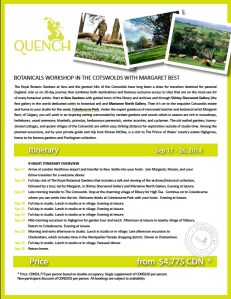
quenchTravel_MBest_England2014 This year Canadian artist and teacher, Margaret Best, travels to England on a 10-day journey to historic sites of significance to the world of botanical art.

Join Margaret September 17-26, 2014 and visit the Royal Botanic Gardens at Kew, tour the Shirley Sherwood Gallery of Botanical Art, tour the Marianne North Gallery and spend a week painting at Colesbourne Park, the estate of Lady Carolyn and Sir Henry Elwes. Among the planned excursions is a visit to The Prince of Wales’ country estate Highgrove, home to his famous gardens and the Highgrove Florilegium.

Immerse yourself in the history of botanical art. Download the detailed itinerary to learn more about this unique adventure.


Botanical Art in the Cotswolds with Margaret Best

September 17-26, 2014
Cost: $4,775 Canadian (convert currency)
www.quenchtravel.com

This information has been added to the Classes Near You sections for Canada and England.

New at Classes Near You > Washington!


Kathleen McKeehen, Scientific Illustrator

www.florawithfauna.com
Kathleen is a teacher and freelance illustrator. Her work has appeared in Organic Gardening Magazine and The Herb Companion. View Kathleen’s artwork in the ASBA Members’ Gallery or at the Guild of Natural Science Illustrators’
Science-Art.com. Kathleen welcomes both beginners and advanced students to her classes.

    Winter Wonderland, Gage Academy of Art
    Fridays, January 17 – March 21, 2014; 1:30 am – 4:30 pm
    Learn the classical method for botanical painting, dry-brush watercolor. Measurement, washes, dry-brush techniques, composition — methods and materials will be covered as students learn to portray botanical subjects, with an emphasis on the classic icons of winter — cones, holly, needles — in a realistic, three-dimensional way. Students who would prefer to work on other subjects, including bugs, bones, or birds, or other botanicals, will be able to do so, with accompanying handouts and subjects from the instructor’s collection. All levels welcome; returning students can choose to work on projects independently with supervision. 206 323-GAGE
    View Details/Register


    Botanical Drawing
    , Gage Academy of Art
    Fridays, January 17 – March 21, 2014; 9:30 am – 12:00 pm
    The basics of drawing will be covered, beginning with using line expressively to portray botanical subjects, then progressing to use of various methods of shading to show form and three-dimensionality. While the class focuses on plant subjects, the methods and techniques taught work well for rendering any subject realistically. All levels welcome; intermediate students can take on more complicated subjects with instructor supervision. 206 323-GAGE
    View Details/Register


    Botanical Painting
    , Center for Urban Horticulture
    Tuesdays, January 21 – March 4, 2014; 7-9 pm
    Dry-brush watercolor is a classical method of portraying botanical subjects. Learn the basics — measurement, handling light on form, washes, dry-brush application, color mixing, etc. — to portray various botanical subjects in a realistic way. All levels are welcome, and repeating students can take on more advanced subjects with plentiful instructor supervision. 206-685-8033
    View Details/Register


    Bugs, Bones, Birds and Botanicals
    , Winslow Art Center
    Wednesdays, January 22 – March 12, 2014; 10 am – 1 pm
    While dry-brush watercolor is the most frequently used method for botanicals, it’s also the perfect medium for portraying other natural science subjects. Learn to paint insects, skulls & bones, birds, or botanicals using the classic dry-brush technique to portray them realistically and three-dimensionally. All levels welcome. 206-618-3112
    View Details/Register


    Botanical Watercolor Workshop – Painting the Pinecone in Watercolor
    , Gage Academy
    Saturday & Sunday, January 25-26, 2014; 9:30 am – 4:30 pm
    Explore classic botanical watercolor techniques of small graded washes and dry brush. Beginners may practice on simpler cones, while more the more experienced may tackle complex specimens. Some cones supplied, but feel free to bring specimens that interest you. All levels. 206 323-GAGE
    View Details/Register


    Botanical Watercolor Workshop – Painting the Produce Section
    , Gage Academy
    Saturday & Sunday, February 8-9, 2014; 9:30 am – 4:30 pm
    Learn the principals of washes and dry-brush watercolor as you paint simple but lovely members of the produce section–mangoes, peppers, etc. All levels. 206 323-GAGE
    View Details/Register


Gaynor Dickeson

www.gaynorsflora.com
Gaynor Dickeson is a British botanical artist living on the south coast of England. Her work has been exhibited widely in Europe, Scandinavia, Australia and the USA. Her work is in various collections including The Hunt Institute in Pittsburgh, USA and her awards include a Royal Horticultural Society (RHS) Silver Grenfell medal for her series of Magnolia x soulangeana paintings in 2011.

Gaynor has taught successfully for many years mostly in the UK and Norway. She teaches workshops for Field Breaks, and is the Botanical Art Tutor for the
London Art College distance learning course. Gaynor also teaches two- and three-day workshops in her home. Visit the Tuition page on her website for more information.

    Botanical Art Painting Holiday in Norway
    Join Gaynor Dickeson in Norway for a seven-day botanical art workshop and holiday June 29 – July 6, 2014. You will paint plants and flowers from the area. Each morning you will get active teaching in watercolour or coloured pencil according to your preference, but the afternoons are yours to spend as you wish. Gaynor plans to be available for guidance most afternoons. You can expect six days of botanical art tuition from an artist very familiar with the area in South-Eastern Norway.

    You will spend seven nights in the Thon Hotel, in Åsgårdstrand, on the banks of the Oslo Fjord, Norway; your studio will be a conference room overlooking the beautiful fjord. Åsgårdstrand was the home of Edvard Munch and has lovely views; the area is renowned amongst artists for its extraordinary light.

This information has been added to the Classes Near You sections for England and Norway.

Please welcome Capel Manor College to Classes Near You > England!

Explore the Capel Manor website to learn about its 800-year history prior to it becoming an educational institution specializing in plants, animals and the environment.


Capel Manor College

Botanical Illustration at Capel Manor College
Capel Manor College offers 3-day short courses in Botanical Illustration in beautiful Regent’s Park in the heart of central London. The courses offer students of all abilities the opportunity to improve their observational drawing skills and learn more about botanical subject matter. Each course focuses on plants that are prominent in the garden at that time of year. Students learn the basic skills required to create a beautiful and accurate botanical drawing including structural line drawing, drawing to scale, composition, applying tone, understanding directional light, colour mixing and use of watercolour washes.

Spaces are still available in the classes below:

  • Line Drawing with Pen and Ink – January 27-29, 2014
  • Spring Bulbs – March 17-19, 2014
  • Summer Flowers and Pollinators – May 12-14, 2014
  • Sketching in the Field – July 7-9, 2014

The program instructor is professional illustrator Louise O’Reilly. Visit Louise’s website to learn more about her and to view her online gallery. Be sure to also visit her blog, Nature Table. Louise can also be found on Twitter (@louiseoreilly10).

Download the 8-page brochure about the Botanical Illustration program.

Contact Andrew Jackson (+44 20748 67930) for enquiries and bookings.

Through this column we’ve seen how classroom activities, informal science activities and drawing can engage students and make learning about plants more interesting. Today we learn how teaching culturally responsive botany can also make plants relevant to students’ lives.

This past Fall, professors Lauren Madden and Arti Joshi published What Does Culture Have To Do With Teaching Science?, an article about teaching the plant sciences from a cultural perspective. They focus specifically on the cultural beliefs and experiences of Asian Indians, the third largest group of immigrants in the US (Madden & Joshi, 2013).

Madden and Joshi (2013) provide information about Hindu beliefs about plants and explain how these beliefs can contribute to children’s prior knowledge about plants and how they grow. They encourage teachers to become familiar with the cultural experiences students bring with them into the classroom and to weave these experiences into their lesson plans.

Madden and Joshi (2012) present five strategies teachers can implement to introduce culturally responsive activities into their classrooms. They include asking parents about the plants they have at home, gathering stories about folk biology and using these stories to create literary connections to plants, and using interactive science notebooks that students and parents work on together.

The authors include links to relevant sections of the Next Generation Science Standards in their article, as well as Web resources and related children’s literature. To learn more about culturally responsive teaching in the plant sciences, buy a copy of Madden and Joshi (2013) online for 99¢.


Do you incorporate culturally responsive teaching techniques in your classroom or environmental education program?

Share your experiences below.


Literature Cited

Madden, Lauren and Arti Joshi. 2013. What does culture have to do with teaching science? Science and Children. 51(1): 66-69


Related