Feeds:
Posts
Comments

Plants, Life, Riverside is an ongoing interpretive project about plants in an urban setting and expands ArtPlantae’s mission to encourage an interest in plants. Where do plants reside amidst miles of concrete, asphalt and stucco? Discoveries will be posted in this new column.
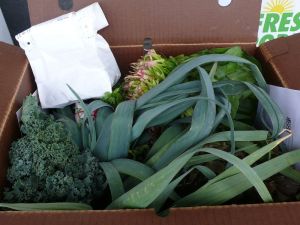

RFC Crop Box

Crop Box from Riverside Food Cooperative

Where can you find plants in the city?

Why in the fridge, of course. Open your refrigerator and you will find a selection of fruit, vegetables and plant-based food items such as tomato ketchup and mustard.

I am thrilled to launch this column by introducing you to an organization whose focus is to bring fresh, healthful food into the homes of Riverside residents.

The Riverside Food Cooperative (RFC) is a not-for-profit organization born out of the Occupy Movement. Founder William Cobb participated in Occupy Riverside and began the food cooperative because he wanted to establish a source of organic food available in bulk for local residents.

The Cooperative’s objective is to open a grocery store between Riverside’s historic downtown area and the University of California Riverside campus. The Cooperative is currently raising money to establish their store. The money to pay for the building, refrigerators and other construction expenses is being raised by selling lifetime memberships.

The Riverside Food Cooperative began as an idea and it was this idea I encountered when I visited their booth at the 2012 Riverside Neighborhood Conference in downtown Riverside. They weren’t selling memberships back then, they were only promoting their idea. Since this conference, they incorporated and became a not-for-profit organization in Spring 2013. Membership in the cooperative is a one-time fee of $300 that can be paid in installments of $10 per month. Currently the cooperative has 43 members. The RFC Board says they need 700-1000 memberships to move forward with the grocery store.

Because membership fees are dedicated to the establishment of the grocery store, the cooperative pays for its operational expenses in another way. They pay for these expenses by selling Crop Boxes to members.

For only $27 per month, members have the option of receiving a Crop Box filled with fresh locally grown fruit and vegetables. Each month the Crop Box contains 12-15 items. The day I visited the pick-up location, members were
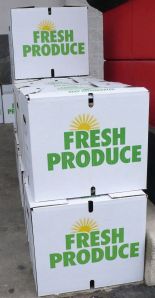
Crop Boxes ready for pick-up.

Crop Boxes

being treated to sunflower sprouts, mandarin oranges, a Meyer lemon, a Zutano avocado, leeks, spinach, broccoli, garlic, red leaf lettuce, kale, radishes, cilantro, snap peas, Etta Mae Gourmet artisan jam and Whole Chinese 5-spice ingredients.

As I watched members come and go, I noticed that they arrived with a smile and were eager to trade the now-empty cardboard Crop Box they received last month for a new box filled with nutritious food.

The Riverside Food Cooperative sources their produce from local farmers. They try to get the best of local produce and aim to include 12 items in each box. The selection of produce changes with the seasons and the balance of the items comes from whatever crop is available.

I spoke with Treasurer Sue Struthers the day I visited the pick-up location. Sue is not only the Treasurer, she is also the author of the recipe booklet included in each Crop Box. She writes a new booklet each month. Sue says that eventually the cooperative plans to host cooking classes so they can teach people how to eat healthfully, inexpensively and creatively using the food they receive from local growers.

To encourage the recruitment of new members, the co-op offers special member promotions. This month Riverside Co-op members can receive a free crop box for every new member they bring to the co-op at the $100 or full membership level by February 16. Members can enjoy the crop box they receive, share it with a friend or donate it through the Riverside Food Co-op to Operation Safehouse.

Learn more about the Riverside Food Cooperative on their website and on Facebook. You can also speak with them in-person at the Grow Riverside conference, a conference for local businesses and residents exploring the economic feasibility of urban agriculture. This conference will be held at the Riverside Convention Center March 19-20, 2014.


Related Resources

An exciting new learning opportunity at Classes Near You > Mississippi:


The Illustrated Garden, A Studio Blog

www.valwebb.com
See Val Webb’s online tutorial, Botanical Drawing with Pencil and Watercolor. Connect with The Illustrated Garden on Facebook. For more information about the class below, email Val Webb.

    Artist-Naturalist Workshop: An Introduction to Botanical Art
    Grand Bay National Estuarine Research Reserve (NERR)
    In conjunction with the Walter Anderson Museum of Art (WAMA)
    Moss Point, MS
    May 9-10, 2014

    Join illustrator Val Webb, coastal ecologist Jen Buchanan and WAMA education director Melissa Johnson at the Grand Bay National Estuarine Research Reserve to learn about freshwater habitats, saltwater habitats and plant anatomy while learning how to draw the plant life at the Reserve.

    This two-day adventure includes an overnight stay at the NERR dormitory and two meals. Cost: $95 Non-WAMA Members; $85 WAMA Members.

    View Photos & Itinerary

Plants. Why Bother.

If you like to tell stories about plants but come up against students who are indifferent towards botanical subjects, consider the strategies suggested by professor Rob Reinsvold in Why Study Plants? Why Not?.

In his short 2.5-page editorial, Reinsvold (1999) provides an overview of how students learn about plants in elementary school, middle school and high school and how what they learn contributes to their thinking that biology is primarily about humans and animals.

To make plants more interesting to students, Reinsvold (1999) suggests educators try the following:

  • Take advantage of society’s obsession with “the biggest and the best”
    (p. 3). Introduce students to the largest known creosote bush, the oldest living tree, the largest living organism, etc. and relate them to comparable examples in the animal world. Reinsvold talks about hosting an Organismal Olympics. You can learn more about this in his paper.
  • Show students that plants are active using time-lapse photography.
  • Explain how people use plants.
  • Talk about money. Discuss plant products as traded commodities.
  • Discuss how plant research has contributed to our knowledge about genetics, growth, development, biodiversity and climate change.

Reinsvold (1999) includes in his editorial a list of principles proposed by the American Society of Plant Physiologists. These principles address what the Society thinks every student and citizen should know about plants. An updated version of this list is available on the website of the American Society of Plant Biologists (ASPB). (Note: The Society changed its name since Reinvold’s editorial was published).

The principles proposed by the ASPB have been aligned with the National Research Council’s Life Science Standards. Educators may be especially interested in the bookmarks the Society created around these twelve principles. These double-sided bookmarks are available for free in limited quantities each month. Go to the Society’s Education page to learn more about the bookmarks, the Standards and the Principles of Plant Biology.

Reinsvold (1999) can be purchased online for $39. You can also search for back issues of this journal at your local college library.


Literature Cited

Reinsvold, R. 1999. Why study plants? Why not? Science Activities. 36: 3-5


Also See


Remembering Dr. James Wandersee

Dr. James Wandersee was a professor of biology education and one of the researchers to coin the term “plant blindness”. In 2009 I had the opportunity to communicate with Dr. Wandersee via email. I told him about ArtPlantae and we discussed some of my ideas. He was very encouraging and supportive. This weekend I was saddened to learn of Dr. Wandersee’s passing. I can’t read or write the phrase “plant blindness” without thinking of our email exchanges and his encouraging words. Dr. Wandersee was 67.


Dust jacket and book

Dust jacket and book, © 2014 Lydia Inglett, Ltd, All rights reserved

Lydia Inglett, Ltd. Publishers announces the release of American Botanical Paintings: Native Plants of the Mid Atlantic.

This book features 60 original works of juried art from 40 artists, including text describing each plant, how each plant is beneficial to gardeners and/or the environment and paintings of insect pollinators and their relationship to the plants.

The original paintings will be on display at the U.S. Botanic Garden in Washington, D.C.,February 15 through June 15, 2014. Botanical Artists for Education and the Environment produced this book and is funded solely through donations. Profits will go to nonprofit organizations working on native plant education, conservation and horticulture.

Lydia Inglett, CEO of the publishing company, is a woman with Lydia-Inglett-publisherenormous experience in art, advertising and publishing. Her design and print studios create the highest quality in elegant, thoughtful books. She has designed and published over 150 books for her clients, three of which won USA best book awards in 2013. She has launched many magazines for both artists and businessmen. She was art director and creative services director for Morris Communications Corporation before starting her publishing company. Her love of art, combined with her love of paper and engraving come together in her published books.

In 2010 Lydia Inglett taught an online class for ArtPlantae in which she discussed how books are published.


About Lydia Inglett, Ltd.

Lydia Inglett, Ltd. has offices on Hilton Head Island in the U.S. and at The Cube in London, England. In addition to providing a suite of publishing services, it manages Starbooks, a subsidiary of Inglett Publishing.

The ART-BIO Collaborative invites you to Puerto Rico during Spring Break!

Spring Break participants will have the exclusive opportunity to display their artwork in an Art+Science exhibition featured in the Massachusetts Institute of Technology’s Cambridge Science Festival this April.

Here is the latest news at Classes Near You > Massachusetts.


ART+BIO Collaborative

www.artbiocollaborative.com
The ART+BIO Collaborative in Cambridge, MA fosters the integration of science, nature, and art through novel collaborations, research, and education. They design innovative art+science curriculum and turn public spaces into interactive learning environments.

    Island Life with the Art-Bio Collaborative
    March 9-16, 2014
    Join us in the Caribbean this Spring Break for a one-of-a-kind, art+nature immersion experience in Puerto Rico. Embark on an artistic exploration of the diverse tropical wildlife from rainforest, mountain, beach and coastal environments. Through hands-on observation, artistic interpretation and various biological and natural history methods, we will learn to utilize the natural habitat as a studio/lab to make informed art about tropical plants, animals, and nature.

    Registration Deadline: February 28, 2014
    Cost: $1,800.00

    View Details/Register

BILLY AD 2Artists of all levels of ability can now learn from UK artist Billy Showell from anywhere in the world!

This past weekend, Billy announced her new online botanical art program. This program is composed of online instruction and projects ranging from 20 minutes to three hours. Tutorials are released every two weeks at BillyShowell.com.

Participating artists can choose from three levels of membership :

    Free Membership
    The Free Membership option gives artists access to basic lessons.

    Monthly Membership
    The Monthly Membership option enables artists to get access to current and new projects at the cost of £9.99 per month (convert currency). New projects are announced every two weeks. After 12 months of Monthly Membership, members at this level will gain access to Billy’s entire catalog of tutorials.

    Annual Plan
    Artists signing up for the Annual Plan at £89.88 per year (convert currency) will have access to all new projects and access to Billy’s catalog of projects, courses and tutorials.

Technology is changing how botanical art enthusiasts learn about this centuries-old discipline. Are you ready for something new?

Learn more at BillyShowell.com.


Related

An interview with Billy Showell

Paint Colorado!

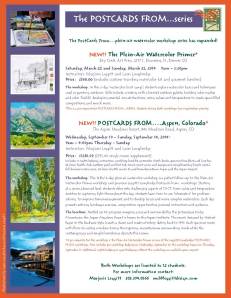
2014_PRIMER-ASPEN_flier-2 Here is what’s new at
Classes Near You > Colorado!


Marjorie Leggitt
Leggitt Design & Illustration

View Marjorie’s Gallery at Science-Art.com
Marjorie is a scientific illustrator who creates illustrations for clients in the fields of botany, zoology, medicine, and education. Her artwork also appears on the seed packets Botanical Interests seed company. You can learn more about the work Marjorie and other illustrators do for Botanical Interests in an interview with Andrew Keys at RadioGarden, a series produced by Horticulture Magazine.


    The Plein-Air Watercolor Primer

    March 22 & 23, 2014
    DC Art Press, Denver
    Instructors: Marjorie Leggitt and Leon Loughridge
    Time: 9am – 3:30pm
    Price: $360.00 (includes custom traveling watercolor kit, gourmet lunch)

    This  new workshop qualifies as a pre-requisite for the September POSTCARDS FROM…Aspen multi-day workshop. Priority is given to those registrants who also place a deposit for the Postcards from Aspen workshop.

    This 2-day weekend workshop introduces all the basics to plein air watercolor painting and, starting this year, is the pre-requisite for the fabulous 4-day POSTCARDS FROM…Aspen watercolor workshop in September. Leon and Marjorie explore everything you need to know for painting outdoors -– working with a limited outdoor palette, building color washes and color builds, developing essential core abstractions, using values and temperatures to create “mini” space-filled compositions.


    Back to Basics: Drawing with Confidence

    April 14-17, 2014
    VOC in Washington Park, Denver
    Instructors: Marjorie Leggitt and Susan Rubin
    Time: 9am – 2:30pm 
    Price: $414.00  
    This fun four-day workshop returns to the drawing basics of Line, Shading, Perspective, and Composition to bolster your drawing skills and boost your confidence. Revisit the principles of light, form, and depth to flesh out compositions both big and small. Practice linear and aerial perspective to accurately portray physical and atmospheric depth. Develop composition strategies to create dynamic artwork. Instruction, exercises, practice, and individual guidance will assure that in just four days you’ll solidify those shaky skills and draw anything better and faster every time.


    POSTCARDS FROM…Aspen, Colorado

    September 10-14, 2014
    The Aspen Meadows Resort (home of the Aspen Institute)
    Instructors: Marjorie Leggitt and Leon Loughridge
    Price: $1360.00 ($395.00 single supplement)

    Includes: 4 nights lodging, instruction, workshop booklet, watercolor sketch books, gourmet breakfasts and lunches, 24-hour health club, outdoor pool and hot tub, tennis court access and equipment, complimentary bicycle rental, full business center access, 24-hour shuttle service to and from downtown Aspen and the Aspen Airport.

    Please note: This workshop has a pre-requisite of the Plein-Air Watercolor Primer (March 22 & 23) or a previous Leggitt/Loughridge POSTCARDS FROM.. workshop.

    This 4-day plein air watercolor workshop is a perfect follow-up to the Plein Air Watercolor Primer workshop and previous Leggitt/Loughridge Postcards From… workshops. Starting at a more advanced level, students delve into the challenging aspects of CVCT. From value sketches and temperature schematics to capturing light throughout the day, students learn how to use “schematics” for problem-solving, to improve time management, and to develop larger and more complex watercolors. Each day presents enticing landscape exercises, composition opportunities, personal instruction and guidance.


    Back to Basics: Drawing with Confidence
     
    September 16-19, 2014 
    VOC in Washington Park, Denver
    Instructors: Marjorie Leggitt and Susan Rubin
    Time: 9am-2:30pm   
    Price: $414.00

    This fun four-day workshop returns to the drawing basics of Line, Shading, Perspective, and Composition to bolster your drawing skills and boost your confidence. Revisit the principles of light, form, and depth to flesh out compositions both big and small. Practice linear and aerial perspective to accurately portray physical and atmospheric depth. Develop composition strategies to create dynamic artwork. Instruction, exercises, practice, and individual guidance will assure that in just four days you’ll solidify those shaky skills and draw anything better and faster every time.