Feeds:
Posts
Comments

Plants. Why Bother.

If you like to tell stories about plants but come up against students who are indifferent towards botanical subjects, consider the strategies suggested by professor Rob Reinsvold in Why Study Plants? Why Not?.

In his short 2.5-page editorial, Reinsvold (1999) provides an overview of how students learn about plants in elementary school, middle school and high school and how what they learn contributes to their thinking that biology is primarily about humans and animals.

To make plants more interesting to students, Reinsvold (1999) suggests educators try the following:

  • Take advantage of society’s obsession with “the biggest and the best”
    (p. 3). Introduce students to the largest known creosote bush, the oldest living tree, the largest living organism, etc. and relate them to comparable examples in the animal world. Reinsvold talks about hosting an Organismal Olympics. You can learn more about this in his paper.
  • Show students that plants are active using time-lapse photography.
  • Explain how people use plants.
  • Talk about money. Discuss plant products as traded commodities.
  • Discuss how plant research has contributed to our knowledge about genetics, growth, development, biodiversity and climate change.

Reinsvold (1999) includes in his editorial a list of principles proposed by the American Society of Plant Physiologists. These principles address what the Society thinks every student and citizen should know about plants. An updated version of this list is available on the website of the American Society of Plant Biologists (ASPB). (Note: The Society changed its name since Reinvold’s editorial was published).

The principles proposed by the ASPB have been aligned with the National Research Council’s Life Science Standards. Educators may be especially interested in the bookmarks the Society created around these twelve principles. These double-sided bookmarks are available for free in limited quantities each month. Go to the Society’s Education page to learn more about the bookmarks, the Standards and the Principles of Plant Biology.

Reinsvold (1999) can be purchased online for $39. You can also search for back issues of this journal at your local college library.


Literature Cited

Reinsvold, R. 1999. Why study plants? Why not? Science Activities. 36: 3-5


Also See


Remembering Dr. James Wandersee

Dr. James Wandersee was a professor of biology education and one of the researchers to coin the term “plant blindness”. In 2009 I had the opportunity to communicate with Dr. Wandersee via email. I told him about ArtPlantae and we discussed some of my ideas. He was very encouraging and supportive. This weekend I was saddened to learn of Dr. Wandersee’s passing. I can’t read or write the phrase “plant blindness” without thinking of our email exchanges and his encouraging words. Dr. Wandersee was 67.


Dust jacket and book

Dust jacket and book, © 2014 Lydia Inglett, Ltd, All rights reserved

Lydia Inglett, Ltd. Publishers announces the release of American Botanical Paintings: Native Plants of the Mid Atlantic.

This book features 60 original works of juried art from 40 artists, including text describing each plant, how each plant is beneficial to gardeners and/or the environment and paintings of insect pollinators and their relationship to the plants.

The original paintings will be on display at the U.S. Botanic Garden in Washington, D.C.,February 15 through June 15, 2014. Botanical Artists for Education and the Environment produced this book and is funded solely through donations. Profits will go to nonprofit organizations working on native plant education, conservation and horticulture.

Lydia Inglett, CEO of the publishing company, is a woman with Lydia-Inglett-publisherenormous experience in art, advertising and publishing. Her design and print studios create the highest quality in elegant, thoughtful books. She has designed and published over 150 books for her clients, three of which won USA best book awards in 2013. She has launched many magazines for both artists and businessmen. She was art director and creative services director for Morris Communications Corporation before starting her publishing company. Her love of art, combined with her love of paper and engraving come together in her published books.

In 2010 Lydia Inglett taught an online class for ArtPlantae in which she discussed how books are published.


About Lydia Inglett, Ltd.

Lydia Inglett, Ltd. has offices on Hilton Head Island in the U.S. and at The Cube in London, England. In addition to providing a suite of publishing services, it manages Starbooks, a subsidiary of Inglett Publishing.

The ART-BIO Collaborative invites you to Puerto Rico during Spring Break!

Spring Break participants will have the exclusive opportunity to display their artwork in an Art+Science exhibition featured in the Massachusetts Institute of Technology’s Cambridge Science Festival this April.

Here is the latest news at Classes Near You > Massachusetts.


ART+BIO Collaborative

www.artbiocollaborative.com
The ART+BIO Collaborative in Cambridge, MA fosters the integration of science, nature, and art through novel collaborations, research, and education. They design innovative art+science curriculum and turn public spaces into interactive learning environments.

    Island Life with the Art-Bio Collaborative
    March 9-16, 2014
    Join us in the Caribbean this Spring Break for a one-of-a-kind, art+nature immersion experience in Puerto Rico. Embark on an artistic exploration of the diverse tropical wildlife from rainforest, mountain, beach and coastal environments. Through hands-on observation, artistic interpretation and various biological and natural history methods, we will learn to utilize the natural habitat as a studio/lab to make informed art about tropical plants, animals, and nature.

    Registration Deadline: February 28, 2014
    Cost: $1,800.00

    View Details/Register

BILLY AD 2Artists of all levels of ability can now learn from UK artist Billy Showell from anywhere in the world!

This past weekend, Billy announced her new online botanical art program. This program is composed of online instruction and projects ranging from 20 minutes to three hours. Tutorials are released every two weeks at BillyShowell.com.

Participating artists can choose from three levels of membership :

    Free Membership
    The Free Membership option gives artists access to basic lessons.

    Monthly Membership
    The Monthly Membership option enables artists to get access to current and new projects at the cost of £9.99 per month (convert currency). New projects are announced every two weeks. After 12 months of Monthly Membership, members at this level will gain access to Billy’s entire catalog of tutorials.

    Annual Plan
    Artists signing up for the Annual Plan at £89.88 per year (convert currency) will have access to all new projects and access to Billy’s catalog of projects, courses and tutorials.

Technology is changing how botanical art enthusiasts learn about this centuries-old discipline. Are you ready for something new?

Learn more at BillyShowell.com.


Related

An interview with Billy Showell

Paint Colorado!

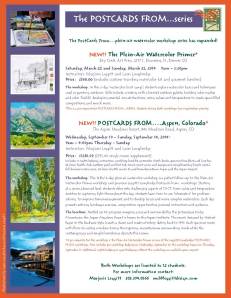
2014_PRIMER-ASPEN_flier-2 Here is what’s new at
Classes Near You > Colorado!


Marjorie Leggitt
Leggitt Design & Illustration

View Marjorie’s Gallery at Science-Art.com
Marjorie is a scientific illustrator who creates illustrations for clients in the fields of botany, zoology, medicine, and education. Her artwork also appears on the seed packets Botanical Interests seed company. You can learn more about the work Marjorie and other illustrators do for Botanical Interests in an interview with Andrew Keys at RadioGarden, a series produced by Horticulture Magazine.


    The Plein-Air Watercolor Primer

    March 22 & 23, 2014
    DC Art Press, Denver
    Instructors: Marjorie Leggitt and Leon Loughridge
    Time: 9am – 3:30pm
    Price: $360.00 (includes custom traveling watercolor kit, gourmet lunch)

    This  new workshop qualifies as a pre-requisite for the September POSTCARDS FROM…Aspen multi-day workshop. Priority is given to those registrants who also place a deposit for the Postcards from Aspen workshop.

    This 2-day weekend workshop introduces all the basics to plein air watercolor painting and, starting this year, is the pre-requisite for the fabulous 4-day POSTCARDS FROM…Aspen watercolor workshop in September. Leon and Marjorie explore everything you need to know for painting outdoors -– working with a limited outdoor palette, building color washes and color builds, developing essential core abstractions, using values and temperatures to create “mini” space-filled compositions.


    Back to Basics: Drawing with Confidence

    April 14-17, 2014
    VOC in Washington Park, Denver
    Instructors: Marjorie Leggitt and Susan Rubin
    Time: 9am – 2:30pm 
    Price: $414.00  
    This fun four-day workshop returns to the drawing basics of Line, Shading, Perspective, and Composition to bolster your drawing skills and boost your confidence. Revisit the principles of light, form, and depth to flesh out compositions both big and small. Practice linear and aerial perspective to accurately portray physical and atmospheric depth. Develop composition strategies to create dynamic artwork. Instruction, exercises, practice, and individual guidance will assure that in just four days you’ll solidify those shaky skills and draw anything better and faster every time.


    POSTCARDS FROM…Aspen, Colorado

    September 10-14, 2014
    The Aspen Meadows Resort (home of the Aspen Institute)
    Instructors: Marjorie Leggitt and Leon Loughridge
    Price: $1360.00 ($395.00 single supplement)

    Includes: 4 nights lodging, instruction, workshop booklet, watercolor sketch books, gourmet breakfasts and lunches, 24-hour health club, outdoor pool and hot tub, tennis court access and equipment, complimentary bicycle rental, full business center access, 24-hour shuttle service to and from downtown Aspen and the Aspen Airport.

    Please note: This workshop has a pre-requisite of the Plein-Air Watercolor Primer (March 22 & 23) or a previous Leggitt/Loughridge POSTCARDS FROM.. workshop.

    This 4-day plein air watercolor workshop is a perfect follow-up to the Plein Air Watercolor Primer workshop and previous Leggitt/Loughridge Postcards From… workshops. Starting at a more advanced level, students delve into the challenging aspects of CVCT. From value sketches and temperature schematics to capturing light throughout the day, students learn how to use “schematics” for problem-solving, to improve time management, and to develop larger and more complex watercolors. Each day presents enticing landscape exercises, composition opportunities, personal instruction and guidance.


    Back to Basics: Drawing with Confidence
     
    September 16-19, 2014 
    VOC in Washington Park, Denver
    Instructors: Marjorie Leggitt and Susan Rubin
    Time: 9am-2:30pm   
    Price: $414.00

    This fun four-day workshop returns to the drawing basics of Line, Shading, Perspective, and Composition to bolster your drawing skills and boost your confidence. Revisit the principles of light, form, and depth to flesh out compositions both big and small. Practice linear and aerial perspective to accurately portray physical and atmospheric depth. Develop composition strategies to create dynamic artwork. Instruction, exercises, practice, and individual guidance will assure that in just four days you’ll solidify those shaky skills and draw anything better and faster every time.

Druivenblossem [De Europische insecten] , Merian, Maria Sibylla, 1647-1717 , Engraving, hand-colored ,1730. Digital image courtesy of the Getty’s Open Content Program.

Druivenblossem [De Europische insecten] , Merian, Maria Sibylla, 1647-1717 , Engraving, hand-colored ,1730. Digital image courtesy of the Getty’s Open Content Program.

In 1699 after conducting many studies of European moths and butterflies, artist-naturalist Maria Sibylla Merian (1647-1717) traveled to Surinam to study insect metamorphosis. You may already be familiar with her paintings of insects and plants. Merian was more than an adventurous artist and divorcée. She was a dedicated independent scholar who made significant contributions to biology and the not-yet-established field of ecology.  

The complete extent of Merian’s contributions are not obvious by looking at her images. One can only begin to fully appreciate the value of her work by reading the text accompanying these images or by learning from someone who has read Merian’s descriptions, such as biology professor Kay Etheridge. According to Dr. Etheridge, Merian is known more for her art than for her scholarly achievements in part because her texts were written in German or Dutch and her written observations are not readily available in English (Etheridge, 2010). The only full English translation of her famous Metamorphosis insectorum surinamensium is a facsimile edition that is viewable in only about 20 libraries worldwide (Etheridge, 2011).

Today we have the opportunity to learn from Dr. Etheridge who is currently preparing for a two-day symposium about Maria Sibylla Merian at the University of Amsterdam (May 26-27, 2014). The symposium, Exploring Maria Sibylla Merian, will feature panels of invited scholars who will discuss their research about Merian’s life and her contributions to art and science.

Please join me in welcoming Dr. Kay Etheridge!


ArtPlantae
: The symposium about Maria Sibylla Merian sounds absolutely wonderful. How did this event come together?

Kay Etheridge: I co-authored a paper book chapter with a Dutch colleague, Florence Pieters, and we were giving a presentation about Merian’s influence on Mark Catesby (1683-1749) at a symposium about Catesby’s work. While at lunch we talked about what a similar symposium about Merian might look like. We discussed the idea with people at the University of Amsterdam, one thing led to another and this is where the symposium will be held. It is a perfect venue because Merian spent much of her life in Amsterdam, and the University has several of her books in their special collections.

There is a lot of misinformation out there about Merian. The one goal of the symposium is to have scholars gather to discuss what we really know about her.


AP
: How many Merian scholars are there?

KE: There aren’t that many. Probably less than one dozen who focus primarily on Merian, although many scholars do study her work to varying degrees. Then there are others who work on Merian, just not exclusively. There will be 10 scholars speaking at the symposium. They include an entomology historian, various science and art historians including a printing expert who discovered a letter by Merian, and a couple who is making a film about Merian. Dutch artist Joos van de Plas will also be at the symposium. Joos is fascinated by metamorphosis and became captivated by Merian’s work. She went to the insect collection in the Wiesbaden Museum, Germany, to study what may very well contain some of Merian’s insects. She matched a number of insect specimens to the engraved images in Merian’s book on Surinam insects and then printed a book of museum overlays.

My own work is an examination of the biology behind Merian’s work, something that I feel has been overlooked. For example, she conducted many of the earliest insect food-choice studies and was the first to look at plant-insect relationships in any detail.


AP
: I have seen one exhibition about Merian’s life and the focus was on her interesting life story, her art and her trip to Surinam. In your articles, you write about her many contributions to biology — such as being the first to “elucidate through word and art what we now think of as food chains and interactions within ecological communities” (Etheridge 2010, p. 21). You also mention that some historians tend to deny her the title of “scholar” and refer to her more often as “artist”, “housewife” and “mother”. Why do you think this type of labeling persists given our current understanding about her contributions to science? 

KE: I think that those who do not call Merian a scholar may define a “scholar” as someone who has university training. Many historians, however, do think of Merian as being a scholar. I believe that as people learn more about her work, her prominence in the history of science will increase.


AP
: In the essay Maria Sibylla Merian: The First Ecologist? you mention that Merian was influenced by Hoefnagel and that many artists and naturalists who came after her were influenced by her art and observations. Tracing the influence of Merian’s work sounds like it would be very difficult. How do you conduct such an investigation?

KE: Other scholars have posed various influences on Merian, but my interest is in who she influenced, that is, those who came after her. If you know who had access to her work and then you see how their compositions mirror hers, the connections are obvious. Before Merian’s books, plants and animals were usually depicted separated; she was absolutely the first to put together related organisms in an “ecological” composition. We now think of this as standard, but Merian set that standard in 1679 with her first book on European insects and their plant hosts.


AP
: You’ve completed extensive research about Merian’s life and work. What would you like the public to understand about Merian? How can the artists, naturalists and educators reading this interview contribute to this effort?

KE: By recognizing that people do not fully understand the scientific context behind Merian’s images and that people need to read the text. 

I am currently on sabbatical and working on the English translation of Merian’s butterfly books, completed by my colleague, Michael Ritterson. My book will include the first English translation of Merian’s initial work on European insects
(Der Raupen wunderbare Verwandelung und sonderbare Blumen–Nahrung, 1679), her accompanying images, and commentary on her numerous formative contributions to natural history.

Her most imitated invention was an “ecological” composition in which the life cycle of an insect was arrayed around a plant that served as food for the caterpillar. As mentioned above, prior to Merian’s Raupen books animal and plant images were segregated, usually in separate volumes. To date most scholarship on Merian has emphasized her fascinating life story or her artwork, and the science content of her books has not been examined in depth; her caterpillar books have been particularly neglected. Reasons for this omission will be addressed in my book, but one factor may be that no English translation of the Raupen books has been published. 

The title of my book will be Wonderous Transformation: Maria Sibylla Merian’s Catepillar Book.


Readers, do you have a question for Kay about her research or the upcoming symposium? Write your comments and questions below.


Literature Cited

Etheridge, Kay. 2010. Maria Sibylla Merian and the metamorphosis of natural history. Endeavour. 35(1): 15-21

Etheridge, Kay. 2011. In V. Molinari and D. Andreolle, Editors. Women and Science, 17th Century to Present: Pioneers, Activists, and Protagonists. Cambridge Scholars Publishing, Newcastle upon Tyne.


Related

(Links updated 27 June 2024)

By Bianca Ana Chavez

Orquideafilia Mural. @ Bianaca Ana Chavez, all rights reserved

Orquideafilia Mural. @ Bianaca Ana Chavez, all rights reserved

March will find me back in the magical highland town of San Cristobal de las Casas, Chiapas, Mexico. Chiapas has the highest diversity of orchids in Mexico, many of which can be seen in the botanical garden El Jardin de Epifitas. The garden is directed by biologist Juan Castillo Hernandez, an incredible lover of art and nature. In addition to the botanical garden, Juan or ‘profe’ as everyone calls him, has a corner plant shop in the center of town. It is to these walls that stretch above cobblestone streets that I will return to complete the Orquidefilia mural and resume a life dedicated to the perpetuation of art, nature and culture.

Through some bit of wisdom or fluke, I first found myself working with Juan at the Orquideafilia plant store a few years ago. In my downtime I would sketch and paint the plants in the shop. Somehow these drawings eventually ended up wrapping around the block. But I left the mural unfinished. While drawing, the old haunting idea of studying botanical illustration would come back to me. I had played with the idea of studying botany in college but shied away from it for a fear of math and the hard sciences. I had long since discovered botanical art, and wanted to explore it more deeply.

So I moved to Seattle to pursue a certificate in Natural Science Illustration (NSI) at the University of Washington. With a lifelong love of plants and the arts, taking the NSI program was a stubborn declaration of my commitment. Through the NSI program I had the chance to work with many inspiring illustrators, botanists, and plant lovers. The program solidified my desire to pursue the arts and that I wanted to do this in a way that brought attention to the earth and our connection to it.

Returning to work again at Orquideafilia, we want to expand the plant store to include a tea shop and space for art and nature-related events and workshops. Juan approaches the work he does with a strong sense of collaboration. It is largely through his encouragement of my crazy ideas that I will offer weekly workshops in botanical illustration at the shop.

Student drawing orchid using a reference photo. @ Bianaca Ana Chavez

Biology student draws orchid using a reference photo. @ Bianaca Ana Chavez, all rights reserved

The workshops will be offered by donation to the community and no one will be turned away for lack of funds. The idea is to create a space where plants and art supplies are provided so that all people have to do is come with an open mind ready to explore and share their techniques with each other. Really, I am still pretty green to all of this — I am learning along with everyone else. The beauty is that we can grow together.

The name Orquideafilia came from combining the two words orchid (orquidea) and the Greek -philia, or filia. A love for orchids. This is what we have.

To support both the mural project and the development of a space for art, nature and culture, I created a one-month only pop-up online art store and donation page on my website. My goal is to raise $3,000 to cover the cost of travel, the art supplies to complete a large-scale mural, and the administrative cost of programming community events and workshops for one year.

To buy original artwork or donate to the project, please click on the following link – http://www.biancaanachavez.com/shop.

For more information about workshops and events, you can contact me directly through my website at www.biancaanachavez.com.


Also See

Bianca and fellow graduates of the Natural Science Illustration program at the University of Washington participate in Endless Forms Most Beautiful at the
Burke Museum in Seattle, WA.