Feeds:
Posts
Comments

Imagine engaging students in conversation about plant morphology, insect morphology, metamorphosis, scale, point of view, value, color blending, symmetry, analogous colors, neutral colors, careers in scientific illustration, Georgia O’Keeffe AND Maria Sibylla Merian.

The resource to help you accomplish such a spectacular feat is the focus of this week’s column. It is only two-pages.


Resource

Russell, Scott. 2012. Beginning with a flower. SchoolArts. May/June 2012.

(Update June 2024: The digital archive at SchoolArts magazine only goes back to 2015. I suggest contacting the magazine for the 2012 issue. There used to be a link to this article.)


Related

By Hunt Institute for Botanical Documentation

As part of a multi-year photography initiative at the Hunt Institute for Botanical Documentation, we are working to photograph our entire Art collection. These photos are primarily for in-house purposes, but we would like to add small, 100 dpi thumbnails of the artwork to our Catalogue of the Botanical Art Collection at the Hunt Institute database, which is accessible on our Web site. These thumbnails will be of low-resolution, unable to be reproduced and still protected by copyright where applicable. Adding thumbnails of the 29,470 works in our Art collection to our online database not only will provide helpful information for researchers but also will give potential visitors and scholars the opportunity to see amazing examples of botanical art by historical masters and leading contemporary artists. To date we have photographed and added thumbnails for several collections that are out of copyright or are otherwise in the public domain.

Because this is a use not covered in the original donation or purchase agreement prior to 2010, we would like to contact all living artists (or their heirs) who have work in our collection to request permission to include thumbnail images in our database. We ask that any artist who has participated in our International Exhibition of Botanical Art & Illustration series prior to the 13th International in 2010 and whose work is in our collection please contact:

    Carrie Roy
    Assistant Curator of Art
    Hunt Institute for Botanical Documentation
    5th Floor, Hunt Library
    4909 Frew Street
    Carnegie Mellon University
    Pittsburgh, PA 15213
    Telephone: 412-268-3035
    Fax: 412-268-5677
    Contact Carrie Roy

State either “Yes, I grant permission for a thumbnail of my artwork to be included on the Web site” or “No, I do not wish for my artwork to have a thumbnail on the Web site.” Be sure to include updated contact information so that we can include it in our private records and contact you should there be any request involving your work.

Feel free to contact us with any questions you have about this issue, and please note that this is a multi-year project involving both a Web site re-design and extensive photography. Photos will be uploaded to the Web site in stages, and we cannot give an exact date for when any single artwork will appear.


About the Institute

The Hunt Institute for Botanical Documentation, a research division of Carnegie Mellon University, specializes in the history of botany and all aspects of plant science and serves the international scientific community through research and documentation. To this end, the Institute acquires and maintains authoritative collections of books, plant images, manuscripts, portraits and data files, and provides publications and other modes of information service. The Institute meets the reference needs of botanists, biologists, historians, conservationists, librarians, bibliographers and the public at large, especially those concerned with any aspect of the North American flora.

Hunt Institute was dedicated in 1961 as the Rachel McMasters Miller Hunt Botanical Library, an international center for bibliographical research and service in the interests of botany and horticulture, as well as a center for the study of all aspects of the history of the plant sciences. By 1971 the Library’s activities had so diversified that the name was changed to Hunt Institute for Botanical Documentation. Growth in collections and research projects led to the establishment of four programmatic departments: Archives, Art, Bibliography and the Library. The current collections include approximately 30,150 book and serial titles; 29,000+ portraits; 29,470 watercolors, drawings and prints; 243,000+ data files; and 2,000 autograph letters and manuscripts. The Archives specializes in biographical information about, portraits of and handwriting samples from scientists, illustrators and all others in the plant sciences. The Archives is a repository of alternate resort and as such has collected over 300 institutional and individual archival collections that may not have otherwise found an easy fit at another institution. Including artworks dating from the Renaissance, the Art Department’s collection now focuses on contemporary botanical art and illustration, where the coverage is unmatched. The Art Department organizes and stages exhibitions, including the triennial International Exhibition of Botanical Art & Illustration. The Bibliography Department maintains comprehensive data files on the history and bibliography of botanical literature. Known for its collection of historical works on botany dating from the late 1400s to the present, the Library’s collection focuses on the development of botany as a science and also includes herbals (eight are incunabula), gardening manuals and florilegia, many of them pre-Linnaean. Modern taxonomic monographs, floristic works and serials as well as selected works in medical botany, economic botany, landscape architecture and a number of other plant-related topics are also represented.

Botanical Illustration of Desert Flora
Desert Studies Center, Zzyzx, CA in the Mojave National Preserve
Apr 11-13, 2014 (Friday night to Sun afternoon)

Learn how to draw artistic and realistic flowering plants in a way designed to understand the form, function, and identification of native plants. Exciting
hands-on experience both in the lab and in the field amid native flora habitats. Techniques in pencil, pen, and watercolor. Learn how to:

  • Focus on comprehensive line drawing stressing contour, volume and perspective.
  • Make drawings of minute structures to full-scale renditions of plants.
  • Understand how artistic and scientific skills work together.

This 1-unit field study course is based at the Desert Studies Center (of California State University) located within the Preserve at Soda Springs (Zzyzx), about an hour outside Las Vegas, about a three-hour drive from Riverside. The course fee includes two nights’ lodging at the Center (dormitory rooms & some couples rooms), and fresh cooked breakfast and dinners; bag lunches and tapas on Friday night. Participants will be sent information via email about the Center and what to bring with them. NO VEHICLE REQUIRED ONCE YOU ARRIVE, so great for car share to and from this special location. Cost: $325

Instructor Donald Davidson is an artist with over 500 pieces of art featured in the Traveling Artist Wildflower Project with the National Park Service.


Course Schedule
:
Friday, April 12: 8-10 p.m.
Saturday, April 13: 8 a.m.-5 p.m.
Sunday, April 14: 8 a.m.- 2 p.m.


Registration Deadline
:
Register by March 28, 2014. Cite registration # 124−CPF−F61

View Details/Register


This information can also be found at Classes Near You > Southern California.

The Botanical Art Society of the National Capital Region (BASNCR) is committed to education in the botanical arts. They provide a variety of educational opportunities through meetings, field trips and workshops to members and artists in the vicinity of Washington, D. C.

You are invited to visit their website at http://www.basncr.org for information about joining and for updates about member workshops and educational opportunities.

The National Capital Region encompasses the following states: Virginia, Maryland, District of Colombia and Delaware.

We’ve taken a look at grocery store botany in this column before. This week we return to the produce section of the grocery store to explore an online resource that can be used in anywhere there is Internet access.

Garden teachers, science teachers, scout leaders, botanical artists and more will appreciate the educational resource, Supermarket Botany, on the website of the Graham Centre for Agricultural Innovation. It is a free interactive tool helping students explore the botany behind the plants we store in our refrigerators.

Created by professors Geoff Burrows and John Harper, Supermarket Botany is very easy to use. The platform is composed of two parts. In one section, students can learn about plant morphology by viewing labeled photographs and reading concise descriptions. This review of plant morphology prepares students for The Challenge!, an engaging activity that makes up the other section of this resource.

The Challenge! is an exploration of 15 fruit and vegetables commonly found in the grocery store. When students begin the game, they are presented with shelves of fruit and vegetables and are asked to respond to the prompt, “What’s on the shelf?”. Students select a fruit or vegetable (i.e., plant part) and must decide if their selection is a root, stem, leaf, flower, fruit or seed. If students choose the correct answer, they are guided to a section where they can learn the technical reasons why their item is either a fruit or a vegetable. If students choose a wrong answer, a pop-up box appears explaining why their fruit or vegetable is not the option they selected. It is this part about this activity that I find especially useful. Students advance through the game understanding why their fruit or vegetable is not a root, stem, leaf, flower, fruit or seed.

Burrows and Harper designed handouts to go with students’ use of their online resource. Teachers can download these handouts free of charge.

Would you like to take The Challenge! yourself?

Go to Supermarket Botany


Related

Plants, Life, Riverside is an ongoing interpretive project about plants in an urban setting and expands ArtPlantae’s mission to encourage an interest in plants. Where do plants reside amidst miles of concrete, asphalt and stucco? Discoveries will be posted in this new column.
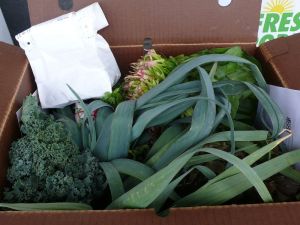

RFC Crop Box

Crop Box from Riverside Food Cooperative

Where can you find plants in the city?

Why in the fridge, of course. Open your refrigerator and you will find a selection of fruit, vegetables and plant-based food items such as tomato ketchup and mustard.

I am thrilled to launch this column by introducing you to an organization whose focus is to bring fresh, healthful food into the homes of Riverside residents.

The Riverside Food Cooperative (RFC) is a not-for-profit organization born out of the Occupy Movement. Founder William Cobb participated in Occupy Riverside and began the food cooperative because he wanted to establish a source of organic food available in bulk for local residents.

The Cooperative’s objective is to open a grocery store between Riverside’s historic downtown area and the University of California Riverside campus. The Cooperative is currently raising money to establish their store. The money to pay for the building, refrigerators and other construction expenses is being raised by selling lifetime memberships.

The Riverside Food Cooperative began as an idea and it was this idea I encountered when I visited their booth at the 2012 Riverside Neighborhood Conference in downtown Riverside. They weren’t selling memberships back then, they were only promoting their idea. Since this conference, they incorporated and became a not-for-profit organization in Spring 2013. Membership in the cooperative is a one-time fee of $300 that can be paid in installments of $10 per month. Currently the cooperative has 43 members. The RFC Board says they need 700-1000 memberships to move forward with the grocery store.

Because membership fees are dedicated to the establishment of the grocery store, the cooperative pays for its operational expenses in another way. They pay for these expenses by selling Crop Boxes to members.

For only $27 per month, members have the option of receiving a Crop Box filled with fresh locally grown fruit and vegetables. Each month the Crop Box contains 12-15 items. The day I visited the pick-up location, members were
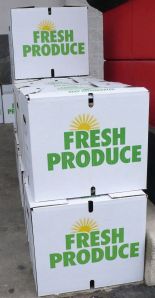
Crop Boxes ready for pick-up.

Crop Boxes

being treated to sunflower sprouts, mandarin oranges, a Meyer lemon, a Zutano avocado, leeks, spinach, broccoli, garlic, red leaf lettuce, kale, radishes, cilantro, snap peas, Etta Mae Gourmet artisan jam and Whole Chinese 5-spice ingredients.

As I watched members come and go, I noticed that they arrived with a smile and were eager to trade the now-empty cardboard Crop Box they received last month for a new box filled with nutritious food.

The Riverside Food Cooperative sources their produce from local farmers. They try to get the best of local produce and aim to include 12 items in each box. The selection of produce changes with the seasons and the balance of the items comes from whatever crop is available.

I spoke with Treasurer Sue Struthers the day I visited the pick-up location. Sue is not only the Treasurer, she is also the author of the recipe booklet included in each Crop Box. She writes a new booklet each month. Sue says that eventually the cooperative plans to host cooking classes so they can teach people how to eat healthfully, inexpensively and creatively using the food they receive from local growers.

To encourage the recruitment of new members, the co-op offers special member promotions. This month Riverside Co-op members can receive a free crop box for every new member they bring to the co-op at the $100 or full membership level by February 16. Members can enjoy the crop box they receive, share it with a friend or donate it through the Riverside Food Co-op to Operation Safehouse.

Learn more about the Riverside Food Cooperative on their website and on Facebook. You can also speak with them in-person at the Grow Riverside conference, a conference for local businesses and residents exploring the economic feasibility of urban agriculture. This conference will be held at the Riverside Convention Center March 19-20, 2014.


Related Resources

An exciting new learning opportunity at Classes Near You > Mississippi:


The Illustrated Garden, A Studio Blog

www.valwebb.com
See Val Webb’s online tutorial, Botanical Drawing with Pencil and Watercolor. Connect with The Illustrated Garden on Facebook. For more information about the class below, email Val Webb.

    Artist-Naturalist Workshop: An Introduction to Botanical Art
    Grand Bay National Estuarine Research Reserve (NERR)
    In conjunction with the Walter Anderson Museum of Art (WAMA)
    Moss Point, MS
    May 9-10, 2014

    Join illustrator Val Webb, coastal ecologist Jen Buchanan and WAMA education director Melissa Johnson at the Grand Bay National Estuarine Research Reserve to learn about freshwater habitats, saltwater habitats and plant anatomy while learning how to draw the plant life at the Reserve.

    This two-day adventure includes an overnight stay at the NERR dormitory and two meals. Cost: $95 Non-WAMA Members; $85 WAMA Members.

    View Photos & Itinerary