Feeds:
Posts
Comments

Why bother with tallgrass prairies?

Whybother with tallgrass prairies?

Award-winning botanical artist and educator Heeyoung Kim continues her work documenting America’s prairies in Project 200: Botanical Documentation of Tallgrass Prairie, a project in which she is documenting 200 native tallgrass prairie plants and building an image database for scientific and educational use.

Heeyoung has worked to bring attention to the fragile state of America’s tallgrass prairies for many years. A combination of human activities have reduced the size of this ecosystem so much, that less than 1% of America’s original prairies remain. Heeyoung is working tirelessly to document prairie plants before they become extinct.

To continue building a database that will benefit future generations, Heeyoung has launched an Indiegogo campaign to help cover expenses and outreach activities. She estimates that Project 200 will take 10 years to complete if she paints full-time. Supporters of Project 200 will receive updates about the project and a gift of appreciation. Contribution requests begin at $5.

Learn more about Project 200 and pledge your support.

Go to Project 200!

Click to download

Click to download

Short Course at The Ruskin: Botanical Drawing

Artist, author and teacher,
Sarah Simblet
, will teach a one-week short course in botanical drawing this summer. Her summer course complements the beautiful and highly regarded book, Botany for the Artist.

Students will spend a week in the drawing studios at The Ruskin School of Drawing and at the Oxford Botanic Garden. They will learn a range of drawing techniques and study plants in Oxford’s historic garden. This short-course will occur August 25-29, 2014. To learn more, click here.

While on the course website, be sure to click-through to read about Sarah’s current project illustrating trees for the The New Sylva, a book about British trees inspired by the world’s first comprehensive study of trees that was published in 1664. This new title is now available for pre-order. Order this book through the Sylva Foundation’s website and 100% of the proceeds will go towards their charitable work with forests.

Information about Sarah Simblet’s summer course has been added to
Classes Near You > England.

Download flyer, event schedule

Download flyer, event schedule

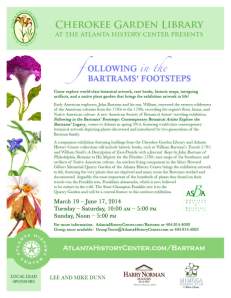
The American Society of Botanical Artists invites you to the opening of their exhibition at the Cherokee Garden Library in Atlanta, GA!

The nationally traveling exhibition Following in the Bartrams’ Footsteps: Contemporary Botanical Artists Explore the Bartrams’ Legacy opens today at the Cherokee Garden Library at the Atlanta History Center. A collaboration between the American Society of Botanical Artists (ASBA) and Bartram’s Garden in Philadelphia, the exhibition features world-class contemporary botanical artworks depicting plants discovered and cultivated by 18th century naturalists John and William Bartram. Early American explorers, John Bartram and his son, William, traversed the wilderness of the American colonies from the 1730s to the 1790s, recording the region’s flora, fauna, and Native American culture. The exhibition reflects John and William’s passionate observation and discovery of nature, which has influenced generations of artists and explorers.

Following in the Bartrams’ Footsteps, presented by the Cherokee Garden Library at the Atlanta History Center, is on display in McElreath Hall, March 19 – June 17, 2014. The exhibition is open Tuesday – Saturday, 10:00 AM – 5:00 PM;
Sunday, Noon – 5:00 PM; free to the public.

The original artworks were selected from a field of nearly 200 entries submitted by ASBA members from around the world. The exhibition allows a fresh look at the Bartrams’ seminal body of knowledge and art. William’s illustrations were often the first images seen of North American plants and animals. Depictions of beautiful native rarities including Franklinia alatamaha (commonly known as the Franklin tree), now believed to be extinct in the wild, Dodecatheon (commonly called shooting star), and American lotus are included in the display. Other subjects include foxglove, morning glory and cockscomb – examples of introductions the Bartrams made to American gardens through their dedication to botany.

Following in the Bartrams’ Footsteps also seeks to illuminate the role contemporary artists play in depicting these same plants for today’s audience, preserving their record for generations to come. The exhibition promises to appeal to a wide audience as it ties together art, science, history, nature, and culture. Artists enthusiastically sought out their chosen plants, with some having gone so far as to track down heirloom seeds and cultivate them in their own gardens in order to be able to paint a particularly appealing subject.

This evening’s opening event includes a lecture at 7 PM followed by a reception and an opportunity to explore the exhibition. Joel Fry, Curator of Bartram’s Garden in Philadelphia will present a survey of William Bartram’s illustrations and examine the scope and influences of his career as a seminal American natural history illustrator. Fry, who is widely published, is a leading scholar on both John and William Bartram and their botanic and collecting careers in the eighteenth century.

Tickets for the lecture are $25 and reservations are required; call 404-814-4150 or purchase online at AtlantaHistoryCenter.com/Bartram. Docent-led group tours are available for a fee and by appointment. Please email Group Tours at the Atlanta History Center.


Buy Catalog

Learn More

Learn More

This beautiful complement to the exhibition, Following in the Bartrams’ Footsteps: Contemporary Botanical Artists Explore the Bartrams’ Legacy, includes an introduction by Joel Fry, Curator, Bartram’s Garden in Philadelphia.
It also includes an essay by Patricia Jonas, Exhibitions Chair of the American Society of Botanical Artists (ASBA). In her essay, Jonas provides background information about the artwork in this traveling exhibition.

This 20-page booklet includes drawings and paintings by: Maryann Roper, Lizzie Sanders, Bobbi Angell, John Bartram, William Bartram, Beverly Duncan, Catherine Watters, Betsy Rogers-Knox, Wendy Cortesi, Lara Call Gastinger, Karen Kluglein, Dick Rauh, Joan Lavigueur Geyer, Judith Simon, Maria Cecilia Freeman, Derek Norman and Diane McElwain.

Available at ArtPlantae ($5).

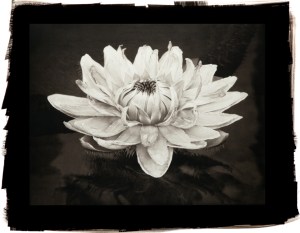
Queen Victoria,  © Cy DeCosse, Courtesy Cy DeCosse Photography

Queen Victoria, © Cy DeCosse, Courtesy Cy DeCosse Photography

Do you love the look and feel of botanical illustrations created in graphite?

If so, you will be mesmerized by the botanical imagery of
Cy DeCosse whose studio focuses on the alternative photographic printing processes of Platinum-Palladium, Gum Dichromate, and Photogravure. These are special, extremely time- and labor-intensive techniques that took DeCosse and master printer, Keith Taylor, years to perfect. The images they create together at Cy DeCosse Photography contain fascinating detail, delicate light and dark tones and botanical subjects that float on paper.

DeCosse’s portfolio includes 11 themed collections. The following collections may be of particular interest to botanical artists: Midnight Garden, The Color of Food, The Beauty of Food in Platinum, Flowers in Platinum and Weeds.

In May, the VERVE Gallery of Photography in Santa Fe, New Mexico will present a solo exhibition of The Midnight Garden, DeCosse’s collection of night-blooming flowers printed in platinum. This exhibition will be on view May 2 – June 21, 2014.

Learn more about the VERVE Gallery of Photography at www.VERVEGallery.com


About Cy DeCosse

Cy DeCosse is a former art director and Fulbright Scholar. His fine art photography has been in solo exhibitions with John Stevenson Gallery in NYC, Weinstein Gallery in Minneapolis, Iris Galleries in Boston and Aspen. His work is in many private collections around the world.

Botanist and scientific illustrator Bobbi Angell is one of many artists participating in Flora: A Celebration of Flowers in Contemporary Art, an exhibition at the Brattleboro Museum & Art Center (March 15 – June 22, 2014). This new exhibition occupies four of the museum’s six galleries and explores artists’ relationship with flowers. Angell has more than 20 pieces in the exhibition. They include

Tritonia copper etching 9"x6" © Bobbi Angell, All rights reserved

Tritonia copper etching 9″x6″ © Bobbi Angell, All rights reserved

copper etchings, scientific illustrations and illustration work printed in related publications.

Educational events associated with Flora will be offered through Spring. They include Artist Talks, an orchid care workshop, a wildflower walk, a gallery tour, a special lecture about bumblebees, a visit to one of the finest private gardens in North America, and a hands-on workshop with Bobbi Angell who will guide participants in the drawing of spring flowers and orchids.

Details about each event, as well as selected images from the exhibition at
Flora: A Celebration of Flowers in Contemporary Art.

There is nothing better than a good story about people and plants. If you like to read about plants, people and history too, consider reading The Big Apples of New York: The Story of How New York State Became The Big Apple by A.L. DuBois.

DuBois is a native New Yorker and a botanical artist who first learned about New York’s agricultural history when she moved to the Hudson Valley after graduating from college. At this time, she also learned that her family is linked to the founding of Flushing, Queens, the first apple town in the United States. Research on her family and the history of New York revealed a lack of books linking the state’s apple history to it’s current history, so she decided to combine her passion for history with her passion for botanical art and write a book of her own.

In The Big Apples of New York, DuBois explains apple history and symbolism, how the apple was the first fruit tree imported by colonists and how New York state established itself as a major apple producing area. She writes about the Prince family nursery, the first commercial nursery in the New World, and the prominent Livingston family — their orchards, hardships, successes and their link to the historic Montgomery estate. She also explores the mystery surrounding the expression “The Big Apple” and its link to slavery and the Underground Railroad. Her historical account of events occurring before, during and after the Civil War is interesting, disturbing and will change how you view apples at the grocery store.

DuBois’ book is as much about the current state of apples in present-day New York as it is about its history.

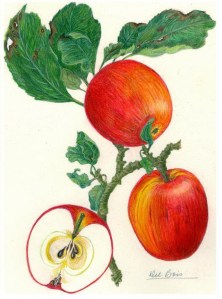
Chenango Strawberry. © A.L. DuBois, All rights reserved

Chenango Strawberry. © A.L. DuBois, All rights reserved

Garden historians, teachers, fruitarians, and anyone with an interest in apples will be pleased to learn that family-friendly events such as apple festivals are alive and well in New York. DuBois shares information about 9 festivals, one of which has an annual attendance approaching 70,000. She also shares how the Culinary Institute of America (CIA) honors the state’s apple history and discusses the orchard replenishment program by Slow Food NYC.

Included in The Big Apples are apple recipes for treats such as Apple Cobbler by the CIA and Fidget Pye, an apple, onion and bacon pie dating back to 1795. Also included are Apple Facts from the USDA, instructions about how to grow an apple tree from seed like the colonists once did, and a directory to 190 apple orchards in New York.
DuBois’ full-color botanical illustrations were created using watercolor, Derwent colored pencils and tempera paint. It took her more than two years to draw and paint the twenty-five varieties featured in her book.

The Big Apples of New York: The Story of How New York State Became The Big Apple is a self-published title and can be ordered directly from the author for $30.99. Please allow one week for shipping.


Literature Cited

DuBois, A.L. 2013. The Big Apples of New York: The Story of How New York State Became The Big Apple.


Readers,
Do you have a question for Ann about her research or the botanical illustrations created for her book?
Post your question below.


Click, Download, Share!

Click, Download, Share!

Celebrate Earth Day and learn about the history of the San Gorgonio Pass at Gilman Historic Ranch and Wagon Museum.

You are invited to the Earth Day Festival on Saturday, April 12, 2014. Festival hours are 9 am – 3 pm. Attend fascinating presentations by guest speakers, participate in fun family activities and learn about solar energy, composting and how to care for the environment while enjoying nature.

Tania Marien will introduce visitors to Georgius Everhardus Rumphius (1627-1702), the naturalist who spent 50 years gathering information about the native plants of Ambon, an island in Indonesia. Rumphius’ detailed plant descriptions and illustrations were used to create The Ambonese Herbal. Produced before Linnaeus’ classification system, the English translation of this historic herbal was published in 2011. Learn about the work of this 17th-century naturalist and how information from this herbal is being applied to modern medicine. After this presentation, attendees will have the opportunity to view all six volumes of The Ambonese Herbal at ArtPlantae’s InterpretPlants Station.

Have lunch at Gilman Ranch and enjoy presentations by:

  • 10:00 AM – Tania Marien, ArtPlantae
  • 11:30 AM – Dr. Mark Hoddle, Center for Invasive Species Research, UC Riverside
  • 1:00 PM – Faith Riley, Riley’s Stone Soup Farm

While at the ranch, be sure to visit ArtPlantae to learn about the botany behind the herbs and spices used in the cookbook, Hungry for History: One Hundred and Fifty Years of Food, History and Legends in the Pass. This one-of-a-kind cookbook will be available for purchase at the Wagon Museum.


Download a flyer, Share it with friends