Feeds:
Posts
Comments

By Botanical Art Society of the National Capital Region
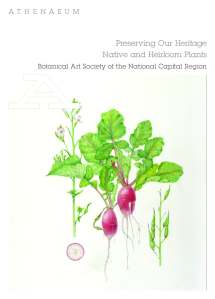
Postcard image courtesy BASNCR.

Go to the Anthenaeum

Preserving Our Heritage:
Native and Heirloom Plants

Anthenaeum
North Virginia Fine Arts Association
November 13, 2014 – January 4, 2015

Each year, the artists of the Botanical Art Society of the National Capital Region (BASNCR) hold at least one juried exhibition in the Washington area to promote awareness of botanical art as a living art form. BASNCR artists work in a variety of media including the traditional watercolor on paper, as well as ink, graphite, gouache, colored pencil, oil, and silverpoint.

This year’s exhibition, Preserving Our Heritage, will be held at the Athenaeum in Old Town Alexandria, VA. The exhibition opens on November 13, 2014 and continues through January 3, 2015. Susan Frei Nathan of Susan Frei Nathan Fine Works on Paper juried the exhibition. Susan has over two decades of experience evaluating botanical art, and is a passionate expert and champion of botanical artwork.

The exhibition offers the artists of BASNCR an opportunity to showcase their favorite native or heirloom plants. There are a variety of definitions for both types of plants. A generally accepted definition for a native plant is one that occurs naturally in a particular region, ecosystem, or habitat without direct or indirect human intervention.

Some define heirloom plants in terms of the length of time a cultivar has been grown, or its existence before a specific date (e.g., 1951). Some use heirloom in its traditional sense and define an heirloom plant as a cultivar that has been handed down from one family or group member to another for many generations.

Whatever the definition for either category of plant, BASNCR artists each have favorite plants that they grow or admire (or anguish over not being able to grow), and will present them in their artwork at the Athenaeum.

Participating Artists:

      Ann Baker
      Carol Tudor Beach
      Judy Brown
      Tina Thieme Brown
      Esther Carpi
      Anne Clippinger
      Karen Coleman
      Jane Dowling
      Lee Boulay D’Zmura
      Bonnie Driggers
      Joan Ducore
      Mary Elcano
      Margaret McPherson Farr (Betsy)
      Lara Gastinger
      Gail Harwood
      Mary Page Hickey
      Juliet Kirby
      Jerry Kurtzweg
      Pamela Mason
      Elena Maza-Borkland
      Linda C. Miller
      Marsha Ogden
      Berit Robertson
      Mary Jane Zander

An opening reception will be held on Sunday, November 16, 2014 from 4-6 pm.

Gallery Hours:
Thursday, Friday and Sunday from 12–4 pm and Saturdays from 1–4 pm.
The Athenaeum is closed on holidays. Admission to the gallery is free.

Learn More

Botanical art tradition, 21st century technology

It has only been three years since Elaine Searle launched her first online course. Her course has grown since then thanks to student feedback and advances in technology.

Elaine has combined this feedback and today’s technology to create a new online program celebrating the traditions of botanical art, as well as the tools of technology. This 21st-century program has new content, new video and new interactive elements. It also includes personal tutorials via Skype.

Elaine offers three levels of instruction in the new program. These levels are outlined briefly below:

  • Foundation – Suitable for those with no or little experience of drawing or painting, and for those who wish to build confidence and proficiency in the core skills of botanical art.
  • Certificate – Suitable for those who have already mastered the foundations of botanical art and would like to study to a more advanced level.
  • Diploma – An opportunity for certificate level graduates to build on their knowledge and skills to attain a diploma via the successful production of a significant themed collection of botanical paintings.

Enrollment is now open for all levels.

The Foundation course begins in January 2015. Students should be able to complete this course in 12 months. Fee includes a kit of brushes, paint, art materials and papers.

The Certificate course begins in April 2015. Students should be able to complete this course in 12-18 months.

If you are interested in the Diploma course, please contact Elaine. The portfolio of works required for this course should be completed within 18 months.

Learn more about this new online program and download the color brochure.

Welwitschia © 2006 Wilna Eloff. All rights reserved

Welwitschia © 2006 Wilna Eloff. All rights reserved

Wilna Eloff is a South African botanical artist whose specialty is indigenous trees and shrubs.

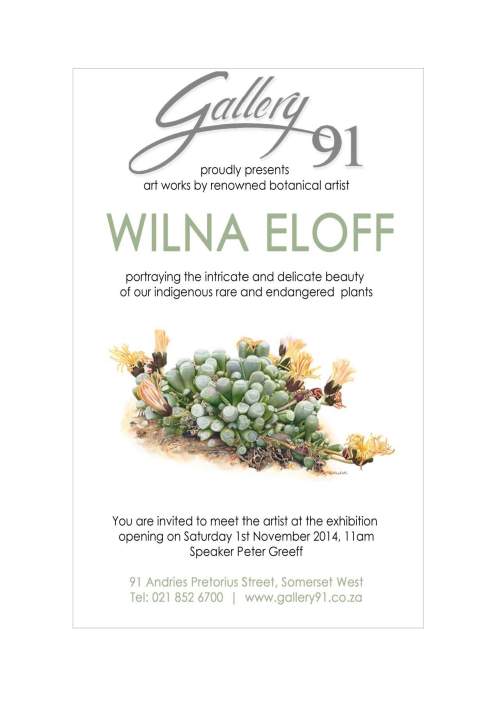
This weekend Wilna will open a solo exhibition at Gallery 91 in Somerset West. You are invited to attend the opening reception on Saturday, November 1, 2014.

Wilna is an award-winning artist who has earned several medals at the Kirstenbosch Biennale Awards (Gold Medals 2013, 2008, 2006; Silver 2010; Bronze 2004). Her work is in the collection at The Hunt Institute for Botanical Documentation at Carnegie Mellon University (USA), the Shirley Sherwood Gallery of Botanical Art at the Royal Botanic Gardens, Kew (UK), and in the First Rand Corporate Art Gallery (South Africa).

Her artwork was commissioned for publication in Field Guide to the Orchids of Northern S.A. and Swaziland by Douglas McMurtry, Lourens Grobler, Jolisa Grobler and Shane Burns (2008). ISBN: 1-919766-46-4

Join Wilna this weekend at Gallery 91 to learn about rare and endangered indigenous plants. Here is a flyer you can download, print and share with friends.

Gallery 91 Expo

Download flyer, share with friends

Download flyer, share with friends

Lyceum of Monterey County
www.lyceum.org
The oldest non-profit on the Monterey Peninsula, the Lyceum of Monterey County offers enrichment classes for adults and families. Included are botanical art classes for adults and families. The Lyceum “inspires a life-long love of learning” through its enrichment programs and academic events.

    Drawing Seeds and Pods and Berries with Nina Antze
    December 6, 2014
    10 am – 12 pm; 1 pm – 3 pm

    Discover the intricate details of fruit, capsules, nuts, pod and flowers. Using colored pencil techniques of layering and blending, learn how to mix a variety of rich and interesting browns and grays along with the colors of autumn. Cost: $60

    View Details/Register

Plants really do receive less attention than animals.

This was determined in a study of attention “blinks” by Benjamin Balas and Jennifer L. Momsen. Experiments confirming this physiological component of plant blindness can be reviewed in Attention “Blinks” Differently for Plants and Animals.

Using an established research protocol in the study of visual cognition, Balas and Momsen investigated the ability of individuals to detect plant and animal images presented to them in rapid succession. The protocol they used is a measurement of “attentional blink” which they describe as a “phenomenon in visual perception in which detecting the first of two targets in a sequence of rapidly presented images compromises the ability to detect the second target for a short time” (Balas & Momsen, 2014). They go on to explain that this compromise occurs because the first image captures the visual attention of the viewer. Because it takes time for a viewer to disengage from the first image (and free up visual attention), subsequent images appearing too close to the first one tend to go unnoticed (Balas & Momsen, 2014). That is, “attention blinks” (Balas & Momsen, 2014).

Balas & Momsen (2014) recruited 24 psychology students to take part in this study. Half were asked to detect plant images and half were asked to detect animal images. Students were placed in a darkened room and viewed image sequences on a MacBook laptop computer. At the end of each sequence, participants were asked to respond to questions about what they observed. Specific details about the research procedure and statistical analyses used by Balas & Momsen (2014) are described in their paper.

Data collected by the authors indicate:

  • Attention is not captured by plants the same way it is captured by animals.
  • Participants are more likely to miss plant images.
  • Participants more often report seeing plant images when none were present in the image sequence.
  • Participants’ attention to plants is delayed, suggesting “attentional resources are deployed differently for plant targets” (Balas & Momsen, 2014).

These results demonstrate a measurable difference in how humans perceive plants and animals and suggest that plant blindness may be a result of delayed attention, instead of reduced attention (Balas & Momsen, 2014).

So what does this all mean for educators?

Because plant blindness has a physiological base, Balas and Momsen (2014) offer these suggestions to educators:

  • Explain to students that plant blindness exists.
  • Incorporate engaging active learning opportunities about plants into your lessons.
  • Integrate plants into life science lessons and stop treating botany as a separate subject.
  • Add auditory and visual learning components to your lessons. Do not rely only on text and images.

The article by Benjamin Balas and Jennifer L. Momsen is available for free through an Attribution-Noncommercial-Share Alike 3.0 Unported Creative Commons License. Click on the link below to download a PDF copy of this article.


Literature Cited

Balas, Benjamin and Jennifer L. Momsen. 2014. Attention “blinks” differently for plants and animals. CBE – Life Sciences Education. 13(3): 437-443. Retrieved from http://www.lifescied.org/content/13/3/437.full.pdf+html.

WeirdWildWonderful The American Society of Botanical Artists, The Botanical Artists Guild of Southern California and The Huntington Botanical Gardens present

A Weird, Wild & Wonderful Symposium
July 23 – 26, 2015

in conjunction with the exclusive Southern California showing of

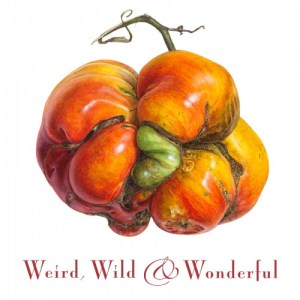
Weird, Wild & Wonderful

The Second New York Botanical Garden Triennial Exhibition of 46 captivating paintings and illustrations of exotic specimens by invited members of the American Society of Botanical Artists at The Huntington Library, Art Collections and Botanical Garden in San Marino, California.

Learn More

Plants, Life, Riverside is an interpretive project about plants in the urban landscape of Riverside, CA.


Cynthia Herrera
is a photographer and MFA candidate at California State University, Long Beach who explores new spaces through photography. In her current project, Making Ground, Cynthia tells the story of immigrant families and how they use the past and the present to create new spaces. In her project, Cynthia also addresses where families place plants around their homes and it is this element that inspired the theme for Making Ground and its focus on transplanting, grafting, herbs and community stories.

Making Ground had its beginning at Gloria’s Nursery, a family owned nursery operated by Celestino and Gloria Garcia. Cynthia chose the nursery for her project because she wanted to explore a space where families visit. Cynthia has spent a considerable amount of time learning from Celestino and Gloria and completing an oral history about the nursery. This history includes information about the development of Riverside’s historic Arlington Greenbelt.

Making Ground workshops are where the community can share living histories and practices that create roots, “make ground”, and generate new histories challenging traditional notions of space, place, ownership and access.

You are invited to take part in Making Ground and to contribute to this unique series. Please join Cynthia and fellow neighbors at one or more of the following event:

    Community Cuttings
    Saturday, October 25, 2014
    11:30 AM – 1:30 PM
    Storytelling and the community history of plants. This transplanting workshop will be held at the Orange Terrace Community Library at 20010-B Orange Terrace Parkway, Riverside, CA 92508. (map)

    La Sierra University Artist Talk and Pop-Up Transplanting Workshop
    Saturday, October 25, 2014
    Time TBA
    Making Ground: Community Engagement as Art Practice, Space and Place | Access and Agency will be presented by Cynthia Herrera.
    La Sierra University is located at 4500 Riverwalk Parkway, Riverside, CA 92505 (map)

    Common Ground: A Stakeholder Event
    Sunday, November 9, 2014
    10 AM – 3 PM
    Community members are invited to join workshops in grafting, transplanting and growing herbs in domestic spaces in an exchange of community histories. Participants will also enjoy a host of dishes from recipes made from plants grown on site. This community event will occur at Gloria’s Nursery in Riverside’s historic Arlington Greenbelt at 2078 Van Buren Blvd, Riverside, CA (map)

    Living Sculpture
    Sunday, February 22, 2015
    9 AM – 1 PM
    Participants will learn about the transitions of healing plants by local curanderas and help create a growing sculpture. The community will be invited to share histories and bring plants to share and exchange. This event will be held at The Farmer’s Market at Galleria at Tyler, 1299 Galleria at Tyler, Riverside, CA 92503 (map)

Making Ground is a community engagement project for hosted by the Riverside Art Museum.
Inquiries about Cynthia’s workshops should be sent to Making Ground 2014.


Event Information to Download and Share (PDF)