Feeds:
Posts
Comments
Canna ‘Phaison”, Amaryllis ‘Candy Cane’, Onoclea sensibilis “Sterile Rebirth”. All images © 2014 Carol Ashton-Hergenhan

Canna ‘Phaison”, Amaryllis ‘Candy Cane’, Onoclea sensibilis “Sterile Rebirth”. All images © 2014 Carol Ashton-Hergenhan


Carol Ashton-Hergenhan
reveals the beauty of plant life cycles in
Florescence, Senescence and Regeneration: The Work of Carol Ashton-Hergenhan.

This exhibition will be on view at Twenty-Two Gallery in Philadelphia from
June 12 – July 2, 2015.

Twenty-Two Gallery states:

This show continues (Carol’s) exploration of the cycle of plants from Florescence when the plant attracts pollinators to continue its species, through Senescence as the aging plant struggles to continue its own existence in preparation for a future generation, to Regeneration, when the species starts anew and the cycle begins again.

Carol is an artist and Master Gardener with a passion for plants. Her work has been featured in numerous botanical art exhibitions. Her painting of Allium sphaerocephalon (Hairy Drumstick Allium) is currently touring the country in Weird, Wild & Wonderful, a traveling exhibition curated by the American Society of Botanical Artists. In 2014, her paintings of Viburnum dentatum (Southern Arrowwood) and Liquidambar styraciflua (Sweetgum) were published in the book, American Botanical Paintings: Native Plants of the Mid Atlantic written by Botanical Artists for Education & the Environment.

The popular Contra Costa Master Gardener Great Tomato Plant Sale expands to two locations this year. If you’ve been inspired by the heirloom tomato by
Asuka Hishiki on the cover of the “Weird, Wild & Wonderful” catalog, here is your chance to find something weird, wild and wonderful for your own garden.

This year the Great Tomato Plant Sale will feature 58 proven varieties of heirloom plants. Contra Costa Master Gardeners propagate their plants using only seeds from open-pollinated varieties that breed true. Start your shopping now by downloading the list of tomato varieties and the list of pepper varieties to be sold at this year’s sale.

You have two opportunities to look for goodies this year. The first opportunity occurs on Saturday, April 4 from 10 a.m. – 3 p.m. at “Our Garden”, the Contra Costa Master Gardeners’ demonstration garden in Walnut Creek, CA (map). The second opportunity occurs the following weekend on April 11. On this date you can visit the sale at “Our Garden” from 10 a.m. – 2 p.m. or shop for heirloom plants at AdamsCrest Urban Farm in Richmond from 10 a.m. – 3 p.m. (map). The sale in Richmond will feature tomatoes better suited for cooler climates. Both plants sales are family-friendly educational events.

Bring your own boxes or wagon. Cash or check only, please.

Celebrate Spring!
Look for that weird, wild and wonderful plant too tempting to ignore.


Visit The Great Tomato Plant Sale

Communities are filled with avid gardeners and you may be one yourself. Home gardens and community gardens are scattered all over the country. On an individual basis, they don’t appear to do much to affect the ecology of a region. Collectively, their environmental impact on a region is unclear.

What type of impact could disconnected gardens possibly have in a neighborhood, city or region? 

It’s a big question to think about and one that plant ecologist,Cara Fertitta is tackling head-on in her research at University of California Riverside. Working with gardeners and small scale farmers, Cara has started to measure the impact gardens have in the urban landscapes of Riverside and Los Angeles. She visits with us today to discuss her research.

Please join me in welcoming Cara Fertitta!


    Cara, thank you for introducing yourself at a recent meeting of the Riverside Community Garden Council. Tell us about yourself.
    I’m currently a third year graduate student at the University of California Riverside pursuing my PhD in plant ecology. I’ve lived here in Riverside for about 4 ½ years. I made the move after graduating with a B.S. in biology from the University of South Carolina in 2010. I was pretty sure at that point that I wanted to pursue graduate school, but I had recently made a few major directional changes, so I decided to take some time off in between. In those intermediate years I actually had a really interesting job working as a baker for a tiny little artisan sourdough bakery (Now the not-so-tiny Rustic Loaf of Upland). I would go bake bread in the morning with my boss in a tiny little commercial kitchen space, and then head out to farmer’s markets to sell. It was a great experience. At the same time I was getting really passionate about gardening and increasingly invested in cooking and sustaining a homemade pantry. Being involved in the farmer’s market scene was a constant inspiration and connected me to a lot of local farmers.

    Originally I’m from Massachusetts — the youngest of four daughters in a stereotypically large, traditional Italian-Sicilian family. I remember gardening and cooking with my mother at a very young age, so these seeds, so-to-speak, where planted early. My enthusiasm for science didn’t arise until high school. About the time I started learning biology, anatomy, and physiology, I was hooked. Discovering my passion for ecology took longer — I had little appreciation for it until my later years of college, but at some point it just seemed to click with me as the most fascinating science. The science of how things interact with each other and the environment — I mean, how cool is that? As a nature buff, gardener, and food enthusiast, the rest unfolded quite naturally.


    Your project is very interesting. Would you mind telling readers about your research?

    My project is investigating the productivity, efficiency, and sustainability of small-scale, local food systems ranging from community gardens to small farms. There are a growing number of gardens and small farms popping up across the country, particularly in urban areas. Over a third of American households are participating in some form of food production, yet we have almost no data quantifying how productive small scale systems are and how they compare to large scale production systems. Further, we have very limited data on how gardeners and small farmers are using their space and resources, and what implications this has for their overall sustainability. Although these systems are small, they stand to have substantial impacts on the environment, particularly in urban regions where they are very much integrated into the community.

    I’m hoping to get a better picture on what gardeners are doing, and use that to quantify the impact of these practices on the environment. I hope this research will help gardeners better manage their resources and reduce waste.

    Why is productivity of small-scale gardens of interest to you? How did you come to research this topic?
    This subject is interesting to me from both a scientific and personal perspective. This research will be the focus of my dissertation for my PhD in plant ecology. My scientific interests have long been focused on the overlap between plant community ecology and agroecology (i.e. agricultural ecosystems). Integrating ecological principles at the large-scale is often quite challenging due to the reliance on very standardized heavy machinery. At the small-scale, people often incorporate ecologically-friendly practices without even realizing it — planting densely and diversely and relaying primarily on renewable human labor, which could represent a substantial advantage in sustainability, but that’s not to say that large-scale systems don’t have certain advantages as well.

    At the personal level, I’m interested because I am a small-scale producer and supporter myself. I’m a very avid and enthusiastic gardener and I’m also a big proponent of home-cooking with an emphasis on seasonal, locally-sourced (if not homegrown) produce. I love gardening because it connects me to both the food I eat and to the environment I live in. When I’m planting and landscaping, I’m also watching the migration of different birds, seeing which pollinators visit what, watching the soil biota shift as I introduce compost to the soil. It’s a fascinating endeavor as both a person and a scientist and I’m very interested to see the results of this study.


    How many home gardens are in your data set? How many community gardens?

    Well our gardener recruitment is an ongoing process. Currently I have 11 different gardens throughout Riverside and LA committed to the study, but I’m always happy to have more. I was initially planning to sample some home gardens as well, but since space and spatial limitation is such an important aspect of this study, we decided that using community garden plots would be more conducive to the study’s objectives. While some home gardens are contained, many of them are sprawling or disjointed. There doesn’t tend to be distinct spatial boundaries in a yard and spatial boundaries are key to my study.


    You’ve mentioned that you hope your research will “influence policy decisions that may improve land tenure and public support for community gardens by showing their value in food production and sustainability.” What do you hope your research will do for home gardens?

    I think for home gardens, the most important take away from this research will be regarding resource use efficiency (meaning yield output per resource input) and sustainability. I’m using a modeling technique to assess sustainability in terms of environmental impacts ranging from air and water pollution, to green house gas emissions, to human health impacts. Gardens pose many opportunities to be more productive and efficient forms of agriculture than large-scale production. They use voluntary, renewable labor, they incorporate a lot of diversity (which is beneficial for nutrient and water retention, prevention of pest, disease, and weed outbreaks, and attraction of pollinators), and much like a natural environment they leave little unoccupied space and they plant creatively (e.g. like using vertical space along horizontal space — think trellising). But there’s a good chance many gardeners are overusing their resources. Studies of lawns show widespread over-use of fertilizers, pesticides, water, etc., and it’s likely this extends to many gardeners as well. Overuse of resources is not only a waste, it can be extremely damaging to the environment — particularly when it comes to agrochemical use. In organic gardens, the resources themselves are often much lower-impact, but getting the timing and composition of compost in balance can be quite a challenge. I’m hoping to get a better picture on what gardeners are doing, and use that to quantify the impact of these practices on the environment. I hope this research will help gardeners better manage their resources and reduce waste.


    Many people garden in small spaces or do container gardening on patios and balconies. How might your research be applicable to this group of people?

    These folks really represent the smallest of small on the spatial limitation spectrum, and my hats off to them to using whatever space they can. Their use of space is often very creative and exploitive, which has the potential to equate to very high productivity (productivity here meaning yield normalized by space). However, properly managing resources in these container gardens is very tricky. The drainage and the shallow depth of most containers makes balancing water and nutrient needs a challenge which could result in reduced productivity and in most cases likely result in reduced resource use efficiency. Since my research will be working with folks that are planting in the ground, I’m afraid it may not be terribly insightful for container gardeners. I think that would really require a study of its own.


    There is a nice collection of resources by the National Gardening Association that can be used in the classroom. Do you plan to develop instructional material for community gardens, school gardens and home gardens in the future?

    I think there’s potential for the development of some helpful reference materials, but it’s not something I’ve considered yet. We do, however, plan to hold one-on-one consultations with all interested participants as well as a couple of public workshops co-sponsored by UCR’s agricultural Extension program.


    Will you be presenting at the Grow Riverside conference in June?

    I’m not planning to present this June since I will still be in the data collection phase. Next summer, however, I should have a lot more worth talking about.


If you would like to follow Cara’s progress, periodic updates will be posted to the University of California Division of Agriculture and Natural Resources Extension’s Urban Agriculture Blog. Subscribe to their blog here.

The City of Riverside is experiencing a renaissance when it comes to local agriculture. This growing interest is fueled by passionate Riverside residents, community organizations such as the Riverside Community Garden Council, Sustain Riverside, and the City’s partnership with Seedstock to create GrowRIVERSIDE, a program establishing a sustainable food and agriculture system throughout the city.

Art, Botany and Urban Agriculture at Home
Many resources exist to facilitate the creation of home gardens and to encourage the study of plants at home. If you’re an aspiring gardener or looking for resources to bring urban gardening to your classroom or outdoor program, here are a few resources to investigate:

Also, be sure to follow Cara’s research into the productivity, resource use and environmental impact of urban gardens. You can follow Cara’s progress by subscribing to the urban agriculture blog maintained by the University of California. What a way to introduce students to ecology!
Community Garden WEB ENG
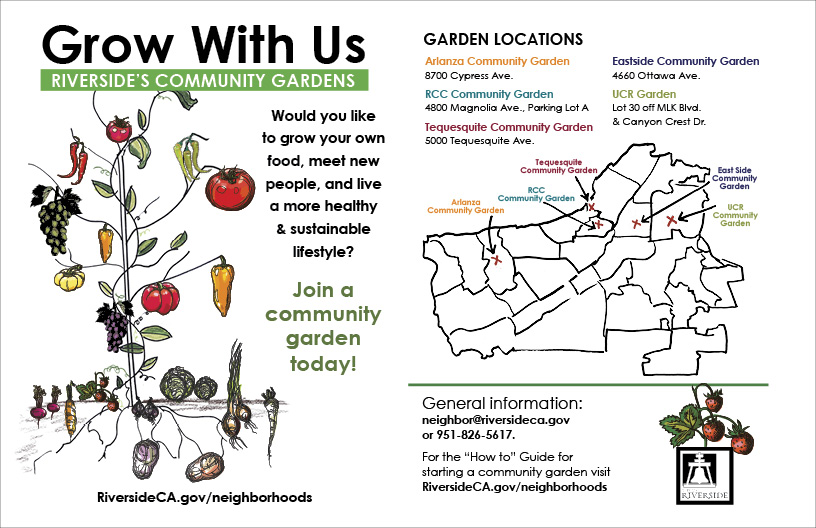
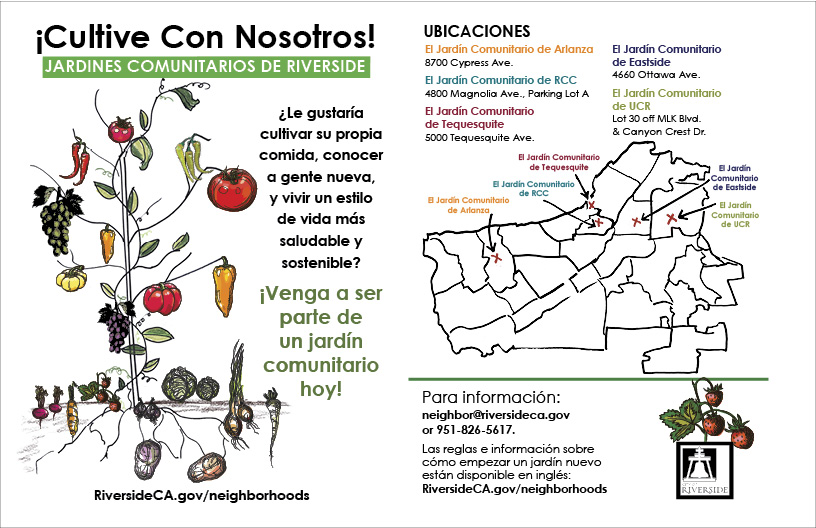
Riverside residents are invited to download a map to local community gardens created by the City of Riverside Community Development Department (see right). This map is available in English and in Spanish.


Plants, Life, Riverside is an interpretive project about plants in an urban setting. Where are the plants in Riverside? Let’s find out.

Courtesy UCR College of Natural and Agricultural Sciences

Courtesy UCR College of Natural and Agricultural Sciences

The University of California Riverside’s College of Natural and Agricultural Sciences in partnership with the UC Global Food Initiative and California Agriculture and Food Enterprise will host a series of lectures about the science of food and health.

This series is a wonderful way to explore the role plants play in our lives and why we should care about plants. Share this information with fellow educators, friends and family!

The following topics will be presented during the Spring Lecture Series:

  • Feeding Botswana: From Field to Lab to Vaccine (April 9)
  • Food Security for Africa: The Cowpea Story from Lab to Plate (April 23)
  • Seeds of Change: UCR’s Healthy and Sustainable Food Initiative (May 7)
  • What You Eat Is How You Feel: Nutrition and Its Impact on Immunity and Health (May 21)

All lectures will be held from 5:30 – 6:30 p.m. at the UC Riverside Extension Center at 1200 University Avenue, near the intersection of University Avenue and the 60 freeway (map). Lectures are free and open to the public. There is no charge for parking when attending the lectures.

For more information, click on the image.

SMorrish_NaturesDetailsMontage_ArtPlantae Over the centuries, the county of Dorset has motivated not only naturalists and scientists but provided the creative inspiration for artists, writers, and poets with its rich tapestry of colours, sounds and sights woven into an ancient landscape. Some artists have used inspiration from the array of wild flower meadows, ancient woodland and iconic views across west Dorset, while others such as Sarah Morrish (Assoc. SBA SFP) find her inspiration in nature’s details. 

Sarah has a background in conservation and education, yet spends most of her time now illustrating the natural world in watercolour and pencil. She has embarked on a special project in partnership with The Kingcombe Centre to produce a series of paintings illustrating the twigs and buds of Kingcombe’s iconic ancient hedgerow trees and shrubs. After a residential visit in winter/early spring, Sarah will produce eight paintings of eight species incorporating several twigs together with associated lichens, leaves and fruit, which she hopes will be exhibited at the Royal Horticultural Society in 2016. 

Sarah said, “Since coming to Kingcombe from the late 1990’s, I have always been fascinated by the hedgerows there and have in the past included many elements of them in my artwork.” 

Sarah began her project in February 2015 and will return regularly to Kingcombe through late winter and spring to continue her work.

To receive updates about the project, follow Sarah’s blog, Art & the Hedgerow.

Sarah also teaches botanical illustration courses at the Kingcombe Centre in Dorset and has two planned for this year. Her class A Brush with Nature – Illustrating Spring Flowers will be held May 5-8 and A Brush with Nature – Illustrating the Natural World will occur August 5-7, 2015. Why not come along and gain experience and a valuable insight into the work of a Botanical & Natural History Artist? You will not be disappointed.

If detailed illustration is not for you, Sarah will also be leading lino-print workshops at the Centre throughout the year.

For information about art workshops at Kingcombe, see Arts/Creative Workshops.

Sarah will also teach courses in her home county of Hampshire. New for 2015 is the Nature’s Details Summer School. This takes place on a private country estate in the South Downs National Park and consists of three courses, Botanical Drawing & Painting, Illustrating Butterflies & Moths and Drawing & Painting Birds. Each course can be attended as a 1 or 2-day option and includes watercolour paper, subjects and a cream tea!

For more information, visit Nature’s Details Summer School.

Scientific illustrator Gretchen Kai Halpert will begin two new sessions of the Scientific Illustration Distance Learning Program she created. She introduced her new program to readers earlier this year.

Here is what’s new at Classes Near You > New York:


Gretchen Kai Halpert

www.gretchenhalpert.com
Gretchen Kai Halpert is the owner and the instructor of a new online program in scientific illustration. A graduate of the Rhode Island School of Design, Gretchen has many years of experience working as a scientific illustrator and teaching programs about natural science illustration.

    Scientific Illustration Distance Learning Program
    Two new Sessions (I and II) begin April 15 and 14, respectively.

    Session I includes basic drawing skills that are the background to any and all illustration. We cover lighting, scientific conventions, proportion, perspective and value, working from life and from We a variety of natural history objects. This class is appropriate for both beginners and intermediate students. Advanced students should talk with me before enrolling. Students work with graphite, with an introduction to crow quill and ink at week 9.

    Session II advances to more complex drawings, using crow quill and ink, and scratchboard.

    Contact Gretchen at ghalpert@stny.rr.com for more information Contact Gretchen Halpert for information.

Download flyer

Download flyer

Helen Allen is coming to Wellesley!

Helen is the Principal and Diploma Course Director at the Chelsea School of Botanical Art in England. She will visit the Wellesley College Botanic Gardens this summer to teach three courses for artists of all experience levels.

Save these dates on your calendar:

    Let’s Get Started
    Does the white expanse of a beautiful clean sheet of paper fill you with dread? About this one day course Helen Allen says, “I love to draw, compose and prepare my paper carefully before contemplating adding paint. I will demonstrate throughout the day the methods of careful preparation with no fuss, therefore no stress. Move from observations into drawings on tracing paper to composition and transfer of the drawing to watercolor paper.” While this course is for all artists, Helen also adds, “If you are taking either of the following painting workshops with me this should help you get ahead of the game.” (CBA: non-credit)

Monday, June 22, 2015
9:30 a.m. – 3:30 p.m.
BAC 15 150X
WCBG Friends Members $135 / Non-Members $170


Dare to Be Different! … and achieve the perfect flower portrait composition

Work through the logical stages of a flower portrait to create the best composition and drawing which should then be a JOY to paint. With Helen Allen as your guide, begin with a review of the drawings you have brought in and a discussion of various ways of recomposing the elements to reach a stunning layout – including how to use aerial perspective effectively. Work on quick tonal drawings to evaluate your composition’s balance of line, form and color. Color notes and checks are essential to really know your combinations work and you won’t be left with MUD! Helen’s demos of techniques and how to maximize the drama in your painting help you to finish the painting with confidence.

Please note: In preparation for this course please bring with you drawings on tracing paper (vellum style) of your chosen plants and the plant you are depicting. We shall be working on a small composition with the constraints of a margin. The finished size should fit into a 12” square small works frame, with or without a mat.

Tuesday, June 23 – Thursday, June 25, 2015
9:30 a.m. – 3:30 p.m.
BAC 15 150/BAC 15 250
WCBG Friends Members $395 / Non-Members $495


Arthur Harry Church: the Man, the Magnification & the Magic

Arthur Harry Church was an English artist and science teacher who made botanical plates showing enlarged sections of flowers to illustrate floral mechanisms. His use of floral diagrams was integral to his work. Study his methods and finished work with Helen Allen as your guide. Although there will be an opportunity to draw using a microscope, Helen will also have some pre-drawn examples that you may like to trace onto watercolor paper. Precision in drawing is key to this exacting and exciting way of creating an interesting piece that is botanically accurate and aesthetically pleasing. (CBA: half elective) Plan your piece within the constraints of a 12” square small works frame, with or without a mat. Your color work will involve working with watercolor in a flat way but showing detail.

Saturday, June 27 – Sunday, June 28, 2015
9:30 a.m. – 3:30 p.m.
BAC 15 151i
WCBG Friends Members $265 / Non-Members $330

To register for a class, contact wcbgfriends@wellesley.edu or call (781) 283-3094

This information has been added to Classes Near You > Massachusetts.


Related

Hellen Allen discusses traditional and contemporary approaches to botanical art