Feeds:
Posts
Comments

Enhance your ability to key out those plants that can ruin your day! Attend the 34th Annual Symposium of the Southern California Botanists this Saturday (Oct. 18th) at the Ruby Gerentology Center at CSU Fullerton.

Tackle grasses with Dr. J. Travis Columbus, delphiniums with Dr. Jason Koontz, the Polemoniaceae with Dr. Leigh Johnson and Mark Porter, oaks with Fred M. Roberts, Jr., Cryptantha with Dr. Michael Simpson, Camissonia with Dr. Warren Wagner, and Ceanothus with Dr. Dieter Wilken.

For more information about this symposium, visit the website of the Southern California Botanists.

Ask the Artist: Margaret Stevens & The Society of Botanical Artists
October 9 – November 20, 2008

You have read about how they work and have seen the step-by-step development of their paintings. Now you have the opportunity to submit questions to Margaret Stevens and members of The Society of Botanical Artists (SBA) during the Ask The Artist event for Fall 2008. Here is how this event will progress:

October 16, 2008
A list of artists participating in the Ask The Artist session will be published. Study their work in The Art of Botanical Painting and The Botanical Palette: Color for the Botanical Painter get your questions ready!

October 20 – 30, 2008
Submit your questions to asktheartist@artplantae.com.
Will you be attending the 14th Annual Meeting and Conference of the American Society of Botanical Artists? Visit us in the Exhibitors’ Hall and submit your questions in-person. We’d love to meet you!

November 3 – 14, 2008
Margaret Stevens and SBA members read and respond to your questions. Their responses will be posted at ArtPlantae Today on November 20th.

November 20, 2008
The Ask The Artist session is published at ArtPlantae Today.
Read, Learn, Comment.
Contribute to our gathering place!

_________________

Available at ArtPlantae Books

Representing leaves accurately is one of the many challenges faced by botanical illustrators. Illustrators need to capture the gesture, movement, texture, color, and veining patterns of leaves. Exhaustive leaf studies are not always possible because leaves wilt. Quickly. Some very quickly.

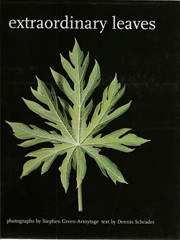
A new book, Extraordinary Leaves by Stephen Green-Armytage and Dennis Schrader, is the perfect reference book for botanical illustrators. The photographs by Stephen Green-Armytage are breathtaking. They contain exactly the type of information illustrators will find invaluable. Many hours can be spent studying color, texture, leaf margins, and veining patterns from the images in this book. Accompanying the sharp detailed photographs is text written by Dennis Schrader, a professional horticulturist, garden designer, and regular on Martha Stewart Living. Schrader shares interesting information about each chapter topic, insectivorous plants, skeletonized leaves, and twenty-nine of the plants featured in this book.

Extraordinary Leaves is comprised of 13 chapters, each dedicated to either a physical feature of leaves (e.g., color, pattern, edges, texture, shape, size, and climbing patterns) or dedicated to a specific plant group (e.g., caladium, kale, ferns, coleus, vines, autumn plants).

The publisher has sample pages of this book on its website. However, these images do not do this book justice. The selected images do not give any indication of what the book truly contains. There is nothing that lets the reader know what there is to learn about the structure of the midrib and secondary veins of Giant Elephant Ear (Alocasia calodora ‘Persian Palm’), the color in Coleus leaves, or the undulating pattern observed in fronds of the Lasagna Fern (Asplenium nidus ‘Plicatum’).

This book is more than exciting. It is spectacular!
_____________

Now available at ArtPlantae Books (Go to Classroom > Reference)

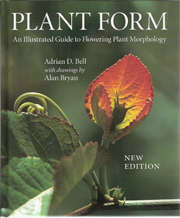
Adrian Bell describes the processes behind plant morphology in the new edition of Plant Form: An Illustrated Guide to Flowering Plant Morphology. Written for amateur botanists and plant enthusiasts, this book is an excellent reference containing bite-sized morsels of information. Author/botanist Adrian Bell and illustrator, Alan Bryan, combine interesting and informative text with detailed pen-&-ink illustrations to provide insight about the following topics:

  • General plant morphology
  • Leaf Morphology: Bell describes thirty-seven morphological aspects of leaves including development, shape change along a shoot, venation patterns, leaf folding, spines, prickles, and hairs.
  • Root Morphology: Bell describes nine morphological aspects of roots including development, root systems, tree root architecture, root modifications, and tubers.
  • Stem Morphology: Thirteen morphological aspects are described including development, bark, prickles, shape, scars, rhizomes, and corms.
  • Reproductive Morphology: Ten morphological focal points including the branching patterns of inflorescences, floral morphology, pollination mechanisms, fruit morphology, and seed morphology are described.
  • Seedling Morphology: Terminology, germination, stem development, and growth are discussed.
  • Vegetative Multiplication: Rhizomes, corms, tuber, stolons, runners, bulbs, and root buds are described.
  • Grass Morphology: Eight morphological aspects are described, including vegetative growth, inflorescence structure, spikelet and floret structure, bamboo shoots and rhizomes
  • Sedge Morphology
  • Orchid Morphology
  • Cactus Look-alikes
  • Constructional Organization of Plants: Forty-two topics including the arrangement of leaves on a stem, the Fibonacci sequence, rhythmic and continuous growth, galls, plant branch construction, tree architecture, and herb architecture are described.

This new edition contains over 1,000 illustrations and promises to be an invaluable asset to both illustrators and gardeners. This book will have you saying, “So that’s what that is!”

Now available at independent bookstores.


The Book Fair schedules for all 12 Stages and the Writing Room are up at the book fair’s web site, as well as a list of exhibitors and their booth numbers. The West Hollywood Book Fair line-up includes:

  • 150+ book stores, authors & literary orgs selling books, hosting fun literary activities, LIVE ART! and book signings. Exhibitors List
  • 8 Author Panel Stages featuring several hundred outstanding authors like Ray Bradbury, Steve Lopez, Sandra Tsing Loh, Adrienne Barbeau, Ed Begley Jr., Francesca Lia Block, Gregg Hurwitz & Many Other Incredible Guests! Schedule
  • 3 Theatre, Performance, Storytelling & Poetry Stages. Schedule
  • A Kids’ Stage featuring theater, story readings, a ballet & more! Schedule
  • Writing Workshops featuring some of LA’s most talented writers. Schedule
  • A Comics & Art Scene! featuring comic book and sci-fi legends like Len Wein, David Gerrold & Larry Niven. Schedule

Directions & Parking (29 KB)

Shuttle Schedule (28 KB)

Book Fair Map (2.7 MB)

Written by Margaret Stevens, in association with the Society of Botanical Artists (SBA), this book complements The Art of Botanical Painting (2004) also published by Stevens and the SBA. In their first book, the SBA provided instruction on drawing techniques, colored pencil techniques, watercolor techniques, and gouache painting techniques. Stevens and SBA contributors gave instruction on the painting of fruit, vegetables, and foliage. In their follow-up work, they focus on colors specific to the botanical palette. They give special attention to the following colors: white, yellow, green, blue, purple, red, brown, and black.

Each chapter is dedicated to one color and contains instruction on how to create this color and how to apply this color in a painting. Instruction is supported by example as Stevens leads artists through step-by-step demonstrations in each chapter. No detail is left out and the methodical processes narrated by Stevens are easy to understand. Each chapter includes a line drawing artists can transfer to paper to immediately apply what they’ve learned. In response to the growing interest in colored pencil, five demonstrations address the creation of colored pencil paintings.

The five colored pencil demonstrations included in this book are:

  • Day Lily (yellow; demonstrator Ann Swan)
  • Madagascar Jasmine (green; Ann Swan)
  • Iris (blue; Susan Christopher-Coulson)
  • Red Rhododendron (red; Susan Martin)
  • Tulip (black; Susan Christopher-Martin)

Watercolor demonstrations featured in this book include:

  • Lily (white; demonstrator Margaret Stevens; how to create form)
  • Rhododendron (yellow; Kay Rees-Davies; how to work with a plant whose flowers fade quickly)
  • Sunflower (yellow; Paul Fennell; how to create highlights and the spiral pattern of disc flowers)
  • Plantain Lily (green; Janet Wood; how to paint variegated leaves)
  • Himalayan Poppy (blue; Brigitte E. M. Daniel; painting multiple stamen, leaf hairs)
  • Delphinium (blue; Vicky Mappin; how to build an inflorescence)
  • Columbine (purple; Valerie Baines; how to use grey and violet)
  • Clematis (purple; Brenda Watts; how to create glowing purple)
  • Cyclamen (red; Jennifer Jenkins; how to create leaf patterns and distinguish between old flowers & new flowers)
  • Poppy (red, orange; Sandra Wall Armitage; how to make orange from red; painting flat hairs)
  • Peony (red, burgundy; Susan Hillier; how to make burgundy using four shades of red)
  • Bearded Iris (brown; Barbara McGirr; how to make brown)

The eight watercolor projects included in this book are:

  • Lily (how to work with white)
  • Sunflower (how to work with yellow)
  • Hosta (how to work with green)
  • Delphinium (how to work with blue)
  • Clematis (how to work with purple)
  • Poppy (creating orange with reds)
  • Peony (creating burgundy with reds)
  • Bearded Iris (how to work with brown)

Stevens’ chapter about color charts is an invaluable tool that will help artists resist the urge to buy every tube of color they see on every materials list they receive in every class they take. Artists can save money by consulting these charts comparing and contrasting yellows, greens, reds, blues, purples, and browns produced by the following manufacturers: Daler-Rowney, Schmincke, Sennelier, and Winsor & Newton.

Stevens closes this book with a gallery of artwork created by members of the Society of Botanical Artists.
__________________

The Botanical Palette: Color for the Botanical Painter
Margaret Stevens, in association with the Society of Botanical Artists
9780061626678
September 16, 2008
$29.95, Hardcover

http://www.soc-botanical-artists.org/

Now Available at ArtPlantae Books

NATURE JOURNALING AT THE PAGE

Location: Page Museum (La Brea Tar Pits)
When: Saturday October 11 – Sunday October 12, 2008; 9:30 a.m. – 4:30 a.m.
Cost: $100 members / $125 non-members; Lunch and basic supplies included
Instructor: Janet Takahashi
More: All skill levels welcome (ages 16 and up); enrollment is limited; download flyer here.