Feeds:
Posts
Comments

Marjorie Leggitt has updated the flyer and registration form announcing her Summer/Fall 2009 workshops. If you have been considering one or more of these workshops, please be sure to download the updated information.

Marjorie’s workshops, and others, can be viewed at Classes Near You > Colorado.


Marjorie Leggitt, Leggitt Design & Illustration

http://www.science-art.com/leggitt

  • POSTCARDS FROM… – A series of field sketching courses that are offered year ’round. Travel to Bavaria in 2010 to experience some of the best sketching and painting opportunities available.
  • Botanical Illustration & Painting at Shoals Marine Laboratory – Study and sketch plants in the tidal zone, wetlands and rocky island habitats. Participant’s will also work in Celia Thaxter’s historic garden. June 22 thru June 29, 2009. More information and course syllabus
  • Zen of Field Sketching – Capturing the Colorado Montane – Learn a Zen-approach to field sketching and journaling on a private ranch outside of Denver. July 18-19, 2009. View flyer. Download registration form.
  • Back to Basics: Drawing with Confidence – Return to the drawing basics of line, shading, perspective, and composition to bolster your drawing skills and boost your confidence. Understand how to “see” like an artist. July 21 – 24, 2009. Volunteers for Outdoor Colorado (VOC), Dos Chappell Room, Washington Park, Denver, CO. Download registration form.
  • Moving Animals – Introduction to basic anatomical structures and instruction on how to turn quick sketches iinto lively animal portraits. September 18. The Denver Zoo. Download registration form.

To read detailed course descriptions, click here.

BrushWithGondwana_sm

The Botanical Artists Group, Western Australia was formed in 1991 by a group of botanical artists hungry to participate in a supportive environment where ideas and resources can be shared with peers. The future founding members of the Botanical Artists Group met at an exhibit held by the Art Gallery of Western Australia that brought attention to the historical and contemporary botanical art of this region. This group of new acquaintances met the following day and loosely formed the Botanical Artists Group, Western Australia. Since then, the Botanical Artists Group has made significant contributions toward increasing appreciation of the local landscape, as well as the conservation of this landscape for future generations. The book Brush with Gondwana highlights the group’s history and the contributions made by each member.

The Botanical Artists Group is comprised of seven members. Each member’s section in the book contains a biography and several examples of each members’ artwork, some of it dating back to 1933. The conservation-minded artists in the Botanical Artists Group are listed below. Our few sentences about each artist does not do them justice. Their interesting biographies should be read in their entirety. The media listed in parentheses refer to the media used to create the artwork included in this book.

Rica Erickson
A lifelong interest in nature, plants and human history was recognized in 1996 when the government of Western Australia created the Rica Erickson Nature Reserve. This 124-hectare reserve is located on the Victoria Plains north of Perth. (watercolor and pencil)

Pat Dundas
Pat received a copy of Rica Erickson’s Orchids of the West when she was a child. Pat became intrigued by the small orchids and it became her lifelong dream to paint each orchid species in Western Australia. It took 17 years for Pat to accomplish this goal. Her monumental undertaking has become a book titled, Orchids of Western Australia. (watercolor)

Ellen Hickman
Ellen is a biological consultant who does biological assessments on land slated for development. Ellen’s lifelong interest in art and science is evident in her detailed and descriptive colored pencil paintings. (aquarelle; aquarelle and graphite pencil)

Penny Leech
Finding beauty and nature in all aspects of life, Penny collects inspiring items and sorts them according to their color, texture, and form. Able to paint only two days each week, Penny finds painting to be a meditative experience. (watercolor)

Philippa Nikulinsky
Philippa’s interest is “painting the natural history of hostile environments” and she can spend weeks painting in the desert. Philippa fills her sketchbook with dissected plant parts and notes about a plant’s color, form, and habitat. (pencil, watercolor, and gouache; pencil, wash and dried specimens)

Margaret Pieroni
Inside the custom-made rammed earth home she built, Margaret paints in a studio filled with natural light. She has illustrated several publications, including Discovering the Wildflowers of Western Australia. (watercolor on tinted paper; watercolor)

Katrina Syme
Katrina’s interests are fungi and she brings attention to Australian fungi through her painting. Australia is home to thousands of species of fungi. Many of Australia’s fungi have yet to be described and named.


Brush with Gondwana
serves as an inspiring example of how a harmonious group of botanical artists can educate the public and bring awareness to the conservation of local flora.


Brush with Gondwana
can be ordered at ArtPlantae Books.
If you look at the column to your right, you’ll notice a growing list of art supplies we can make available to you through Dick Blick Art Materials. Click on any of the items and you will be directed to Dick Blick’s website where your order will be placed, processed, and fulfilled. We will post special offers as they become available and hope that you make use of this direct access to one of the nation’s largest art suppliers.

Botanical Drawing
Sacramento Fine Arts Center

www.sacfinearts.org
Through a review of plant morphology and careful observation, participants will learn how to create realistic botanical drawings. Saturday, June 13; 10 AM – 4 PM. Click link above for details.

whitelinesBookSampleLong popular in Sweden, Whitelines writing paper is now available in the U.S.

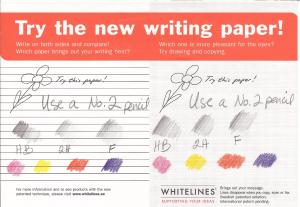
When you open a Whitelines notebook, the first thing you notice are its gray pages and its white lines. You might ask, “Why would I want to write on this? This looks a little odd.” However, there is nothing odd about this paper. The white lines you see put an end to the distracting way lined paper can compete with and crowd-out your written words. With Whitelines writing paper, your handwritten text takes center stage. The gray background may not appeal to you at first, however, you will change your mind the first time you photocopy a page of Whitelines writing paper containing text or sketches. The gray background disappears and the usual ho-hum photocopy is transformed into something worth keeping in your files. Imagine having the ability to make clean photocopies of plants studies. Or how about the ability to turn a demonstration into an instant handout for students that is free from the distracting muddled background typically seen in photocopies made on ordinary paper. Allow us to demonstrate what we’re talking about.

This is a sample sheet comparing regular paper and Whitelines paper (note the gray background):
whitelinesBlankSample

We have written on both sides of this sample sheet:
whitelinesUsedSamplePaper

Below is a photocopy of the sample sheet above. Notice how the whitelines and gray background disappear and do not compete with the text and swatches of graphite or colored pencil:

whitelinesPhotocopySample 001

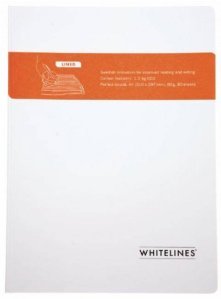
Would you like to try Whitelines paper yourself? We have pads of sample sheets to share with our readers. We have enough samples to send to the first 80 readers who respond. If you send your contact information to us, we will send you two sample sheets to use with your favorite dry media. You will also receive a 15% coupon to use on the purchase of a Whiteline Wire A4 Lined notebook at ArtPlantae Books. This offer is not available online at ArtPlantae Books and is available only through this mail-in opportunity. The Whitelines Wire A4 notebook is a spiral-bound, 8 1/2″ x 11 3/4″ notebook containing 160 pages ($9.50). It is a great format with which writers and artists can become familiar with this exciting line of writing paper. To receive your sample sheets and your coupon, send your mailing address and email address to books@artplantae.com. Please include the word WHITELINES in the subject line. We will let you know when your sample sheets have been mailed.

** Whitelines Sample Offer has ended. Thank you for your interest.
The A4 notebook is still available at ArtPlantae Books. **

Botanical artist and instructor, Gwen Koths, will teach a four-week botanical painting course at Stone Turret Studio in Elkins Park, PA. Gwen is gathering 2-4 students interested in learning how to paint botanicals in a small group setting. This course will begin on Wednesday, June 4th. All details can be obtained here.

Gwen currently teaches botanical painting classes at the Pennsylvania Academy of Fine Arts in Philadephia.

See additional learning opportunities in Pennsylvania at Classes Near You > Pennsylvania.

Old Westbury Gardens, Westbury
www.oldwestburygardens.org
Registration: Paul Hunchak, (516) 333-0048

  • Introduction to Botanical Painting – Using a step-by-step method, botanical artist Rose Pellicano will teach the basic techniques of botanical painting in watercolor. Level: Beginners. July 13-17; 10 AM – 1 PM.
  • Botanical Painting – Botanical artist Rose Pellicano will teach advanced techniques of botanical painting. This class is designed for students who have completed introductory courses in botanical painting or who have prior experience. Level: Intermediate/Advanced. July 6-10; 10AM – 1PM.

View examples of Rose Pellicano’s artwork in the Member Gallery of the American Society of Botanical Artists.

These courses and more can be found in Classes Near You > New York.