Feeds:
Posts
Comments

Now at CLASSES NEAR YOU > NORTH CAROLINA:


North Carolina Botanical Garden

www.ncbg.unc.edu
Certificate students will receive a well-rounded education enhancing their scientific understanding of plants, their knowledge of visual arts theory, and the way they approach drawing and painting plant portraits. Program information and a brochure can be obtained here. Upcoming classes include:

  • Pen & Ink – Mondays, November 2 – 23; 1:00 PM – 4:30 PM. In this core course of the certificate program, students will work with dip pens and with modern technical pens. They will work work with herbarium specimens and receive plenty of individual instruction.
  • Painting White Flowers – Friday – Sunday, November 13 – 15; Nov 13 1:00 – 4:30 PM, Nov 14 9:30 AM – 4:30 PM, Nov 15 1:30 – 4:30 PM. Learn how to use warm and cool colors, subtle value contrasts, and thin glowing glazes to paint white flowers on a white background. Pre-Requisite: Some experience in watercolor and drawing.

In the Art of Horticulture course she teaches in the Department of Horticulture at Cornell University, Marcia Eames-Sheavly began to notice a trend with her students. She observed her students were full of enthusiasm when learning about plants as subjects of art and that they boldly accepted design challenges such as creating sod sculptures. However whenever she transitioned into the unit requiring students to draw plants, her fearless bunch began oozing self-doubt. Suddenly self-conscious, students started to look over their shoulders to compare their work to the work of fellow classmates. Marcia began to wonder…..what would happen if students could learn how to draw plants in a private and supportive learning environment?

To find out, she created a six-week online botanical illustration course for beginners and launched this course in Summer 2005. She wanted to provide students with the opportunity to explore their creative side in private, while providing a nurturing environment comprised of interaction with peers and personalized guidance from an instructor.

For many of the students, this introductory illustration course is a first for them in two ways. It is the first time they have taken a drawing class and the first time they have taken an online course. Learning Cornell’s Moodle interface is critical to a student’s progression in the course so it receives special attention the first week. During this week, students learn how to scan documents, create digital files, and how to upload these files to Moodle.

The remaining weeks of class are dedicated to step-by-step instruction, the comprehension of selected reading material, peer interaction in the student forum, and the development of creative and observational skills through entries made into a reflective journal. While students have the option of posting artwork in their private forum, they are not required to do so. Only Eames-Sheavly sees the drawings and the final project created by each student. This is how she ensures one of the key elements of this course — the private and constructive assessment of student work. It is also how she encourages students to express their creativity and develop their personal style.

Drawing Plant Forms in Pen & Ink is taught to the public twice per year, once in summer and again in winter. The Fall semester is open to Cornell’s horticulture students only. The response to this class has been very positive and a second course has been developed. This new six-week course will be launched in January 2010 and will serve as an introduction to color. Students will learn color theory and watercolor techniques. Exercises will address the following topics: composition, the creation of preliminary sketches, color mixing, the application of watercolor washes, dry brush technique, painting plants, and how to work with backgrounds. Assignments will focus on single-stem flowers, fruit or vegetables. The launch of a second online botanical art course is an exciting next step for Cornell University’s Department of Horticulture. The department has set in motion a long-term goal of creating a certificate program in botanical illustration for horticulture students.

Fortunately for the rest of us, this unique learning opportunity is also open to the public. If you have been searching for an online course in botanical art, here it is. What better way to incorporate botanical art into your busy schedule? You are ensured engaging conversation with artists in a private forum, one-on-one constructive feedback about your work, and the opportunity to learn from a thoughtful instructor in tune with her student’s needs.

Check Cornell University’s listing in Classes Near You > New York for information about the January 2010 schedule.

Do you have questions about Cornell’s botanical illustration course? Send your comments through this blog (please use your first name, your initials, or some other screen name if this make you more comfortable). Marcia Eames-Sheavly will respond to your comments and questions. The comments section will close on Wednesday October 14, 2009 at 5 PM PST, so be sure to get your questions in early. Marcia will respond to comments by the end of the week.

We would like to thank Marcia for introducing us to her online courses and for responding to readers’ questions.

Marcia was featured in January 2009 in our post about Cornell’s CyberTower and her presentation about rare books and botanical art. Read More…


About Marcia Eames-Sheavly

Marcia is a senior lecturer in the Department of Horticulture at Cornell University in New York. She provides statewide leadership and coordination of an interdepartmental/multidisciplinary garden-based learning extension program for children and youth educators. She also develops curriculum and educational resource materials, collaborates with other garden-based learning educators nationwide, teaches the Art of Horticulture, and supervises independent study projects focusing on art and garden-based learning.
Yes, summer is over and the weather has cooled off considerably. However it is always nice in Hawai’i and doesn’t sunshine, tropical vegetation, and a slower pace sound good right now?

Botanical illustrator, Linda Ann Vorobik, will lead a botanical watercolor class on the lovely island of Hawai’i in February 2010. Workshop participants will immerse themselves in drawing and painting, benefit from Linda’s undivided attention, enjoy views of the ocean, and indulge in tropical fruit, local cuisine, and Kona coffee. Participants will also visit an orchid farm, a volcano, a historical place of refuge, and a botanical garden.

Photos and detailed information can be viewed at Vorobik Botanical Art. The syllabus and application form for this trip is also available online. The application deadline is fast approaching. Applications are due by November 1, 2009. Please contact Linda ASAP if you would like to register for this class.


Related
:

Updates now at CLASSES NEAR YOU > CALIFORNIA:


Vorobik Botanical Art

www.vorobikbotanicalart.com
Linda Ann Vorobik, Ph.D. is a botanical illustrator and botanist who teaches at the Jepson Herbarium at UC Berkeley, conducts field research in the Siskiyou Mountains in Oregon. View samples of Linda’s work on her website. Linda’s 2010 teaching schedule includes:

  • Painting Orchids on the Big Island of Hawaii – February 21 – 26, Sunday-Friday, 2010. A week of botanical watercolor instruction dedicated to the study of orchids. Formal instruction occurs daily and includes numerous art demonstrations and individual instruction as needed. Local field trips too. Details and photos at Vorobik Botanical Art.
  • Crash Course in Flowering Plant Families – Saturday and Sunday, April 3rd & 4th. Create a framework for learning plants by comparing traits of more than 50 flowering plant families, and learning how to key using The Jepson Manual. Location: Jepson Herbarium Workshops at University of California, Berkeley, CA.
  • Crash Course in Flowering Plant Families – Saturday and Sunday, April 10th & 11th. Create a framework for learning plants by comparing traits of more than 50 flowering plant families, and learning how to key using The Jepson Manual. Location: Jepson Herbarium Workshops at University of California, Berkeley, CA.
  • An Introduction to Botanical Art: Pencil Drafts – Saturday, May 8th. Participants will learn the basics of how to draw plants accurately in preparation for finishing art pieces in another medium. Botanical terminology and composition will be emphasized. Sponsored by Pt. Reyes National Seashore Association, www.ptreyes.org. For more information call 415-663-1200 ext 373 or e-mail seminars@ptreyes.org.
  • An Introduction to Botanical Art: Pen and Ink – Saturday, May 15th. Dr. Vorobik teaches the use of pen & ink for finishing art pieces. Participants are expected to bring in drawings to ink. Dr. Vorobik will also provide drawings to trace. The workshop closes with a friendly critique. All skill levels are welcome. Sponsored by Pt. Reyes National Seashore Association, www.ptreyes.org. For more information call 415-663-1200 ext 373 or e-mail seminars@ptreyes.org.
  • An Introduction to Botanical Art: Watercolor – Sunday, May 16th. Dr. Vorobik teaches the use of watercolor for finishing art pieces. Participants are expected to bring in drawings to paint. The workshop closes with a friendly critique. All skill levels are welcome. Sponsored by Pt. Reyes National Seashore Association, www.ptreyes.org. For more information call 415-663-1200 ext 373 or e-mail seminars@ptreyes.org.

Many thanks to those of you who have completed the Readers’ Survey or the Teachers’ Survey. The feedback from both surveys helps to improve the content of this site.

All readers of ArtPlantae Today are encouraged to complete the Readers’ Survey. Click here to see how you can contribute to our learning tool.

All teachers who create lesson plans or activities about plants are encouraged to complete the Teachers’ Survey. If you are a teacher and work in a traditional classroom setting, at a nature center, at a garden or some other outdoor setting, click here to see how you can contribute to a tool that can save you time.

Thank you for helping us fine tune our efforts!

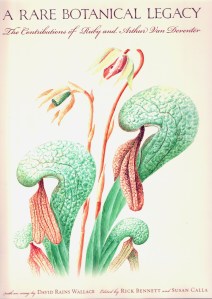
ARareBotanicalLegacy A Rare Botanical Legacy
Essay by David Rains Wallace, Edited by Rick Bennett and Susan Calla (2009)
$35, Hardcover

In 1936, a chance meeting with Willis Linn Jepson led to a 10-year collaboration between the renowned California botanist, an amateur botanist named Ruby Van Deventer who was on a mission to document the flora of Del Norte County. This book features 120 watercolor paintings of plants specific to Del Norte County and represents forty years of work completed Ruby and her artist husband, Arthur. Arthur painted plants while Ruby (and Jepson) busied themselves with describing the plants growing in this region of northern California. Arthur’s paintings are simple compared to the level of detail seen in contemporary botanical art, yet their simplicity does not take away from the fact that they served both Jepson and Ruby well and continue to serve as visual records of Del Norte plants. This book will appeal to anyone interested in botanical art history and to anyone interested in getting a glimpse into the behind-the-scenes work that went into creating California’s Jepson Manual.

FloweringPlantsFlowering Plants
Armen Takhtajan
$269, Hardcover
This title ships for FREE to U.S. addresses

Publisher’s Comments:
Armen Takhtajan is among the greatest authorities in the world on the evolution of plants. This book culminates almost sixty years of the scientist’s research of the origin and classification of the flowering plants. Flowering plants are divided into two classes: class Magnoliopsida (or Dicotyledons) includes 8 subclasses, 126 orders, c. 440 families, almost 10,500 genera, and no less than 195,000 species; and class Liliopsida (or Monocotyledons) includes 4 subclasses, 31 orders, 120 families, more than 3,000 genera, and about 65,000 species. This book contains a detailed description of plant orders and descriptive keys to plant families providing characteristic features of the families and their differences. This book will appeal to botanists and students working or studying at universities and botanical gardens.

These titles and more are available at ArtPlantae Books.

The Grand Opera House once served as host to entertainers such as Buffalo Bill Cody and John Phillip Sousa. Today the 138-year old opera house presents ballets, rock concerts, comedy shows, and musical evenings with the Delaware Symphony. Next month, it will add an exhibition of contemporary botanical art to its long history.

Brenda A. Aiken, botanical illustrator and member of the Philadelphia Society of Botanical Illustrators and the American Society of Botanical Artists, will be featured in an exhibition of her watercolor paintings at the Grand Opera House in Wilmington, Delaware. The exhibition is titled “Late Bloomer” and will be on view in the lobby November 1-30, 2009.

When asked about the title of her exhibit, Brenda replied:

“Late Bloomer” refers to the fact that, although I have been painting and sketching all my life, it is only in the last 2 1/2 years that I have concentrated on botanical illustration and, for that matter, watercolor. I have always feared watercolor and its immediacy. Once I tried it (about 6 years ago), I LOVED it and regretted my lifelong neglect of that medium.

After 4 years of “dabbling” in watercolor, at the suggestion of my husband, I started taking lessons in botanical illustration from an excellent teacher, Joan Frain, and the rest, as they say, “is history”. Botanical illustration proved to be my forte and I am now a botanical illustrator, a “late bloomer” because I am 73 years old and have FINALLY found my niche in life!

You are invited to meet Brenda and view her work at an artist’s reception scheduled for Friday November 6th from 5:30 PM – 7:30 PM.


Related Links