Feeds:
Posts
Comments

A Reader’s Survey has been launched and your feedback is important. We would like you to tell us what YOU want. A link to the very short survey is located below. There is also a link in the right-hand column under the heading “Readers!”.

All responses are anonymous.

Thank you for your time.

Click here to take our Reader Survey

A Leaf A Day

Mindy Lighthipe will be blogging about leaves in October. If leaves cause you grief, you’ll be in a much better place by October 31st if you drop-in on Mindy’s blog this month. In celebration of leaves and all their features, Mindy is drawing one leaf per day. Each leaf will be available for purchase. Act quickly, however. Each leaf will be sold on a first-come, first-served basis.

Get ready for this event by reading all about it at the Studio 16 website.

Updates at CLASSES NEAR YOU > MINNESOTA:


Minnesota School of Botanical Art at the Bakken Museum

www.minnesotaschoolofbotanicalart.com

  • Art for Reproduction – Mondays, Nov. 2, 9, 16, 23, 30, Dec. 7;
    9:30 AM – 12:00 PM. Work on sample projects for reproduction. Students will learn about scanning, printing, the file types with which designers and illustrators must work, how to retouch images and more.
  • Greens & Leaves – Thursdays, Nov. 5, 12, 19 (skip Nov. 26), Dec. 3, 10, 17; 6:00 PM – 8:30 PM. Learn about the many shades of green found in nature. Students will learn leaf morphology and practice drawing leaves with accurate veins. Students will work in watercolor.
  • Memories of Summer (Winter 2010) – Monday, January 11, 18, 25, February 1, 8, 15; 9 AM – 12 PM. Dig out all those plant photos you took at gardens and plant sales this summer. In this class you will learn how to work from reference photos. Students will create a composition and complete a watercolor painting.
  • Black & White Media (Winter 2010) – Thursday, January 14, 21, 28, February 4, 11, 18; 9 AM – 12 PM. Learn the techniques used by illustrators who work in graphite, pen and ink, scratchboard, and carbon dust. Instructor Bruce Wilson will demonstrate how to work with each medium. Students will create a final drawing in the medium of their choice.

New updates at CLASSES NEAR YOU > ILLINOIS:


The Morton Arboretum Botanical Art Certificate Program

http://www.mortonarb.org/
The Morton Arboretum is located in Lisle, Illinois and is dedicated to the conservation of trees. Its 1,700-acre garden contains 4,000 kinds of trees, shrubs, and plants. The current course schedule can be viewed here. Below is a sample of upcoming classes:

  • Water Soluble Colored Pencil – October 21 – November 18, 2009. Wednesday evenings. Learn how to create botanical illustrations and watercolor effects using watersoluble pencils.
  • Autumn Gourds in Pastel – October 24 & October 31, 2009. Learn how to create the colors and textures of gourds using pastels. Experience using soft pastels and charcoal helpful, but not required.
  • The History of Botanical Art & Illustration – January 9-30, 2010. Saturdays. Learn how illustrations were used in herbals and how contemporary botanical art is used today. View artwork from rare book collection.

1254259405_facebookIf you haven’t stopped by the Facebook page, you’re missing out on some good information. You’ll also miss out on engaging conversation too, if you don’t swing by every once in a while or, better yet, become a Fan. There aren’t any chatty teenagers reading our page. Instead, there are very nice adults who would enjoy conversation with fellow botanical artists and nature journaling enthusiasts. To fill you in on what has been going on, here are some recent highlights:

  • Information about a course dedicated to time management for artists.
  • An article and slideshow about two botanical art exhibits in Arizona.
  • An exhibition by the New England Chapter of the Guild of Natural Science Illustrators.
  • Information about 18th-century artist and embroiderer, Mary Delany.

Hope you’ll join us.

This article was published in the December 2006 issue of Artists’ Botany.

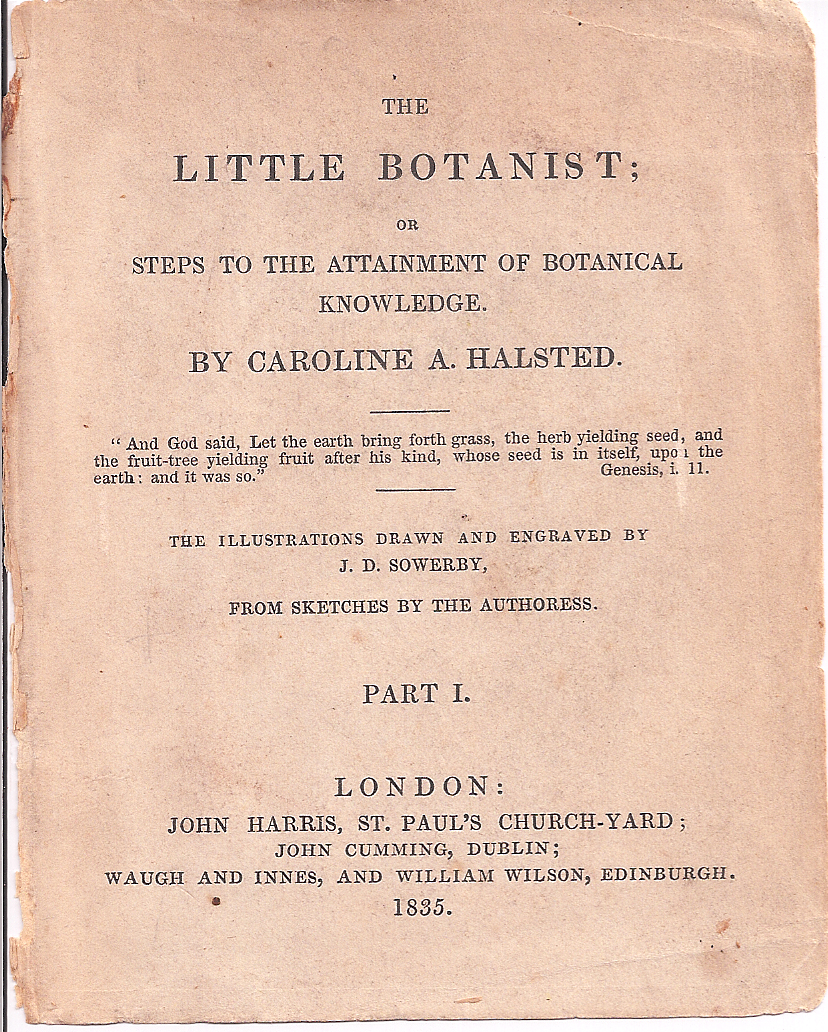
coverTheLittleBotanistOne of the true treasures in our collection is an introductory botany book that was published in 1835. This book is not a college text, but instead an introductory botany book for children. The botany lessons in this book are presented as a conversation between a mother and a young child. These conversations are modeled after actual conversations the author had with a nine-year old family friend.

This book is titled, The Little Botanist or Steps to the Attainment of Botanical Knowledge. The title alone makes us giddy. The fourteen illustrations included in this book were drawn and engraved by J.D. Sowerby and were based on sketches created by the author, Caroline A. Halsted.

The conversations between mother and child are so sweet and so engaging, it is not possible to describe them well enough in this little space. Throughout the book, the young girl’s mother patiently and lovingly discusses the following
topics with her daughter: the definition of botany, flower structure, artificial and natural classification systems, Greek and Latin terms, and the morphological features of several types of plants. During a conversation about flower parts, the young mother teaches her daughter how to remember the arrangement of parts in a flower. She asks her daughter to stretch out her hand and to lift her fingers so as to form a cup. She then explains:

…call the thumb the calyx, the first finger the corolla, the second the stamens, the third the pistil, the fourth the pericarp, and the entire of the hand the receptacle…..for the calyx, like the thumb, stands apart from the next four parts of a flower, which, like the fingers, are more immediately connected with each other; and they all spring from the receptacle, which is the bottom part of a flower, and on which, generally speaking, all the other parts rest.

The conversations recorded in this book are precious. The botany lessons in this 171-year old book are as well because they offer a glimpse into how botanists made meaning so many years ago.


Updated 9/26/09

This book can be viewed online and is available as a PDF at Google Book Search.

bacExhibitNov09

Twenty-four members of the Botanical Artists of Canada (BAC) will present 65 drawings and paintings at the Papermill Gallery in the Todmorden Mills Heritage Museum & Arts Centre in Toronto. The great theme for this exhibition was chosen by the BAC Coordinating Team. The name was voted upon by group members.