Readers submitted great questions for this month’s Ask The Artist with Diane Cardaci. A warm thank you to both readers and Diane. Diane has given generously of her time and expertise of graphite techniques and how to learn from the Old Masters. Be sure to read through the questions below to find out how you can download a special PDF document Diane created about studying the work of the Old Masters.
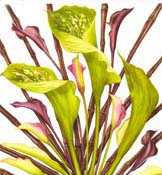
1. Your work is just wonderful. I love drawing and working with pencils (both colored and graphite) as well. I was excited to see the Ornithogalum on the cover of Flowers & Botanicals. I happened upon this same plant earlier this year and did a graphite drawing of nearly the same view myself! I notice that my rendering is not quite as smooth/delicate as yours, but see in Flowers & Botanicals that you used some graphite powder washes to lay down tone initially. This may sound silly, but my question is this – do you use graphite powder from a particular pencil, for example, a 2B or something softer? Or doesn’t it matter once it’s powdered? I would love to try it in my future drawings.
Thank you so much for your kind words, and sharing your beautiful drawing. I think that there is a great point here to make regarding both our drawings. Today, there is so much emphasis on “being different”, that we sometimes forget that the essence of creativity is our individual response to a particular subject/topic and that the subject does not need to be dramatically different from what others choose to draw/paint. We both chose the same subject and practically the same view, yet our drawings are clearly different and are a reflection of our individual styles.
Your question regarding the graphite powder is a great one. You will definitely find that using powder from different pencils will give different effects. I like to use powder from soft pencils, like a 6B. But I always want to encourage people to experiment with different pencils, techniques etc. and find out for themselves what “feels” right. I recommend making small swatches, using different grades of graphite, and also using different papers. It is also great to experiment with different ways of applying or smearing the graphite. Experiment with a brush, facial tissue, stumps, and anything else that you might think of. You can also purchase a jar of graphite powder if you really enjoy the technique.
2. This is a fascinating interview. Would (Diane) be willing to suggest several particular Old Master drawings that would be good to copy – where to begin?
I just love that you are thinking about Old Master drawings—fantastic! I think the most important thing to do when choosing a drawing is to find one that you really like. There are two reasons for this: 1) you will enjoy copying it more and will therefore learn more from it, and 2) you may find yourself wanting to incorporate what you learn into your own artwork.
If you haven’t spent time looking at Old Master drawings, I think the best place to start is on the Internet. You can Google artists such as Rubens, Michelangelo, Leonardo da Vinci, Degas, Seurat etc. and just spend some time looking at the images. When you find one that you are particularly drawn to, see if you can find a high-resolution image of it, or better yet, one that is in print. For example, if you find yourself really loving the Degas drawings, maybe you can go to the library and take out a book on him that has great reproductions.
If you want more detailed suggestions, I have put together a PDF (inspired by this question!). You can go to my blog www.dianecardaciblog.com and sign up, and you will receive a link for the download.
3. What are common mistakes made by people who are learning how to draw plants?
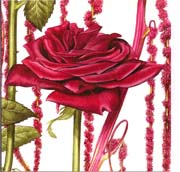
I think that whether you are learning to draw plants, animals or any other subject, the most difficult part is to learn to look at the whole instead of all the many wonderful details. For example, if you are drawing a face, you first want to look at the shape of the face, and ask yourself—is it round, long, etc., rather than looking at the individual features. The same goes for drawing a plant. If you are drawing a rose, you first want to look at the BIG SHAPE of the rose, and not the many details of the petals.
Another common difficulty is in establishing the correct angles. For example, when you are drawing the stem, you need to be careful that the angle is correct—that is, it is not leaning too much one way or another. Also, when you draw the stem, you want to be sure the stem is directed to the center of the flower.
4. To what extent should I develop a graphite drawing when my true goal is to create a watercolor painting?
For most artists, throughout the centuries, drawing has been considered a means of study, rather than a medium to be used for the final completed artwork. It is a relatively more recent development that artists have decided to use graphite pencil to create fully developed pieces of artwork. Since you prefer to work with watercolor, it would probably be good for you to follow the tradition of using your pencil for the purposes of studying your subject with pencil sketches. The advantage of the pencil is that it eliminates the color issue, so you can really study your subject, thinking only about the drawing (line, angles, proportions) and value. Watercolor is not very “forgiving”, so when you begin to paint, you want to understand your subject as much as possible, and your pencil sketches will give you that knowledge.
In terms of the actual execution of your watercolor painting, you may or may not want to include graphite. Some watercolor artists like to combine a more developed pencil drawing with their watercolors, but I would say that the majority of artists use the pencil just to get an accurate outline drawing down.
5. Is there a pill for patience?
I LOVE this question!! We live in such a high-speed world, and the pencil is such a SLOW medium! But then again, maybe the pencil is the perfect antidote to our 21st century craziness! It forces us to just slow down, you just cannot rush a pencil drawing or disaster will strike.
I think that one thing that can help us develop patience is to once again turn to the Old Masters. They created such beautiful magnificent art—but it was produced in a time when there was no such thing as broadband, cell phones and microwaves. Life went at a much slower pace. Try to imagine an employer today (and a very demanding one at that!) asking his employee to stay on his back for 4 years to paint a ceiling. And yet, Michelangelo did just that and painted the Sistine Chapel, probably the most admired artwork in Western Art. When you look at all the amazing masterpieces that have been painted in the last 500 years, you will be reminded that no great art can be produced without patience.
One thing I think that helps also to develop patience is to get yourself nice and relaxed BEFORE you start to draw. Meditate, go for a walk or run, listen to some soothing music—do whatever it is that helps you unwind from the 21st century speed. And keep your drawing space as quiet and peaceful as possible—for many years most of my artwork was done late at night because of the “peaceful” factor.
6. How do I blend in graphite from light to dark?
In one word—slowly! The key to delicate transitions is to use very light pressure at first and build up with many layers. One exercise you can do is to practice making “swatches”—first put down a strip of a very light even layer of tone by using parallel pencil strokes. Then add another layer of strokes, starting to the right of where you started at first. Keep building up layers, always starting the new layer a little to the right of where you started the last layer.
I like to use an HB for the first layers, and then as I go to the darker layers I switch to a 2B and then if I need to go very dark I will use a 4B or 6B pencil in the last layers.
It takes a lot of practice to develop smooth transitions, so it’s important to not let yourself get frustrated. After a while, you develop a “feel” for how much pressure you need to apply, and how to make the transition more gradual. The good news with the pencil is that it is very forgiving—if you get too dark, you can always use a kneaded eraser to pick up some of the graphite.
7. Which pencils are good for creating a smooth finished look?
I find that the most important factor for creating a smooth finish is the paper choice rather than the pencil choice. For my drawings, I usually only use 4 pencils—an HB, 2B, 4B and 6B. These pencils will create totally different effects on different paper surfaces. If you are striving for a smooth finish, it is best to use a smooth, plate finish paper—I like to use plate finish Bristol paper (acid free and preferably 100% Rag). These papers have very little texture, so that the pencil strokes go down smoothly. It is much harder to create a smooth look with a cold pressed (also called vellum) or rough finish paper. These papers have texture, so when you stroke the paper with your pencil, it picks up the graphite unevenly.
8. Do you use workable fixative on those pictures where you use powdered graphite or carbon pencils? Or would that ruin the contrast between regular graphite and carbon pencils and make them both with a less shiny finish? Also, if you put the carbon down, then workable fixative, would it be possible to use graphite pencils on top? Thank you.
I only use workable fixative when I am absolutely sure that I am finished with the drawing, and only if I know the drawing is going to be shipped or moved around a lot. I prefer not to spray fixative on my pencil drawings when possible, because it definitely changes the texture slightly. But if the drawing is at risk of being smeared through shipping, then I feel it is better to spray it.
I don’t use carbon pencil in the majority of my drawings—I show the technique in my books, because I know there are artists who would like to use the technique, and it is very effective for getting very deep darks. In the drawings that I have used carbon pencil, I have used the same procedure as for my 100% graphite drawings, which is that I spray only at the end of the drawing, and only if the drawing is going to be shipped or subject to a lot of movement.
I never draw on top of workable fixative-it totally changes the surface texture. But as always, I recommend that you experiment so you can see for yourself the effects.
9. What advice do you have about drawing leaf margins? Should I get the overall shape of a leaf drawn first and add the margins later? Or should I try to get them in early?
Leaf margins are a detail of the leaf. The rule in drawing is to always start with the BIG SHAPES, as I mentioned in Question 3, before you work on details. So you want to get the overall shape of the leaf, and once you are sure the shape is correct, you can than go in and draw the details, such as leaf margins. The key is to draw very lightly in the early stages of a drawing. If you draw light lines, your later shading will cover over the initial lines, and you won’t need to do a lot of erasing. Some artists find it difficult to draw lightly—in that case, the artist can use a very light/hard pencil, such as a 2H.
10. I have read a great deal about using graphite and many drawing techniques. However, I would like to know about carbon dust or carbon powder and how it is used. Susannah Blaxill uses carbon dust but she does not have a book out and her classes are in Australia. Her work in carbon dust is gorgeous. Do you know any artists who use carbon dust or powder and what their techniques are?
I was first exposed to carbon dust techniques in my days as a scientific illustrator. I believe this technique was really perfected by the early medical/scientific illustrators. By doing a search on Google, I found a nice description of the basic techniques that they used. In addition to using brushes, which is described in the above link, you can also experiment with using stumps, tortillions, chamois cloth, facial tissue etc.
I have found that I prefer to use my pencil with delicate stroking for most of my drawings, rather than using graphite or carbon dust. But I will sometimes incorporate the use of graphite powder techniques in my drawings, which I show in my books. I tend to use the powder mainly when I want to get a quick base tone (sort of like a wash) on a drawing. However, when I do subjects such as portraits, I do not do this.
This is why I always encourage experimentation. Although I absolutely love the look of the carbon dust drawings, I found through experimentation that I actually prefer to work in a different way. Over the years, I have always made it a habit to try new papers, new pencils, as well as new techniques. The great thing about the pencil medium is that all this experimentation does not cost a lot of money!
You May Also Like:
- An interview with Diane Cardaci
- Techniques to achieve realism with graphite
- The Guild Handbook of Scientific Illustration features a chapter on carbon dust. You can preview this chapter online on the publisher’s website (click the Google Preview button).
- Books by Diane Cardaci