Feeds:
Posts
Comments

Stephen Joseph, Herbarium Print. California Polypod, Polypodium californicum. Polypodiaceae. Hab. Sierra Nevada, California. Collected by John Muir. 1875

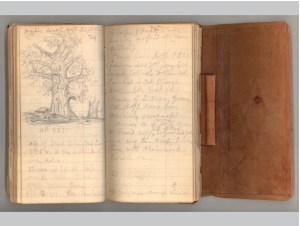
The Oakland Museum of California (OMCA) presents A Walk in the Wild: Continuing John Muir’s Journey, on view August 6, 2011, through January 22, 2012, in the Museum’s Great Hall. In this provocative new exhibition, OMCA celebrates the legendary naturalist’s life, work, and legacy in California and beyond. Told through OMCA’s collections of art, history, and natural science, as well as interactive digital technology and extensive loans―Muir’s journals, manuscripts, original drawings and plant collections―the exhibition pays tribute to the “Father of the National Parks,” whose legacy continues to inspire environmental stewardship in California today.

Through interactive, multisensory displays, A Walk in the Wild invites visitors to explore the vast natural environment of California and experience the sights, sounds, and smells that Muir encountered during his explorations. Through video and interactive technology, visitors will be able to meet “Modern Day Muirs” and learn about their work and motivations. The featured Modern Day Muirs include: Shelton Johnson, Yosemite National Park ranger; John Wehausen, wildlife biologist; Dune Lankard, Alaskan environmental activist/fisherman; Rick Deutsch, Half Dome hiker/author; Jean Krejca, cave explorer; Greg Stock, Yosemite National Park geologist; Steve Sillett, redwood canopy researcher; Tori Seher, Yosemite National Park bear biologist and Alcatraz bird biologist; and Kemba Shakur, tree planter for Oakland Relief.

“This exhibition is filled with wonder and discovery,” says guest curator Dorris Welch. “We all have many things to learn from John Muir’s legacy. To be able to honor and bring John Muir’s legacy into a modern-day light is an extremely important thing,” Welch says of the OMCA-exclusive show.

A Walk in the Wild: Continuing John Muir’s Journey is made possible by generous support from the Oakland Museum Women’s Board, The Bernard Osher Foundation, the J.M. Long Foundation and the University of the Pacific Library, John Muir Papers, Holt Atherton Collections/Muir-Hanna Trust.

The museum is located one block from the Lake Merritt BART station on the corner of 10th Street and Oak Street. The accessibility ramp is located at the new 1000 Oak Street main entrance. Daily hours and admission information are available online at the OMCA website.

Journal. Yosemite Journal, 1872. John Muir Papers, Holt-Anderson Special Collections, University of the Pacific Library. ©1984, Muir-Hanna Trust.

Artist and instructor, Katie Lee, will lead a trip to Costa Rica with master bird bander/naturalist, Judy Richardson in January 2012. Click on the image below to download the color brochure. Group size is limited to 8 people.


You May Also Like:

Fundamental Graphite Techniques

    by Katie Lee

Eye-catching detail, clean edges, delicate petals and fruit good enough to eat. These elements describe the artwork of Anna Knights. The natural gesture of her leaves, the colors of her fruit and the transparency of her water drops will captivate you. This month we have the opportunity to learn from this award-winning artist and teacher.

Please welcome Anna Knights!


ArtPlantae
: You are a self-taught artist. On your website, you write that one day you discovered your innate talent for botanical art. How did this happen?

Anna Knights: I always knew that I could draw and paint as I had loved to do so as a child – and took art up until the end of high school. But then I decided to do the sensible thing and went and did history at university. I had a brief stint painting murals in the US whilst I was doing a university exchange over there but then 5 years passed before I picked up a paintbrush again.

Then in February 2006, when I was coming up to my 26th birthday, I was working as a management trainee with local government, and I realised I really missed painting. So I started looking online for inspiration to get me back into doing some for fun. It was then that I saw botanical art for the first time. It was like a light bulb went off and I thought “I’m sure I can do that!”. I bought myself a set of artists watercolours and that was the beginning! And I was lucky enough to be able to do it straight away. In June 2006 I submitted work to the RHS picture committee and was awarded the Dawn Jolliffe Botanical Art Bursery to help with the costs of exhibiting at one of their botanical art competitions. I exhibited there a year later and won the Gold Medal.


AP
: When did you begin drawing/painting and what type of subjects did you paint before you were drawn to plants?

AK: I have always painted and drawn. When I was a child I loved illustrating holiday diaries – showing what me and my family had been up to each day. So I liked to draw everything really. I do remember doing a series of enormous dissected fruits at age 14, so that interest has been with me a long time.


AP
: Your paintings are extremely realistic. How much of your work is completed in a wet-n-washy type of painting and how much is done in dry brush?

AK: For the most part I work with very watery washes. However, I never load my brush very much, so the effect is that I use the paint quite dry. Between layers I always let them dry – so in the main it is “dry brush” except that I use the paint very thin a lot of the time. Especially where subtlety is needed – which is a lot in botanical subject matter!


AP
: Are you a full-time botanical artist or do you split your time between botanical art and another profession? Approximately how many hours do you spend on your artwork?

AK: I have been a full-time botanical artist since I first exhibited at Chelsea Flower Show in 2008.


AP
: At the recent conference of the Guild of Natural Science Illustrators, there was a panel discussion about the future of botanical art. One of the topics discussed was, Will there always be traditional botanical art or does botanical art have a digital future? What do you think?

AK: I feel I need to make a distinction between botanical art and illustration here. I don’t do botanical illustrations. I do vibrant, big, bold but accurate watercolours of botanical subjects. I stick broadly within the botanical conventions in that I have a plain paper background – making them more like “studies”. I do them purely for their aesthetics and I try to depict a subject in its best possible light. I therefore consider what I do art – in that it’s about the aesthetics.

Botanical illustration is a bit different and whilst I think it’s great, I do think that with digital cameras getting ever more impressive, there is going to be a case for being able to accurately record every aspect of a botanical subject using a camera and some clever Photoshop work. It will probably end up taking longer than an illustrator would take to paint, but I’m sure it can be done.

People have a great appreciation for the beauty of nature being depicted as accurately as possible which is why I think there will always be an interest in botanical painting.


AP
: As you know, student learning is a special interest here on this site. Particularly, how people learn about plants. How do you think people learn about plants best?

AK: I think they learn about them by growing them and living with them! The reason botanical art appealed to me so much is that I had caught the gardening bug and realised how perfectly possible it was to sit and stare at a Clematis sp. you’d grown from cutting for absolutely ages without a hint of boredom! What a joy.


AP
: Drawing upon your experiences as a teacher, what is the best way students new to botanical art learn can about composition?

AK: I encourage people to play around with their digital cameras and use a white screen to set up shots in terms of composition alone. Playing that way gives you instant feedback on what looks good.


AP
: On your website, you state you are thinking about developing a correspondence course and that you would like feedback from artists interested in this type of a course. Is there anything you would like to ask potential students that may help you create the curriculum for this course?

I have in mind a course delivered via video clips of me painting whilst describing what I’m doing – demonstrations. There are a few IT issues for me to address for this to be feasible. Ideally I’d like it delivered online but it will be a significant piece of work for me to organise this so it’s likely to take me a while. I suppose I am thinking of a course that students can take at their own pace – paying per lesson, or block of lessons. Then there would be an opportunity for feedback via email – so students can scan and email me work (or perhaps post on a private website) for me to advise them about. I would be interested to know whether your readers might be interested in this. If I feel there will be enough people signing up to make it worthwhile, then I might be able to justify employing an IT whizz to make it happen.

AP: Readers, what do you think?


Ask the Artist with Anna Knights!

You are invited to participate in a Q&A session with Anna Knights. Please submit your question(s) to education@artplantae.com by Friday August 12, 2011. Anna’s replies to your questions will be posted on Monday August 22, 2011.


Visit Anna on Facebook

If you “Like” Anna’s Facebook page you can receive offers and watch her paintings develop as she photographs them in various stages of completion.

The classes of Anna Knights have been added to Classes Near You > England.


Anna Knights

www.annaknights.co.uk
A self-taught artist, Anna’s botanical art is full of life and features captivating deter and lifelike movement.

  • One-Day Workshops in Cranleigh, Surrey – Thursdays; 10 AM – 4 PM. Learn Anna’s composition, color mixing and layering techniques. Coffee, buffet lunch and afternoon tea included. Limit: 10. Cost: £70 per day, or £65 per day if enrolled in two or more workshops. Register Online
    • October 13 OR October 20 (both workshops feature the same exercise)
    • November 3 OR November 10 (both workshops feature the same exercise)
  • Contemporary Botanical Watercolor: Painting Fruit – October 14, 2011 or October 17, 2011; 10 AM – 4 PM. Fruit will be the focus of these workshops taught at Nymans, National Trust property. Cost: £50 per session. Registration Info
  • Capturing Color, Light and Shade in Late-summer Flowers – September 9-11, 2011. West Dean College Nr Chichester. Using flowers from the West Dean cutting garden, learn to create realistic flower portraits. Learn about light and shadow, color mixing, layering, and how to take reference photographs. Register Online / Download Itinerary
  • Nature in Art – September 16-17, 2011; 9:30 AM – 4:30 PM. Create realistic and vibrant botanical watercolor paintings. Learn how to create form, mix colors in watercolor and how to layer colors to bring your subjects to life. Registration Info
  • Fruit Good Enough to Eat – October 7-9, 2011. Learn how to create shine and bloom on seasonal fruit at the 17th-century home of botanist, John Evelyn. Includes lunch, accommodations and evening meals. Cost: £449 fully residential, £219 non-residential. Additional information at
    Field Breaks.
  • Holly Leaves, Berries and Mistletoe – November 25-27, 2011. West Dean College Nr Chichester. Learn how to mix the colors you need and how to apply tints and layers to create Christmas cards featuring holly and mistletoe. Register Online / Download Itinerary

It starts in childhood and has the potential of being reinforced throughout life.
“It” is an anthropomorphic (human) view of the world.

How students assign value to and classify living things is the focus of Are Animals “More Alive” than Plants? Animistic-Anthropocentric Construction of Life Concept by Nurettin Yorek, Mehmet Sahin and Halil Aydin of Dokuz Eylul University in Turkey.

Yorek et al. (2009) surveyed 193 ninth-grade students to determine the following:

  1. Which living things and concepts do students choose to associate with first in constructing the life concept?
  2. Which criteria (do) students use other than biological classification and which characteristics (do) they take into account when classifying living things?
  3. How do students describe/define the level of importance of living things?

A survey composed of five questions was developed by the researchers and distributed to individuals in the study group. Researchers also conducted interviews with high-school biology teachers and students to obtain additional clarifying information.

When asked to “write down the names of ten living things that come to your mind first” (Yorek et al., 2009), students listed “human” first in most cases. The most common living things to follow “human” were dog, cat and bird in this order (Yorek et al., 2009). Of the students who did include a plant on their list, the plant did not rank higher than 6th place (Yorek et al., 2009). Plants followed animals and based on the results of their research, Yorek et al. (2009) claim that students’ “cognitive construction of the life concept occurs mostly by associating it with animals.”

When researchers asked students to classify all living things into groups, they found themselves with an “only animals” group and a “humans, animals and plants” group (Yorek et al., 2009). In spite of what they learned in school about classification systems, students classified living things according to their own terms, using habitat type and mode of locomotion (Yorek et al., 2009) as factors. Students separated humans from the rest of nature and said humans were the “most advanced” of living things (Yorek et al., 2009). Here are two examples of how students responded to the question, “What do you think about the place of human among all the other living things?”

Human is at the top position…As if we are not revolving with the earth but the earth is revolving for us…Like all natural phenomenon are occurring for us. Since human can think and has skills, he is at the top. – Student II

Human is the most important living being who leads and develops the natural cycle…The most important distinction of human from animals and plants is his ability to think. Besides, everything in nature is created for humans. – Student VII

Even though humans were ranked at the top as being distinct from nature, most students said all living things were important and no living thing could be labeled as being “unimportant”, citing ecological relationships between living things as the reason for their opinion (Yorek et al., 2009). However when Yorek et al. (2009) studied closely what students said about “unimportant” living things, they found references to organisms not normally thought of too highly by the public, specifically insects, snakes and rats. It turns out students assigned the value of “importance” in terms of an organism’s perceived benefit (or harm) to humans (Yorek et al., 2009).

Upon review of the data, three things became clear to Yorek et al. (2009):

  • Students view humans and animals as being more important than other living things.
  • Regardless of what they learn about biological classification in school, students classify the natural world according to a system based on their own observations of nature.
  • Students view humans as being separate from nature.

In light of their research results, Yorek et al. (2009) suggest an emphasis be placed on the “harmony” between all living things and humans in classroom curricula. They also recommend that environmental education programs take a “holistic ecocentric” (nature-centered) approach instead of an anthropomorphic approach. Yorek et al. (2009) visualize their observations in a diagram called the Animistic-Anthropocentric Construction Model of the Life Concept showing the relationship of animals, humans, plants, and other living things against the backdrop of a Life Concept. This diagram and a detailed description of the survey tool used to gather information about students’ conceptual understanding of living things can be viewed in Yorek et al. (2009). This paper is available online for free.


Literature Cited

Yorek, Nurettin, Mehmet Sahin and Halil Aydin. 2009. Are animals “more alive” than plants? Animistic-anthropocentric construction of life concept. Eurasia Journal of Mathematics, Science & Technology Education. 5(4): 369-378. Web. <www.ejmste.com/v5n4/EURASIA_v5n4_Yorek.pdf> [accessed 27 July 2011]

Learn the glazing techniques of the Dutch flower painters to create an elegant botanical painting!


Corcoran College of Art & Design

www.corcoran.edu
The only college of art and design in Washington, DC also offers a certificate program in botanical art and illustration. Included on the Fall 2011 schedule are:

  • Introduction to Botanical Drawing – Wednesdays,
    September 7 – December 12, 2011; 9:30 AM – 12:45 PM. Working in graphite and colored pencil, students will explore the history, issues and concepts of detailed plant drawings. They will also explore form and the use of contemporary drawing sensibilities in the tradition of botanical illustration. Audit: $720. Credit: $1440. Also, $60 lab fee.
  • Intermediate Botanical Drawing – Wednesdays,
    September 7 – December 14, 2011; 9:30 AM – 12:45 PM. A continuation of Introduction to Botanical Drawing. Audit: $720. Credit: $1440. Also, $60 lab fee.
  • Plant Portraits in Oil – Thursdays, September 8 – December 15, 2011; 6:30 – 9:45 PM. Learn how to turn botanical drawings into elegant oil paintings in the tradition of the Dutch flower painters. Pre-requisites: Introduction to Botanical Drawing or Introduction to Botanical Painting. Audit: $720. Credit: $1440. Also, $60 lab fee.

This information has also been posted to Classes Near You > New York.

New at Classes Near You > New York:


Cornell Plantations

www.cornellplantations.org
Located on the campus of Cornell University, Cornell Plantations manages 4,300 acres of natural area that includes bogs, fens, gorges, glens, meadows, woodlands and other ecosystems.

    The Joy of Botanical Illustration – Thursdays, September 8, 15, 22 29, October 6, 13; 2:00 to 5:00 PM. If you love botanical art but wonder if YOU could really do it yourself, this class is for you. An introduction to painting the flora of the Plantations’ botanical garden, students will learn how to observe plants, how to draw plants, and learn the principles of perspective, composition and color mixing. Botanical artist Camille Doucet will lead students in an exploration of black and white, pen and ink, and watercolor. A suggested materials list is available by request. Pre-registration required. Cost: $215 ($180 members and Cornell students). Location: Nevin Welcome Center. Register Online