Feeds:
Posts
Comments

The schedule of classes at The Wagon House B&B in Cornwall, England has been updated at Classes Near You > England.


The Wagon House

Lost Gardens of Heligan, Cornwall
www.thewagonhouse.com
A bed-and-breakfast in the English countryside where you can eat breakfast at a time that is convenient for you, visit the gardens in Cornwall, and take botanical art classes too! Classes are taught by botanical artist and teacher, Mally Francis. The 2012 schedule includes four- and five-day classes.

  • March 22-25, 2012 (4 days)
  • April 20-23, 2012 (4 days)
  • May 18-21, 2012 (4 days)
  • July 10-14, 2012 (4 days)
  • September 6-9, 2012 (5 days)
  • September 26-30, 2012 (4 days)
  • October 26-29, 2012 (4 days)

View Details/Register

Holiday Wishes

Dear Readers,

Before we take time off to spend the weekend with family and friends, I would like to take a moment to thank you for your continued interest and support of ArtPlantae, its educational objectives and the learning opportunities it provides each month. I appreciate the feedback you have provided through surveys and through personal email. Your contributions help to make ArtPlantae a better resource for everyone.

I would also like to thank the feature artists, authors and educators who shared their work with us and who taught us so much this past year: Jane LaFazio, Mally Francis, Kandis Elliot, Margaret Best, Elaine Searle, Mindy Lighthipe, Niki Simpson, Anna Knights, Helen Allen, the Birmingham Society of Botanical Artists, Hazel-West Sherring and this month’s featured guest, John Muir Laws, who is discussing the use of nature journals in the classroom. Guests work with me well in advance of their feature month and I am extremely grateful for their time, enthusiasm and generosity.

There were big changes this year with a new store and the exciting addition of exhibition catalogs by the American Society of Botanical Artists (ASBA), the ASBA’s new coloring book Colorful Edibles, Google eBooks and mobile apps for Android and iOS. Store proceeds keep this website and ArtPlantae’s outreach activities going and I thank you for visiting and using the new store. I hope you find it to be a useful and informative resource.

Wishing you all good health, good company and forward movement beyond your wildest dreams in 2012,

Tania

Book lovers have two new ways to read ebooks!

Readers can now use the IndieBound Reader for Android and the IndieBound Reader for iOS to shop for Google eBooks at ArtPlantae Books.

Readers no longer have to choose between reading digital and supporting independent bookstores like ArtPlantae Books. Google eBooks enables ArtPlantae Books to remain the store of choice for its audience of teachers, artists, and naturalists who are reading digital and utilizing technology in their classrooms and educational programs.

ArtPlantae’s large inventory of Google eBooks (and print books too!), also make ArtPlantae Books a practical choice for books about gardening, hiking, cycling, and other leisure time activities. Because Google eBooks work with many devices — tablets, smartphones, computers, even most e-ink devices — consumers are not bound to one retailer. This opens up a wealth of options to avid e-book readers.

Explore Google eBooks at ArtPlantae Books

See what’s new at Classes Near You > Australia!


Living & Learning Nillumbik

A community-based organization providing classes in the arts, technology, environmental studies, health & wellbeing, plus much more.
www.nillumbik.vic.gov.au

    Botanical illustration with Arnolda Beynon – Learn about the history of botanical illustration and explore techniques illustrators use to create botanical drawing in pencil and watercolor. Students will create a botanical diary. A materials list will be provided. Two sessions will be offered. Download the February-June 2012 schedule of classes plus the course information sheet here. View Arnolda Beynon’s online gallery.

    Session #1:
    Fridays, Feb. 10 – March 30, 2012; 10 AM – 12 PM (8 sessions)

    Session #2:
    Fridays, April 20 – June 8, 2012; 10 AM – 12 PM (8 sessions)

    Cost: $146 / $133 concession per

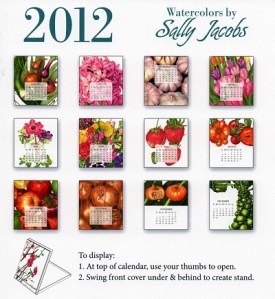
Brighten 2012 with Watercolors by Sally Jacobs. Treat yourself and a friend with this colorful calendar featuring the botanical watercolor paintings of botanical artist, Sally Jacobs.

Calendar orders placed today and tomorrow will ship for free via
USPS Priority Mail.

Shipping offer applies to US addresses only.

This special shipping offer expires Tuesday, December 20, 2011, at
12 PM Noon (Pacific) or while supplies last.


Spoil yourself and a friend today!

In the 18th century, botany books were mostly written for a female audience. Women were encouraged to study botany as it was considered to be an acceptable activity for women. In Linnaeus in Letters and the Cultivation of the Female Mind: ‘Botany in an English Dress’, professor and 18th-century scholar, Sam George, discusses the feminization of botany in the 18th and 19th centuries.

During this time, authors wrote popular botany books for women. Botanists even got into the game and, as George (2005) describes it, “wooed female readers” by making analogies between flowers and the finer virtues of women. Flowers became symbols of innocence and all was beautiful and happy. That is, until Carl Linnaeus came along with his classification system and his discussion about the sexual parts of flowers.

Language likening botanical terms to human sexuality became an issue. George (2005) refers to two books published not too long after Linnaeus’ System Naturae (1735), that were some of the first to describe the sexual system to British readers. In Introduction to Botany (1760), author James Lee refers to male stamen as “husbands”, female pistils as “wives”, sexual union as “marriage”, flowers without stamen or pistils as “eunuchs” and the removal of anthers as “castration” (George, 2005). In Elements of Botany (1775) by Hugh Rose, the flower calyx is referred to as “the marriage bed”, the corolla as “the curtains” (George, 2005) and the metaphors go on and on.

Suddenly, it became controversial for a woman to study botany. Linnaeus was labeled by moralist Charles Alston as being “too smutty for British ears” and there were warnings that botanizing females were “indulging in acts of wanton titillation” (George, 2005). You can imagine the reaction of one Reverend Richard Polwhele when he saw boys and girls botanizing together (George, 2005)!

Fortunately, not everyone was appalled by the thought of women studying Linnaeus’ classification system. But this issue didn’t work itself out overnight. There was a lot of discussion about how women should learn about plants. George provides an interesting overview of the controversy as she explores how two proponents of botany education for women, Priscilla Wakefield and Jean-Jacques Rousseau, promoted botany as a worthwhile activity for ladies.

Both Wakefield and Rousseau emphasized the importance of Linnaeus’ classification system and how it can help the female mind make sense of the plant world. They thought the study of botany was a good way for women to learn how to be socialized in an ordered hierarchical system (George, 2005). Wakefield and Rousseau also agreed that learning about plants outdoors was better than learning about plants in isolation and only from books (George, 2005).

Although they may have agreed upon these points, the philosophies behind their respective positions varied.

Even though Wakefield was dedicated to the education of women, she stopped short of encouraging women to become all that they could become. She thought women should be educated according to their place in society and thought that women should not enter “masculine spheres” (George, 2005). She promoted botany as “an antidote to levity and idleness” (Wakefield (1818), as cited in George, 2005).

Rousseau’s view about women studying systematics was a little different. He saw the study of Linneaus’ classification system as “true” botany (George, 2005). Even so, he was more concerned that women use botany as way to observe and describe plants instead of using Linnaeus’ method to study botany seriously. He thought it was best for women to study plants outside because the study of “true” botany had to occur where plants existed in a natural undisturbed state. Uneducated women were thought to be closer to an undisturbed “state of nature” and so had “a special affinity” for plant exploration (George, 2005).

Although Wakefield’s and Rousseau’s thinking is backward and offensive today, they are credited with giving women access to botanical knowledge. George (2005) says that because of Wakefield and Rousseau, botany had become so feminized by the 19th century that it was considered to be “unmanly”.

To learn much more about this period of botany’s history, buy a copy of George (2005) from the British Journal for Eighteenth-Century Studies or read George’s paper online (accessed 16 December 2011).


Literature Cited

George, Sam. 2005. Linnaeus in letters and the cultivation of the female mind: “Botany in an English Dress”. British Journal for Eighteenth-Century Studies. 28(1): 1-18.


Related
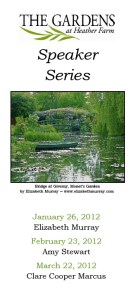
Three dynamic speakers will educate, entertain and motivate you with their garden-inspired lectures at
The Gardens at Heather Farm
.

Mark your calendars to see Elizabeth Murray on January 26, Amy Stewart February 23 and Clare Cooper Marcus March 22. Doors open at 7:00 PM with presentations beginning promptly at 7:30 PM. Reception and book signing will follow at 8:30 PM. Advance ticket purchase is $35 ($30 for members of Gardens at Heather Farm. Members can purchase the entire series for $75.

To register for any of these lectures, please contact The Gardens at Heather Farm at (925) 947-1678, reservations@gardenshf.org or visit their website at www.gardenshf.org.

Save these dates!

  • Thursday, January 26, 2012: Elizabeth Murray, author, photographer, painter and key note speaker is a voice that inspires and ignites a commitment to beauty, nature, spirit and sustainability. She has dedicated herself to diverse projects around the world including those in African villages and the Amazon rainforest. However, Elizabeth’s passion for nature is best known in her work helping to restore Monet’s Gardens and photographing them for 25 years.
  • Thursday, February 23, 2012: Amy Stewart, award-winning author of five books on the perils and pleasures of the natural world will provide a spirited insight into the strange world of bugs and plants. Drawing from her work on Wicked Bugs, Wicked Plants, and Flower Confidential, Amy’s humorous lecture will both entertain and inspire the audience.
  • Thursday, March 22, 2012: Clare Cooper Marcus, professor emeritus in the Departments of Architecture and Landscape Architecture at the University of California, Berkeley, is internationally recognized for her research on the psychological and sociological aspects of architecture and landscape design – particularly in urban open space. Clare will present Healing Gardens: How the Design of Green Space in Healthcare is Restorative to the Human Spirit.

Download color brochure