Feeds:
Posts
Comments

The Quinta Mazatlan Nature Center in McAllen, Texas is a historic adobe mansion featuring birding trails, an art gallery, a nature store and educational programs. The nature center has been added to Classes Near You > Texas. Take a look!


Quinta Mazatlan Nature Center

www.quintamazatlan.com
Built in 1935 as a private residence, Quinta Mazatlan is now an urban sanctuary dedicated to “sharing knowledge about birds, plants, and environmental stewardship in South Texas.” The nature center has partnered with the World Birding Center, Inc. and recently opened their first LEED-certified building, a Discovery Center for children. Quinta Mazatlan offers classes for adults and children and hosts art exhibitions too. The botanical art of Sue Sill is currently on view in the Art in Nature Gallery.

    Botanical Illustration – Saturday, May 26, 2012; 10 AM – 4 PM. New students are welcome to attend the third installment of a workshop series about botanical illustration taught by Sue Sill. In this class, students will learn how to add watercolor to a drawing or sketch. Cost: $55 per person. Materials included. Bring lunch. View Details/Register.

    Nature Journaling – Saturday, August 4, 2012; 1-4 PM. Explore techniques you can use to record your observations. Learn techniques from sketching to writing to scrap booking. Cost: $5 per person. Bring water, hat, sunscreen and bug spray. View Details/Register

Mixed media artist, Jane La Fazio, has announced an updated schedule that includes workshops well into 2013. The classes listed below are only a glimpse of what Jane has to offer. Be sure you visit her website to see her complete schedule.

Here is what’s new at Classes Near You in Southern California, New Mexico, Maryland, Texas and Greece.


Jane LaFazio, Plain Jane Studio

www.plainjanestudio.com
Jane is a mixed media artist and a member of the San Diego Sketchcrawl group. Jane teaches at conferences across the U.S. and leads classes in Italy and Greece too. In addition to the sketching classes, Jane teaches workshops in collage, mixed media, and quilting. A detailed class schedule can be viewed on her blog. Also see an interview with Jane and her Ask The Artist Q&A with readers.

  • Sketching & Watercolor: Journal Style – Begins June 7, 2012. This six-week class is taught online via Joggles.com. View Details/Register
  • Sketching & Watercolor in a Mixed Media Journal – July 9-10, 2012; 9 AM – 4 PM. Learn Jane’s quick and intuitive method to drawing and watercolor. Create designs based on your sketches and learn how to create backgrounds to enhance your journal entries. View Details/Register
  • Tesoro del Corazon – April 21-28, 2013. Mixed media art retreat in Sante Fe, New Mexico. Interested? Let them know
  • Red Thread Retreats – May 16-20, 2013. Mixed media retreat in Maryland. Learn more about Red Thread Retreats. Contact info@ArtistSuccess.com to be placed on interest list.
  • Lavender Sage Art Retreat with Pamela Underwood – June 10-14, 2013. Mixed media retreat in Taos, New Mexico. View Details/Register
  • Art Journaling Workshop – July 8-14, 2013. Lakonia, Greece. Learn how to incorporate watercolor sketches and memorable prose in a journal format. Writers’ Workshops International. View Details/Register
  • Lavender Sage Art Retreat with Pamela Underwood – October 3-7, 2013. Mixed media retreat in Austin, Texas. Click here for more information. Join Interest List

Know your veggies.
Eat your veggies.
Draw your veggies.

Making vegetables and plants irresistibly interesting to the next generation is the goal of Botany on Your Plate: Investigating the Plants We Eat, a ready-to-use curriculum written by Katharine D. Barrett, Jennifer M. White and Christine Manoux.

The eight interdisciplinary lessons in this book written for K-4 students are based on the Grocery Store Botany program taught at the UC Botanical Garden Berkeley. Each lesson includes a materials list and instruction on how to lead students to an understanding of plants through inquiry. Drawing is an essential part of each lesson and clearly enhances student observation skills and student understanding of plants and how they grow. Here is a summary of each lesson:

  • Lesson 1: Let’s Become Botanists! – During this lesson, teachers will determine students’ prior knowledge about plants and learn about the plants their students eat. Students create the botany journal they will use throughout the unit and learn about the “plant snack process”. A recurring feature, the “plant snack” activity encourages students to “taste and describe” the fruit and vegetables they are learning about.
  • Lesson 2: Roots – Students learn about roots and their function through observation, dissection and drawing. Suggestions about how to relate this lesson to math, nutrition, cooking, social science, language arts and plant propagation are provided.
  • Lesson 3: Stems – Students learn about stems and how water and nutrients travel through plants while dissecting and drawing stems. Students learn about the scientific process while conducting an experiment and learn about products made from stems. Suggestions about how to relate this lesson to math, nutrition, cooking, social science and language arts are provided.
  • Lesson 4: Leaves – Leaf structure and photosynthesis are the focus of this lesson. Dissection and drawing again play an integral role. Suggestions about how to relate this lesson to math, nutrition, social studies and language arts are provided.
  • Lesson 5: Flowers – Students study flowers and learn about pollinators while dissecting flowers and drawing floral structures in their botany journals. Suggestions about how to relate this lesson to math, nutrition, pollination ecology, cooking, social science and language arts are provided.
  • Lesson 6: Fruit – A study of two types of fruit leads to discussion about seeds and seed dispersal. Suggestions about how to relate this lesson to math, nutrition, ethnobotany, social science, cooking and language arts are provided.
  • Lesson 7: Seeds – In this lesson, students explore seeds in more detail. They learn about a seed’s function through dissection and drawing. Suggestions about how to relate this lesson to math, nutrition, cooking, gardening, social science, and language arts are provided.
  • Lesson 8: Plants – Top to Bottom – A recap of the many elements in this unit, students end the eight-lesson series drawing and writing about plants in their journals.

Background information about plant biology is provided for teachers, as are copies of the handouts required for each lesson. A helpful glossary is also included.

Botany on Your Plate: Investigating the Plants We Eat is an invaluable resource that should be in every classroom or at least in every school library.


Literature Cited

Barrett, Katharine D. and Jennifer M. White and Christine Manoux. 2008. Botany on Your Plate: Investigating the Plants We Eat. Burlington, VT: National Gardening Association.


Related Topics

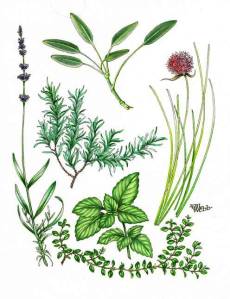
Herb Sampler, ©Val Webb. All rights reserved

Draw and Paint Six Culinary Herbs
Saturday, June 30 from 10am-4pm
Studio at Alabama Art Supply
1006 23rd Street South
Birmingham, AL
$120 includes all art supplies and six potted organic herbs to take home

Learn the basic structure of a leaf, then put that knowledge to work as you create a color rendering of six culinary herbs in layered watercolor and colored pencil. Step-by-step guidance, no previous experience necessary, and all supplies are provided. Take home your completed botanical art and six potted herb plants at the end of the day. This is a very limited small-group workshop, and it is expected to fill up very quickly. Your registration fee must be received to reserve your spot. To register, contact instructor Val Webb or call 251-510-9615.

Val Webb, award-winning illustrator of 11 books for children, is known for her images of nature and garden subjects. Her artwork appears nationwide on seed packages, and is featured in public and private art collections around the world. Val lives in Fairhope, Alabama.

This information can also be viewed in Classes Near You > Alabama.

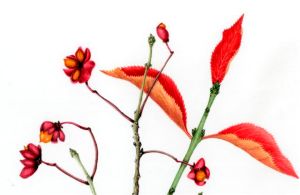
Euonymus europaeus. © Liz Leech. All rights reserved

Questions for You!

This morning Liz has questions for readers who own a copy of Botany for Artists. Liz’s book was released in the UK in November and was released in the US on May 1. Liz has specific questions about reader’s experiences with her new book.

Reader comments about the book have begun to appear in your ongoing conversation with Liz. This is perfect timing because today Liz has questions for all of you.

See what Liz is asking readers.

Join this conversation already in progress…

Artist and teacher, Wendy Hollender, will host a exhibition of botanical art on May 19 at Hollengold Farm, her organic farm located in the Hudson Valley in New York. This exhibition will feature the artwork of Carol Woodin, Paul Harwood and Wendy Hollender. Meet the artists and learn about the summer workshops each will teach at the farm.

Carol Woodin and Wendy Hollender will teach Botanical Art Basics twice per month on Friday afternoons beginning June 1, 2012.

Paul Harwood, Carol Woodin and Wendy Hollender will each teach Saturday workshops at the farm. These all-day workshops include a farm-fresh lunch! Choose from these summer workshops at Hollengold Farm:

  • Botanical Field Sketching in Pencil and Watercolor with Carol Woodin – May 26
  • Drawing Trees in Charcoal and Chalk with Paul Harwood – June 23
  • Drawing Fresh Produce in Colored Pencil and Watercolor with Wendy Hollender – July 28
  • Drawing Still Lifes with Charcoal and Chalk with Paul Harwood – Aug. 11
  • Heirloom Fruits in Watercolor with Carol Woodin – September 8
  • Drawing Dahlias in Colored Pencil and Watercolor Pencil with Wendy Hollender – October 6

Botanical Art Exhibition at Hollengold Farm
Meet the artists!
Learn about classes at the farm!
Accord, NY
May 19, 2012
6-8 PM

Workshop information can also be viewed at Classes Near You > New York.

Sempervivum arachnoideum. © Liz Leech. All rights reserved

Ask Liz!
Liz and I hope you have enjoyed learning about her approach to teaching botanical artists about plants. Today Liz and I would like to open up the conversation. Do you have any questions you would like to ask Liz?

Click here to join the conversation