Feeds:
Posts
Comments

Archive for the ‘Teaching & Learning’ Category

Teach a person to see any one thing, just as it is, in form and color, and as it stands related to other objects around, and you accomplish much.

— Lewis P. Clover (1861)

As Marianne North painted habitat studies, plant portraits and botanical still life paintings while traveling the world, she had an educational objective in mind. Because she was alarmed at how little people knew about plants, North drew and painted plants so that others could learn about them.

Learning about nature and the world through the drawing process is the subject of a presentation Lewis P. Clover made to the State Teachers’ Institute in Quincy, Illinois in 1860. His presentation was reprinted in The Crayon in 1861 and it is this reprint we’ll take a look at today.

An advocate for “educating the eye” (Clover, 1861), Clover makes a case for drawing to become a core requirement in all schools. He makes his case in Drawing, as Connected with the Common and Higher Pursuits of Life.

Clover (1861) argues that there is not a pursuit in life that does not benefit from the act of drawing. He explains how botanists, geologists, machinists, physicians, carpenters, builders, architects, mechanics and even lawyers can benefit from knowing how to present information visually. He also argues that anyone can learn the principles of drawing, learn how to measure distances between objects, and learn to see (and appreciate) nature in a new way.

In his paper, Clover agrees with philosopher John Locke and states that drawing instruction in the school system should not be about creating master artists. It should instead be about equipping students with the skills to “represent tolerably on paper anything (one) sees.” (Locke, as quoted in Clover, 1861).

Clover argues that students need to be taught to see and to learn through drawing so they can have “awakened thoughts” (Clover, 1861) about the world and other things that would otherwise go unnoticed. Clover’s plea to teachers is best summarized in this statement:

Make drawing a branch of study in the schools, and you adopt the most successful mode of teaching pupils to discriminate.

— Lewis P. Clover (1861)

To get a copy of Clover (1861), search the stacks at your local college library.


Literature Cited

Clover, Lewis P. 1861. Drawing, as connected with the common and higher pursuits of life. The Crayon. 8(4): 73-77


More About Marianne North

This month we will learn more about Marianne North from featured scholar,
Katie Zimmerman. We’ll learn about North’s work and her contributions to botany. I hope you take advantage of the opportunity to learn from Katie directly and to ask her questions.
Join the conversation

Read Full Post »

An analysis of outdoor activities by Deborah J. Chavez, a specialist in outdoor recreation research, suggests this to be the case.

Chavez writes about student reactions to selected outdoor activities in Youth Day in Los Angeles: Evaluating the Role of Technology in Children’s Nature Activities.

The Youth Day activities described in Chavez (2009) include two technology-dependent activities and two activities in which technology did not play a role. The format for each activity was the same. Each activity was designed to have a 5-minute introduction, a 30-minute activity, a 15-minute wrap-up, and a 10-minute transition to the next activity. Youth Day participants ranged in age from 6-17. Thirty-eight youth from the Los Angeles area were divided into eight groups and rotated through each activity on a pre-planned schedule designed by Chavez. Two trained facilitators were assigned to each group. Observers were stationed at each activity to record participant’s reactions and comments.

Here is a brief review of the Youth Day activities described in Chavez (2009):

    Technology-Dependent Activities

    Camera Safari:
    Participants took photos of things that interested them as they walked along a nature trail. Photos were printed and categorized for analysis.

    Geocache:
    Participants looked for hidden treasure along a nature trail using GPS units.


    Technology-Free Activities

    Etchings:
    Participants completed rubbings and created etchings.

    Nature Scavenger Hunt:
    Participants received a list of natural items to look for along a trail.

Each activity was evaluated by participants, observers and facilitators. Participants rated each activity using a color-coded rating system where a Green rating meant participants liked an activity, a Yellow rating meant participants thought an activity was “OK” or that they were undecided about their opinion of an activity. A Red rating meant participants did not like an activity.

The technology-dependent activities received the highest approval ratings from participants — Geocache (92%), Camera Safari (86%). The Nature Scavenger Hunt and the Etchings activity received approval ratings of 76% and 62%, respectively. These results, in addition to the thorough notes and feedback of facilitators and observers suggest that using technology in outdoor nature activities may be a good way to encourage young people to engage with nature.

To read a full analysis of Youth Day, including a review of background literature related to outdoor education, how Chavez designed Youth Day, and Chavez’s helpful discussion of planning and logistical issues for informal science educators interested in conducting similar one-day events, look for Chavez (2009) at an institution that subscribes to JSTOR. Conduct a search by country on JSTOR’s website. Alternatively, you can subscribe to the journal Children, Youth and Environments for access to all back issues of this journal.


Literature Cited

Chavez, Deborah J. 2009. Youth Day in Los Angeles: Evaluating the role of technology in children’s nature activities. Children, Youth and Environments. 19(1): 102-124


You may also enjoy reading…

Outdoor Education, Plant Awareness

Read Full Post »

The focus on technology, plants and art this month has been both fun and stressful. How does one even begin to blend a discipline as ancient, traditional, moving and beautiful as botanical art with the bells, whistles and modern-day graphics of technology?

My mind has traveled in all sorts of directions.

Apps are easy to think about. Which apps do you use?

“Go outside” my brain said. Think sun, fresh air. Think adventure.
Get that GPS article!

That “GPS article” I am referring to is Backyard Botany: Using GPS Technology in the Science Classroom by Ph.D. candidate Kathryn A. March.

In her article, March shares how she has used Global Positioning System (GPS) units to teach students about plants in informal settings. Her paper is fantastic and I recommend it highly.

March incorporates GPS technology in plant-based learning activities for middle and high school students. In her paper she explains how GPS activities can help teachers address Standards and how they can address issues related to plant blindness. The lesson plan in March (2012) is an activity that calls upon students to create a field guide to trees.

Educators are given all the information they need to conduct this activity themselves. March (2012) provides a list of materials and background information, recommends procedures, suggests an assessment tool, suggests an alternative activity if you can’t afford GPS units and suggests many alternative lesson ideas — one of which involves navigating students to plants so they can draw what they see.

To obtain a copy of March’s article, purchase a copy from JSTOR ($14)
or visit your local college library.


Literature Cited

March, Kathryn A. 2012. Backyard botany: Using GPS technology in the science classroom. The American Biology Teacher. 74(3): 172-177.


Do you use GPS technology in conjunction with botanical or scientific illustration? Tell us about your project in the Comment box below.


Related

Read Full Post »

If we all approached drawing as a means of fixing a memory as opposed to creating a work of art, we’d do more of it and see more as a result.

— Nancy Ross Hugo

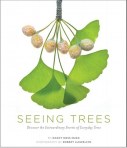
If you want to spend time getting to know trees, begin your journey with
Seeing Trees: Discover the Extraordinary Secrets of Everyday Trees by author and educator, Nancy Ross Hugo, and photographer Robert Llewellyn. Together they lure readers out of their reading chairs and take them outside to look at trees in a new way.

Hugo and Llewellyn accomplish this through their discussion of thirteen viewing strategies and by teaching readers how to look at leaves, flowers, cones, fruit, buds, leaf scars, bark and twigs. Llewellyn’s informative and beautiful photographs support Hugo’s text and helps readers zero in on the details they need to see.

This same attention to detail is applied to the tree profiles featured in the book. You don’t have to get too far with even the first tree profile to realize you’ve looked at trees all wrong and that you’ve taken them for granted.

As you know, we’re focusing on technology this month and how technology can be taken outdoors. Seeing Trees is a great example of how technology can be used to enhance our understanding of plants. Hugo and Llewellyn’s book is more than a print book. It is available in ebook format and as an interactive book. It is the interactive format I will focus on today.

The interactive version of Seeing Trees is available through Inkling, a Web-based service that is transforming how readers interact with books. They have eliminated the “book” part and focus on how users view and consume content on iPads, iPhones, MACs and PCs.

When visiting Inkling’s website, the first thing you’ll notice is that you can buy the individual chapters of a book for as little as $1.99. The second thing you’ll notice is that the books are interactive and much more than simply a print book in a digital format. The types of interactive components vary among books. In the case of Seeing Trees, readers will find images they can enlarge, words they can highlight and define, and will enjoy the ability to conduct an in-depth search around a specific word. In the introduction section of the Inkling version, there is also a video about how the book was made and how Llewellyn’s approach to photographing this book was inspired by the botanical illustrators of long ago.

Other interactive features of Seeing Trees include:

  • A slideshow of Japanese maple leaves (Acer palmatum and A. japonicum)
  • A slideshow of sweetgum leaves (Liquidambar styraciflua)
  • A slideshow of twigs from 14 species of trees.
  • Links to resources about plants and trees
  • A feature enabling readers to watch fruit development in Liquidambar styraciflua.

While the trees in this book are common to the East Coast, this does not take away from its effectiveness as a tool for seeing. The viewing strategies Hugo and Llewellyn recommend can be applied to any tree (and any plant) regardless of one’s geographic location.

The Inkling edition of Seeing Trees is available for $16.99. The chapter price for this title is $4.99 per chapter.

SeeingTrees
Literature Cited

Hugo, Ross Nancy. 2011. Seeing Trees: Discover the Extraordinary Secrets of Everyday Trees.
Photography by Robert Llewellyn. Portland: Timber Press.


Also See

Read Full Post »

Keep Plants Simple

Two weeks ago we considered how we can help children experience plants differently. This topic sparked a conversation about teaching ideas that ranged from how to see leaves differently to how to help kids relate to invisible processes.

Today let’s revisit this topic and consider adult learners and learning that occurs outside of a traditional classroom setting.

Informal learning is learning that occurs outside of traditional formal learning environments, such as a classroom or a lab. Examples of informal learning environments include nature centers, visitor’s centers, botanical gardens and museums. In these places of learning, scientific information is presented to the public in meaningful and easy-to-digest ways.

Building a bridge between experts and non-experts can be a perilous activity and can come with criticisms about dumbing down content (Davis et al., 2013).

Do informal science educators water down information too much when presenting it to the public? Do they encourage misconceptions or enable the formation of new misconceptions?

Pryce R. Davis, Michael S. Horn and Bruce L. Sherin address this issue in
The Right Kind of Wrong: A “Knowledge in Pieces” Approach to Science Learning in Museums.

Every single one of us is a teacher. It doesn’t matter that we do not have a physical classroom to call our own. Through our interest in plants, nature and the wonderful world of natural science illustration, we teach and communicate information about plants and nature in many ways.

When you are teaching, do you ever worry about being wrong? About making the wrong impression, about using the wrong analogy or about stretching the truth a bit too much just to make a point?

The article by Davis and his colleagues might put your mind at ease. In their article, Davis et al. (2013) argue that simplifying content does not necessarily lead to problems and they present an approach that can lead general audiences to meaningful understanding of content.

Expertise in a subject is great, but it can also be a problem because it can get in the way of teaching. Experts in their field have mastered the technical jargon of their discipline, are quick to point out the mistakes of non-experts, want to replace wrong knowledge with correct knowledge, and have forgotten what it was like to be a learner in their field (Davis et al., 2013).

To make the gap between experts and non-experts smaller, Davis et al. (2013) recommend that museum educators take non-experts on a gentle and winding path to expert knowledge by putting the misconceptions they bring with them to good use and by using the assorted bits of prior knowledge they each possess. The approach they encourage is called the “Knowledge in Pieces” approach.

Davis and his colleagues explain that the “Knowledge in Pieces” approach to science communication in informal learning environments isn’t about making grand leaps of understanding within the small space of a museum exhibit. Instead, it is about making small learning gains that engage learners by allowing them to relate the new knowledge to what they already know and how they have come to know it in their daily lives. By doing this, the learner remains comfortable and confident along the path to “expert” knowledge. To do otherwise (i.e., to replace what a learner thinks they know with a fresh batch of expert knowledge in one swift movement), would be to create a situation that leaves a learner bewildered and unsure of what they know because their new “expert” knowledge isn’t based on prior personal experiences.

Communicating science has never been easy. Davis et al. (2013) provide an interesting look at the history of science communication and how it has changed in the 21st century. Did you know there was once a belief that respected scientists did not “go public” with their research (Goodfield, 1981 as cited in Davis et al., 2013)?

Learn more about the “Knowledge in Pieces” approach. The article by
Davis et al. (2013) is available online for free. Click on the link below.


Literature Cited

    Davis, Pryce R. and Michael S Horn, Bruce L. Sherin. 2013. The right kind of wrong: A “Knowledge in Pieces” approach to science learning in museums. Curator: The Museum Journal. 56(1): 31-46. Web. <http://onlinelibrary.wiley.com/doi/10.1111/cura.12005/full>
    [accessed 22 March 2013]

    Goodfield, J. 1981. Reflections on Science and the Media. Washington, DC: American Association for the Advancement of Science.


Also See

Science Communication Through Art

Read Full Post »

What would a classroom experience look like if it were described in a visual form instead of in a written form?

Richard Hickman explores this in Visual Art as a Vehicle for Educational Research. An advocate for the use of the arts in classroom research,
Hickman (2007) carefully designed a project that uses art as a research tool. His project is different than the projects we usually learn about in this column because he went out of his way to avoid creating a project that used drawing as a research tool. This difference is important to note. Hickman (2007) explains that he did not create a drawing project because:

  1. A drawing is not necessarily art.
  2. Drawing research is often about drawing and its use as a thinking tool — not just by artists, but by anyone.
  3. Projects that use drawing as a research tool have their data reported as text, not images.

Hickman (2007) wanted to investigate something different. He wanted to investigate if it were possible to gather data and report data through the arts (emphasis mine).

Hickman’s pilot project involved graduate students assigned with the task of recording and explaining their experiences as student teachers. Nineteen students of art and design preparing to teach secondary school were told to “capture, in visual form, the essence of your experiences of classroom life” (Hickman, 2007). They were also told to include commentary that would help them present their visual work to their peers. During this six-month project, students conducted on-going observation in their respective classrooms, participated in small group seminars and engaged in reflective thinking (Hickman, 2007).

What was the outcome? You’ll have to get the paper to see the artwork for yourself since student reporting was done in a visual form. I will say that how the artwork captured interactions between the teachers and students is interesting. All I can do here, however, is present the observations and take-home messages Hickman (2007) shares in his paper. They are:

  • Visual art forms can help explain aspects of the teaching and learning process that are not easy to explain in words.
  • Visual art is engaging.
  • Visual art forms can be used to tell an entire story at one time.
  • Visual art can offer layers of information through “metaphor, analogy and iconography” (Hickman, 2007).
  • Visual art can transform boring daily life into an experience that can change our perceptions.
  • Visual art forms are accessible to everyone.

Hickman (2007) feels his attempt to investigate the extent to which art-based classroom research can enhance teaching and learning was a success. Even so, he does acknowledge that some forms of visual art are not self-explanatory. So his recommendation is that each piece of visual art be accompanied by a brief commentary by the artist so that an artist’s work is not misinterpreted.

Hickman’s study made me wonder…What would my classroom and the informal learning activities I lead look like if they were captured in a visual form?

What would your classroom look like?


Literature Cited

Hickman, Richard. 2007. Visual art as a vehicle for educational research.
The International Journal of Art and Design Education. 26(3): 314-324

This article can be purchased online for $35 from the Wiley Online Library. Alternatively, you can search for this article at your local college library.

Read Full Post »

How can we help children experience plants differently before we teach them that they are insignificant?

This heavy question is rooted in the sobering reality that adults teach children how to think about plants and how to treat them.

In Where did you go? The forest. What did you see? Nothing., Lynda H. Schneekloth discusses how adults send conflicting messages about plants to children and how the dominant message to children is that vegetation can be categorized as “nothing” (Schneekloth, 1989). Examples of conflicting messages adults send to children are “vegetables are good for you, eat them…we need to build something here, bulldoze the trees” (Schneekloth, 1989).

How did vegetation become so invisible?

Schneekloth (1989) presents three factors contributing to the unfortunate status of plants in our society. She explains that plants make up too much of the background. Because there are so many plants, they have suffered the fate of any element, when in abundance, that forms a background. Because they are the background, plants make what is different appear to be more important (Schneekloth, 1989).

Also contributing to the problem of visibility is how people experience plants in their real lives compared to what we know about them at the scientific level. Regardless of how we’ve come to know plants scientifically, in our real lives plants exist only to serve us (Schneekloth, 1989). This reality contributes directly to the the third issue making plants invisible and this issue is, it’s all about us.

Because we have come to know plants so well through research, Schneekloth (1989) says this has created a feeling of superiority that prevents us from seeing the extent to which we are dependent upon plants. She explains that our ability to make plants grow and appear in ways that suit us has created a “false sense of security” (Schneekloth, 1989) and has left us feeling in control of our world.

With plants existing only in the background and with our anthropormorphic view of the world, how are plants perceived by humans?

Schneekloth investigated this by asking two groups of people (environmental educators and grad students studying architecture) to draw a picture of “an experience, place or activity” (Schneekloth, 1989) that was key to their forming a relationship with nature. The details of her study can be reviewed in her paper. The big takeaway from her investigation is this — when people drew their nature experience, they placed humans in a scene with vegetation; when they talked about their experience, the actions taken by humans was the focus. Schneekloth (1989) observed that drawing gave plants a presence, while language rendered plants invisible. She observed that in a drawing, plants are “something” (Schneekloth, 1989) because they are given form.

There is much more to learn from Schneekloth in her article about the value of vegetation. Look for the journal Children’s Environments Quarterly at your local college library.

So let’s get back to that big question…

    How can we help children experience plants differently before we teach them that they are insignificant?

Share your thoughts in the comment box below.


Literature Cited

Schneekloth, Lynda H. 1989. Where did you go? The forest. What did you see? Nothing. Children’s Environments Quarterly. 6(1):14-17


Related

Children’s books cited by Schneekloth that give plants a foreground presence:

  • The Little Prince by Antoine de Saint-Exupery, translated by Richard Howard (2000)
  • The Return of the King by J.R.R. Tolkein (1965)
  • A Wind in the Door by Madelaine L’Engle (1973)

Read Full Post »

« Newer Posts - Older Posts »