Feeds:
Posts
Comments

Archive for the ‘Teaching & Learning’ Category

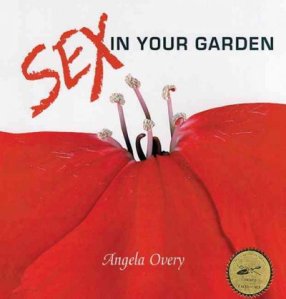
SexInYourGarden Plant reproduction can be as sensitive a topic as human reproduction.

This was made clear to me years ago at the, then, L.A. Garden Show when a gentleman disapproved of me displaying the book, Sex in Your Garden. He shook his head, made the “tisk, tisk, tisk” sounds and told me I shouldn’t have this book out on display. It was the word “sex” in the title that prompted his reaction. If you are unfamiliar with this book, it is a light-hearted and very anthropomorphic look at how plants attract pollinators. It contains text and images drawing similarities between how plants and humans call attention to themselves.

Even though it has been years, I always think of this gentleman when talking about flowers, fruit and reproduction. It is easy to talk about sperm, eggs, ovules and seeds when speaking with adults (although I usually have to give them a few moments to digest the fact that there are ovaries in their fruit bowl).

It is talking about plant reproduction with young audiences that always gets me thinking. What is saying too much?

If you’ve ever felt compelled to launch into an explanation of double fertilization while dissecting flowers with kids (even though you know you shouldn’t), here are some resources that may stop you from going over the cliff.

In How Do Apples Grow?, author Betsy Maestro and illustrator Guilio Maestro provide a comprehensive look at how buds on an apple tree develop, how the buds bloom and how flowers attract bees. They discuss flower anatomy, fruit development and explain what we’re eating when we eat an apple. They explain how apple trees make their own food and close their story where they began it — with flower buds on a bare apple tree. This life cycle book for botanists ages 5-9 addresses some big topics. Here is a list of vocabulary terms and concepts explained in this book:

  • leaf buds
  • flower buds
  • sepals
  • petals
  • stamen
  • pollen grains with male cells
  • pistil
  • ovary with female cells
  • pollination
  • fertilization
  • pollen tube germination
  • fruit development
  • seeds as fertilized female cells
  • photosynthesis
  • apple varieties

Maestro also touches upon seed dispersal and decomposition. The supporting watercolor illustrations by Guilio Maestro are colorful, labeled clearly and are easy to understand. Together Maestro and Maestro do a nice job of making flower development, pollination and fruit development very observable processes.

Just as Maestro makes fruit development observable, Helene J. Jordan brings seed germination and development out into the open in How a Seed Grows. The seed growing activity in her book enables students to see how seeds change beneath the soil and how seedlings grow above ground without investing in those growing chambers with the glass sides. Jordan’s clear instructions are supported by the informative gouache and colored pencil paintings by illustrator Loretta Krupinski. While Jordan’s book was written for children ages 4-8, the seed-growing exercise is appropriate for older children. It helps explain how seeds become plants and brings the life cycle of plants full circle. Plus it really lends itself to exercises related to botanical illustration.

Here is a list of vocabulary terms and concepts introduced in
How a Seed Grows:

  • seed
  • plant
  • tree
  • soil
  • watering for growth
  • writing numbers for identification
  • seed germination
  • roots
  • counting
  • leaves
  • soil
  • water
  • sun
  • photosynthesis

Jordan also includes directions to an experiment children can do to investigate the resources plants need to grow.

We can’t talk about seeds, flowers, pollinators and fruit development without showing how all these things are related. A great book that ties up all the loose ends is The Reason for a Flower by Ruth Heller. She introduces young readers to pollinators they might not normally consider and introduces them to wind pollination too. In her colorful 48-page book, she also introduces readers to seed pods, seed dispersal, herbivores, carnivorous plants, parasitic plants, angiosperms and familiar products derived from plants.

If you ever find yourself wondering “how much is too much?” when preparing an activity for young audiences, browse through children’s books about plants to get ideas about how to teach less, better.


Resources Cited

    • Heller, Ruth. 1999.

The Reason for a Flower

    • . New York: Penguin Putnam.

Jordan, Helen J. 1992. How a Seed Grows. New York: HarperCollins.

Maestro, Betsy. 1992. How Do Apples Grow?. New York: HarperCollins.


Also See

Botanical Illustration & Plant Morphology for Preschoolers

Read Full Post »

An investigation into adolescents’ perceptions and experiences with nature revealed that some urban youth view nature as a threatening place. A place where crimes occur and where trees hide the activities of criminals.

Sound extreme?

Read on.

Arjen E. J. Wals provides extensive background into this observation and others in Nobody Planted it, it Just Grew! Young Adolescents’ Perceptions and Experiences of Nature in the Context of Urban Environmental Education.

The perception that nature is a threatening place was uncovered when Wals interviewed students from four classes at four different middle schools in and around Detroit, Michigan. Wals’ study included students from four different communities. The communities represented in this study include upper-class families whose children attend private schools, middle- and working-class families whose children attend suburban schools, and working-class and “out of work” families whose children attend schools in Detroit (Wals, 1994). The student populations at these schools ranged from almost all-white in the suburban schools to almost all-African-American in the Detroit schools. The locations of the schools ranged from a park-like setting for the private school to “a bunker in an urban war zone” (Wals, 1994) for one of the Detroit schools. The schools shared the same curriculum, however the Detroit schools were not as well equipped, had to spend time on safety issues, had to spend time performing tasks normally completed by parents and guardians and had to spend time teaching basic skills before students dropped out of school (Wals, 1994). This study included students who considered themselves fortunate to be living in safe neighborhoods and students who mostly used the outdoors “to get from one place to another” (Wals, 1994). For more information about the students and the urban environments involved in this project, read Wals (1994).

Arjen Wals created his study to investigate the following:

  • Did nature have a place in the lives of students?
  • How did students interact with nature?
  • Where did students experience nature in their respective urban environments?

Before we get too far along, I need to explain that Wals (1994) is an ethnographic-phenomenological study, not a statistical study. Phenomenological research investigates perceptions and experiences. While students from all four classes participated in the study, interviewed only 32 students. He chose eight students from each class and explains his sampling procedure in his paper.

Throughout the study, Wals was an active participant in classroom events. He observed student reactions to nature experiences, kept a research journal, interviewed students and reviewed their reflective journals (Wals, 1994).

What did he learn about students and their relationship with nature?

Wals (1994) found that students managed to build relationships with nature, regardless of their environment. He found that two themes emerged from student interviews and journals — how students define nature and how they experience nature.

Wals observed that students define nature as: flowers, animals, trees, alive, pure, peaceful, not human-made, freedom, solitude, self-supporting, wild, spontaneous (Wals, 1994).

He also observed that students experience nature as: entertainment, a challenging place, a place where time stands still, a threatening place, a background to other activities, a place for learning, a place to reflect, and as
a threatened place (Wals, 1994).

Excerpts from student interviews supporting the observations above can be reviewed in Wals (1994). Environmental education (EE) teachers will also be interested in the author’s comments about EE programs. Wals discusses his findings and the implications they have on environmental education. At the close of his paper, he suggests nature experiences teachers might want to try in their programs.

Nobody Planted it, it Just Grew! can be read online for free.


Literature Cited

Wals, Arjen E.J. 1994. Nobody planted it, it just grew! Young adolescents’ perceptions and experiences of nature in the context of urban environmental education. Children’s Environments. 11(3): 177-193


Also See

Read Full Post »

Paula Panich is an essayist, journalist, fiction writer, and writing instructor. She has been writing about plants, gardens and other subjects for 30 years.

In 2005, she published Cultivating Words: The Guide to Writing about the Plants and Gardens You Love, the first-ever comprehensive book about garden writing.

Coming soon is The Cook, the Landlord, the Countess, and Her Lover, a book of essays on food, place, memory, and history.

Gardeners, horticulturists and anyone wanting to write about plants or gardens will find Cultivating Words invaluable. In her book, Panich teaches garden writers:

  • How to write “how-to” stories.
  • How to write service stories.
  • How to construct sentences.
  • How to write garden-related travel stories.
  • How to write clearly.
  • How to edit.
  • How to look for publications in which to publish articles.

I have read Paula’s book twice and have taken a class with her at the Los Angeles County Arboretum and Botanic Garden.

We have the wonderful opportunity to learn from Paula today.

Please welcome Paula Panich!


Paula, how did your writing career begin? Have you always written about plants and gardens?

I grew up in a house without books. But I loved them. I think there were a few of those Little Golden Books for young children in the house, but the first “real” books to arrive came from my visits to a bookmobile in a shopping center in Dallas, Texas. Yet my grandparents had a bookshelf in a glass-fronted built-in; one of their sons went to college for a couple of years, and the books were his. I still remember the smell of those books. The bookmobile had that same delicious smell of bindings and glue and paper. Intoxicating!

My first “real” book was Treasure Island, by Robert Louis Stevenson, by the way. I remember in vivid detail what it felt like to close its back cover. I had finished! I was just thrilled.

My paternal grandparents were from Serbia. They were my primary influences when it came to plants and gardening as I watched them work in their yard. Their lives were unthinkable without these tasks, as mine is today. My grandmother quilted, cooked, baked, sewed, and canned; she was always doing something. Her work was precise, and her precision was imprinted on me. When I began to work on a word processor decades later, the image I had in my mind was my grandmother at her treadle sewing machine.

I think writing often comes to writers because they feel an inner need to rearrange the world. My god! The architecture of sentences! They can change the landscape of perception. But writing also comes to people because they know a great deal about something, and want to share it — like gardens and plants.


What did you want to rearrange?

There was a childhood trauma when I was five. It set up many things in my life. I desperately needed to make sense of the world; but that understanding only came much later. Writers are often people who were set aside in some way, or set out on their own either physically or emotionally.

My first professional gig as a writer came in my 30s when I was pregnant with my daughter. I began writing for Phoenix Home & Garden magazine. (I had been writing publicity stuff for paying clients previously.) But writing journalism was a completely new step and I was exhilarated with the freedom to write about subjects while dipping into my personal cultural capital. I wrote about plants, gardens, and historic preservation. The editor couldn’t throw any thing at me I wasn’t interested in — like crown moulding. I had been a history major, and I had, and still have, insatiable curiosity.

I am always interested in what is beyond, behind under, and over the topic. Back when there was a real publishing industry (wherein people could make a living) and there were categories for writers (e.g., garden, food, etc.). I was placed in the “garden writer” category. But I write about food, history, plants, gardens, landscape, literature, science, and travel — especially travel, where all of these topics come into play.


What topics haven’t you written about that you would like to write about?

I am interested in the interrelationship of things. I am very interested in place and in perception. It occurred to me that both have been the spoken or unspoken platform of my work. Now all of my teaching of writing seems to be about seeing. We can learn to craft a decent sentence — but it is the quality of mind of the writer that counts most.

My interest in seeing — or at least the most concrete example I can give — springs from my interest in contemporary artist Robert Irwin. I began to understand experiential seeing during a six-month experiment that involved weekly visits to his Central Garden at The Getty Center in Los Angeles. I intentionally didn’t take written notes when I sat in this garden, but eventually I began to “take” notes with a disposable camera. Irwin has spoken about seeing and perception for decades. I decided, through these numerous visits over time, to try to understand what he means.

I have written about the experience in a couple of ways. One in an interview with Irwin for the L.A. Times, and another quite different article for Pacific Horticulture. I also taught a class at the Getty Center on writing about the garden in which I used photographs to reveal what I saw and to reveal what was revealed to me. So I learned a lot about seeing. Seeing has a lot to do with the grounding of the person who is doing the seeing. It doesn’t matter if the focus is a garden or a plant or a landscape or a rock.

Irwin is grounded in the philosophy of phenomenology (the study of phenomena and perception), but the act of seeing has been described in philosophy, art, science and medicine. Sixty percent of what we see, according to some researchers, is a mix of our experience and thought. If you and I look at the same plant, we will be able to agree on 40% of what we’re seeing. Everything else depends upon our past experiences.

If we were to describe the same sweet potato, we would describe it differently. I would describe the complicated color, and the texture. But also for me, the sweet potato comes with a story. It is part of my cultural experience because of my grandmother’s experience with it. She told my sister and me that sweet potatoes were her candy in Serbia. So her experience and narrative affects how I see every sweet potato.

You asked how we teachers can encourage people to write about plants in an affective, meaningful feeling, way. I would turn the question around and ask — how is it possible not to do it?

We spend our entire lives constructing our visual world, a mix of our thoughts, feelings, and experiences.

I am not a plant geek. I am interested in stories behind the plants. I think a good way to encourage students to tell stories about plants is to send them out with paper notebooks to describe a plant, but provide them a prompt. For example, This plant makes me feel… . There are hundreds of prompts. The last time I saw a plant like this . . .

Stories shape our brains and are the basis of human culture. There is incredible overlap between the scientific world and the narrative. Don’t forget about young children: stories make their world. Ours too.


People tend to relate to animals better than they relate to plants. The term plant blindness has been coined by researchers to describe the condition that people don’t notice plants as much as they do animals. Drawing helps to encourage one way of seeing. Writing is another. How can artists, naturalists and educators help people “see” with words?

If there is plant blindness, then there is also “writing fear” because of the way writing and reading are taught. I think it’s especially important that the atmosphere in a writing class be supportive, and that fear is dispatched one way or another.

I had what I realize was an important moment in my own “plant blindness.” For two or three years I looked out a window in a tiny shack in the San Jacinto Mountains as I wrote. I actually looked at a certain tree in the midst of a pine forest. I finally realized — after all that time! — I was actually looking at a California live oak. And this tree was only a few yards from the window! Yes — I had “blindness” but in every way that tree conferred its blessing and shelter on me. I drank from that tree. The tree sustained me. Finally — I realized its proper category in the world human beings have made. But it did not wait for me to call it by name to confer its intrinsic goodness.

But back to writing.

Natalie Goldberg wrote Wild Mind: Living the Writer’s Life, and I use some of her writing strategies in classes with kids as well as adults. I ask adult students to get the cheapest notebook they can get — wide rule, 70 pages — to do timed writings. I tell them to move the pen across the page and to not lift it. This helps to take the sting out of putting down words as most people have their high school English teachers, red pencil sharpened, sitting on their left shoulders.

My classes now are more about experience. I started teaching at 21; later, I wanted to focus on urging people to become professional writers. I don’t do this anymore.

I like to bring the rich adult literature about landscape and plants and human response into the mix, even it is just a paragraph. A Sand County Almanac by Aldo Leopold; the books of John Muir; the books of John McPhee. Another book that has captivated me is Keith Basso’s Wisdom Sits in Places. He writes about the Western Apache in Arizona and how their language, psychology, and medicine are rooted in places in the natural world around them.

For teenagers, who always think about sex, the Botany of Desire would be a good book to use. Who could resist the story about how roses got their names? Or the coevolution of the marijuana plant and us?

Sometimes a paragraph or two is enough to open up students’ minds: Here are these wonderful writers, and here are their inventive, wide-ranging minds and concerns. What are yours?

Also, you have to work on yourself as a teacher and as a “person who sees”; that way, you can gently lead students to get out of their own way. Children are already there. They teach you how to move out of your own way.

Addressing plant blindness will require an act of will to interrupt the habitual way of seeing. Harvard professor John Stilgoe wrote a great book called Outside Lies Magic: Regaining History and Awareness in Everyday Places. He tells his students to hop onto bicycles and figure out how the world is put together. It’s a wonderful book. I wish we could spread it around the country, like Johnny’s appleseeds.


Cultivating Words

Paula’s book, Cultivating Words: The Guide to Writing about the Plants and Gardens You Love, can be purchased from Paula through her website for $21.95. 
Order


Take a Class with Paula

Paula will teach a two-day class dedicated to writing about plants and place in January/February 2014 at the Los Angeles County Arboretum and Botanic Garden. Cost: $70 for two sessions (nonmembers); $60 members
Learn More


Plan Ahead to Join Paula in New Mexico in 2014

You are invited to join Paula Panich for WALKING SANTA FE: Place, Plants, Spirit, Food ~ A Writing Workshop based on the sights, smells, taste, and spirit of Santa Fe, New Mexico. Founded in 1610, the city sits amid the natural beauty of Northern New Mexico; it has a deep and rich history braided by the traditions and beliefs of the three cultures now at home here. November 13-15, 2014.
Cost: $300

Paula’s classes have been added to Classes Near You > Southern California.

Read Full Post »
    What thoughts cross your mind when preparing to teach students about plants?

    How do you prepare yourself?

    What type of student reactions do you prepare for?

    What would you do if you had the money, space and time to teach botany any way you wanted?

In their very interesting paper, Elementary Botany: How Teachers in One School District Teach About Plants, Melanie A. Link-Perez and Elisabeth E. Schussler address the questions above as they begin their investigation into how K-12 teachers teach botany.

In 2006, Link-Perez and Schussler (2013) interviewed 13 elementary school teachers about their experiences teaching plant biology. The teachers interviewed were all female and were a mix of both new and experienced teachers. Interviews were recorded, transcribed and then evaluated for recurring themes (Link-Perez and Schussler, 2013). Data collected were teachers’ “self-reported experiences in teaching about plants, in order to assess their comfort level and experiences in botanical instruction” (Link-Perez and Schussler, 2013).

The research questions Link-Perez and Schussler (2013) wanted to investigate were:

  • How do teachers feel about teaching plant content?
  • What types of activities are used to teach about plants?
  • How do students react to lessons about plants?
  • Is there anything teachers need to help them teach about plants?

After evaluating teacher interviews, Link-Perez and Schussler (2013) categorized themes according to their research questions above. Here is a quick summary of their findings:

    How did teachers feel about teaching plant biology?
    Teachers stated they were comfortable leading lessons about plants, even though most of the teachers claimed to have no (or very little) training in botany.


    How did teachers teach about plants in their classrooms?

    Teachers reported using their own activities to supplement the textbook given to them by their school district. Teachers also mentioned they do the same activities repeatedly and that some students complain about having to repeat a plant lesson they completed in an earlier grade.


    What did teachers have to say about how students react to learning about plants?

    Teachers stated that, while students like to grow plants, their enthusiasm and attention span for learning about plants dies quickly.


    What did teachers say they need to teach about plants in their classroom?

    Teachers expressed a need to find a better way of managing light, temperature and water in their classrooms. They also stated the need for more space.

Using teacher feedback and these themes as a guide, Link-Perez and Schussler (2013) offer two recommendations to anyone interested in enhancing botany instruction within their school district: 1) Provide teacher training in the plant sciences and 2) Help teachers develop curriculum so they can stop teaching the same lessons over and over again.

Learn more about the research conducted by Link-Perez and Schussler and the history of botany education by obtaining a copy of this article online. This article is available for free from the Botanical Society of America.


Literature Cited

Link-Perez, Melanie A. and Elisabeth E. Schussler. 2013. Elementary botany: How teachers in one school district teach about plants. Plant Science Bulletin. 59(3): 99-110. Web. http://www.botany.org/plantsciencebulletin/PSB-2013-59-3.pdf [accessed 2 October 2013]


Also See

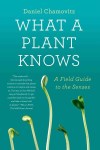
WhatAPlantKnows What a Plant Knows
A free seven-week online course taught by Daniel Chamovitz, author of What a Plant Knows (2012) and the Director of the Manna Center for Plant Sciences at TelAviv University. This class started October 1. It involves video instruction, reading assignments, quizzes, a final exam and discussion forums. Sign Up Today


More About ArtPlantae’s Teaching & Learning Column

ArtPlantae is participating in Connected Educator Month. As a participant in this wonderful event, I would like to welcome readers who are reading this column for the first time. This weekly column is published on Friday. Through this column we explore the links between drawing and knowing (knowing plants, specifically). To read past columns by myself and guest contributors, please see the “Teaching & Learning” section in the right margin of this page. Thank you for joining us online.

Read Full Post »

By Kathleen Garness
Guest Contributor

What can you do with a sketchbook and a bag of professional colored pencils?

Well, what can’t you do???

When the call came after the 2012 ASBA conference in Chicago, saying that I had just been awarded $1,000 to bring botanical art experiences and materials to underserved audiences, I was shocked to say the least! But excitement set in too, because this had been a long-held dream of mine. You see, botany hasn’t been part of a Chicago high school curriculum since 1965, the year before I started. And I felt cheated. I had really wanted to take botany in high school, and it was gone.

In the first part of the 20th century, botany was a standard item in the high school science curriculum. Noted Chicago botanist and Lakeview High School teacher Herman Silas Pepoon had written and collaborated on several botany texts, stunning in their depth of detail, for the Chicago public schools. But as a thirteen year old rising freshman, I didn’t know any of that yet, just that I wouldn’t be able to study plants as I had hoped to in ninth grade. That took the wind out of my sails, scientifically speaking, for much of the next forty years. While I continued to pursue art, I also felt adrift from my inner purpose.

But then I discovered the citizen science program, Plants of Concern, at the Chicago Botanic Garden. A new world of rare plant conservation opened before me, and inspired me to start drawing and painting again. As I became more involved with natural areas stewardship, my experience as a young person still haunted me – how many other young people were we missing in not having botany as a part of a standard school curriculum? Who would be the next generation of environmental leaders and field botanists if there weren’t any early experiences and classes to excite young minds?

So I wrote the grant, inspired by a ‘Why not?’ from Suzanne Wegener, Nature Arts Education Manager at the Morton Arboretum. And I had NO idea what I was getting myself into.

This was what I wrote:

    Grant Activity Description & Details

    Description: Botanical Art Introduction for Natural Areas Stewardship Youth Programs
    Date/Timeframe: April – September 2013 – selected days within that timeframe
    Location: Volo Bog Youth Art Guild; Cook County Forest Preserves Education Offices


    Goals of Activity
    :

    Direct Aims:

    To introduce new audiences to the use of botanical art to communicate scientific concepts – taxonomy, measurement, observation of species in habitat. (Examples of new audiences: people who enjoy drawing but aren’t familiar with plants, people who know plants but don’t know how to use drawing to communicate their understanding of same, and underserved high-school-age youth who will be enriched by both activities)

    To familiarize participants with basic botanical art techniques and terminology.

    To teach local flora with a view towards participants learning to understand the value of native versus non-native invasive flora and the value of biodiversity.


    Indirect Aims
    :

    To have participants become more involved in natural areas preservation, restoration and/or advocacy.

    To nurture confidence in beginning artistic and scientific observation and documentation skills and encourage further participation in botanical art activities.

Our audience would likely be natural areas stewardship volunteers, high school students and the general public. I planned for two workshops of about 12 or 13 students each, for a total of 25 students. (I was pretty stingy about in-kind contribution expectations.)

But then when the funds were secured, I started calling around. And a very nice person at Dick Blick saw to it that they offered a better discount than anyone else I had contacted about it (Actually, they were the ONLY ones who offered a discount!). So instead of outreach to 25 students we would be able to provide outreach to 50! So I sent her a wish list and she sent me a quote. I started making color wheels – how few pencils could we use and still have the full spectrum we needed for the class? What brands? What colors? Sketchbooks? Tracing paper? So many decisions! Her first quote was $150 under the grant. I wanted the grant to exactly cover the materials. So I thought, just 50? What about 70??! I took a leap of faith that some in-kind donations would help offset any additional costs.

So there we had it. Seventy 25-piece sets of art supplies containing: Dick Blick and Prismacolor colored pencils, Derwent 4B and 4H graphite pencils, an inexpensive clickie pencil, kmg_ColoredPencils 2 a kneaded eraser, a metal single-hole sharpener, a 6” clear ruler in inches and metrics, a Dick Blick zipper pencil bag to hold all the loose bits, and a spiral-bound sketchbook. Oh, and a folder full of handouts addressing how to’s, basic botanical nomenclature and diagrams, a bibliography and a few of the plant family pages I had developed for the Field Museum.
We ended up presenting the workshop at seven different venues in three Illinois counties (Cook, Lake and Will). The venues were one art museum, three different nature preserve centers with a variety of amenities, two forest preserves (yes, you can do an art workshop on a picnic table!) and the beautiful Forest Preserve District of Cook County general headquarters.

When we draw something we see it differently; we develop a relationship with it. A deeper interest and understanding evolves of our subject born of the time it takes to look, explore, draw, look again, learn context. And this evokes something deeper, more spiritual even, in us, bringing a new respect for our floral subjects to our life. If we and others do not love nature, how will we continue to protect it? Drawing can be a wonderful ‘gateway drug’ to botanical art and, from there, possibly advocacy and stewardship!

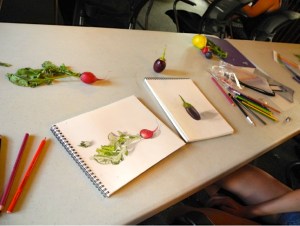
The handouts were key – we were giving them the tools, but more importantly, the visual language to describe their experience. First they worked on their grey value scales. Then a color wheel, then a color grid, showing the many nuances of color available with layering and blending, using their colorless blender. After a break, they put their new understanding of the tools to use rendering a piece of fruit in full color. I brought pears, radishes, tiny oriental eggplants, mushrooms, knob onions – depending on what was available at the fruit market. Less than two hours into their first colored pencil lesson, the results were impressive:

kmg_FirstColoredPencilLesson 2

kmg_OutreachGoals 2

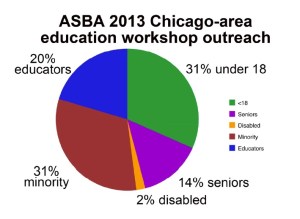
I think our outreach goals were met:

kmg_Chart_Outreach

And an unexpected bonus was developing partnerships with area high school and college teachers, who were very interested in how the format of the class could be implemented in courses they were already teaching.

I’m already thinking about how I can do this again next year, and the next, and the next. The per-student cost was under $25, with professional-quality materials, donating my time and gas, still life materials and handouts. With what other introductory medium can you achieve such flexibility with comparable results? And what an enticing way to help people fall in love with plants!

There’s a part of me that hopes this concept will go viral.

What would you do if you believed you would not fail?


About Kathleen Garness
:
Kathy is passionate about plants and conservation – and getting the next generation to be enthusiastic about them too. She enjoys being ‘boots on the ground’, conservation-wise, and has been a steward of Grainger Woods, an Illinois nature preserve, since 2003. She teaches watercolor, colored pencil and book arts. She is the current Artist-in-Residence at the Oak Park Conservatory and was an exhibitor in the international exhibition, Losing Paradise? Endangered Plants Here and Around the World, created by the American Society of Botanical Artists. Kathy received the 2008 Chicago Wilderness Grassroots Conservation Leadership Award and has served as president of the Palette and Chisel Academy of Fine Arts in Chicago. A selection of Kathy’s regional plant family illustrations can be viewed on the Field Museum’s website.


Related

Discover Plants of the Chicago Region

Read Full Post »

How has drawing been used as a learning tool in the classroom?

After reviewing 100 years of literature about children and drawing, Boston College faculty Walt Haney, Michael Russell and Damian Bebell discuss their findings in Drawing on Education: Using Drawings to Document Schooling and Support Change.

Haney et al. (2004) observed the following patterns about scholarly work addressing drawing in the classroom:

  1. Most of the literature addresses the psychological analysis of children’s drawings with respect to cognitive development or emotional issues.
  2. Most of the literature is about young children instead of older children.
  3. Drawing in large research projects is a recent development.
  4. Drawings are seldom used in research projects concerning education.

Haney et al. (2004) include their own research in their review and propose that student drawings can also be used to investigate classroom environments and school life. They found that asking students to draw their teacher at work reveals a lot about what goes on inside the classroom.

The authors began their research in 1994 and, after pilot-testing several prompts, included the following prompt in their initial study:

    Think about the teachers and the kinds of things you do in your classrooms. Draw a picture of one of your teachers working in his or her classroom.

From this initial study, Haney et al. (2004) went on to develop prompts encouraging students to document educational phenomena. Students documented phenomena such as what they do when they read and what they do when they learn math. Examples of other prompts used in their research and a lengthy explanation of how Haney et al. (2004) evaluated student drawings can be found in their paper.

How can the work of Haney, Russell and Bebell be applied to classroom research addressing plant-based education?

Take a quiet afternoon to read and digest Haney et al. (2004) and come back here to share your thoughts. This article is available online from
Harvard Educational Review for $9.95.

You can also look for this article at your local college library.


Literature Cited

Haney, Walt and Michael Russell, Damian Bebell. 2004. Drawing on education: Using drawings to document schooling and support change. Harvard Educational Review. 74(3): 241-272.


Are you interested in how drawing can be used in a biology classroom?
Join the conversation with this month’s featured guest, Jennifer Landin.


Read Full Post »

We learn from Dr. Dale J. Cohen again this week.

This time we learn about the experiments he designed to investigate the relationship between drawing accuracy and how artists look at a subject. In Look Little, Look Often: The Influence of Gaze Frequency on Drawing Accuracy, Cohen presents interesting information about how artists glance between a subject and their drawing.

Let’s begin by defining gaze frequency.

Dr. Cohen defines gaze frequency as “the rate at which artists glance between their drawing and the stimulus” (Cohen, 2005). What Cohen calls the “stimulus” in his experiments, I will refer to as the “subject” here. While stimulus is the more appropriate term to use, it would be confusing to use the term in this review without you having read Cohen’s review of drawing accuracy, stimulus interpretation and how stimulus interpretation can influence accuracy and the way marks are made on paper. Since his stimuli are what we would call subjects, I will refer to them in this way.

In Look Little, Look Often, Cohen (2005) describes four experiments conducted at the University of North Carolina Wilmington. Once again, some students participated as “artists” (i.e., they completed assigned rendering tasks), while others participated as “critics” who rated the accuracy of drawings produced by those in the artist group.

In his first experiment, Cohen (2005) investigated if there was a correlation between gaze frequency and drawing accuracy. Artists (both art majors and nonart majors) were shown two color photographs — portraits of males seen from the shoulders up (Cohen, 2005). The photos were placed about 51 cm to the right of the participant and at a 45 degree angle, as this allowed the video recorder to record the artist and how they worked (Cohen, 2005). The video recorder was positioned in front of the artist and was placed in a doorway of an adjoining room behind a curtain with a hole cut out for the camera lens (Cohen, 2005). Artists were given 10 minutes to work on the photographs (Cohen, 2005). The video recordings were viewed by a coder who coded eye movements using a software program written by Cohen. Gaze frequency, the number of times an artist switched their gaze “from the photo to the drawing and back again per second” was measured in Hertz (Cohen, 2005).

Data collected in Experiment 1 demonstrated that a positive relationship exists between gaze frequency and accuracy rating. That is, the higher the gaze frequency, the higher the accuracy rating.

Experiments 2,3 and 4 further explored the findings of Experiment 1. In these experiments, gaze frequency was manipulated. Here is a very quick look at these experiments and the results of each.

    Experiment 2
    Research Question: Does gaze frequency influence drawing ability?
    Findings: Gaze frequency influences drawing accuracy only for trained artists. Cohen (2005) found that decreasing the gaze frequencies of trained artists decreased the accuracy of their drawings.


    Experiment 3

    Cohen (2005) repeated Experiment 2. This time, though, he increased the gazing times because it appeared that the times set in Experiment 2 were too fast for non-artists. In this experiment, gaze frequency was “constant across artistic training levels” (Cohen, 2005). Results indicated that gaze frequency can inhibit artist drawing accuracy.


    Experiment 4

    Cohen (2005) repeated Experiment 3. This time there were only two gaze frequency periods. One was 3 seconds and the other 10 minutes. Because of observations observed in Experiment 1 (see Cohen’s paper), it was hypothesized that the drawings created during the 3-second gazing period would be less accurate than the 10-minute period. Data from this experiment indicated that gaze frequency inhibits drawing accuracy (Cohen, 2005). Raters rated the drawings rendered at 3 seconds to be less accurate than those rendered at 10 minutes — a time period in which artists could look at the subject and their drawing at will and not in response to an experimental stimulus (Cohen, 2005). It was also observed that trained artists switched their gaze more often than non-artists (Cohen, 2005).

The summaries above are brief and don’t do Cohen’s experiments justice. To truly understand his methods, his results, and how his assessment of 130 artists demonstrates that higher gaze frequencies result in more accurate drawings, read Cohen (2005). His article is available online on the website of the University of North Carolina Wilmington.


Literature Cited

Cohen, Dale J. 2005. Look little, look often: The influence of gaze frequency on drawing accuracy. Perception & Psychophysics. 67(6): 997-1009. Web. http://people.uncw.edu/cohend/research/papers/Cohen%202005.pdf
[accessed 11 September 2013]


Gaze frequency and drawing plants. What have you noticed?

Share your comments below.


Read Full Post »

« Newer Posts - Older Posts »