Feeds:
Posts
Comments

Archive for the ‘Special Events’ Category

Margaret Best, EE Week Contributor

Different colours are generally associated with different emotional reactions in human beings. Not only that, the same colour may evoke different reactions in different people. As a result, a single colour can be associated with different and diverse emotions, some positive and some negative.

Blue is generally regarded as a colour of peace and tranquility, a calming colour. But it is also said that the impact of the colour can change as the shade of blue changes. For instance, electric or brilliant blues express exhilaration by becoming dynamic and dramatic. It has also been said that some shades of blue or the overuse of blue may come across as cold or uncaring.

The colour blue occurs in abundance in nature, two of the most obvious examples being the sky and the ocean. It is perhaps not surprising then, that it is apparently the most popular of colours with about equal appeal to both genders.

Blue has an interesting historical association with art, particularly as a result of the origin of the pigments used to produce blue paint. The most commonly referenced association of the colour blue with art, is in the religious symbolism of the colour in religious paintings of the medieval era.

Mary, the mother of Christ, a central theme in the many religious paintings of that period, was mostly depicted in blue. It is believed that it was because she was deemed worthy of the most expensive blue pigment available at the time, ultramarine. Ultramarine was acquired by means of the laborious grinding and processing of Lapis Lazuli, a relatively rare semi-precious stone mined in Afghanistan.

Some artists of the era could neither afford nor obtain this sought-after colour. They substituted with azurite, a more readily available, mineral-based pigment (copper carbonate) that was mined in vast quantities near Lyon in France. Unfortunately, blue paint made from azurite (commonly called azure) darkened over time to a dark grey or even an almost black appearance, depending on the environmental conditions to which the art was exposed. The result was a far cry from the striking brilliance and permanence of the more red-shade blue of Lapis Lazuli.

It is interesting to note that while it is sometimes assumed that the “marine” component of the name “ultramarine” has oceanic links, particularly with the Mediterranean, that is not the case. Its origin actually lies with the medieval Italian artists who referred to the highly-prized “Oltromarino” (“from beyond the seas”) as a pigment that had to be brought from a distant Afghanistan that was “over the sea.”

Today, artists have a wide range of blue pigments available to them. Fortunately, a less expensive source of the colour Ultramarine (PB29) has been manufactured synthetically for decades and, for the most part, has replaced the Lapis Lazuli source. The colour is vibrant, transparent and, equally important, it is permanent. It will not fade or change with age or as a result of exposure to ultra violet light.

The only downside is that for watercolourists, it can be a little annoying because it can easily separate if blended with other pigments and therefore requires constant stirring. But it is a vital component in mixing the deeper blues seen in the enormous waves of high-tide seas or in the brooding sky and water in the calm before the storm.

For seascape artists in particular, another vibrant pigment now readily available and which is perhaps closer to the more stereotyped colour of the ocean, is Phthalocyanine Blue (PB15:3). The jaw-breaking name is often shortened to Phthalo or Thalo Blue. This is a powerful green-shade blue that is rapidly gaining in popularity and showing up more frequently in the palettes of contemporary artists.

There are also a number of other blue pigments that have served artists well through the centuries. A quick visit to an art supply store will reveal a host of tempting names of blue options such as Cobalt, Cerulean, Indigo, Prussian, Turqouise and more. The choice of blue best suited to the artist’s individual needs and preferences often depends on the medium, for example, watercolour, gouache, acrylic, or oils. The key is to conduct tests and to follow the manufacturer’s advice on safety of use and its tendency to change over time.

Whether it is the blue of the sky, the blue of the ocean or any other blue subject, there are many choices available to artists who wish to capture it.


Learn More About Color

Margaret Best Discusses Color in Botanical Art

Read Full Post »

Today we are very fortunate to learn from sound recordist and engineer, Dan Dugan. Dan is a member of the Nature Sounds Society and serves on their Board of Directors. The Nature Sounds Society is based in northern California. Dan and other Society members travel to natural areas to record nature’s sounds.

Please welcome Dan Dugan!


ARTPLANTAE: Tell us about the Nature Sounds Society. How did it begin?

DAN DUGAN: The Nature Sounds Society (NSS) was founded in 1983 by Paul Matzner, then curator for the California Library of Natural Sounds at the Oakland Museum of California, and Marie Mans, retired from her first scientific career and actively pioneering nature sound recording to augment her photography and to assist natural scientists (such as Dr. Luis Baptista at San Francisco State University) to obtain data for their research. From their organizing work and interest in the conservation of natural quiet, they reached out to others to create an organization which would become a nexus for similarly interested professionals and amateurs in the scientific, educational, arts, and environmental arenas. The organizing committee that evolved decided that the principal purpose of NSS is to encourage the preservation, appreciation and creative use of natural sounds. The organization has been active and viable for almost 30 years and has members from all corners of the globe.


AP: How did you become involved with the Society?

DD: Paul Matzner brought the museum’s Nagra tape recorder to me for service 23 years ago. He invited me to join the Nature Sounds Society at their annual workshop at Yuba Pass in the Sierras. Technology and nature together? Sounded like a great idea. I’ve volunteered as a technical advisor ever since and more recently, as a Board member.


AP: How are recordings of nature’s sounds usually put to use?

DD: There are pure soundscape recordings that are appreciated by lovers of nature’s music in the raw. Species recordings that are used to help with species identification for scientists and birders. Smooth mixes used for relaxation by therapists and individuals. Many musicians like to mix nature sounds into their compositions. Radio producers, podcasters, and YouTubers use natural sounds to enhance their stories. National Public Radio (NPR) often features natural sounds in radio reports. The national parks need volunteer recordists to inventory and monitor their soundscapes. Visual artists — sculptors, painters, multimedia artists — use sound more and more in their installed works. Museums and teachers want nature sounds for their exhibits and demonstrations. Nature films depend on recordists to capture the sounds that go with their fabulous visuals.


AP: The theme for EE Week is Ocean Connections. When I think about the word “ocean,” I see and hear waves along a rocky coastline. I also hear seagulls and imagine a cool, damp, salty breeze. This scene is the default imagery in my head when it comes to any type of coastal scene. Drawing upon your experience as a sound recordist, what am I missing? What am I not hearing?

DD: OK, add a shreaking killdeer to your mix. How about a sea-lion barking in the distance? The hiss the sand and pebbles make as the edge of a wave recedes. The sounds of buoys or foghorns when the fog closes in. The changing rhythm of the waves as the tides turn over a 12-hour period. This very subject was the focus of a recent installation by Golden Gate National Recreation Area resident artist, Aaron Ximm.


AP: When you meet someone who is new to the discipline of sound recording or the practice of “listening,” how do you encourage them to open their ears?

DD: The most transformative experience for someone new to sound recording is to put on the headphones to a live recorder hooked up to a microphone array to experience what one of our members and educator, Arlyn Christopherson, calls “bionic ears.” Just as a field guide of birds magnifies each individual bird, the act of listening with bionic ears magnifies the soundscape elements. You suddenly become aware of things you’ve heard before, but never really listened to: birds, wind, water, and the intrusiveness of man-made noise. Putting on bionic ears is a bit like the aural equivalent of the moment the “Wizard of Oz” goes from black and white to color in film — a whole new world opens up.

Learning to listen to nature sounds requires a specific skill that takes some practice but is not hard to do. In our lecture-demonstration, we start by asking people to close their eyes and make an inventory of everything that they can hear in the (hopefully) quiet room. Then I play a brief rain forest recording several times over, each time pointing out a different element of the complex biophony, and how they fit together like the instruments of an orchestra. From there, we demonstrate the differences between mono, stereo and surround sound and begin a very general discussion about equipment and how to obtain the results that you are interested in hearing.


AP: One day in the eastern Sierra, I came upon an area possessing the purest and loudest silence I have ever experienced. It was different than simply a quiet spot along a trail. It was a startling experience. Paul Matzner, the founder of the Nature Sounds Society, writes about the value of quietude – “a state or situation where natural sounds can be heard uninterrupted” by the “technological sounds of humans.” He also writes that quiet places “are some of our most endangered habitats.” How does the Nature Sounds Society advocate for quietude?

DD: Paul’s description of the value of quietude — or natural quiet, the current terminology for quietude — is at the heart of the conservation efforts of NSS. Right now is a critical time for preserving natural soundscapes in our national parks. Federal regulations promulgated in 1999 defined soundscapes as a resource which requires preservation and management on an equal footing with other park resources. The parks are currently drafting soundscape management plans and putting them out for public comment. Recently, Zion National Park rushed through a plan that we objected to as compromising wilderness values too much in favor of the air travel industry. There is a draft environmental impact report open for comment right now regarding air tours in the Grand Canyon. If there can be no-fly zones over military reservations, why not have no-fly zones over national parks?

Members of NSS provide commentary individually and under the NSS umbrella regarding these plans and other topics related to natural quiet. They have also provided volunteer assistance to gather and present observational data for baseline studies and have provided opinion pieces. NSS provides a forum through its listening parties, lectures, technical discussions, workshops, listserve and partner with the Bay Area Sound Ecology (BaseBOT) group, the local chapter of the World Forum of Acoustic Ecology (WAFE), for discussions of these topics to take place.

Independent work includes a compelling short documentary “Hush” directed and produced by Stanford film school graduate, Mike Seely, featuring Paul Matzner narrating the importance of quiet places. A more recent documentary, “Soundtracker” (2010) by Nick Sherman, follows Gordon Hempton’s efforts to find quiet places to record. Bernie Krause, in his book Wild Soundscapes (which is also an excellent beginner’s guide to sound recording) describes the depredations to the natural soundscape over the arc of his career as an acoustic ecologist.


AP: You mentioned in an earlier conversation, you make regular trips to the Muir Woods. Your recordings indicate that old-growth forests are very quiet places. I don’t know how long you have been recording in the same location, but it seems to me that what you do not hear in your recordings speaks volumes. Your recordings provide valuable presence and absence data. Have old growth forests changed since you began recording data? If so, how?

DD: I haven’t been recording long enough to notice a major difference (about 5 years in this environment). Ask Bernie Krause, he’s been documenting soundscapes for forty years. Both Bernie and Gordon Hempton have noticed the increasing intrusion of man-made sound on even the most pristine landscapes and they have recorded all over the world as their life’s work.


AP: You are currently documenting the sequoia groves at Yosemite National Park. How do you go into the field to collect sound data? Do you have a structured approach and take samples for a specific amount of time? Or is your approach more relaxed? Briefly describe what a day in the field looks like.

DD: I do have a routine. I hike in to the location carrying between 30 to 50 pounds of equipment depending on the difficulty of the terrain. To avoid problems with bears, I carry only water. Not even a snack bar. I mount mics on my pack wired to a recorder on my belt, so if I hear something interesting on the trail I can catch it. I take pictures too. Everything is date- and time-stamped, and I slate my recordings extensively, describing the date, time, type of equipment being used, weather conditions, terrain, etc.

If it’s a new location, I go early so I can explore and find a good spot. I set up a four-channel surround array and a “cowboy camp” (no tent). I’ll record anytime something interesting happens, but I always start 90 minutes before nautical twilight and record the evening sounds till then.

Through the night I keep my recorder on standby. It has a ten-second prerecord buffer, so if I hear an owl, coyotes, or a tree falling, I hit record and I’ve already got it.

I set a timer to start recording at nautical twilight, in case I’m asleep. I’ll record the dawn chorus for 90 minutes. If there’s action and I don’t want to be somewhere else, I’ll continue beyond that. Then it’s pack up, hump the gear out and go for breakfast.

The most amount of time is spent in post-production back in the studio, which is never quite as much fun as collecting the recordings. I’ve developed, and stick to, a rigorous protocol documenting (in the field and in the studio) and transferring the recordings. I provide “raw” recordings to the National Park Service (NPS), but I put a lot of time in reviewing the recordings to mark events and will consult with experts on birds and animals to accurately identify what is recorded. I write a report following the NPS format which accompanies my submission along with the other written documentation.


AP: The Nature Sounds Society hosts listening parties. What happens at a listening party? Who attends these gatherings?

DD: Our members and friends. People bring their favorite recordings from the year to share. People out-of-town wire contributions, too. The mix is always lively — the rain forests and lemurs of Madagascar, ice breaking up, spiders dropping from a ceiling, thunderstorms, coyotes — and there’s always a great personal story to go with the sound. Oh, and the food’s pretty good, too.


AP: What recommendations do you have for teachers who may be interested in recording nature sounds for use in their classrooms?

DD: The NPS recently published a revised updated activity card for classroom use that was originally authored by educators and NSS members, Arlyn Christopherson and Mele Wheaton. They can get this card by contacting the NPS or the NSS.

Upcoming events for NSS include our Saturday May 14 Tech Talk and our annual Workshop at San Francisco State University’s Field Station at Yuba Pass, June 24-26. More information is on our website at http://www.naturesounds.org.

Anyone can subscribe to the Yahoo! group for questions and information.

Teachers can also subscribe to the Naturerecordists Yahoo! group and ask for advice there. This group is heavily technical and much of the discussion is about gear, but its members are always willing to help a newbie.


AP: Thank you, Dan, for making us better listeners.

DD: You’re welcome.


EE Week readers, do not miss…

Read Full Post »
Welcome to EE Week 2011!

National Environmental Education Week (EE Week) is organized by the National Environmental Education Foundation to connect K-12 teachers and their students to environmental resources informing the public about environmental issues affecting all of us. ArtPlantae is proud to once again serve as a national partner for EE Week.

This year’s theme inspires us to discover our oceans and to become more aware of the many ways we are connected to them, even though we may live miles and miles away. This year, like last year, I have had the opportunity to work with enthusiastic individuals committed to helping ArtPlantae show connections between plants, art, and the theme for EE Week. Please join me in welcoming each contributor as they are introduced.

We will discuss several interesting topics this week and learn a lot.

Let’s begin!

Read Full Post »

A quick reminder that EE Week begins on Sunday and, like last year, I will post to this site everyday during EE Week. This means I will post daily through Saturday April 16, 2011.

This year’s EE Week theme is Ocean Connections. The generous and enthusiastic contributors to EE Week 2011 have made it possible to link plants, art, and the ocean in support of this year’s theme. I hope you enjoy learning from them as much as I have.

You are invited to participate in a live conversation with author Glynis Ridley on the Facebook page on April 16th. Glynis will discuss her new book, The Discovery of Jeanne Baret: A Story of Science, the High Seas, and the First Woman to Circumnavigate the Globe. The story of Jeanne Baret is fascinating and Glynis conducted several layers of research to piece together Baret’s story. You don’t want to miss this conversation. Mark your calendar and please join us on the Discussion page at 11 am (PST) / 2 pm (EST) on April 16.

If you’re in southern California, consider kicking off EE Week with ArtPlantae at the Spring Fair & Art Festival at Tucker Wildlife Sanctuary this weekend, April 9-10 (9 AM – 4 PM, daily). There will be live music, art & craft demonstrations, guided nature hikes, and more. Tucker Wildlife is operated by the College of Natural Sciences and Mathematics at California State University, Fullerton.

Can’t kick-off EE Week with a Spring festival? Then consider ending EE Week at the 25th Annual Avocado Festival in downtown Fallbrook in north San Diego County. ArtPlantae will on the Avenue of the Arts during this one-day festival occurring on Sunday April 17 from 9 AM – 5 PM. The Avocado Festival brings in about 70,000 people each year, so come early, bring your walking shoes, and your appetite!


And don’t forget your map…

Read Full Post »

Joyce Westner, President, NESBA

For the first time, the Annual Meeting and Conference of the American Society of Botanical Artists (ASBA) will be held in scenic New England. The local chapter, the New England Society of Botanical Artists (NESBA), is planning to make the October conference memorable! To help botanical artists decide whether they would like to attend, or what they might do if they’re already planning to attend, NESBA has created a Boston ASBA 2011 blog. Subscribe to this new blog to find out about the terrific instructors, wonderful classes, field trips, forums and demonstrations that will define this memorable experience.

During the conference, the public is invited to view the Small Works exhibit at the Boston Marriott Newton, Oct 27-29, 2011. While small works are required to be no larger than 9″ x 12″, the magnitude of the art itself will be limited only by the artist’s imagination and skill.

The New England Society of Botanical Artists is a chapter of the ASBA and has 120 members. Members’ work is featured annually at the Boston Flower and Garden Show and other venues throughout New England. Most NESBA members live in six New England States and a few mid-West states as well.

Learn more about NESBA online at http://www.nesbaartists.blogspot.com.

Read Full Post »

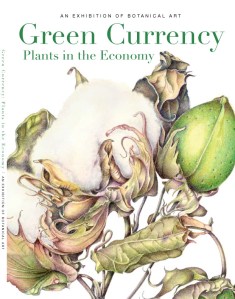
Green Currency: Plants in the Economy, a juried exhibition of original contemporary botanical art depicting plants of economic significance, opens April 20, 2011 and runs through July 31 at The New York Botanical Garden (NYBG). Forty-three pieces of art featuring plants used for medicine, food, clothing and shelter will be on display as part of this exhibition organized and hosted by The New York Botanical Garden and curated by the American Society of Botanical Artists.

The NYBG Institute of Economic Botany (IEB) has focused research on the relationship between plants and people since its founding in 1981, so the selection of economic botany as the theme for the first botanical art exhibition organized by the Garden was fitting. The ASBA with its headquarters located at the Garden has over 14 years experience curating juried international exhibitions making the partnership between the two organizations on Green Currency a natural.

Green Currency capitalizes on the beauty of nature and the mastery of today’s most skilled botanical artists to portray plants upon which people depend for basic necessities and which fuel commerce around the world. ASBA member artists from the United States and 6 other countries, a number of whom are widely collected, are represented in the show. Works in watercolor, gouache, colored pencil, graphite, acrylic, oil, aquatint, and copperplate engraving demonstrate the variety of media employed by contemporary botanical artists, who create art that is both beautiful and botanically accurate.

An audio tour, interpretive material and a catalog have been produced to accompany the exhibition. Using their cell phones, “visitors will be able to listen to what each artist has to say about their experience in capturing that plant” explains Woodin. Signage throughout the Garden ties the living collection to plants featured in the exhibition. The catalog which has “a bit of an interesting story about each plant in the show, artists’ bios and bios for all the jurors” continues Woodin, will be available at the NYBG Shop in the Garden.

Featured on the catalog cover, Esther Klahne’s contemporary watercolor portrayal of cotton (Gossypium herbaceum), contrasts the delicate brittleness of the dried leaves with the fluffy softness of the ball of fibers, and captures reflected light and color throughout the composition. A graduate of the Rhode Island School of Design, she earned a Certificate in Botanical Art through the Wellesley College Friends of Horticulture Botanical Art Program in Massachusetts. According to the International Cotton Advisory Committee (ICAC), cotton fibers are used to make textiles for clothing, furniture and upholstery, medical applications such as bandages and swabs, and pulp for paper. In fact much of the paper on which botanical art is done is 100% cotton rag. Cotton seeds are used as animal feed, to condition soils, and in the production of cottonseed oil. The USDA reports that the United States produced 12.4 million bales (480 pounds/bale) of cotton in 2009 with the largest harvests coming from Texas, Georgia and Arkansas. The U.S. is the third largest producer behind India and China and the largest exporter according to the ICAC.

Inquiries regarding the purchase of artwork should be directed to asbaexhibitions@aol.com.

The New York Botanical Garden is located at Bronx River Parkway and Fordham Road, Bronx, New York.

Read Full Post »

The year was 1765. Eminent botanist Philibert Commerson had just been appointed to a grand new expedition: the first French circumnavigation of the world. As the ships’ official naturalist, Commerson would seek out resources—medicines, spices, timber, food—that could give the French an edge in the ever-accelerating race for empire.
 
Jeanne Baret, Commerson’s young mistress and collaborator, was desperate not to be left behind. She disguised herself as a teenage boy and signed on as his assistant. The journey made the twenty-six-year-old, known to her shipmates as “Jean” rather than “Jeanne,” the first woman to ever sail around the globe. Yet so little is known about this extraordinary woman, whose accomplishments were considered to be subversive, even impossible for someone of her sex and class.
           
When the ships made landfall and the secret lovers disembarked to explore, Baret carried heavy wooden field presses and bulky optical instruments over beaches and hills, impressing observers on the ships’ decks with her obvious strength and stamina. Less obvious were the strips of linen wound tight around her upper body and the months she had spent perfecting her masculine disguise in the streets and marketplaces of Paris.
           
Expedition commander Louis-Antoine de Bougainville recorded in his journal that curious Tahitian natives exposed Baret as a woman, eighteen months into the voyage. But the true story, it turns out, is more complicated.


Who was herb woman, Jeanne Baret?

Find out during EE Week! You are invited to participate in a conversation with author Glynis Ridley during EE Week (April 10-16, 2011).

Immerse yourself into the life story of Jeanne Baret and get ready to ask questions. Order a copy of The Discovery of Jeanne Baret from ArtPlantae Books and save 20% off the list price for this special event.
Offer ends April 17, 2011.


EVENT DETAILS
:

    When: Saturday April 16, 2011 at 11 am-12 pm (PST) / (2-3 pm EST)
    Where: Discussion Forum on the ArtPlantae Facebook page.

UPDATE (4/21/11): Read interview with Glynis Ridley


Synopsis courtesy of Random House, Inc.

Read Full Post »

« Newer Posts - Older Posts »