Feeds:
Posts
Comments

Archive for the ‘Special Events’ Category

Do nature journaling activities work better with some age groups more than others?

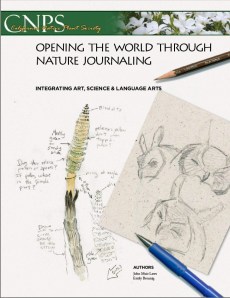
This question was posed to feature guest, John Muir Laws. In his reply, John refers to the matrix he created for the curriculum, Opening the World Through Nature Journaling. In this matrix, he lists each activity, the grade and age each activity was designed for, the length of time required to conduct each activity and special instructions. This matrix can be found on page 5 of the program John created with Emily Breunig and the California Native Plant Society.

Only four days remain to take advantage of the wonderful learning opportunity provided to us by John. Hopefully you have followed the conversation and have requested your free copy of Opening the World Through Nature Journaling.

Teachers, please share this opportunity with your colleagues!

So to get back to the question….

Do nature journaling activities work better with some age groups more than others?

Read John’s reply

Read Full Post »

Sunday, January 1, 2012

This is the deadline for the botanical art and photography exhibition to be held during the conference about plant biodiversity at the University of Washington. Time is running out!

Here again is information and links for participating artists:

The University of Washington Botanic Gardens will host a botanical art exhibition and contest celebrating the native plants and plant communities of northwestern North America. The exhibition and contest will be held in conjunction with the conference Conserving Plant Biodiversity in a Changing World: A View from NW North America, March 13-14, 2012. The exhibition will be on view in the Miller Library at the UW Botanic Gardens from March 1-31, 2012. Conference attendees will vote for the winner in the botanical illustration category and the photography category.

Review of Requirements:

  • Artists must send digital image of their work for consideration.
    Deadline: January 1, 2012
  • Digital image must be 300-800 dpi and must be sent to 2012plantconf.art@gmail.com. Include artist’s name, contact information, name of species, the plant’s native ecosystem and location.
  • Artists will be notified by January 15, 2012 if their work has been selected. Further instructions will be provided at this time.
  • Work must be framed and wired for hanging. No glass. Plexiglass only. Size limit: 20″ x 24″
  • Send all questions to 2012plantconf.art@gmail.com.

Additional instruction (.pdf files) about submitting botanical illustration artwork and photography is available on the exhibition website.


Conserving Plant Biodiversity in a Changing World:
A View from NW North America

University of Washington Botanic Gardens
Seattle, WA
March 13-14, 2012

Read Full Post »

Three dynamic speakers will educate, entertain and motivate you with their garden-inspired lectures at
The Gardens at Heather Farm
.

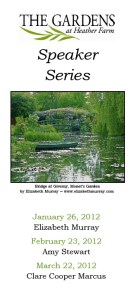
Mark your calendars to see Elizabeth Murray on January 26, Amy Stewart February 23 and Clare Cooper Marcus March 22. Doors open at 7:00 PM with presentations beginning promptly at 7:30 PM. Reception and book signing will follow at 8:30 PM. Advance ticket purchase is $35 ($30 for members of Gardens at Heather Farm. Members can purchase the entire series for $75.

To register for any of these lectures, please contact The Gardens at Heather Farm at (925) 947-1678, reservations@gardenshf.org or visit their website at www.gardenshf.org.

Save these dates!

  • Thursday, January 26, 2012: Elizabeth Murray, author, photographer, painter and key note speaker is a voice that inspires and ignites a commitment to beauty, nature, spirit and sustainability. She has dedicated herself to diverse projects around the world including those in African villages and the Amazon rainforest. However, Elizabeth’s passion for nature is best known in her work helping to restore Monet’s Gardens and photographing them for 25 years.
  • Thursday, February 23, 2012: Amy Stewart, award-winning author of five books on the perils and pleasures of the natural world will provide a spirited insight into the strange world of bugs and plants. Drawing from her work on Wicked Bugs, Wicked Plants, and Flower Confidential, Amy’s humorous lecture will both entertain and inspire the audience.
  • Thursday, March 22, 2012: Clare Cooper Marcus, professor emeritus in the Departments of Architecture and Landscape Architecture at the University of California, Berkeley, is internationally recognized for her research on the psychological and sociological aspects of architecture and landscape design – particularly in urban open space. Clare will present Healing Gardens: How the Design of Green Space in Healthcare is Restorative to the Human Spirit.

Download color brochure

Read Full Post »

By Janice Sharp
Los Angeles County Arboretum & Botanic Garden

The hurricane force winds that hit the Pasadena/Arcadia area on the night of November 30 caused extensive damage to the Los Angeles County Arboretum and Botanic Garden. A preliminary assessment of damage indicates at least 326 trees are a total loss and over 700 require extensive restorative pruning.

The 127 acres of the Arboretum has long been a valuable “green space” in the midst of LA suburbia. It is a place where educational programs flourish along with the many Mediterranean gardens. In the wake of the damage to the Arboretum, an outpouring of community support has lead to the establishment of the Arboretum Tree Fund. This is the single largest tree planting campaign in the garden’s history. Please help with the acquisition of new trees and shrubs by making a GIFT ONLINE, or by MAIL to:

    Los Angeles Arboretum Foundation
    301 North Baldwin Ave
    Arcadia, CA 91007

To make a donation by phone, please call Brittany Fabeck in the Development Office at (626) 821-3237. Please include “Tree Fund” on your donation. 


Related

View L.A. County Arboretum & Botanic Garden Wind Damage

Read Full Post »

Arts & Archives Tour
with Mervi Hjelmroos-Koski
of Denver Botanic Gardens

March 22 – April 3, 2012

This 12-day tour includes visits to the Shirley Sherwood Gallery of Botanical Art at Kew Gardens, viewings of work by Maria Sibylla Merian, William Bartram, Mark Catesby and others. Also included are a tour of the British Library’s medieval illuminations and herbals collection, plus visits to the studio of botanical artist Ann Swan, the home of William Morris, a 150-year old art store, a pharmacy museum, the headquarters of Faber Castell, and so much more! Click on the image to download the itinerary and to read the irresistible details.

Read Full Post »

The month-long opportunity to discuss nature education and how to use drawing as a learning tool in the classroom has begun. Follow the stream of comments where the conversation is happening or view the latest comment in the Recent Comments box now located in the column at right.

John has started the conversation by asking…

    1) Are any teachers out there using nature sketchbooks in your classrooms? What has your experience been?

    2) Do you have any ideas to help motivate ourselves or our students to set aside time to sketch everyday?

Join the conversation…

Read Full Post »

A steward of the environment, especially California’s Sierra Nevada, John Muir Laws, has dedicated himself to revealing the natural world through art and science.

John (Jack) Laws has been an environmental educator for 30 years. He recently collaborated with the California Native Plant Society and with English instructor, Emily Breunig, to create a wonderful curriculum integrating art, science and the language arts.

I am thrilled to introduce John Muir Laws and Opening the World Through Nature Journaling, the Feature Curriculum for December.

John has kept a sketchbook since elementary school. Challenged by dyslexia, he found that keeping a journal was the easiest way to record his experiences. Drawing and sketching helped him see things he had never noticed before. John’s mom gave John his first sketchbook. One year during a family trip, John and his family met a woman who was keeping a wildflower sketchbook. John’s mom noticed how he followed this woman and her sketchbook throughout their trip. On the next family vacation, John’s mom gave him a sketchbook and colored pencils so he could document their vacation. Little did she know that years later, John would use sketchbooks as a teaching tool.

While working as a naturalist group leader at Walker Creek Ranch in northern California, John led activities designed to connect children to nature. He decided to incorporate journaling into his activities to help students slow down and focus in the same way his own journals helped him to slow down and become a better observer. He soon began to notice differences between his journaling audience and the groups of children who ran through the ranch without stopping to see what was really there. John began to expand upon his journaling exercises. The Marin County Outdoor School at Walker Creek Ranch became a great testing ground. It took about four years for John to develop his activities. He wrote up his observations, began sharing them with other naturalists and teachers, and over a period of 10-15 years, his activities were tested hundreds of times and refined. This collection of journaling exercises eventually became Opening the World Through Nature Journaling.

The response to Opening the World Through Nature Journaling has been “amazing”, according to John. He says “(the curriculum) has been well-adopted in California and across the country. Teachers get this is authentic student-driven education.”

While John was developing and testing journaling activities, he was also launching the program Following Muir’s Footsteps and working on his book, The Laws Field Guide to the Sierra Nevada (2007).

Following Muir’s Footsteps is a conservation project for schools in the Sierra Nevada region whose aim is to encourage local youth to become citizen stewards of the Sierra. Encompassing an eighteen-county area around the Sierra Nevada, Following Muir’s Footsteps connects youth to nature through firsthand experiences and journaling. Through this program, John provides in-service training for teachers about how to use field guides and how to use science journals in their classrooms. He also sponsors one mentor teacher from each school so they can attend the Sierra Nevada Teacher Institute, a summer program where teachers learn about the biodiversity of the Sierra Nevada. School libraries also benefit from this fantastic program. The library of each participating school receives 25 copies of The Laws Field Guide to the Sierra Nevada.

The idea to create his comprehensive field guide to the Sierra Nevada was hatched when John was in high school. One day, while hiking the John Muir Trail and juggling many field guides, he thought how wonderful it would be to have all of his field guides packaged into one portable book. By the time he finished high school, John says he could visualize the pages, the layout — everything. John’s grandmother encouraged him to begin working on his dream. At about this same time, he came across a poem by Mary Oliver called The Journey. The first line of this poem read:

One day, you finally knew what you had to do, and began.

So John quit his job and says he “filled my backpack with paper and granola.” He spent the next six years documenting the flora and fauna of the Sierra Nevada. In the early stages of this full-time project, he drew whatever he encountered. At the end, he went into the field with species lists. John says the last few species on his list were a particular challenge and that locating them was a true “scavenger hunt.”

How did John take on the expansive Sierra Nevada? He started at the lower elevations in the south and, as plants bloomed in the Spring, he followed the bloom hopping back and forth between the west side and the east side. Every 1-2 weeks, John hiked out to pick up fresh supplies, get more paper, bathe and shave.

In The Laws Field Guide to the Sierra Nevada, you will find descriptions of over 1700 species and 2,700 watercolor paintings. John drew each plant from life and each illustration was started and completed in the field. Illustrations of birds, insects and mammals began as quick gesture sketches in the field. They were then finished in the studio after a careful study of museum skins, reference materials, and the collections at the California Academy of Science.

When asked how it is he can make so many big things happen, John says none of his programs were launched as big complete packages. He explains, “It was an accumulation of a lot of little pieces coming together organically. This is what makes it possible to do something big.”


Ask The Artist with John Muir Laws

John received a Bachelor of Science in Conservation and Resource Studies at UC Berkeley and a Master of Science in Wildlife Biology at the University of Montana. He is also a graduate of the scientific illustration program founded at UC Santa Cruz, that is now taught at California State University Monterey Bay. In 2011, John received the TogetherGreen fellowship from Audubon/Toyota and this enabled him to deliver the Following Muir’s Footsteps program to 10 schools in the Sierra Nevada. This month, we have the extraordinary opportunity to discuss art, science and education with John.

To take advantage of this opportunity, post your questions or comments in the comment box below. John will respond to questions throughout the month of December.

Teachers, do you know of other teachers who might like to join in the conversation? Please send them the link to this article. The conversation will happen right here on this page.


Request a copy of Opening the World Through Nature Journaling

To request your own copy of the nature journal curriculum written by John Muir Laws and Emily Breunig in collaboration with the California Native Plant Society, click here.


Drawing Plants: Tutorials by John Muir Laws

John recently posted tutorials about how to draw plants on his website. These tutorials were created specifically for teachers. The demonstrations are easy for teachers to recreate in their own classrooms. Leaf and flower templates are available for download. View John’s instructional videos in the Nature Drawing section of his website.


Get “The Laws Field Guide to the Sierra Nevada”

Read Full Post »
« Newer Posts - Older Posts »