Feeds:
Posts
Comments

Archive for the ‘Special Events’ Category

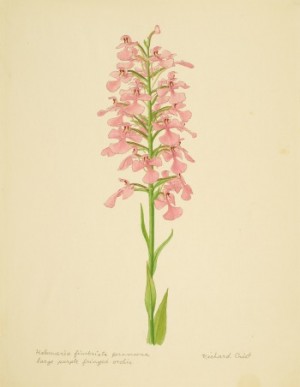
Habenaria fimbriata peramoena, Large purple fringed sic orchis Platanthera peramoena (A. Gray) A. Gray, purple fringeless orchid, Orchidaceae (orchid family), watercolor on paper by Richard Crist (1909–1985), HI Art accession no. 6615.309. © 2012 Richard Crist Estate. All Rights Reserved


Native Pennsylvania,
A Wildflower Walk

Hunt Institute
Carnegie Mellon University
March 2 – June 29, 2012

The Hunt Institute for Botanical Documentation and the Botany department at Carnegie Museum of Natural History will celebrate the native wildflowers of Pennsylvania in a collaborative exhibition opening in March.

Native Pennsylvania, A Wildflower Walk allows visitors to take a virtual walk through a southwestern Pennsylvania growing season and become more familiar with some of the native wildflowers that are integral to so many relationships. Information about Pennyslvania’s many parks, woodlands and wetlands is provided throughout the exhibition. Visitors are encouraged to follow their visual walk with a physical one in many of the state’s wildflower habitats.

Thirty-six wildflower watercolors by Richard Crist (1909–1985) from the Institute’s collection illustrating the simplicity and beauty of Pennsylvania’s native species will be on view. Coupled with Carnegie’s significant herbarium specimens, these pieces combine to create a visual wildflower walk through Pennsylvania’s blooming seasons with a focus on endangered, rare and threatened species within Pennsylvania. Additional watercolors by artists Lyn Hayden and Andrey Avinoff (1884–1949) also underscore the exhibition’s emphasis on the importance of herbaria and their contributions toward research, education and conservation.

Thoughout spring and early summer, visitors can learn more about Pennsylvania’s native plants through a series of public talks that will occur at the Hunt Institute on Sunday afternoons. All talks are free and begin at 2 PM. Plan ahead to attend the presentations below:

  • Why Do Plants Bloom When They Do? Spring Ephemerals and Other Seasonal Flowering Patterns – March 18; Steve Grund, botanist
  • Pressing and Mounting Specimens for a Personal Herbarium – March 25; Jeanne Poremski, landscape designer/botanist
  • Wildflowers of Pennsylvania – April 15; Dr. Mary Joy Haywood, botanist and plant pathologist
  • Wildflowers in the Home Garden – April 22 (Earth Day); John Totten, landscape architect
  • Gallery tour of Native Pennsylvania, A Wildflower Walk (in conjunction with Carnegie Mellon commencement ceremonies), May 20
  • Rare Plants of Pennsylvania – June 24; Bonnie Issac, collections manager at Carnegie Museum of Natural History and exhibition co-curator. This presentation will be held in conjunction with the Hunt Institute’s Open House.
  • Early Pennsylvania in Writing and Images – June 25; Angela Todd, Hunt Institute Archivist. This presentation will be held in conjunction with the Hunt Institute’s Open House.

The exhibition will be on display on the 5th floor of the Hunt Library building at Carnegie Mellon University and will be open to the public free of charge.

Hours: Monday–Friday, 9 a.m.–noon and 1–5 p.m.; Sunday, 1–4 p.m. (except 11 March, 6–8 April, 6 and 27–28 May). The library’s hours of operation are occasionally subject to change, please call or email before your visit to confirm their hours. For further information, contact the Hunt Institute at 412-268-2434.


About the Hunt Institute

The Hunt Institute for Botanical Documentation, a research division of Carnegie Mellon University, specializes in the history of botany and all aspects of plant science and serves the international scientific community through research and documentation. To this end, the Institute acquires and maintains authoritative collections of books, plant images, manuscripts, portraits and data files, and provides publications and other modes of information service. The Institute meets the reference needs of botanists, biologists, historians, conservationists, librarians, bibliographers and the public at large, especially those concerned with any aspect of the North American flora.

Read Full Post »

Naturalists, field biologists, natural resource managers, faculty and students are invited to participate in a regional forum about the natural history of the northeastern United States and eastern Canada. The 2012 conference will be held at the OnCenter Convention Center in Syracuse, NY on April 15-19, 2012.

Session topics include: invasive species, field research methods, urban ecology, biodiversity, fish ecology, wetland restoration and conservation, avian ecology, amphibian conservation, ethnobotany and plant ecology. View all topics here.

Registration for this event is now open. Proposals for presentations, organized sessions, workshops, field trips and special event are still being accepted. Proposal deadlines are fast-approaching, so presenters and organizations should act quickly.

View complete details about this regional forum on the website of the Humboldt Field Research Institute.

Visit the Northeast Natural History Conference 2012

Read Full Post »

Download Information


LATE-BREAKING NEWS

Entry Deadline:
Wednesday, January 18, 2012

Botanical Drawing & Illustration Exhibition
West Valley Arts Council
Glendale Arts Commission
Arizona SciTech Festival
February 3 – March 6, 2012

Botanical art bursts into bloom during the Arizona SciTech Festival, a state-wide event showcasing Arizona’s leadership position in science, technology and innovation. More than 200 organizations in industry, academia, the arts, community services and K-12 education, will introduce Arizona residents to inventive concepts in science and technology occurring within their home state.

The West Valley Arts Council will hold its first botanical art exhibition in historic downtown Glendale, AZ. This exhibition is open to all artists 18 years or older who feature botanical subjects in their work. Lichen, fungi and plant pollinators can also be included. Work must be original and completed with the past two years.

Exhibition Awards: $200 First Place, $150 Second Place, $100 Third Place

Click on the image to download details and contact information.

Read Full Post »

The 3rd Annual Plants Illustrated exhibition opens on Saturday at the UC Botanical Garden at Berkeley. The annual exhibition featuring the botanical paintings and drawings of artists from the Northern California Society of Botanical Artists will be on view through February 3, 2012.

The UC Botanical Garden hosts many botanical art classes throughout the year. Their current schedule of classes is listed below. Be sure to visit
Classes Near You > Northern California to view the Garden’s complete schedule that includes walking tours with horticulturists, a workshop about how to make jams and preserves, and information about the upcoming exhibition about plants, fibers and natural dyes.


University of California Botanical Garden at Berkeley

http://botanicalgarden.berkeley.edu
This 34-acre garden was established in 1890 and is now a non-profit research garden and museum. The botanical art classes below are taught by Lee McCaffree and Catherine Watters. View a detailed schedule and register on the Garden’s website.

  • Plants Illustrated Exhibition – January 14 – February 3, 2012;
    10 AM – 4 PM. The Garden is pleased to announce its third annual botanical art exhibition, Plants Illustrated. The exhibition, held in conjunction with the Northern California Society of Botanical Artists, invites viewers to explore the relationship between scientific study and fine art. The exhibit presents original artworks in watercolor, graphite, colored pencil and pen and ink and explores the many styles, forms and approaches unique to botanical art and illustration. Free with Garden admission.
  • Botanical Art for Youth & Young Adults – Saturday,
    January 14, 2012; 10 AM – 12 PM. In this workshop, young artists will be introduced to botanical art and tour the Plants Illustrated exhibition. Students will learn how to draw plants and have fun making impressive works of art to take home. An online gallery will be created to display artists’ work. Recommended for ages 8 and up. Registration required.
    $20 non-members, $15 members.
  • Botanical Art Through the Ages – Friday, January 20, 2012;
    2:00 – 3:30 PM. Botanical artist Catherine Watters will discuss the rich history of botanical art. View prints, slides and other media. Learn about Pierre-Joseph Redoute´, Maria Sibylla Merian and significant historical events such as Tulipmania and the Age of Exploration. $10 non-members; $5 members, UCB students, staff and faculty.
  • Botanical Illustration: Introduction to Botanical Art with Catherine Watters – Friday & Saturday, March 16-17, 2012; 10 AM – 4 PM. Catherine Watters will teach you to observe, measure and draw plants in great detail and with botanical accuracy. Students will work with graphite, colored pencils and watercolor. All levels are welcome. Cost: $160 non-members, $150 members. Registration required.

Read Full Post »

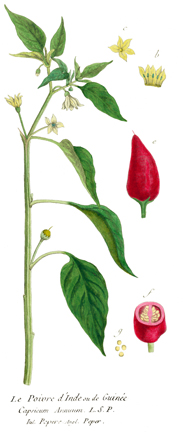
Image courtesy of the Lloyd Library and Museum


Peppers in Image and Word

Lloyd Library and Museum
January 14 – April 13, 2012

The Lloyd Library and Museum in Cinncinnati, OH celebrates Capsicum annuum (the chili pepper) in an exhibition that will feature books from the 16th through 21st centuries, the photography of Eduardo Fuss and the work of Jean Andrews, David Carangilo, Amal Naj, Jeff Schickowski and W. Hardy Eshbaugh.

An opening reception will be held this Saturday, January 14, from 4-7 PM.

Arrive early to learn from pepper expert, W. Hardy Eshbaugh, who will discuss the chili pepper in a special presentation titled,
Some Like It Hot: The Little Known World of Chili Peppers.

Eshbaugh’s lecture begins at 4:30 PM.

Map to Lloyd Library and Museum

Read Full Post »

Wild Green Things: The Art of Anne Ophelia Dowden
Andersen Horticultural Library
Minnesota Landscape Arboretum
January 18 – May 2, 2012

Anne Ophelia Todd was born in Denver and grew up in Boulder, Colorado spending her early years roaming the foothills of the Rockies. Dowden says, “I collected and drew any living thing that came my way, especially insects and flowers, and the study of nature was my absorbing hobby.”

© 2008 Hunt Institute for Botanical Documentation. All Rights Reserved.

After graduated with an art degree from Carnegie Institute of Technology, the artist moved to New York City in 1930, and taught drawing for more than 15 years. During that time, she married fellow artist Ray Dowden. Dowden began her botanical illustration work in the early 1950s, when magazines began to use her artwork on their covers and in their articles. She was in her 50s when she wrote, designed and illustrated her first book, Look at a Flower.

After 60 years in New York City, Dowden moved back to Boulder in the early 1990s to be near family and her beloved mountains. She set up her studio and published her last book, Poisons in Our Path: Plants That Harm and Heal, in 1994, when she was 87 years old. Dowden died in 2007 at the age of 99.

Anne Ophelia Todd Dowden’s artwork will be on view in the Andersen library, the Snyder Building lobby and the skyway ramp between the Visitor Center and Snyder Building. There also will be works in an Oswald Visitor Center display case.

A special insiders look at the art of Anne Ophelia Todd Dowden by exhibit curator, Lucie Taylor, will occur when Wild Green Things opens next week. Visitors will have the opportunity to view Dowden’s books, original sketches and original paintings during a one-hour presentation scheduled for Wednesday January 18 from Noon – 1 PM in the Snyder Building. Limit: 30. Cost: $7.50 members, $10 non-members. Register Online

The Minnesota Landscape Arboretum is located in Chanhassen, Minnesota on State Hwy 5, nine miles west of the intersection with I-494. The largest public garden in the Upper Midwest, the Arboretum is part of the University of Minnesota College of Food, Agricultural and Natural Resource Sciences. Open 363 days a year, admission is $9 adults; free for members and ages 15 & under.

Read Full Post »

Martin J. Allen is an award-winning botanical artist from the UK who creates larger-than-life paintings with exquisite detail. He has earned three gold medals from the Royal Horticultural Society (RHS) and has shown his work in exhibitions held in England, Germany and the United States. Martin’s paintings have been published in three books and are featured in a series of Collectors’ Plates by the RHS. Martin is represented in the United States by Susan Frei Nathan Fine Works on Paper, LLC.

Please welcome Martin J. Allen, the Feature Artist for January!


ARTPLANTAE
: Happy New Year. I am thrilled to begin the new year with the opportunity to introduce you and your work. The start of a new year is always a time when people think big and plan for the year ahead. It is fitting, then, that we begin this year discussing your big approach to botanical art!

The examples of your work that I have seen in catalogs are about 14” x 9”
(36cm x 23cm) in size. They are definitely larger-than-life. Where does the impulse to go big come from?

MARTIN J. ALLEN: The two main influences on going big have been the work of Rory McEwen, whose later works were much enlarged, and the German photographer Karl Blossfeldt in whose black and white images the identity of the plant is secondary to its aesthetic appeal.

The initial impulse came about because I was asked by Constance Hepworth, who owned the gallery Hortus in London at the time, to take part in a joint exhibition on tulips. In trying to think of a way of saying something about tulips that would be different, I enlarged the images.

Later I found that in taking a small part of a plant (about an inch in size) that would otherwise have been overlooked in the garden, and enlarging it to reveal its beauty in detail, enabled me to present something exciting and different without having to travel to exotic countries or search for obscure plant species.

It would have been difficult to create such images without access to a good macro lens on my camera, an A3 colour printer, and of course a computer through which to coordinate it all.


AP
: In an article published by the Pittsburgh Tribune about the 13th International Exhibition of Botanical Art & Illustration held last year at The Hunt Institute for Botanical Documentation, it is explained that you enlarge photographs of your subject in Photoshop and use the printed image as a reference. You then create your original paintings using hand-painted dots. From this I assume you make limited use of washes, if you use them at all. How did you come to use this technique?

MJA: It can take me a month to finish a painting and no plant material stays in good condition for that long, so I always use photographs as reference material for this type of painting. I once had a part-finished painting on my desk for well over two years, as between work and bouts of ill health I didn’t have time to do any painting let alone get it completed. It was worth the wait though – it’s the painting at the top of this page.

My painting technique is a much messier affair than suggested in the article as it’s only tidying up at the end when the dots come into it. Basically I will do whatever I need to so that I get the effect I want.

To start, I add paint with a large brush (perhaps a number 4 or 6) and the paint is not really wet enough to be a wash and not dry enough for dry brush, but somewhere in between. I try to aim for the colour I see rather than building it up in layers, which is too complicated a technique for me. I invariably paint it a bit lighter than I want initially so I have to keep on adding more paint until it’s fairly close to the strength of colour I want. At this stage the painting all looks a bit scrubby (the stage when we all get bad tempered and say it’s not going to work), so I then spend a lot of time filling in the gaps to give the paint a smoother appearance on the paper with a number 2 brush – the smallest size I use. This is where the dots bit comes in as by that then it looks like I’m just adding little marks. It sounds laborious but I can do it quite quickly now.

I think my technique developed as a result of painting on Schoellershammer paper, on which paint lies very much on the surface like it does on vellum. If you paint over wet paint it will lift off the layer below. You can’t mess around with wet paint on the paper so you have to apply some paint and then let it dry. Only when it is dry can you add more paint, so I’ve got used to waiting until later to correct and tidy up.

The painting never looks right until the end. It always seems to me as if I spend all my time correcting mistakes I’ve made before. In my head I have this idea that every brush stroke should be perfect but life never works out like that. Sometimes I recognise a painting isn’t working but can’t see why, having looked at it too much. I hide the painting away for a couple of months and then look at it with fresh eyes. It’s surprising just how much easier it is to be constructively critical of your work once all the emotional baggage of applying the paint is forgotten.


AP
: If you work mostly dry, how to you keep color consistent throughout a painting? It is one thing to use stippling technique with a single pen and an unchanging medium. But paint is fussy. How do you manage color mixing, pigment concentration, etc. from one area to the next?

MJA: Colour is so important in how real or natural a painted image looks, especially with a large image.

I spend time at the beginning of a painting working out which paints I will use to mix all the colours in the painting and I practise mixing those colours so I can get an idea of proportions and density of colour I will be using. I don’t actually have many paints in my palette (about six I use regularly – perhaps ten in total) to use anyway so the choice is not that difficult!

I have a flat palette and place blobs of the three colours I’ll be using most in the corners and then mix them in the middle of the palette. When I mix a colour, I mix small amounts and then put it on the painting – applying colour to a test swatch first to check it is right for the area I am painting, and then I get on with mixing up the next lot.

I’m reasonably consistent but there are always slight variations – it’s these slight variations that I think make a painting look more real. If you think about how you look at a plant, then you can see why this might be. Your two eyes see slightly different versions of the plant and your head is always moving, so your eyes will register constant slight colour changes over the plant as the light changes when your head moves. A slightly varying colour over the whole of the painting is the way I translate this onto paper.


AP
: On your website, you explain that your objective is to “draw people into the painting and engage them.” How do you accomplish this? When you select a specimen, do you look for features that you think will draw people’s attention or do you choose your specimens based on your own reaction to them and then only later decide how to present the specimen in a captivating way?

MJA: Great question. I’ve spent a lot of time thinking about how a person views a painting. What they look for and what they see there depends on how much they know about art or about botany. I think there are a few generalities that can be made about what it is I am looking to create in a painting.

Firstly, a striking visual image when viewed from afar is needed to catch people’s attention so that they come and look at the painting at an exhibition. Then a clear focal point – a place in the image that immediately attracts the attention – to hook them in, followed by some secondary focal points so that the eye can move around the image and keep the viewer engaged. A variation in colour and texture also helps keep the image interesting.

Then I’ve tried to present an image that is not instantly recognisable; something that is ambiguous. A consequence of enlarging the plant material and taking it out of context is that we have no easy reference points in our brain and so we can’t identify it straight away. So the brain projects ideas of what it might be onto the image to try and get a best fit from our past experiences. It’s this that leads to the feeling that the paintings remind you of something else. I find this approach allows space for a more emotional and thoughtful response from the viewer than simply depicting all of the plant clearly as would occur in a botanical illustration.

In looking for plant material to paint, I basically wander round a garden or the local park and look for things that catch my eye. I bring them back to the studio and photograph them from different angles. Sometimes I chop things off if I think that will make a more striking image. I then choose what to paint when I look at the resulting photographs. It is surprising how things I am excited about in real life don’t always work on paper and then something I picked just because it was there, suddenly looks amazing when enlarged. There have been images that I knew I wanted to capture and so then I will visit a plant everyday to catch it at the right moment.

So my specimen choice works on a bit of luck, a bit of judgement, and a lot of discarding things that don’t work.


AP
: Your career as a contemporary botanical artist spans 20 years. How has contemporary botanical art changed since 1992?

MJA: The general technical standard of paintings is so much higher now than it was when I started and there are so many more botanical artists painting – which is all very exciting. One thing I am really enjoying at the moment is the way some artists are pushing the edges of how we see plants within a botanical art context and producing a contemporary image that reflects the present Zeitgeist.

Also one very important advance has been the influence of the Internet, as it is now so much easier to keep up with what is happening no matter where you live.


AP
: What would you like to see botanical art groups and organizations across the globe accomplish?

MJA: I think they should do whatever they want to do. There’s absolutely no point being an artist if you aren’t enjoying yourself and doing your thing on your own or as part of a group; it’s never going to make you rich, so you may as well be happy.

Visit Martin’s website to learn more about him and to view samples of his work. There you will also find links to websites of fellow botanical artists, descriptions of the classes he teaches, and a link to the exhibition guidelines for showing work at the Royal Horticultural Society.


Ask the Artist with Martin J. Allen

This month we have the opportunity to discuss botanical art and “seeing” with Martin. Do you have questions about his stippling technique? Have you been wanting to break out and take a more bold approach to botanical art? Let’s talk!

Please forward the link to this article to colleagues and friends who may wish to participate.


Related Information

Read Full Post »
« Newer Posts - Older Posts »