Feeds:
Posts
Comments

Archive for the ‘Special Events’ Category

Laura Stickney: Aspects of Theodore Payne Foundation in Line and Color
Theodore Payne Art Gallery
Sun Valley, CA
Oct. 12 – Dec. 29, 2012

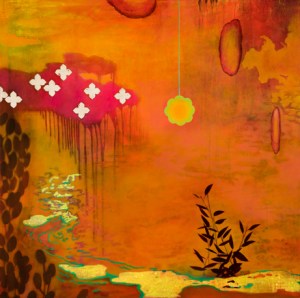
The Theodore Payne Foundation for Wild Flowers and Native Plants (TPF) invites you to the opening reception of the art exhibition celebrating the work of artist-in-residence, Laura Stickney. Luminous watercolors, richly colored oil paintings and seed-packet artist’s books will be on view. Created over the course of Laura’s one-year residency, each piece was inspired by the nursery, gardens, and other discoveries made at the Theodore Payne Foundation.

Laura Stickney is a graduate of USC with a major in printmaking. In addition to her work as an artist, Laura has taught art to all ages for 25 years at the well-known Barnsdall Art Park in Hollywood, and the art of printmaking at the Art Center College of Design in Pasadena.

Here are examples of the wonderful work Laura created during her residency. View the entire collection and learn from Laura yourself during the opening reception on Saturday, October 13, 2012. The reception will be held from
2:00 – 4:30 PM. The Artist Talk begins at 3:00 PM.

Many thanks to the Theodore Payne Foundation for this early look at the exhibition. Images and descriptions courtesy of The Theodore Payne Foundation.


Seed Packet Artist’s Books

Laura’s artist’s accordion books are based on Theodore Payne seed packets. Unfolded, they reveal delicate graphite drawings of selected native plants, a tiny clear bag of seeds, and a poem written by Laura and inspired by that plant.
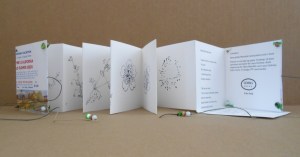
Seed Packet Artist Book 3, mixed media © 2012 Laura Stickney, all rights reserved


Pod Paintings

Painted from life, Laura’s series of small oil paintings of native seed pods at TPF are densely packed with information, texture and color. The images are painted on repurposed, rectangular Polaroid metal film canisters. The use of discarded film containers is linked and refers back to Laura’s concept of light. In some way, the paintings refill those empty Polaroid vessels with new memories.
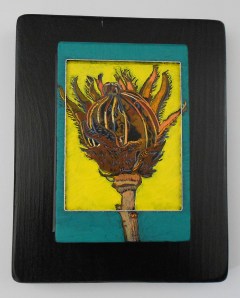
Matilija Pod, oil on Polaroid metal film canister © 2012 Laura Stickney, all rights reserved


Watercolors

Laura’s iridescent watercolors capture the beauty of sunlight and the colors of TPF. Conceptually layered, they focus on the place where nature and culture collide, where the nursery plants and the evidence of their caretakers intersect: a plant cart, a plant pot, a secluded corner of the garden. “All of my work is about still life,” Laura says. One could call these watercolors of nature and culture “environmental still lifes.”
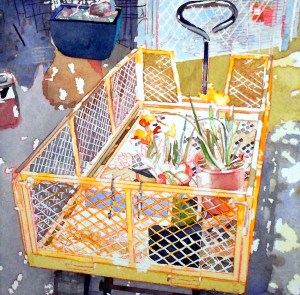
Plant Cart, watercolor on archival paper © 2012 Laura Stickney, all rights reserved
Read Full Post »

Every first Thursday of the month, the city of Riverside hosts its “Arts Walk” celebration. During this monthly celebration, museums, galleries and art studios open their doors to the public.

The celebration planned for the first Thursday of October, however, will be a little different.

This week, Riverside launches the first ever Long Night of Arts & Innovation, an event showcasing some of the best Riverside has to offer. Members of Riverside’s business, university and arts communities will take part in this special evening. More than 130 exhibits will be set up in downtown Riverside. The 24-page event program includes information about art demonstrations, theatrical performances, musical performances, presentations for entrepreneurs, and a long list of interesting conversations led by faculty from local colleges and universities.

Conversations such as the one led by Dr. Jodie Holt, UC Riverside botanist and consultant for the James Cameron movie ‘Avatar’. Dr. Holt will present Do you ‘see’ plants? Raising Plant Awareness through Art, Science and Media at the
UCR California Museum of Photography from 7:30 – 8:15 PM.

The Long Night of Arts & Innovation will take place this Thursday, October 4 from 6 PM – Midnight. This event is free. All are invited!

Read Full Post »

Divine Rain © Ruth Ava Lyons. All rights reserved

The Road Not Taken
Nature Art Gallery
North Carolina Museum of Natural Sciences
Raleigh, NC
October 5-28, 2012

Ruth Ava Lyons will be the Nature Art Gallery’s featured artist for October. Lyons’ oil paintings and an ongoing body of work inspired by her travels and field studies of oceans, wetlands, national forests and wildlife preserves will be featured in the exhibition, The Road Not Taken.

A Fulbright Fellow, Lyons has exhibited continuously since 1982 in group and solo shows nationwide. She has received several grants and awards, including one from the National Endowment for the Arts and two from the NC Arts Council, and has received Artist Residencies including her most recent residency at Everglades National Park (2011).

Meet Ruth Ava Lyons at the opening reception this Friday, October 5, from
6:30 PM to 9:00 PM.

The North Carolina Museum of Natural Sciences is located at 11 West Jones Street in downtown Raleigh (Directions/Map).

Hours: Monday-Saturday, 9 AM – 5 PM and Sunday 12-5 PM.

Admission: Free

Read Full Post »

Plant models by Gary Hoyle. All rights reserved

What is the first image to come to mind when you hear the word, diorama?

Do you see an open shoebox laying on its side containing a scene depicting life at one of California’s historic missions? How about a mountain scene? A desert scene perhaps?

While smaller and much simpler in construction, the classroom diorama is really no different from the dioramas seen in natural history museums. What they have in common, is they are all snapshots of life occurring at a site-specific location.

Dioramas were patented by Louis Daguerre in 1822 (Hoyle, 2008). Daguerre was a stage designer in the theatre and the inventor of the daguerreotype (Hoyle, 2008). Daguerre’s “stage window” (Hoyle, 2008) eventually evolved to become the nature scenes we know today.

These incredibly detailed landscape scenes are created by a dedicated team of curators, scientists, historians and artists who work together to connect the public to nature. Artists such as Gary Hoyle who specializes in creating representational work for museums.

How did Gary’s museum career get its start?

When Gary was ten years old, he saw his first wildlife diorama at the Museum of Science in Boston, Massachusetts. He says that after this visit, he became obsessed with creating environments for the clay animals he made as a young child. When he was fourteen, he was invited to watch Klir Beck, curator of the Maine State Museum, create the Black Bear Diorama. Sometime after this experience, he showed Beck his animal sculptures and, to his surprise, was invited to sculpt two box turtles for another exhibit. Months later, a 15-year old Gary presented the turtles to the Governor of Maine during a ceremony at the museum.

After high school, Gary studied biology instead of art because he had little interest in abstract art, which was the focus of art programs at the time. While he wanted to combine art and science in some way, Gary felt a burden to be practical because “the whole idea of having a profession in ‘diorama art’ seemed more like a childhood dream than anything remotely possible in the 1960s.” Because there were no scholarships and no way to create a degree with an interdisciplinary focus, Gary studied zoology at the University of Maine.

Years later while finishing up his degree and during his three years of teaching, Gary checked-in with the Maine State Museum periodically to see if they were hiring. In 1973, he was hired as a Research Associate in Natural History at the museum’s new home in the Maine State Cultural Building. Gary’s mentor for those first ten years was Fred Scherer. Scherer had retired from the American Museum of Natural History (AMNH) in New York and worked at the museum in Maine once per week as a museum consultant. Gary says Scherer taught him the techniques he learned as a preparator during his 38-year career at the AMNH. From Scherer, Gary learned how to make small plants, ledges, leaves and trees for the foregrounds of dioramas. He also learned some of the painting techniques Scherer had learned while working as a background painter for legendary artist James Perry Wilson. Gary says he still learns from Scherer, now 97, by phone and when he goes on walks. Gary says, “…when I walk in nature, (I) remember his advice.”

Gary’s first challenge in creating botanical specimens occurred after his mentor left the museum. While he had a good foundation in plant fabrication, this new project required Gary to create hundreds of berries, fruits, plant parts and life-like plant specimens for an exhibit about native American edible plants. Adding to this challenge was the size of his work space — a 12′ by 16′ lab at the museum. Gary says he had to do a lot of experimenting before he could even create his first plant specimen. At the time, there was only one other person in the US creating plant models in wax (Gary’s preferred medium because of its low toxicity). This other person was Dick Sheffield at the Museum of Science in Boston. Gary contacted Sheffield and Sheffield provided a lot of helpful advice about working with wax. Even with all of Sheffield’s generous advice, Gary said, “collecting, color noting, preserving, mold making, wax coloring, casting, fabricating and mounting consumed two years of my work days.”

Today Gary works as an exhibits consultant and a visual artist whose specialty is representational works for museums, corporations and individuals.

This month we have the unique opportunity to learn about plant models, exhibit design and dioramas from an expert with forty years experience in the museum field.

Please join me in welcoming Gary Hoyle, our featured guest for October.


Literature Cited

Hoyle, Gary. 2008. From theatrical illusion to ecological theater: The development of the classic wildlife diorama. Journal of the Guild of Natural Science Illustrators. Volume 40, Number 8.

Read Full Post »

Last month the nonprofit group Botanical Artists for Education & The Environment, announced that a copy of the hard-to-find and very expensive book, An Approach to Botanical Painting, will be raffled off on October 28. Proceeds from the raffle will be used to help cover the publication costs of their book, American Botanical Paintings: Native Plants of the Mid Atlantic.

Raffle tickets for a brand new, autographed copy of Anne-Marie and Donn Evans’ book can be purchased for $10. Interested parties can download a Raffle Ticket Order Form on the BAEE website.

Learn more about the BAEE book project

Read Full Post »

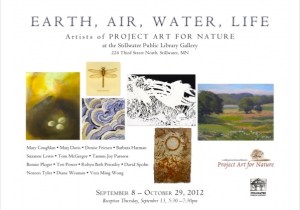
Earth, Air, Water, Life
Sept. 8 – Oct. 29, 2012
Stillwater, MN

Fourteen artists from
Project Art for Nature are participating in Earth, Air, Water, Life an exhibition now on view at the Stillwater Public Library Gallery in Stillwater, MN. The artists of Project Art for Nature work independently and with each other to create art promoting awareness of threatened natural areas in Minnesota and Wisconsin. They host educational art exhibitions every year at art galleries, nature centers, libraries and other venues in both states.

Visit the Stillwater Public Library

Read Full Post »

The annual fall plant sale at the University of California Botanical Garden at Berkeley will be held this weekend.

The garden’s native plant sale is also coming up soon. Read more about this annual celebration, the upcoming iPhoneography class, and the last Butterfly Walk of the year below.


University of California Botanical Garden at Berkeley

http://botanicalgarden.berkeley.edu
This 34-acre garden was established in 1890 and is now a non-profit research garden and museum. The botanical art classes at UCBG are taught by Lee McCaffree and Catherine Watters. View a detailed schedule and register on the Garden’s website.

  • Sick Plant Clinic – First Saturday of Each Month, 9 AM – 12 PM. Free.
    No reservations required.
  • Monthly Butterfly Walks – Fourth Tuesday of each month (March – October); 3 – 4 PM. Garden volunteer, docent, and caterpillar lady, Sally Levinson, will lead walks through the garden in search of butterflies. Space is limited. Children welcome. Free with admission.
  • Garden Strollers – Second Wednesday of Each Month,
    11 AM – 11:45 PM. A 45-minute tour of the garden for adults with young children (3 and under). Tour will end on the lawn for play and snacks (bring your own). Children must be in a stroller or carrier during the tour. FREE with garden admission. Meet in front of the Garden Ship. For more information, call (510) 642-7082 or email garden@berkeley.edu.
  • Fall Plant Sale – Sunday, September 30, 2012; 10:30 AM – 2:00 PM. Get a head start at our eagerly anticipated fall sale. We specialize in regionally appropriate, Mediterranean-climate plants including California natives, and plants from South Africa, Australia, the Mediterranean region, and South America. We also have the exotic and unusual. Our wide variety of plant offerings will appeal to everyone. See the UCBG Fall Plant Sale page for more information.
  • iPhoneography: Create Great Garden Photos Using an iPhone October 6, 2012; 9:30 – 12:30. Get the photos you want with iPhone photographer, Yoni Mayeri. View Details/Register
  • Native Plant Extravaganza – October 7, 2012; 10 AM – 4 PM. Lectures and plant sale. View Details

This information can also be found at Classes Near You > Northern California.

Read Full Post »

« Newer Posts - Older Posts »