Feeds:
Posts
Comments

Archive for the ‘Special Articles & Interviews’ Category

Caitlin Bergman Creating the Permasphere

Authentic Passion

Caitlin Bergman knows permaculture.

She lives it, she feels it, and she shares her authentic passion with others in her role as designer, instructor, and lead permaculturist at the Los Angeles County Arboretum and Botanic Garden. The enthusiasm Caitlin exudes for her subject couldn’t possibly exist in a purer form. Caitlin “does permaculture all day and dreams about it at night.”

A graduate of the University of Hawaii, Caitlin earned a degree in Botany, with a focus on Ethnobotany. While at UH, she researched native forest restoration, focusing on soil seed bank and community structure studies at Lyon Arboretum. She also did a year-long study on the unusual produce found within Honolulu farmers’ markets.

Since being hired to work as a propagation specialist two years ago, Caitlin has served as interim-curator of the LA Arboretum’s Grace Kallam Garden, and is concurrently the curator and designer of both the Vegetable Garden and the Permasphere, The Arboretum’s new permaculture garden. She received a certificate in permaculture design and has become a popular spokesperson at the Arboretum.

Current projects include designing Pasadena City College’s first permaculture garden, mentoring Barnhart School (a local elementary school) with the creation of a permaculture garden to serve as a teaching tool for students, as well as creating a food forest at Chateau Colombier, a bed-and-breakfast in Provence, France. Caitlin’s largest project at the moment is the creation of the permaculture garden at the LA County Arboretum & Botanic Garden.

The Arboretum’s permaculture garden has been designed to harvest rain. The placement of this garden is deliberate. It is to serve as a water retention garden whose primary function is to capture runoff from the compost area at the Arboretum. Currently, water flows freely from the piles of cut vegetation destined for mulching and redistribution throughout the Arboretum’s many gardens. When water flows out of this area, it flows rapidly down internal access roads, through the parking lot, onto busy Baldwin Avenue, and continues down to the ocean. Now that the permaculture garden is in place, water will enter the garden and be stored in swales carved out of an area that used to be a simple patch of flat dirt. Swales are channels on contour in which water pools. The water collecting in these gentle contoured areas percolates into the soil. Barrels will also be used to harvest water. These barrels will hold both rain water and gray water. Caitlin estimates the Arboretum will be able to capture hundreds to thousands of gallons of water and reduce street runoff which is the source of 70% of all the pollution entering the ocean.

In addition to serving as a rain garden, the permaculture garden will serve as an outdoor classroom. Visitors to the Arboretum will learn how to create food forests at home and learn how to prepare the food and other useful products growing in their urban forests. There are plans to build a cob oven in the new garden and this will enable visitors to learn new green building techniques as well.

What is permaculture exactly? The word “permaculture” is derived from the word perma meaning “permanent” and the word culture which refers to human culture or agriculture. This word was created by two Australians who use it to refer to “permanent culture” and “permanent agriculture” (Hemenway, 2009). Permaculture is about sustainability. It is a systems approach to creating a sustainable landscape for humans and other animals. Permaculture isn’t about planting a specific type of plant. It is about creating an “ecological garden” (Hemenway, 2009) that encourages biological processes observed in nature. Naturally occurring events such as the accumulation of leaf litter that creates habitat for earthworms (and eventually nutrients that will be used by plants) are allowed to happen. Caitlin constantly reminds people that Mother Nature does not own a weedwacker, a rake, or a rototiller. She explains that “permaculture is about unity and support of each other and of nature. Monocrops we depend on in agriculture (and in our gardens) are forced upon nature. Because this system is working against nature, it can not be separated from herbicides, pesticides, and a tremendous amount of work.”

Caitlin is documenting the progress of the new rain garden on her blog SayPermaculture.com. She has also documented the development of the Peacock Food Forest that was created in 2008. Be sure to read about this lush forest located near the Arboretum gift shop.


Would you like to learn more about creating a sustainable homestead? Save these dates!

Los Angeles Garden Show
LA County Arboretum & Botanic Garden
April 30 – May 2, 2010
9 AM – 4 PM
Visit the Permashpere! The new permaculture garden will be open this weekend. Demonstrations, lectures, hands-on activities and cooking lessons are planned. Also, attend Caitlin’s presentation, Enter the Permasphere: Portal to Permaculture in Ayres Hall on May 1 at 2:00 PM.

Permaculture Design Certificate (PDC) Course
LA County Arboretum & Botanic Garden
Saturdays, May 8 – June 26, 2010
Sunday, June 27, 2010
This 72-hr, hands-on course will cover: urban food forestry, landscape design, habitat restoration, rapid soil rebuilding, earthworks, sustainability, food production, rain and grey water use, and community integration. This course is open to anyone with an interest in sustainable, solution-based design. Cost: $200 non-refundable deposit due by May 3, 2010, plus $1000 tuition for this certificate course.

Water Harvesting
LA County Arboretum & Botanic Garden
Saturday, May 22, 2010
10am-12pm
Learn how to contour the earth to create water-collecting swales in the urban landscape. Also learn how to harvest rain water and how to use rain water and grey water at home.


Caitlin asks EE Week Readers
:
How does the Earth design gardens? Do we garden like nature? If not, what could we change to garden naturally?


Literature Cited

Hemenway, Toby. 2009. Gaia’s Garden: A Guide to Home-Scale Permaculture. Second edition. Chelsea Green Publishing. Learn More
Read Full Post »

Step into the herbarium at Rancho Santa Ana Botanic Garden (RSA) and you step into a world rich with history. This herbarium contains an impressive 1.1 million specimens. The collection is comprised of mostly vascular plants. Ancillary collections include 3,000 pickled cacti, seeds, pine cones, and a small collection of lichens. Of the more than one million specimens, it is estimated 600,000 are from southern California.


What is an herbarium and what happens in an herbarium?

An herbarium is a collection of plant specimens that have been pressed, dried, and mounted onto archival sheets of paper. An herbarium sheet is comprised of a pressed specimen and a label containing collection information, such as the name of the plant, the name of the collector, and location information. Often times, there will also be seed envelopes and fragment folders on an herbarium sheet. Seed envelopes hold loose seeds and fragment folders hold bits that may have broken off the mounted specimen or they may hold some other material the collecting botanist deemed to be important.

Mounting pressed plant specimens onto herbarium sheets is a never-ending task at any herbarium. At RSA, herbarium staff and dedicated volunteers spend countless hours mounting plants onto herbarium sheets. Each morning volunteers go to the herbarium’s workroom to mount whole plants, flowers, branches, leaves, and seeds. Specimens are attached to herbarium sheets with water-based glue that does not yellow with age. On average, 10,000 – 12,000 specimens are acquired by the RSA herbarium each year. Some specimens are collected by RSA botanists, some are donated by other individuals, and some are on loan from other institutions. This year RSA will acquire closer to 15,000 specimens because of the recent acquisition of the private collection of Dr. Robert F. Thorne, a former curator of the RSA herbarium.

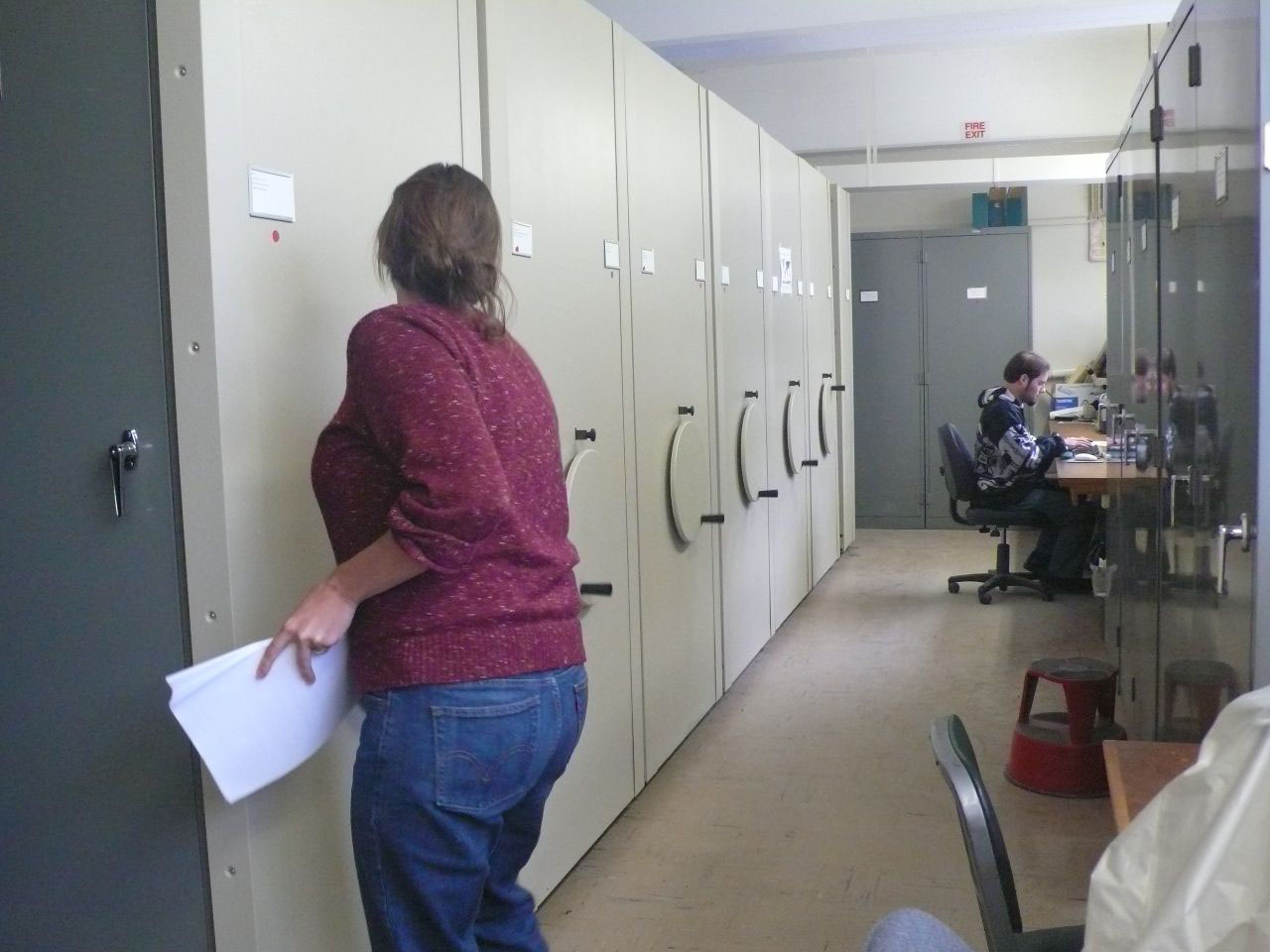
After herbarium specimens have been mounted, dried for a week, and all items securely attached, they are brought upstairs to the collection. The RSA herbarium occupies two complete floors. Here they are placed into cabinets for permanent storage. The herbarium’s more than 1 million specimens are arranged in a filing system of specially-designed cabinets. To maximize space, the cabinets line up next to each other the way the pleats of an accordion lineup next to each other. The cabinets slide and separate by turning the handles seen in this photo.

Open the door to one of the cabinets and you will find folders filled with mounted plant specimens. The large folders housing the herbarium sheets are called genus folders and they contain examples of species belonging to a given genus. For example, in the genus folder for Salvia, you might find mounted plant specimens of Salvia mellifera, Salvia nigra, etc. If you look at the genus folders located at the top of the cabinet, you’ll notice some of the folders are different colors. Genus folders are color-coded and each color represents a different region of the world.

Many of the plants in the RSA collection were collected by RSA botanists. Botanists collect three specimens of each species. They keep one and trade the other two specimens. RSA has been collecting this way since the herbarium opened in 1927. There was a collecting boom in the 1930s and 1940s. Collecting dropped off in the 1950s, however. Through continuous collecting and the acquisition of personal collections, RSA has become the 10th largest herbarium in the United States.


What happens with the specimens after they are added to the collection? Do they stay in a cabinet forever?

Not exactly. Although it may seem this way. Herbarium specimens are viewed and studied by botanists, graduate students, and other researchers. Specimens are also loaned to other herbaria. Sometimes a botanist cannot find an herbarium specimen where she/he is conducting research and they have to borrow the specimen from a distant herbarium.

Herbaria across the world have always worked cooperatively to aid researchers with their studies. The way herbaria work with each other is about to change as research facilities are using technology to their advantage. Soon researchers will no longer have to borrow specimens from distant herbaria. All they will have to do is go online to view the specimens they need. There is a huge scanning project underway and the RSA herbarium is helping to lead the way.

The scanning project is a collaborative effort of institutions worldwide. It is part of a larger movement called the Global Plants Initiative (GPI) headed by the Andrew W. Mellon Foundation. The RSA herbarium is contributing to this effort thanks to a grant from the Foundation. Rancho Santa Ana Botanic Garden has been able to obtain a digital scanner and fund the digitizing of all the type specimens at RSA. Type specimens are the original specimens used to describe a new species. In addition to the scanning of RSA’s 6,500 specimens, the type specimens at The Huntington Library, Art Collections, and Botanical Gardens, the San Diego Museum of Natural History, Santa Barbara Botanic Garden, UC Riverside, and UC Santa Barbara are also being scanned. This means that RSA alone will be responsible for digitizing 10,000 type specimens. The objective of the GPI project is to digitize representations of the world’s flora and to make these digital images available for viewing. The scanning project will not be available online to the public until 2013.

For this article, I met with Sula Vanderplank, Administrative Curator of the RSA herbarium, to learn about what goes on behind-the-scenes at the herbarium. During my visit, I had the opportunity to observe the scanning of one herbarium specimen. What a treat that was! The scanner used by the imaging team is much larger than the average office scanner, as it needs to accommodate herbarium sheets that are 12.5″ x 18″. Since dried plants are fragile and herbarium sheets cannot be placed face down on the scanner the same way a sheet of paper is normally placed onto a scanner, the scanner is the item that is inverted. The inverted scanner rests securely in place on a cart designed especially for the scanner. The scanner rests with the glass plate facing down. Herbarium sheets are placed on a platform and this platform is raised, thereby bringing the herbarium specimen to the scanner’s glass plate. The Scan button is clicked by the technician and the rest is magic. Each scan is 600 dpi and 200 MB. One scan takes 10 minutes to complete. The 10-minute scanning process includes the placement of the herbarium sheet, the actual scanning of a specimen, and the cataloging of an image. The imaging team can comfortably scan five specimens per hour.

If you have an image in your head right now about what a scanned herbarium sheet might look like, magnify the clarity of your vision by 10. The images created by the imaging team are crystal clear. The tiniest detail can be observed and when zoomed in upon, details can be viewed in an even more mind-blowing way. These herbarium images from Kew Botanic Gardens do not match what I saw in person, but they will give you an idea of what an herbarium scan looks like. Some of the images created by the RSA imaging team can be purchased in the garden’s gift shop. These images are of herbarium specimens of plants growing on the grounds at RSA. These images have been carefully mounted using archival materials and framed behind glass that protects the specimens from sunlight.

The Global Plants Initiative will not only open the world’s herbaria to researchers, but introduce the public to the diversity of plants on our planet.

Are you interested in learning more about how an herbarium works and how to create herbarium specimens? Then you might be interested in a special herbarium class taught by Sula and other key members of the herbarium staff. This class is offered only a couple times per year, so check the Rancho Santa Ana Botanic Garden Calendar regularly.


The RSA Herbarium Connects With Teachers

The Rancho Santa Ana Botanical Garden has a longstanding relationship with teachers and schools in southern California. School groups tour the garden and the herbarium during the school year. The herbarium has a special show-n-tell collection comprised of mounted plant specimens, one of the them having been collected by explorer Captain James Cook himself. To learn more about docent-led tours for K-12 students, college classes, youth groups, and adult community groups, visit the RSABG website.


Question for EE Week Readers in southern California
:
Would you like to take the herbarium class at Rancho Santa Ana Botanic Garden? If so, please add your name to an Interest List for this class.


April 2014 – Links to the RSABG website have been updated. The original link to ArtPlantae Books has been removed.

Read Full Post »

The current renaissance of botanical art began in the 1980s. Dr. Shirley Sherwood is credited with reviving the public’s awareness of botanical art. Since the first certificate program in botanical art was established at the New York Botanical Garden, programs have been established in Arizona, California, Colorado, Florida, Illinois, Maryland, Massachusetts, Minnesota, North Carolina, Pittsburgh, and Washington DC. Public workshops in botanical art are offered in almost every state across the country at botanical gardens, community centers, and even online. Regular readers of this website are treated to news of new workshops almost weekly and are not surprised by the rich offering of learning opportunities across the country.

Newcomers to botanical art and illustration, on the other hand, are surprised to learn there are certificate programs for this centuries old discipline considered by some to be merely a hobby of weekend art enthusiasts. Because ArtPlantae has the attention of such a large audience this week, I thought it would be a good time to address a question I’ve heard more than once which is:

So what is a certificate program in botanical art, anyway?

Answering this question for us today are Lee McCaffree and Catherine Watters, founders of the certificate program at the Filoli Estate in Woodside, CA. Lee and Catherine serve as the primary instructors and curriculum designers for this program. Here is what they have to say about Filoli’s certificate program and the value of botanical art education:

Botanical art emphasizes the connection between nature and art. Botanical artists develop the skill of observing nature in detail so they can create an accurate image of plants. This art form is a way to document the plants in our environment. Artists have an awareness and understanding of plants because they spend many hours observing and painting them. When these paintings are displayed in an exhibition, audience awareness of plants increases.

The Filoli Botanical Art Certificate Program gives students a way to learn this art form by offering a unique, in-depth study of botanical art through challenging, integrated and comprehensive courses. The curriculum includes the systematic study of artistic skills and concepts, basic botany and botanical art history. A certificate is presented upon successful completion of coursework (180 classroom hours plus homework) and presentation of a portfolio and final project. This program is for the serious student who wishes to develop knowledge and skills in botanical art. The minimum time for completion of the program is generally 2 years; there is no limit on how long a student may take to finish.

What makes the Botanical Art Program at Filoli unique is that it is taught in the beautiful Georgian country house surrounded by a spectacular 16-acre English Renaissance garden and 600 acres of open space. The certificate program has long been an essential part of Filoli’s mission to interpret and preserve the history of this country estate and its surroundings in the San Francisco area. Plants from the garden are used regularly as subjects in the classroom.

The program at Filoli teaches individuals how to “interpret and observe” in the same way explorers, botanists, and artists recorded their discoveries so many years ago. In addition to the integrated coursework designed by Lee and Catherine, the Filoli program invites highly acclaimed national and international interpreters/observers to teach at Filoli. Programs with visiting instructors are usually intensive multiple day courses and provide students with truly unique learning opportunities.

Filoli is participating in National Environmental Education Week through its nature education program which, like the botanical art program, encourages environmental awareness. View Filoli’s EE Week activities on their website. Be sure to also read about their Teachers and School Programs and the workshops for families and children, including a botanical art workshop for kids scheduled for April 24, 2010.


Related Information
:


Question for EE Week Readers
:

Read Full Post »

© Kari Malen. All rights reserved

© Lori Makarick. All rights reserved

Botanical illustrators at the Desert Botanical Garden are living a dream. They are continuing the centuries old tradition of documenting plants to create both a scientific record for biologists and educational material for the public. The botanical illustrators who have endured five years of study and many hours in the studio are about to make their work public.

Eighteen illustrators will present 40-50 pieces of work in the Celebration of Plants exhibition to be held at Kolb Studio on the south rim of the Grand Canyon (July 2 – August 31, 2010). This exhibition is a cooperative effort between the Grand Canyon Association, Grand Canyon National Park and the Desert Botanical Garden in Phoenix, AZ.

Many lectures and activities will be presented during this exhibit. Artists and botanists will draw visitors into the world of art and science by sharing stories about early explorers and the botanists/artists who accompanied them. There will be explanations about how new species are described and discussions about why people should care about plants. Learning activities will include guided plant walks, plant identification workshops, guided plant walks into the canyon, and illustration workshops for all levels.


A Practical Idea Grows

Six years ago Wendy Hodgson, Herbarium Curator at the Desert Botanical Garden, met Lori Makarick, the Vegetation Manager at the Grand Canyon who oversees the management of rare plants, invasive species and habitat restoration. At the time, Makarick was reading a field guide about the special status plants in the Grand Canyon by former botanist, Nancy Brian. Makarick noticed the guide did not contain enough key characteristics in the plant descriptions and that some plant descriptions were not accompanied by illustrations. Hodgson and Makarick discussed updating the field guide. They thought it would be good idea to include an illustration for each plant described in the guide. When they discussed this, Wendy’s thoughts went immediately to the new botanical art and illustration certificate program at the Desert Botanical Garden. Wendy asked students if they were interested in illustrating the rare plants needed for the guide. The idea was met with enthusiastic response.

Makarick asked the Grand Canyon Association to help assemble an exhibit at Kolb Studio. The small group exhibit quickly metamorphosed into a much larger project. Makarick and Hodgson are now using this event as a launchpad to bring attention to the diversity of plants in the Grand Canyon and to bring attention to plants overall. Hodgson explains that, “Nearly fifty percent of all plants growing in Arizona occur in the Grand Canyon.”

Amazing information from someone who knows the Grand Canyon very, very well. Hodgson has studied and documented the plants of the Grand Canyon for 17 years and has described two new species of plants within the canyon. Throughout the process of research and discovery, Hodgson says her research has generated more questions than answers. Her work would be much more difficult if it were not for the plant researchers who came before her. Hodgson says she feels very fortunate to be able to learn from them through their field notebooks, specimens, and publications, with hopes that her own notes, specimens and artists’ illustrations will help future botanists with their studies.


About Wendy Hodgson

Many years ago botanist and illustrator, Wendy Hodgson, landed her first job at the Desert Botanical Garden in Phoenix, AZ. Agave expert Howard Scott Gentry needed illustrations for his book, so Wendy created them. A series of Garden jobs ensued until Hodgson, whose true calling is field work and plant documentation, became Herbarium Curator in 1984. The hours Wendy dedicates to her work in the Grand Canyon, are but one part of her career as the botanist for the Desert Botanical Garden in Phoenix, AZ., where she has worked for 36 years.


About Lori Makarick

Lori Makarick is the Vegetation Program Manager at the Grand Canyon. Her work is at the heart of the everything that has to do with plants at the Grand Canyon. Lori and her 40 staff members manage rare and invasive plants, manage a native plant nursery, and oversee the collection of seeds from native plants. Lori began her career as an intern with the Student Conservation Association and now helps to manage the Grand Canyon’s 1.2 million acres.

Watch the video below as Lori takes leads a virtual tour of the plant communities in the Grand Canyon.


Artists Participating in the Celebration of Plants Exhibition

    Susan Ashton
    Marsha Bennett
    Sally Boyle
    Katherine Rink Callingham
    Lynne Davis
    Karen Gengle
    Molly Gill
    Gabriele Henn
    Wendy Hodgson
    Elaine Hultgren
    Joan LaMoure
    Jo Ann Loza
    Deborah Ravin
    Lynn Reves
    Gillian Rice
    Daniela Siroky
    Sandy Turico
    Marceline VandeWater
    GiGi Wilson


Questions for EE Week Readers
:
Have you ever studied the plants of a specific area and documented or illustrated your observations? If so, where did your project take place? If you studied the plants in your own backyard, that’s great! We’d love to hear about this too!

Read Full Post »

Reginald Durant is the undeniable force behind Back To Natives Restoration, a 501(c)3 service learning organization dedicated to the teaching of ecological concepts through hands-on learning. He is seriously passionate about his work and has created an impressive organization demonstrating the value of native plant communities, hands-on learning, and community involvement. Durant stresses, however, that “without Lori Whalen, our volunteer Director of Education, writing all of our curriculum, promoting and marketing BTN, and coordinating our volunteers we may have been another Orange County secret!”

Starting in 2003, Durant worked as a docent for Crystal Cove and as an honorary docent for the Nature Conservancy. As a docent, he put his really good memory to work and developed a knack for learning plant names. Later as the Grounds Administrator at the Environmental Nature Center in Newport Beach, he had to learn how to name and identify 5,000 species of plants. It was at this time he observed the need for a native revegetation firm dedicated solely to the restoration of native habitat. He had a vision to create a pool of volunteers who would learn how to plant natives, collect seeds, understand the intricacies of habitat restoration and apply their knowledge to another site. Durant formed Back to Natives in 2005 and actively pursued Board members to convince them to join. Back To Natives became a non-profit corporation in February 2007.

Today Back to Natives (BTN) works in partnership with the National Forest Service to conduct the USFS/Back to Natives Restoration Training Program specializing in the restoration and conservation of wildlands in Orange County. The first graduating class of the Forest Service/BTN training program graduated in June 2008. All graduates have to donate one year of service (two hours per month). In 2008, 1,000 BTN volunteers put in 3,500 volunteer hours on public lands and non-profit properties.

Back to Natives also offers many environmental education programs for children in grades K-6. Outdoor workshops for boy scouts and girl scouts enable scouts to earn badges, pins, and become smart caring naturalists. The BTN Traveling Naturalist program visits classrooms and engages students in learning activities based upon the California State Content Standards for Science. These programs can be paired with the BTN Schoolyard Habitat Garden program to provide students with a truly unique hands-on learning experience ensuring a comprehensive understanding of the value of native plants and how they can be incorporated into the suburban concrete landscape.

In order to cover their operating expenses, BTN provides professional native landscape design services. When homeowners decide to trade their lawn for a native landscape consistent with local wildlands, BTN provides all of the specialized services one would expect from a landscape design company. And then they do one more thing…they turn a homeowner’s renovation project into a community service learning project. Back To Natives conducts a workshop on-site in the homeowner’s yard and teaches participants the value of native plants and how to incorporate them into a residential setting. This workshop is not a lecture-only learning opportunity for participants. The lecture part only lasts an hour. The rest of the time is spent planting the homeowner’s yard and learning how to plant and care for natives, be they small plugs or one-gallon plants.


An Illustrator’s Garden

Southern California illustrator, Deborah Shaw, decided to transform her front yard into a native landscape after attending a BTN workshop hosted at a private residence. She took a few moments to tell us about the transformation.

    How long did planning take?
    When we moved in, the front yard was “leftover landscaping” from the previous owners, consisting of a mixture of various grasses that made up an uneven lawn, some sickly-looking birch trees and some tortured begonias in the planters by the house. The grass was mostly overgrown thatch and impossible to mow with our small hand-push mower. The birch trees required a lot of water, and, even if well-watered, always look spindly and anemic when grown in this area.

    We spent a few years fantasizing about getting rid of the grass, and haphazardly researching any best method that didn’t involve massive doses of “Round Up” or other chemicals, especially since everything in our area goes directly to the ocean. An additional challenge was that we had too much dirt on the property. Coupled with the ankle-deep thatch below the grass, any water, including rainwater, would run directly to the gutters instead of staying on the property to water the plants and percolate down to replenish the groundwater. In the end, we simply got out the shovels in June 2009 and started digging up the lawn. Each shovelful contained lawn, thatch and about six inches of the dirt. We piled each scoop onto boards to dry out.

    It took months of shoveling and drying grass piles — from June 2009 through September. We rented and filled two “sod” dumpsters that were then picked up, taking away 16 tons of sod for mulching. We left the existing sprinkler system in place, then watered the dirt occasionally so we could pull up weeds and grass that were trying to make a comeback. Family members helped cut down the trees over the holidays and dig and form mounds for the planned landscaping.

    We met with Reginald Durant from Back to Natives in October 2009 to start planning the garden; did a lot of digging and shaping in November and December; and put the plants in the ground in January 2010. We then adapted the existing sprinkler system to a water-efficient system that would give the natives the small amount of water they needed in order to get established.

    How did you choose the plants for the plant palette?
    We met the Back to Natives crew at a workshop at a Costa Mesa home (which has since earned a LEEDs Platinum designation). Although I was familiar with natives from the deserts, mountains and foothills (and had my favorites), I was surprised to discover during the lecture the local Orange County natives I didn’t know about. We had looked at all kinds of natives at the Tree of Life nursery and the Theodore Payne Foundation, but liked the idea of growing what belonged in this area.

    Our plant preferences were based on the following:
    After soil, exposure, etc., were taken into account, we wanted to grow natives that were: edible, endangered, had wonderful scents, flowered throughout the year, had interesting botanical features, provided native butterfly and bee habitat, and provided native bird and hummingbird habitat.

    We also had a few “favorites” that we wanted to be sure to have in the garden, although there are a couple of favorites we had to give up on for a variety of reasons.

    How did you choose the plants for your illustration garden?
    I have always been enamored of natives, including the various California native habitats and the Sonoran desert (where I grew up). By growing natives, I would be able to live with the plants I love to paint. I had done some studies for paintings for “Losing Paradise,” the American Society of Botanical Artists’ exhibition on endangered species, but then didn’t have time to complete the paintings before the deadlines. I like the idea of growing locally endangered species, and being able to view the entire life cycle of the plant. Hopefully, we’ll be able to grow a variety of plants and then harvest the seed so that Back to Natives can then use them to restore habitat in other areas. If possible, we can be a small version of a native and endangered seed farm.

    There are genera and families of plants that I’ve always been attracted to: Dudleyas being one (we have five local species growing, including Dudley pulverulenta, Chalk Dudleya, one of my favorites). Also on the “must have” list was Trichostema lanatum, Wooly Blue Curls (smell just like Bazooka Bubble Gum—really); Mimulus aurantiacus, Monkey Flower; Lotus scoparius, Deerweed; and Sisyrinchium bellum, Blue-eyed Grass. Truthfully, all of the plants in our garden are on my “must draw” list.

    What plans do you have for the illustrations you will produce? Exhibit? Personal enjoyment?
    First on the list is personal fulfillment. I would like to continuously illustrate a species through its life cycle, throughout the year. By growing the plants, I’m also hoping to have a continuous supply to dissect and compare, so I can see how the species looks, as opposed to painting a portrait of one particular plant. I would also like to explore illustrating the same plant in a variety of mediums (including digital). If there are paintings that I feel are exhibit worthy, I’ll certainly submit them, but it’s not my overriding goal. The native garden feels like an extension of painting.

Would you like to help Back To Natives restore habitat?

Back To Natives is currently looking for interns for both the office and the field. Field assistants will participate in monitoring activities and help biologists who need assistance. Back To Natives also needs Corporate Sponsorships, memberships, and donations. Landscape design funds only part of their costs associated with habitat restoration and education (most of which is mainly insurance and staff). Back To Natives is a California Non-Profit Public Benefit Corporation and is a Non Profit Public Charity under section 501(c)3 of the Internal Revenue Code. Contributions to Back To Natives are deductible under section 170 of the IR Code as of February 13, 2007. They are qualified to receive tax deductible bequests, devises, transfers or gifts under section 2055, 2106 or 2522 of the IR Code.

To request more information, please contact the BTN office. Or attend Reginald Durant’s presentation at the LA Garden Show on Sunday May 2, 2010 at 3:00 PM. Download 2010 Garden Chat Schedule

Question for EE Week Readers:
How many of the 125 species of butterflies listed as native to Orange County have you seen lately? (Hint: native butterflies need native plant species to lay their eggs on!)


Additional Information
:

Are you wondering which native plants are included in Deborah’s plant palette? Here’s a list:

    Trees

    • Arctostaphylos glauca, Big Berry Manzanita [beautiful red bark, delicate urn-shaped flowers]
    • Platanus racemosa, California Sycamore
    • Sambucus mexicanus, Blue Elderberry [edible berries, also loved by songbirds, which, in turn, are loved by Cooper’s Hawks]

    Shrubs

    • Eriogonum fasciculatum, California Buckwheat
    • Ribes speciosum, Fuchsia Flowered Gooseberry [edible berries, beautiful fuchsia flowers and bright red spines; flowers adored by hummingbirds]
    • Salvia apiana, White Sage
    • Salvia leucophylla, Purple Sage
    • Salvia mellifera, Black Sage
    • Symphoricarpus mollis, Creeping Snowberry
    • Trichostema lanatum, Woolly Blue Curls

    Sub Shrubs & Perennials

    • Achillea millefolium, Yarrow
    • Epilobium canum, California Fuchsia [blooms with a red so vibrant it hurts to look at; will be an interesting color to try to mix]
    • Eriophyllum confertiflorum, Golden Yarrow [the yellow looks wonderful mixed with the blue from the Blue-eyed Grass]
    • Heuchera maxima, Jill of the Rocks
    • Lotus scoparius, Deerweed
    • Mimulus aurantiacus, Monkey Flower [one of the bright yellow varieties]
    • Satureja chandleri, Yerba Buena/San Miguel Savory
    • Sisyrinchium bellum, Blue-eyed Grass
    • Stachys bullata, Hedge Nettle
    • Lupinus succulentus, Arroyo Lupine
    • Brodiaea filifolia, Thread Leafed Brodiaea

    Vines

    • Clematis lasiantha, Pipestem Clematis
    • Calystegia macrostegia, Island False Bindweed, Island Morning Glory
    • Vitis girdiana, Southern California Wild Grape, Desert Wild Grape [small edible grapes, with big seeds]

    Ground Cover

    • Fragaria chiloensis [edible strawberries that were one of the original species that were hybridized into the strawberries we buy in the grocery store]
    • Aster chilensis, California Aster

    Grasses

    • Aristida purpurea, Purple Three Awn
    • Carex praegracilis, Field Sedge
    • Juncus mexicanus, Mexican Rush
    • Melica imperfecta, Coast Range Melic

    Succulents

    • Dudleya edulis, San Diego Dudleya
    • Dudleya hassei, Hasse’s Dudleya
    • Dudleya lanceolata, Lance Leaf Dudleya
    • Dudleya pulverulenta, Chalk Dudleya
    • Dudleya viscida, Sticky Dudleya

    Read Full Post »

By Irene Brady

I love giving workshops. It is a real high to help people discover that they’re unimaginably good artists, or share with them “aha!” tricks and tips that I’ve been using throughout my 40-year art career. But when the economy tanked, I had to stop giving workshops due to low enrollment in this non-urban area.

An important part of my workshops were the heavily illustrated workbooks I designed for my students to take home, filled with advice to keep them going once the workshop was over. So I’ve spent the last few months writing, re-writing, and illustrating tutorials and step-by-step exercises to make those workbooks into stand-alone lessons – then putting them up on my Workshop Workbook web page for download. I’m not done yet, but here’s what I have so far:

    Nature Sketching Basics (Special! $9.95) – A right-brain guide to teach you how to sketch what you actually see. This is the foundation book, and since all the others build upon the right-brain skill of transferring what you see to the paper, I recommend it to anyone wanting to draw realistically. There’s a lot in its 26 pages, from an introduction to right-brain techniques, to exercises in free-hand drawing of leaves, shells and pinecones, ways to create left-brain templates to allow the two sides of your brain to work together, then shading, blending, and 3-dimensional effects. The book includes a tutorial on drawing a turkey feather, with step-by-step instructions, and it ends with advice on how to critique your own work.

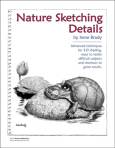
    Nature Sketching Details (Special! $9.95) – Advanced techniques for 3-D shading, ways to tackle difficult subjects, and shortcuts to great effects. This workbook starts where the Basics workbook leaves off, with ways to draw textures, symmetrical subjects, and shade white objects. There are several tutorials: drawing a cattail (with life-size cattail photos), tricky ways to create fine white lines against a in dark background (think “cat’s whiskers” or “leaf veins”), lizard and snake scales, and my own invention of “drawing” white on black (and not with white pencils, either).

    Sketching Wildlife Basics (Special! $9.95) – Wildlife sketching techniques and time-tested tips for every situation. In this workbook, I show you ways to develop left and right-brain templates to help you draw moving animals, how to use several models to draw a single sketch, or one model to draw several concurrent sketches. You’ll learn to develop your “visual snapshot” skills, then apply your pencil to get the tonal values you need to create fur and feathers. You’ll learn how to draw an eye with speed and skill, and the principles of drawing and shading fur, nestling down, and hair. There is a tutorial on sketching moving birds in the field, and techniques for drawing and shading realistic feathers. Find out what to do with birds that hit your window (sketch them, of course!), and ways to use your camera as a backup when sketching. Making useful labels and notes is discussed, as well as paper weight, electric erasers, and using a ballpoint pen when sketching. There’s even a tutorial on how to attach a pencil loop to your sketchbook!

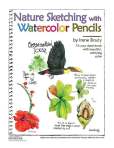
    Nature Sketching With Watercolor Pencils (Special! $9.95) – Fill your sketchbook with beautiful, satisfying color. Adding color to your sketches is incredibly satisfying (and a bit scary to some). This workbook takes all the fear out of it, introducing the waterbrush and its care and watering, and the skills you need to work like a pro. There’s a lovely color wheel exercise, instructions for making color charts if you want to, EIGHT ways to get the color onto the paper, a tutorial on applying a mask, and a tutorial on how to hold and use the paintbrush effectively for different results. This is not a sketching book – it concentrates on using color. So there are lots of sketches on which you to try out step-by-step instructions: a bobcat kitten, a mountain scene, trees and shrubbery, hemlock cones, a fawn, a skull, and a conch shell. There is a full-blown tutorial for painting an orchid, from delicate shading and bold spots on the petals to a striking background that you could use anywhere. I’ve also included a tutorial by Susie Short on how to paint raindrops or dewdrops, because she says it perfectly. This workbook will have you applying color in no time at all.

    Observing Nature ($24.95) – A journal sketching guide to discovering your natural environment. If you would like to encourage your kids to go out and sketch/journal, you can jump-start the process with this curriculum developed in conjunction with three nature centers to use with students from middle school through high school. If you go out with them to sketch, you’ll get as much enjoyment as they do. Purchasing this download gives you permission to print out as many as you want for your students. The course emphasizes quiet observation, developing curiosity, improving drawing skills, honing interpretive skills, practicing writing and descriptive skills, and developing self-confidence, self-reliance and independence. Kids absolutely love this course. See also the Teacher’s Manual.

    Observing Nature Teacher’s Manual ($24.95) – Teaching children to develop observational, writing and drawing skills as they discover the natural environment through sketching and journaling. This is extremely useful tool to help you implement the course for children, even if it’s only your own kids. It features creating Observation Boxes filled with natural items to examine, draw, and journal about: acorns, leaves, seedpods, and whatever natural curiosities you find in your area. This manual also has a class plan and everything you need if you decide to try your hand at teaching a group of children these skills in a more formal setting. This goes with the Observing Nature book described above. Buy Now

    Workbooks In-Preparation: Drawing Raptors (almost ready), Basic Landscape Sketching, Travel and Nature Journaling. Additional titles to be announced.


Question for EE Week Readers
:
Do you use drawing as a learning tool? If so, how do you incorporate drawing into your activities?


Related
:

Read Full Post »

If your school has a schoolyard garden, you need to know about TheMulch.com.

TheMulch.com is more than a website with a list of links to other websites. It is an online community of horticulturists, landscape architects, garden writers, radio talk show hosts, garden-related businesses, and gardeners who willingly share years of gardening experience with each other. You barely have to lift a finger to find information you need and if you become a member (it’s free) you will receive monthly Plant Care Reminders.

The community at TheMulch.com is centered around member profiles through which members share garden-related activities and interests. Before you start thinking Facebook, MySpace, and all the rest…..stop. Member profiles are not comprised of streams of rambling comments. Profiles at TheMulch.com are maintained by dedicated gardeners. A member’s profile is a comprehensive platform through which a member can share interesting articles, pose plant care questions, research plant care topics, list the plants they grow and even list plants in a Plant Cemetery so others can learn from their mistakes. When a Mulch member uploads a plant list, they are able to connect with other members who grow the same types of plants. Through the large discussion platform, members can discuss a wide range of gardening topics. Do you have questions about growing fruits, nuts and vegetables? There is a forum just for you. Do you need help with planning your waterwise landscape? Direct your questions to the Waterwise forum. Need help identifying a plant? Just say, hey what’s this? Is horticultural travel your passion? There’s a forum for this too. The horticulture professionals and avid gardeners at The Mulch are a wealth of information.


The Mulch Team Needs Your Help

As you harvest invaluable information from TheMulch.com, consider giving back to this knowledgeable gardening community. The Mulch needs your help with a very special project.

The Mulch Team would like to connect with a schoolyard garden in each region of the U.S. so it can enter plant care information relevant to each region. The Mulch team would like to apply the tools and information already in place to support learning activities in schoolyard gardens across the country. The only way they can accomplish this is by communicating with garden teachers directly. The Mulch Team would like to invite garden teachers to contact them with information about what they grow in their schoolyard garden. The founder of TheMulch.com, Mitch Shirts, has promised to work alongside garden teachers to implement a resource that will benefit garden-based learning programs.


Question for EE Week Readers

Are you involved in a garden-based program at your school or in your homeschool program? If so, tell us about your current project.


Fun Gardening Project
:

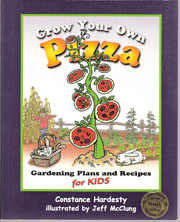
GrowYourOwnPizza_sm Contains plans to grow 26 themed gardens. Grow yourself “Your Personal Pizza Garden” or a “Stir Fry Garden.” Garden plans range from easy to advanced. Recipes included.
Buy

Read Full Post »

« Newer Posts - Older Posts »