Feeds:
Posts
Comments

Archive for the ‘Science Library’ Category

When students arrive in your classroom, what is their attitude towards plants?
How did these attitudes form?

If you teach a traditional botanical art class, you most likely have enthusiastic students with vast amounts of plant-based experiences and knowledge. If you lead nature walks and work with the public, you may find that your audience does not have a particular interest in plants.

Do you ever wonder what people’s experiences with plants have been prior to meeting them?

I do. While I don’t have an answer to the question above, I can share a study that might serve as a first step to answering this question.

In the late 1980s, then-graduate student Margarete R. Harvey, conducted a study of how children experience plants and how their experiences contribute to their interest in the environment. She describes her research project and findings in Children’s Experiences with Vegetation.

Harvey (1989) conducted a study in which she evaluated children’s experiences with vegetation as play objects, as food, as tasks, as obstacles, as ornament and as adventure. She created subcategories for each experience. Because knowing these subcategories is important to understanding even this very brief look at Harvey’s research, I need to create a quick list of each experience and their respective subcategories. Here they are as presented in Harvey (1989):

    Vegetation as Play Object
    (tree climbing; playing in tall grass; playing hide-and-seek in bushes)

    Vegetation as Food
    (picking fruit and vegetables; tasting leaves, flowers or berries;
    planting seeds)

    Vegetation as a Task
    (mowing the lawn; watering plants; pulling weeds)

    Vegetation as an Obstacle
    (being stung by nettles; allergic reactions; plants interfering with
    an activity)

    Vegetation as Ornament
    (growing houseplants; putting flowers in a vase; pressing leaves
    or flowers)

    Vegetation as Adventure
    (playing in a park; walking in a forest; camping)

Harvey (1989) created a questionnaire that was distributed to 995 children, ages 8-11, at 21 schools in England. Her analysis is based on the 845 completed questionnaires she received. Harvey analyzed how often students engaged in the 18 activities described above, their level of enjoyment with these experiences, children’s attitudes towards vegetation and their attitudes towards trees, bushes and flowers on school grounds.

Large amounts of data were analyzed. Here are some interesting points from Harvey (1989):

  • Boys enjoy contact with vegetation as play objects and as adventure.
  • Girls enjoy contact with vegetation more as food and ornament.
  • Girls’ attitudes towards vegetation is more positive overall.
  • Both boys and girls liked bushes the least. Boys liked trees best, girls liked flowers the most.
  • Older children had fewer positive reactions to plants, than younger children.
  • Children of higher socio-economic status had more experiences with vegetation, more contact with vegetation and expressed more appreciation towards plants.
  • Experiences with vegetation had a positive influence on children’s attitudes towards plants.

These points only hint at what is contained in Harvey’s interesting paper. Pick up a copy of her paper to learn about the tools she used to measure degrees of enjoyment, student interest in vegetation, and how children’s past experiences with vegetation influenced their attitudes towards plants.

Get a copy of Children’s Experiences with Vegetation at your local college library.


Literature Cited

Harvey, Margarete R. 1989. Children’s experiences with vegetation. Children’s Environments Quarterly. 6(1): 36-43.


Related
Read Full Post »

Now at Classes Near You > Massachusetts!


Massachusetts College of Art and Design

massart.edu
Professor Saúl Nava teaches the life sciences and biology at the Massachusetts College of Art and Design (MassArt). He also teaches summer programs about art and biology. One program is called Field BIO+ART: Collaborative R.N.A. (Research in Nature and Art). The other program is about natural history and biological art and is an introduction to visualizing plants, animals and natural forms. This second class begins soon. Sign-up today!

    Natural History and Biological Art
    Monday-Wednesday, July 8 – July 31
    9:30- 1:00 PM

    This course provides an introduction to visualizing and exploring the diversity of wildlife, habitats, and biological forms of plants and animals through art and direct observation in the field. Through careful examination, illustration, microscopy, and photography, participants will study and visualize anatomical, behavioral, and ecological similarities and differences between species. Participants will use various media but will focus on classical observation and drawing/painting techniques in the field. This course involves travel to various locales, field sites and The Harvard Museum of Natural History. View the blog from the 2012 course at http://naturalhistorybiologicalillustration.blogspot.com.
    View Details/Register

Read Full Post »

Years ago when I was teaching in grad school, the SimLife game was used as an activity in the Bio 101 labs to teach non-majors about population biology. Students had control of an assortment of variables and could watch generations of their sample population change over time. Students enjoyed the exercise and it helped them understand how the traits they assigned to their sample population resulted in either their population’s survival or eventual demise.

One of the objectives of incorporating botanical drawing into studies about the environment is to use it as a way to tell Nature’s story. Botany’s story is more than complicated terminology, labels with arrows and expensive textbooks.
In today’s column, we move beyond look-see-draw and engage in a bit of storytelling.


Botanical Illustration in the Lab

How does botanical illustration fit into a lab about population biology?

How about as a game?

Educators Erik Lehnhoff, Walt Woolbaugh and Lisa Rew explain how to do this in Designing the Perfect Plant: Activities to Investigate Plant Ecology.

What Lehnhoff et al. (2008) do first is lead students in a conversation about plant ecology. They show students photographs of whole plants, leaves, seeds, growing situations and other imagery related to plant ecology (Lehnhoff et al., 2008). They then ask students to consider the advantages and disadvantages of the growth forms, growing conditions and plant traits observed in the photographs.

Student observations become the foundation of a class conversation about plant ecology. With this conversation fresh on students’ minds, Lehnhoff et al. (2008) call upon students to design a plant with traits they think will ensure their plant’s long-term survival. Instead of creating a plant using a computer program, students are asked to draw their plant and to include in their drawing every trait they assigned to their plant. The authors ask students for a detailed drawing because they have observed that the “act of drawing the plant characteristics allowed students to better comprehend each of them, and to recognize how the plant may fit into its environment.” (Lehnhoff et al., 2008).

With their plants drawn, students then engage in a competitive game of cards. The game they play enables them to live with their plants through 10 generations. The custom deck of cards they play with contains four categories of cards. These categories are Weather, Dispersal Mechanisms, Disturbance Factors and Predation/Disease. Each card drawn exposes the carefully designed plants to conditions that could impact their survival. The cards in this custom deck each have a point value. Plants with the highest points per generation survive. Plants receiving negative points in repeated generations spiral towards extinction. After living through ten generations with their plants, students are asked to write about their plant’s fate.

This clever activity provides a way to introduce botanical illustration as a tool to learn about broad ecological concepts and to move it beyond its use as a tool to learn plant morphology. Included in this paper by Lehnhoff et al. (2008) are examples of the playing cards they use in their game.

Designing the Perfect Plant is available for purchase from the National Science Teachers Association (NSTA) at the NSTA Science Store (99¢). You can also search for this article at your local college library.


Literature Cited

Lehnhoff, Erik and Walt Woolbaugh, Lisa Rew. 2008. Designing the perfect plant: Activities to investigate plant ecology. Science Scope. 32(3): 29-35.


Related

Read Full Post »

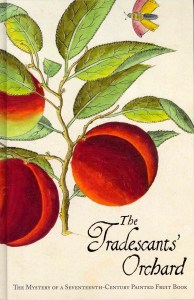
TheTradescantsOrchard There is a book about fruit that is surrounded by mystery and intrigue.

Is it a book?
Is it a catalog?
Is it a teaching tool about fruit trees?

The Tradescants’ Orchard is more catalog than book and, according to evidence of how often each painting has been handled, was also a teaching tool, according to authors Barrie Juniper and Hanneke Grootenboer.

Juniper and Grootenboer, together with the Bodleian Library, have published The Tradescants’ Orchard: The Mystery of a Seventeenth-Century Painted Fruit Book — a fascinating look at plantsman John Tradescant the elder, his son John Tradescant and their contributions to horticulture and the development of fruit orchards in 17th century Europe.

Originally called A Book of Fruit Trees with their Fruits (Juniper & Grootenboer, 2013), a photograph of this 400-year old manuscript is included in their book.

You are most likely already familiar with the Tradescants. The Spiderwort plants bear their family name (Tradescantia). Does this houseplant look familiar?

The Tradescant father and son team were responsible for introducing and raising many familiar garden plants (Juniper & Grootenboer, 2013). John Tradescant the elder was a sought-after plantsman in elite circles, operated a large nursery and, because of his extensive traveling, built an impressive cabinet of curiosities (Juniper & Grootenboer, 2013). When he died in 1638, John Tradescant the younger took over the family business and eventually became acquainted with Elias Ashmole.

This is where the story of the colorful manuscript containing 66 paintings of fruit and imaginary arthropods, frogs, birds, snails, a lizard and a squirrel gets very interesting.

Thought to be created somewhere around the 1620s or 1630s, The Tradescants’ Orchard was published when interest in growing fruit and when creating horticultural information for the public became popular (Juniper & Grootenboer, 2013).

Who commissioned the manuscript?

How did it end up at the Ashmole Museum?

What is unique about the paintings?

Much is explained in the forty-one pages of text leading up to Juniper & Grootenboer’s reproduction of The Tradescants’ Orchard. Their book is yet another wonderful chapter about the history of botanical art.


Literature Cited

Juniper, Barrie and Hanneke Grootenboer. 2013. The Tradescants’ Orchard: The Mystery of a Seventeenth-Century Painted Fruit Book. Oxford: Bodleian Library.

Available at independent bookstores. ($65)

Read Full Post »

Ask and the answer might arrive sooner than you think!

Readers looking for classes in the Chicago region have three opportunities to learn botanical art and colored pencil techniques this summer.

Kathleen Garness will teach three sessions of an introductory course about drawing plants in colored pencil. Participants will receive materials to take home with them, compliments of the Anne Ophelia Dowden grant awarded to Kathleen last Fall by the American Society of Botanical Artists.

Here is what’s new at Classes Near You > Chicago:


Kathleen Garness

www.gnsi.org/profile/kathleen-garness
Kathleen is a natural science illustrator whose illustrations are being used to illustrate a guide to common plant families in the Chicago region. Her work has been shown in many exhibitions and is also featured in the 2011 issue of Smithsonian in Your Classroom, an issue dedicated to botany, art and conservation.

Introduction to Botanical Colored Pencil

  • June 9, 2013: Volo Bog State Natural Area, Volo, IL: 9:30-3:00
  • June 22, 2013: Illinois Beach State Park Nature Center: 9:30-3:30
  • August 18, 2013: Lake County Museum, Wauconda, IL 9:30-3:30

Looking for classes near you?
Tell the teachers!

Read Full Post »

iStock_TeachingPlants_ExtraSmall copy This weekend it was announced that the featured topic for June is Teaching Plants. We’ll take a look at how educators from various disciplines teach the public about plants.

There is probably no better way to kick this month off than with the collection of presentations being featured this week on TED: Ideas Worth Sharing. Guerrilla gardening, biodiversity, house plants, growing clothes, food choice, and the ecosystem of tree canopies are all featured.

View this wonderful collection now at Plantastic!.

Read Full Post »

Get course schedule

View course schedule

Author and illustrator, Sarah Simblet, will lead a studio course in botanical drawing July 8-12, 2013 at the Ruskin School of Drawing & Fine Art at the University of Oxford.

Inspired by her book Botany for the Artist, this special learning opportunity includes:

    Learning how Sarah researches, collects and works with plants in her studio.

    A tour of the University of Oxford Botanic Garden.

    An opportunity to draw in the Garden and learn how to work outdoors.

    A study of lines, marks and gesture.

    A study of shape, length, volume and form.

    A study of light, tone, optical illusions, linear perspective.

    A study of paper and how to create a field sketchbook.

    An opportunity to view the original work of Ferdinand Bauer.

To download the course itinerary and to register, visit the Botanical Drawing page on the Ruskin School website.

Sarah’s intensive drawing course will inspire confidence in beginners and refresh the work of more experienced artists. No previous experience needed. Basic materials are provided. Participants completing the course will leave with a portfolio of experimental and traditional drawings and skills relevant to both fine art practice and botanical illustration.

Cost: £750.00 (convert currency)


More About Sarah Simblet

This information can also be found at Classes Near You > England.

Read Full Post »

« Newer Posts - Older Posts »