Feeds:
Posts
Comments

Archive for the ‘general botany’ Category

An exciting new learning opportunity at Classes Near You > Mississippi:


The Illustrated Garden, A Studio Blog

www.valwebb.com
See Val Webb’s online tutorial, Botanical Drawing with Pencil and Watercolor. Connect with The Illustrated Garden on Facebook. For more information about the class below, email Val Webb.

    Artist-Naturalist Workshop: An Introduction to Botanical Art
    Grand Bay National Estuarine Research Reserve (NERR)
    In conjunction with the Walter Anderson Museum of Art (WAMA)
    Moss Point, MS
    May 9-10, 2014

    Join illustrator Val Webb, coastal ecologist Jen Buchanan and WAMA education director Melissa Johnson at the Grand Bay National Estuarine Research Reserve to learn about freshwater habitats, saltwater habitats and plant anatomy while learning how to draw the plant life at the Reserve.

    This two-day adventure includes an overnight stay at the NERR dormitory and two meals. Cost: $95 Non-WAMA Members; $85 WAMA Members.

    View Photos & Itinerary

Read Full Post »

If you like to tell stories about plants but come up against students who are indifferent towards botanical subjects, consider the strategies suggested by professor Rob Reinsvold in Why Study Plants? Why Not?.

In his short 2.5-page editorial, Reinsvold (1999) provides an overview of how students learn about plants in elementary school, middle school and high school and how what they learn contributes to their thinking that biology is primarily about humans and animals.

To make plants more interesting to students, Reinsvold (1999) suggests educators try the following:

  • Take advantage of society’s obsession with “the biggest and the best”
    (p. 3). Introduce students to the largest known creosote bush, the oldest living tree, the largest living organism, etc. and relate them to comparable examples in the animal world. Reinsvold talks about hosting an Organismal Olympics. You can learn more about this in his paper.
  • Show students that plants are active using time-lapse photography.
  • Explain how people use plants.
  • Talk about money. Discuss plant products as traded commodities.
  • Discuss how plant research has contributed to our knowledge about genetics, growth, development, biodiversity and climate change.

Reinsvold (1999) includes in his editorial a list of principles proposed by the American Society of Plant Physiologists. These principles address what the Society thinks every student and citizen should know about plants. An updated version of this list is available on the website of the American Society of Plant Biologists (ASPB). (Note: The Society changed its name since Reinvold’s editorial was published).

The principles proposed by the ASPB have been aligned with the National Research Council’s Life Science Standards. Educators may be especially interested in the bookmarks the Society created around these twelve principles. These double-sided bookmarks are available for free in limited quantities each month. Go to the Society’s Education page to learn more about the bookmarks, the Standards and the Principles of Plant Biology.

Reinsvold (1999) can be purchased online for $39. You can also search for back issues of this journal at your local college library.


Literature Cited

Reinsvold, R. 1999. Why study plants? Why not? Science Activities. 36: 3-5


Also See


Remembering Dr. James Wandersee

Dr. James Wandersee was a professor of biology education and one of the researchers to coin the term “plant blindness”. In 2009 I had the opportunity to communicate with Dr. Wandersee via email. I told him about ArtPlantae and we discussed some of my ideas. He was very encouraging and supportive. This weekend I was saddened to learn of Dr. Wandersee’s passing. I can’t read or write the phrase “plant blindness” without thinking of our email exchanges and his encouraging words. Dr. Wandersee was 67.


Read Full Post »

Dust jacket and book

Dust jacket and book, © 2014 Lydia Inglett, Ltd, All rights reserved

Lydia Inglett, Ltd. Publishers announces the release of American Botanical Paintings: Native Plants of the Mid Atlantic.

This book features 60 original works of juried art from 40 artists, including text describing each plant, how each plant is beneficial to gardeners and/or the environment and paintings of insect pollinators and their relationship to the plants.

The original paintings will be on display at the U.S. Botanic Garden in Washington, D.C.,February 15 through June 15, 2014. Botanical Artists for Education and the Environment produced this book and is funded solely through donations. Profits will go to nonprofit organizations working on native plant education, conservation and horticulture.

Lydia Inglett, CEO of the publishing company, is a woman with Lydia-Inglett-publisherenormous experience in art, advertising and publishing. Her design and print studios create the highest quality in elegant, thoughtful books. She has designed and published over 150 books for her clients, three of which won USA best book awards in 2013. She has launched many magazines for both artists and businessmen. She was art director and creative services director for Morris Communications Corporation before starting her publishing company. Her love of art, combined with her love of paper and engraving come together in her published books.

In 2010 Lydia Inglett taught an online class for ArtPlantae in which she discussed how books are published.


About Lydia Inglett, Ltd.

Lydia Inglett, Ltd. has offices on Hilton Head Island in the U.S. and at The Cube in London, England. In addition to providing a suite of publishing services, it manages Starbooks, a subsidiary of Inglett Publishing.

Read Full Post »

Do you teach botanical art classes, botany classes, book arts classes or lead nature journaling adventures in your community? Tell others!

I am working on the Classes Near You section one page at a time and you are invited to add your classes to this popular section.

Updates and class announcements will be posted at the beginning of each week and the most time-sensitive announcements will be posted first. Please understand that an announcement about your class may not be posted immediately.

If you already have a listing in the Classes Near You section, please check it to see if it is current. If it is not, please send updates.

The page for California has been updated. Here is information that may be of particular interest:

  • Filoli and Maryjo Koch are offering many inspiring classes in 2014. Visit their listings in the section for Northern California to learn more.
  • In Southern California, mixed media artist Jane LaFazio and watercolorist Brenda Swenson have a year’s worth of learning opportunities scheduled. The writing workshop with Paula Panich, The Literary Gardener, will be held this month at the LA Arboretum and Botanic Garden. Register now to participate in this workshop about the deep connection between storytelling and plants.

And for those interested in botanical art, don’t miss the new classes at the
Los Angeles Arboretum and Botanical Garden!


Go to Classes Near You > California

Read Full Post »

See Val Webb’s online workshop about herbs. It’s art, history and folklore!

Here is what’s new at Classes Near You > Alabama:


The Illustrated Garden, A Studio Blog

http://valwebb.wordpress.com
Val Webb is the 2013 Artist-in-Residence at the Mobile Botanical Gardens. This year Val will work at the gardens and encourage others to sketch the garden’s collections to learn about plants, gardening and all that the Mobile Botanical Gardens has to offer. Visit Val’s website to view her online tutorial, Botanical Drawing with Pencil and Watercolor. Connect with The Illustrated Garden on Facebook.

    Birds in Colored Pencil – Starting January 6, 2014
    Learn how to paint colored pencil portraits of birds using Val Webb’s “gentle pencil” drawing technique. Then learn how to layer color to create detailed colored pencil images. This online course is composed of nine lessons. Work at your own pace. No experience necessary. Pre-registration required. Cost: $50
    View Details/Register


    Drawn & Decorated Watercolor Lettering
    – Starting January 13, 2014
    Create decorated letters using watercolor, Pigma Micron pens, pencils and brush. No experience necessary. Participants have four months to complete 10 projects. Work at your own pace. Pre-registration required. Cost: $50
    View Details/Register


    Draw & Paint Six Culinary Herbs
    – Starting March 3, 2014
    Not your typical botanical drawing course. Participants will create pencil studies, spirited ink-and-wash sketches, mixed media paintings and learn about the history and folklore of the six herbs that are the focus of this course. Ten lessons. Work at your own pace. Pre-registration required. Cost: $50
    View Details/Register

Also see Val’s online workshop about drawing dogs and cats in pencil and charcoal that begins on January 27, 2014.

Are miniature gardens and fairies your passion? Then don’t miss Val’s class, Draw & Paint Fairies in Nature.

View all online workshops at The Illustrated Garden

Read Full Post »

fsc2014 The Field Studies Council in England has announced its schedule of classes for 2014. Click on the image to view their 52-page brochure listing 350 classes about plants, art and nature.

This is what’s new at
Classes Near You > England.


Field Studies Council

www.field-studies-council.org
Founded in 1943, the Field Studies Council (FSC) provides learning opportunities about the environment for all ages and abilities. Visit their website to learn more about interdisciplinary fieldwork opportunities, classes for individuals and families, publications and profession development courses. Courses are held across the FSC network of UK Centers, from the Scottish Highlands to the south Devon coast. The extensive schedule of classes for 2013 includes:

Botany Courses – Courses include studies of flowers, trees, grasses and grasslike plants, ferns, freshwater and wetland plants, lichens, fungi, general plants, mosses and liverworts. View Details/Register

Natural History Courses – Courses include studies of the natural world, birds and other animals, habitats and conservation. View Details/Register

Art Courses – Courses include painting, drawing, crafts (e.g. bookbinding), traditional skills (e.g., basketry), photography, archeology and botanical illustration. Get information about FSC botanical illustration courses online.

Read Full Post »

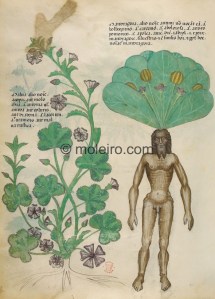
Mandrake. Image courtesy of M. Moleiro Editor, S.A., all rights reserved

Mandrake. Image courtesy of M. Moleiro Editor, S.A., all rights reserved

The historic Tractatus de Herbis, codex Sloane 4016 can now be enjoyed by anyone with an interest in the history of botany, botanical illustration or the history of medicinal plants.

The new facsimile reproduction has been published by Spanish publisher Moleiro Editorial whose specialty is the reproduction of codices, maps and works of art made on parchment, vellum, paper and papyrus between the 8th and 16th centuries.

The reproduction of Tractatus de Herbis features 218 illuminated pages and is bound in embossed dark green leather. It is an exact replica of the original and is accompanied by a volume of commentary written by Alain Touwaide, Smithsonian scholar and co-founder of the Institute for the Preservation of Medical Traditions.

Institute co-founder, Emanuela Appetiti, explains the significance of this historic work:

The manuscript Sloane 4016 is a large album of botany made sometime around 1440 in Italy. Although it is traditionally identified as a copy of the well-known Tractatus de herbis (Treatise on medicinal plants), it does not contain the text of this treatise, but only its illustrations. The major question posed by this manuscript is why it abandoned the text of the Tractatus, giving birth to the new genre of the botanical album. Significantly enough, the captions of the illustrations provide the names of the plants in the different languages used in the 15th century, all written with the Latin alphabet, however. They hint at the function of the botanical album as an international work that could be used by all the different linguistic groups, whereas the text of the Tractatus could be used only by those who understood Latin. In this view, the development of the botanical album is an unsuspected very modern phenomenon that sheds a completely new light on the history of botanical illustration and highlights a process of internationalization and, at the same time, of linguistic specialization coupled with a principle of economy that had not been uncovered so far.

Alain Touwaide explains more about the history of botanical albums in the description of the Tractatus de herbis, codex Sloan 4016 viewable on the publisher’s website.

Also available for viewing are 18 images showing the contents of this album. After reading Alain’s description, click on one of the images above his text. This will take you to a page where you can view all sample images.

Only 987 copies of this historic album are available for purchase worldwide. Alain’s commentary has been published in separate editions available in English, Spanish and French. To inquire about purchasing this limited edition reproduction at a special discounted price, contact the publisher.


You Might Also Like

Read Full Post »

« Newer Posts - Older Posts »