Feeds:
Posts
Comments

Archive for the ‘general botany’ Category

In Herbarium Amoris, Swedish photographer Edvard Koinberg photographs plants named by Carl von Linné (Linnaeus). Inspired by Linnaeus’s poetic descriptions of plant sexuality, Koinberg designed a project to bring attention to plants and their reproductive features.

Swedish crime writer, Henning Mankell, and Swedish science professor, Tore Frangsmyr, contribute to Herbarium Amoris. In their respective essays, Mankell and Frangsmyr explain how Linnaeus recruited help from scouts and students who traveled throughout the world to send him plants. They explain that, before Linnaeus created a new way of classifying plants, plants were organized by color, size, flower type, and fruit. However during a time when plant exploration was booming, new discoveries did not fit into existing categories. This prompted Linnaeus to create a new way of organizing plants.

Frangsmyr explains how Linnaeus spent time thinking about the sexuality of plants and how his thoughts lead to his publication about classification systems in nature (Systema Naturae). In Systema Naturae, Linnaeus describes a classification system dividing plants into 24 groups according to the number and arrangement of their reproductive parts. His system was well-received and this new way of organizing plants, along with binary nomenclature (a naming convention assigning plants a 2-part name) established botany as a legitimate discipline.

In 1756, Linnaeus created a floral calendar (Calendarium Florae) in which he used flowers to reflect different time periods of a calendar year. Koinberg’s Herbarium Amoris was inspired by this calendar. Koinberg’s moving photographs are presented as one- and two-page spreads. His revealing images and enlightening plant descriptions encourage readers to reflect upon the seasons of the year and the plants with which we share our planet.

Koinberg’s photographs are arranged as follows:

  • Glacialis – Reviving Winter Month (December 13)
  • Regelations – Thawing Month (March 19)
  • Germinations – Budding Month (April 12)
  • Frondescentiae – Leafing Month (May 9)
  • Florescentiae – Flowering Month (May 25)
  • Grossificationis – Fruiting Month (June 20)
  • Maturationis – Ripening Month (July 16)
  • Messis – Reaping Month (August 4)
  • Exsolationis – Sowing Month (August 28)
  • Defoliationis – Shedding Month (September 22)
  • Congelationis – Freezing Month (October 28)
  • Brumalis – Declining Winter Months (November 5)

To view publisher’s images, click here.

Herbarium Amoris (Floral Romance) is available at ArtPlantae Books for $39.95. This title ships for free through October 31, 2010!


You may also enjoy…

Order From Chaos: Linnaeus Disposes
Lessons for a Young Botanist

Read Full Post »

The Plant Parts series by Vijaya Khisty Bodach is a collection of six books addressing plant morphology. Each book is dedicated to a single topic. The topics Bodach writes about are roots, stems, leaves, flowers, fruit, and seeds. Each book in the series follows the same format, so a pattern emerges that unites the books and builds on the theme. Young readers learn why roots, stems, leaves, flowers, fruit, and seeds are required by plants. They also learn about the parts of plants we eat as food.

Large color photographs are paired with descriptive text that is easy to read. Word count for the books in this series ranges from 114 to 130. Each book ends with a glossary of terms and suggestions for further reading. On the last page of each book, a unique identification code is provided giving young learners access to FactHound.com, a portal to 1,600 pre-selected, age-appropriate websites about many different subjects.

The books in the Plant Parts series are available at your local independent bookstore or from the publisher ($6.95).

Read Full Post »

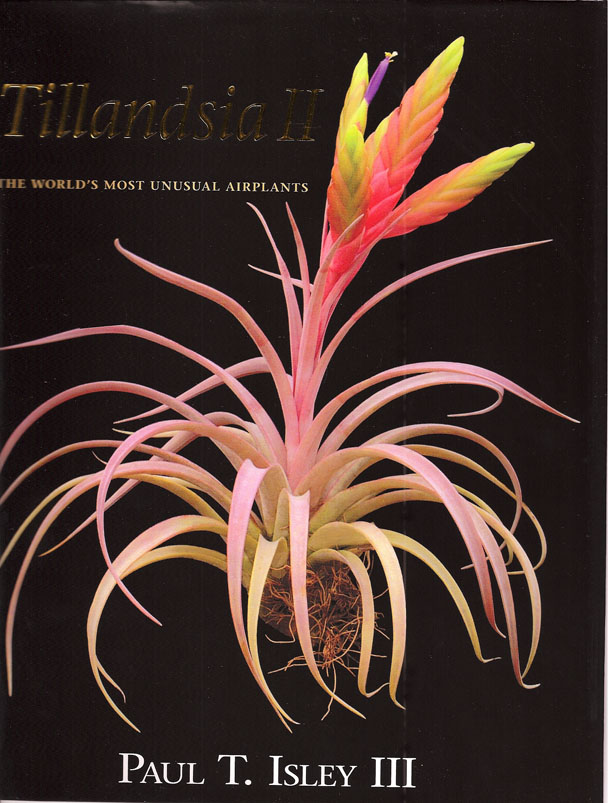
Tillandsia II was written by Paul T. Isley III, one of the co-founders of Rainforest Flora, Inc.. This book is a continuation of Isley’s Tillandsia that was published in 1987. It features updated nomenclature, wonderful color photographs, and a chapter dedicated to Tillandsia hybrids developed over the past 22 years.

The plants in this book are so fascinating, that reading happens at a snails pace because your eye is always drawn to the photograph(s) on the opposite page. Isley provides an overview of the genus Tillandsia and discusses how these plants should be cared for in both outdoor and indoor environments. Included in this discussion are instructions on how to mount a plant onto a substrate and how to incorporate Tillandsia into the landscape. Isley ends the book with a detailed chapter about Tillandsia evolution and biology. To aid the reader in his/her own studies of these intriguing plants, Isley includes a laminated ruler with each book.

Tillandsia II is a self-published title printed by Isley’s Botanical Press.

Read Full Post »

Step into the herbarium at Rancho Santa Ana Botanic Garden (RSA) and you step into a world rich with history. This herbarium contains an impressive 1.1 million specimens. The collection is comprised of mostly vascular plants. Ancillary collections include 3,000 pickled cacti, seeds, pine cones, and a small collection of lichens. Of the more than one million specimens, it is estimated 600,000 are from southern California.


What is an herbarium and what happens in an herbarium?

An herbarium is a collection of plant specimens that have been pressed, dried, and mounted onto archival sheets of paper. An herbarium sheet is comprised of a pressed specimen and a label containing collection information, such as the name of the plant, the name of the collector, and location information. Often times, there will also be seed envelopes and fragment folders on an herbarium sheet. Seed envelopes hold loose seeds and fragment folders hold bits that may have broken off the mounted specimen or they may hold some other material the collecting botanist deemed to be important.

Mounting pressed plant specimens onto herbarium sheets is a never-ending task at any herbarium. At RSA, herbarium staff and dedicated volunteers spend countless hours mounting plants onto herbarium sheets. Each morning volunteers go to the herbarium’s workroom to mount whole plants, flowers, branches, leaves, and seeds. Specimens are attached to herbarium sheets with water-based glue that does not yellow with age. On average, 10,000 – 12,000 specimens are acquired by the RSA herbarium each year. Some specimens are collected by RSA botanists, some are donated by other individuals, and some are on loan from other institutions. This year RSA will acquire closer to 15,000 specimens because of the recent acquisition of the private collection of Dr. Robert F. Thorne, a former curator of the RSA herbarium.

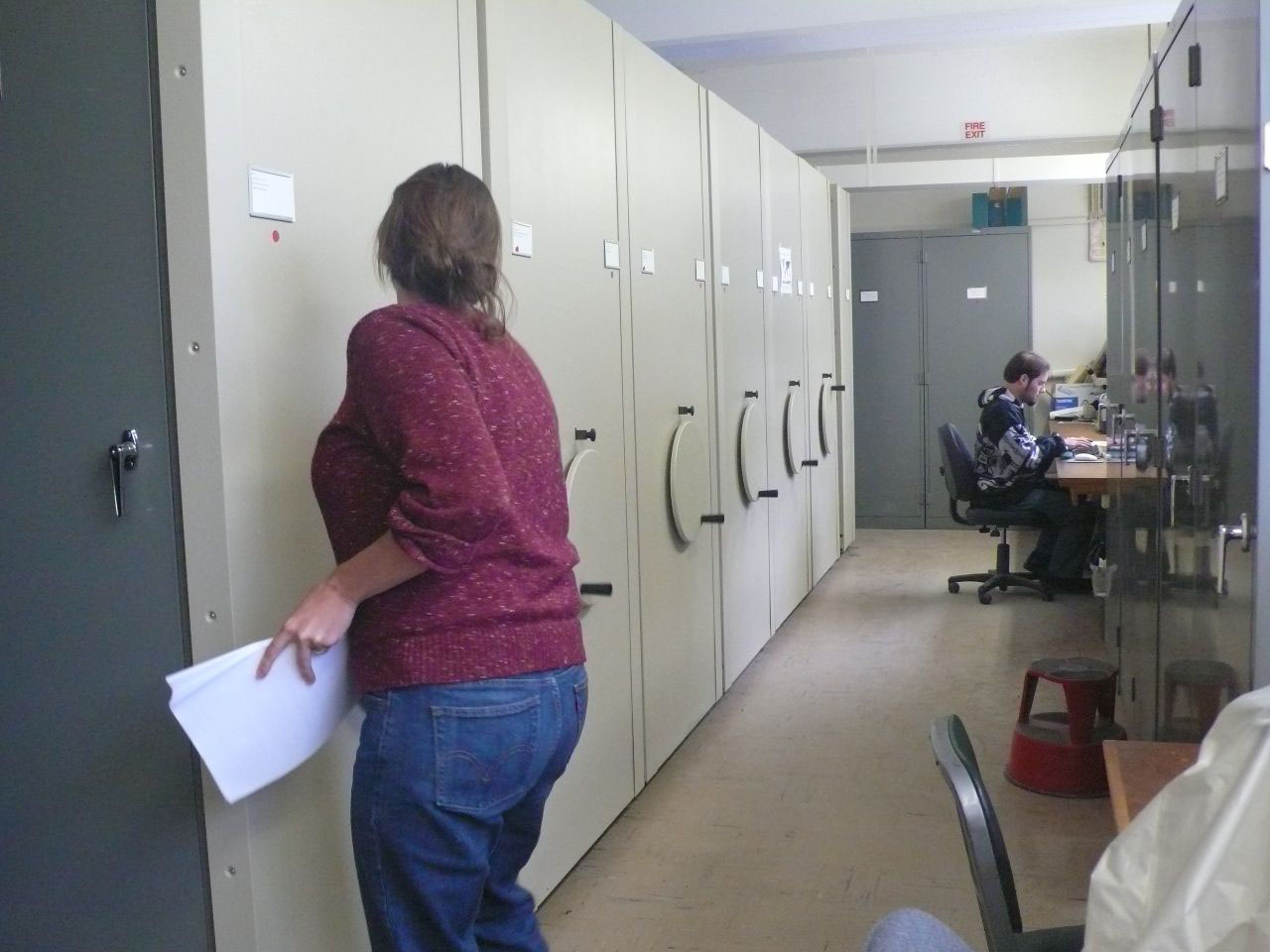
After herbarium specimens have been mounted, dried for a week, and all items securely attached, they are brought upstairs to the collection. The RSA herbarium occupies two complete floors. Here they are placed into cabinets for permanent storage. The herbarium’s more than 1 million specimens are arranged in a filing system of specially-designed cabinets. To maximize space, the cabinets line up next to each other the way the pleats of an accordion lineup next to each other. The cabinets slide and separate by turning the handles seen in this photo.

Open the door to one of the cabinets and you will find folders filled with mounted plant specimens. The large folders housing the herbarium sheets are called genus folders and they contain examples of species belonging to a given genus. For example, in the genus folder for Salvia, you might find mounted plant specimens of Salvia mellifera, Salvia nigra, etc. If you look at the genus folders located at the top of the cabinet, you’ll notice some of the folders are different colors. Genus folders are color-coded and each color represents a different region of the world.

Many of the plants in the RSA collection were collected by RSA botanists. Botanists collect three specimens of each species. They keep one and trade the other two specimens. RSA has been collecting this way since the herbarium opened in 1927. There was a collecting boom in the 1930s and 1940s. Collecting dropped off in the 1950s, however. Through continuous collecting and the acquisition of personal collections, RSA has become the 10th largest herbarium in the United States.


What happens with the specimens after they are added to the collection? Do they stay in a cabinet forever?

Not exactly. Although it may seem this way. Herbarium specimens are viewed and studied by botanists, graduate students, and other researchers. Specimens are also loaned to other herbaria. Sometimes a botanist cannot find an herbarium specimen where she/he is conducting research and they have to borrow the specimen from a distant herbarium.

Herbaria across the world have always worked cooperatively to aid researchers with their studies. The way herbaria work with each other is about to change as research facilities are using technology to their advantage. Soon researchers will no longer have to borrow specimens from distant herbaria. All they will have to do is go online to view the specimens they need. There is a huge scanning project underway and the RSA herbarium is helping to lead the way.

The scanning project is a collaborative effort of institutions worldwide. It is part of a larger movement called the Global Plants Initiative (GPI) headed by the Andrew W. Mellon Foundation. The RSA herbarium is contributing to this effort thanks to a grant from the Foundation. Rancho Santa Ana Botanic Garden has been able to obtain a digital scanner and fund the digitizing of all the type specimens at RSA. Type specimens are the original specimens used to describe a new species. In addition to the scanning of RSA’s 6,500 specimens, the type specimens at The Huntington Library, Art Collections, and Botanical Gardens, the San Diego Museum of Natural History, Santa Barbara Botanic Garden, UC Riverside, and UC Santa Barbara are also being scanned. This means that RSA alone will be responsible for digitizing 10,000 type specimens. The objective of the GPI project is to digitize representations of the world’s flora and to make these digital images available for viewing. The scanning project will not be available online to the public until 2013.

For this article, I met with Sula Vanderplank, Administrative Curator of the RSA herbarium, to learn about what goes on behind-the-scenes at the herbarium. During my visit, I had the opportunity to observe the scanning of one herbarium specimen. What a treat that was! The scanner used by the imaging team is much larger than the average office scanner, as it needs to accommodate herbarium sheets that are 12.5″ x 18″. Since dried plants are fragile and herbarium sheets cannot be placed face down on the scanner the same way a sheet of paper is normally placed onto a scanner, the scanner is the item that is inverted. The inverted scanner rests securely in place on a cart designed especially for the scanner. The scanner rests with the glass plate facing down. Herbarium sheets are placed on a platform and this platform is raised, thereby bringing the herbarium specimen to the scanner’s glass plate. The Scan button is clicked by the technician and the rest is magic. Each scan is 600 dpi and 200 MB. One scan takes 10 minutes to complete. The 10-minute scanning process includes the placement of the herbarium sheet, the actual scanning of a specimen, and the cataloging of an image. The imaging team can comfortably scan five specimens per hour.

If you have an image in your head right now about what a scanned herbarium sheet might look like, magnify the clarity of your vision by 10. The images created by the imaging team are crystal clear. The tiniest detail can be observed and when zoomed in upon, details can be viewed in an even more mind-blowing way. These herbarium images from Kew Botanic Gardens do not match what I saw in person, but they will give you an idea of what an herbarium scan looks like. Some of the images created by the RSA imaging team can be purchased in the garden’s gift shop. These images are of herbarium specimens of plants growing on the grounds at RSA. These images have been carefully mounted using archival materials and framed behind glass that protects the specimens from sunlight.

The Global Plants Initiative will not only open the world’s herbaria to researchers, but introduce the public to the diversity of plants on our planet.

Are you interested in learning more about how an herbarium works and how to create herbarium specimens? Then you might be interested in a special herbarium class taught by Sula and other key members of the herbarium staff. This class is offered only a couple times per year, so check the Rancho Santa Ana Botanic Garden Calendar regularly.


The RSA Herbarium Connects With Teachers

The Rancho Santa Ana Botanical Garden has a longstanding relationship with teachers and schools in southern California. School groups tour the garden and the herbarium during the school year. The herbarium has a special show-n-tell collection comprised of mounted plant specimens, one of the them having been collected by explorer Captain James Cook himself. To learn more about docent-led tours for K-12 students, college classes, youth groups, and adult community groups, visit the RSABG website.


Question for EE Week Readers in southern California
:
Would you like to take the herbarium class at Rancho Santa Ana Botanic Garden? If so, please add your name to an Interest List for this class.


April 2014 – Links to the RSABG website have been updated. The original link to ArtPlantae Books has been removed.

Read Full Post »

The Rancho Santa Ana Botanic Garden is more than a research facility for academics. It is an outdoor classroom for the general public. Look beyond the garden’s beautiful 86 acres of California native plants, and you will find a research library and a calendar full of learning opportunities for the public to enjoy.


RSA Library

The research library is located in the main building and possesses about 50,000 bound volumes. The collection’s strengths are its books about systematic botany, evolutionary botany, and the botany, taxonomy, and ethnobotany of California plants. The library’s horticultural collection is specific to California and features extensive information about gardening in this western state. The RSA library is actively cataloging gray literature and has a special interest in documents about California.

Illustrated botanical books are also included in the collection, however these are very fragile. Most of the illustrated books were published before 1923 and are therefore in the public domain. Harvey Brenneise, Head Librarian, says individuals interested in botanical books should view the holdings of the Biodiversity Heritage Library and the Digital Library of the Real Jardin Botanico of Madrid. The Biodiversity Heritage Library is a consortium of twelve natural history libraries, botanical libraries, and research institutions who are digitizing books in order to preserve documented records describing the planet’s biodiversity. The Digital Library of the Real Jardin Botanico of Madrid is a collection of antiquarian books from the Royal Botanic Garden.

While the RSA library is open to the public, it is open by appointment only. Most of the library’s visitors are researchers and grad students who benefit greatly from the wealth of information at Brenneise’s fingertips. It used to be that requests for information would take days to process. Now thanks to email and the Internet, Brenneise says librarians are able to share information with each other in record time. He says all he does is send a request out to his network of fellow librarians and a librarian from another part of the world will respond and provide exactly what he needs. What makes this quick response time even more impressive is that the information retrieved is often several decades old. In fact, the botanical information researchers need usually is quite old. According to Brenneise, “In botany, there is nothing too old or too obscure. In other disciplines, if it wasn’t published within the past five years, [researchers] don’t want to look at it.” The botanists at RSA are lucky to have Brenneise in their corner. One doesn’t need to speak with him for too long to figure out there isn’t anything he and his deep pool of resources can not track down.


So Much to Learn, So Little Time

Rancho Santa Ana Botanic Garden hosts many special events, garden activities, and workshops throughout the year. Year-round attractions include docent-led activities at one of the garden’s Discovery Carts. From October through May, weekend visitors can learn about native plants through special hands-on activities. Discovery Carts are located in the Container Garden and the Horticultural Garden and are available on Saturdays from 11 AM – 1 PM and Sundays from 1-3 PM. Another year-round event is the FREE Native Plant Clinic conducted on the first Saturday of each month from 10 AM – 1 PM. Gardeners can ask RSA experts their most pressing questions about native plant gardening. Garden admission is not required to attend a Native Plant Clinic.

Annual events include a wildflower show, art events, garden tours, a Mother’s Day Brunch, a Father’s Day BBQ, special autumn events, and plant sales at the garden’s Grow Native Nursery. For instance, tomorrow (April 16th) is the kickoff of the Meadow Gardens sale of plants suitable to create your own meadow garden. If you’re a fan of California’s native succulent plants, then be sure to put the Cacti and Agaves and Succulents! Oh My! plant sale on your calendar. This sale will be held April 30 – May 2 from 10 AM – 5 PM.

The garden also offers a variety of special workshops that includes topics in beginning botany, advanced plant identification, basketry, book arts, gardening, photography, and botanical illustration. Bookmark this page to keep up with the garden’s extensive course offerings.


Visitor Information:

Adults, $8; Students w/valid ID $6; Seniors (+65), $6; Children (3-12), $4; Free admission for members and children under 3. Rancho Santa Ana Botanic Garden is located in Claremont, CA (map)


Related
:

Now at Classes Near You > California:


Los Angeles Arboretum & Botanic Garden

www.arboretum.org

    Around the World in 127 Acres: More of the Arboretum’s Plant Collections
    Classes meet on Wednesdays from 1:30 PM – 3:00 PM (rain or shine). Instructor: Frank McDonough. Cost: $5 member/$7 non-member per class. All classes meet in the Arboretum Library. Wear your walking shoes. Dress comfortably. Bring water. Register: 626.821.4623

    • Pirate Plants: Plants of South America and the Spanish Main – April 7, 2010. Learn about South American plants and how they are used locally and throughout the world.
    • Survivor Plant II: Winter Blast – April 21, 2010. How did small tropical plants come to survive China’s temperate forests?
    • From the Stairway to Heaven to the Gates of Hell, Park II (Sacred, Spiritual, and Ritual Plants) – May 5, 2010. A look at the spiritual significance of selected plants in the Arboretum’s collection.
    • Bushtucker Walkabout – May 19, 2010. Discover wild foods growing in the deserts, jungles, and forests of Australia.
    • The Most Useful Plants in the World – June 2, 2010. Learn how people have used palms and bamboos for food, shelter, and more!
    • Eat or Be Eaten – June 16, 2010. Fascinating plant-animal interactions will be revealed on this walking tour through the Arboretum.

    Read Full Post »

I was across the room when I overheard a student say this to her study group in a busy non-majors biology lab I taught during grad school. Fifteen years later, I am still not sure what caught me off-guard the most — the surprised tone in which the question was asked or simply the question itself. My first reaction was to wonder how the student could have missed the fact that grasses are plants. Then I thought about it some more and thought about the ways she could not have known that grasses were part of the plant kingdom.

  • What if she had never plucked grass out of the lawn to see its roots?
  • What if she had never had to install sod in her backyard?
  • What if she had never seen her family lawn in an overgrown state and never had the opportunity to see inflorescences form?
  • What if her parents did not take her to nurseries and botanical gardens as often as my parents took me?

I think about this student’s question each time I see someone shrug their shoulders to express their indifference towards plants. I always wonder about the root cause of their indifference. Surely they have had at least one memorable experience involving plants. Haven’t they?

Children & Plants
In 2000 at the annual conference of the British Educational Research Association, Sue Dale Tunnicliffe presented the results of her study addressing children’s learning experiences looking at plants in a botanical garden. Tunnicliffe conducted her research at the Royal Botanical Gardens Kew. Conversations among students (mostly ages 7, 9 and 11), teachers, and other adults were recorded in front of plant exhibits. She observed that children comment on the most noticeable features of a plant and that plant functions (e.g., photosynthesis and seed development) receive very little attention. She also observed that if an animal entered into view, children quickly turned their attention to the animal. Interestingly, Tunnicliffe discovered students learn about plants from their family and that students do not think of school as a place to learn about plants. Students admit to learning little from books, but a lot from daily experiences involving plants.

The intricate results of Tunnicliffe’s work must be read in detail to be appreciated. Science educators and anyone who leads group tours at botanical gardens will find this article to be a helpful resource. By having insight into what students notice about plants, educators can create engaging lessons and memorable interactive experiences.


Literature Cited

Tunnicliffe, Sue Dale. 2000. Talking About Plants: Comments of Primary School Groups Looking at Plants as Exhibits in a Botanical Garden.
Paper presented at the British Educational Research Association Annual Conference, Cardiff University (September 7-10, 2000). Read article

Read Full Post »

« Newer Posts - Older Posts »