Feeds:
Posts
Comments

Archive for the ‘general botany’ Category

Looking for adventure?

See what’s new at Classes Near You > Mexico!


Amelia Hoopes

Amelia is the Director of Cylburn Nature Science Camp in Baltimore and teaches botanical art at Cylburn Arboretum. Learn more about Amelia and view examples of her work in the ASBA Member Gallery.

    Botanical Art in Zirahuen
    June 20 – July 4, 2012

    Come to the shore of one of the cleanest lakes in Mexico to learn how to paint realistic watercolor illustrations of native wildflowers. Brush up on drawing skills and practice traditional watercolor techniques of graded wash, wet-in-wet and drybrush as you enjoy beautiful weather and the unique flora of Mexico’s central highlands. Swim in Lake Zirahuen, go zip-lining far above the lake, hike in the pine forests, bird-watch, sing around the campfire and partake in wholesome meals created from the organic produce of Michoacan, the “breadbasket of Mexico.” This one-of-a-kind adventure will be led by experienced botanical art instructor, master naturalist and science teacher Amalia Hoopes.

    Cost: $546, includes 2 meals/day; does not include lodging or transportation. For an additional fee, transportation can be arranged to and from the Ixtapa/Zihuatenejo airport on Tuesday or Wednesday, June 19th or 20th and on Wednesday or Thursday, July 4th or 5th. Transportation can also be arranged to and from the Morelia airport. Please contact Amalia Hoopes for lodging information. Options range from free camping to a resort hotel.

Read Full Post »

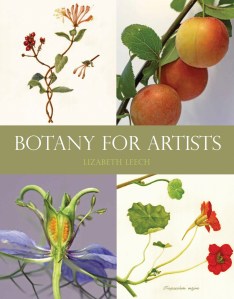
Liz Leech’s new book, Botany for Artists, has been adopted by the English Gardening School as a recommended text. It joins other helpful references written for students of botany and botanical art. Which references do you like to use?

Teachers, which resources have you found most helpful while teaching?

Students, which resources do you like to use in your studies?

Find out why Botany for Artists has been called an “essential reference book” by teachers and students in the UK.

Join this conversation already in progress..

Read Full Post »

After Liz identified a need for botany instruction, she was encouraged to write her book. She explains:

I finally decided to write my book in October 2009, having toyed with the idea for the previous 4 years or so. The final impetus came when I met Valerie Oxley who had just published her wonderful book “Botanical Illustration” with the Crowood Press. I mentioned that I intended to write a book on botany for botanical artists and wondered if she too thought there was a need. She was suitably enthusiastic and pointed me in the direction of her publisher with the words “Get on with it”.

Join this conversation already in progress…

Read Full Post »

Today, guest Liz Leech shares with us the moment she realized botany classes for artists were necessary. She says she knew botany classes would be helpful when…

A couple of fellow students on the diploma course produced wonderful paintings marred by obvious botanical errors (e.g. one had put in a leaf to make the composition better but had upset the natural leaf pattern on the branch, and could not “see” anything wrong with her painting). Others had on-going problems understanding the structure of some flowers and how the parts related to each other. Various fellow students then started to ask me questions and to ask for help with their botanical concerns. Once we founded the Florilegium, over time, I was asked to do a range of sessions on botanical topics for my fellow members. I also started to teach botany-based courses for artists at West Dean College, a new idea at the time. This in turn lead to my “distilling” information in the form of a series of notes to be handed out after I had delivered workshops, using lots of plant material, on different topics – starting with floral structure, fruits, ferns, fungi etc. Anything of interest or considered difficult.

Join this conversation already in progress…

Read Full Post »

Click to download flyer

The Wellesley College Friends of Horticulture has changed its name to Friends of Wellesley College Botanic Garden. The Friends’ listing in the Classes Near You section has been updated.

Here is what you’ll find at Classes Near You > Massachusetts:


Friends of Wellesley College Botanic Gardens
Certificate Program in Botanical Art and Illustration

www.wellesley.edu/wcbgfriends
This program offers several weekly and two- or three-day classes on botanical art and scientific illustration with Sarah Roche and Jeanne Kunze and seminars with visiting instructors including Susan Fisher, D. L. Friedman, Kathie Miranda, Carol Ann Morley, Kate Nessler, Elaine Searle, Catherine Watters and more. The courses offered through this program cover all aspects of botanical art. The following is only a glimpse of what this program offers:

  • Foundations of Botanical Drawing and Painting
  • Techniques of Botanical Drawing and Painting
  • Plant Drawing for the Petrified
  • On Location: Daylilies with Sarah Roche
  • Fruit from the Orchard
  • Botanical Painting on Vellum
  • Flowers as They Grow
  • Playing with Transparency: Colored Pencil on Mylar
  • View current schedule & instructor bios


Additional Learning Opportunities

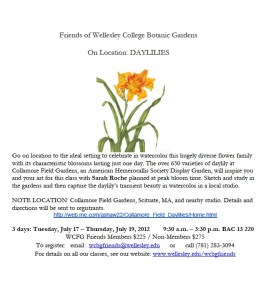
Daylilies at Collamore Field Gardens – July 17-19, 2012; 9:30 AM – 3:30 PM. Learn about daylilies at Collamore Field Gardens, an American Hemerocallis Society Display Garden featuring over 650 varieties of daylilies. Sketch lilies in the garden during peak bloom and learn how to transform your sketch into a watercolor painting in the studio. Botanical artist and instructor, Sarah Roche, will show you how! Cost: WCFG Friends Members $225, Non-members, $275. To register, contact wcbgfriends@wellesley.edu or call (781) 283-3094.

Read Full Post »

Botanist and botanical artist, Lizabeth Leech, has written a comprehensive introduction to botany for both artists and non-artists alike. In Botany for Artists, Liz does more than simply rattle off facts about plants. She teaches readers how to observe and record information about the plant specimens before them, as well as any fungi or lichen that may have taken their breath away.

Liz teaches readers how to see with “helpsheets” — worksheets designed to help artists see carefully, the morphological features of different plant groups. Blank helpsheets for flowers, winter twigs, gymnosperms, ferns, moss, and fungi are provided in the appendix and are easy to copy for personal use.

Each chapter of Liz’s book has information that will help artists navigate the plant world from an artist’s perspective. Sections of special note are:

    Liz’s Explanation of the Floral Formula. Helpsheet #2 (Recording Flower Details While Sketching and Annotating) found in Chapter 2, provides a helpful breakdown of the floral formula. This sheet will make recording data in the field easier and, most importantly, reliable! With this helpsheet completed, artists shouldn’t have too much of a problem keying out a plant back in the studio or keying out a plant at some later date.

    Labeled Line Drawings. Informative line drawings can be viewed throughout the book. Good examples are grass (Chapter 3), an orchid flower (Chapter 4), a winter twig (Chapter 8), and moss (Chapter 11).

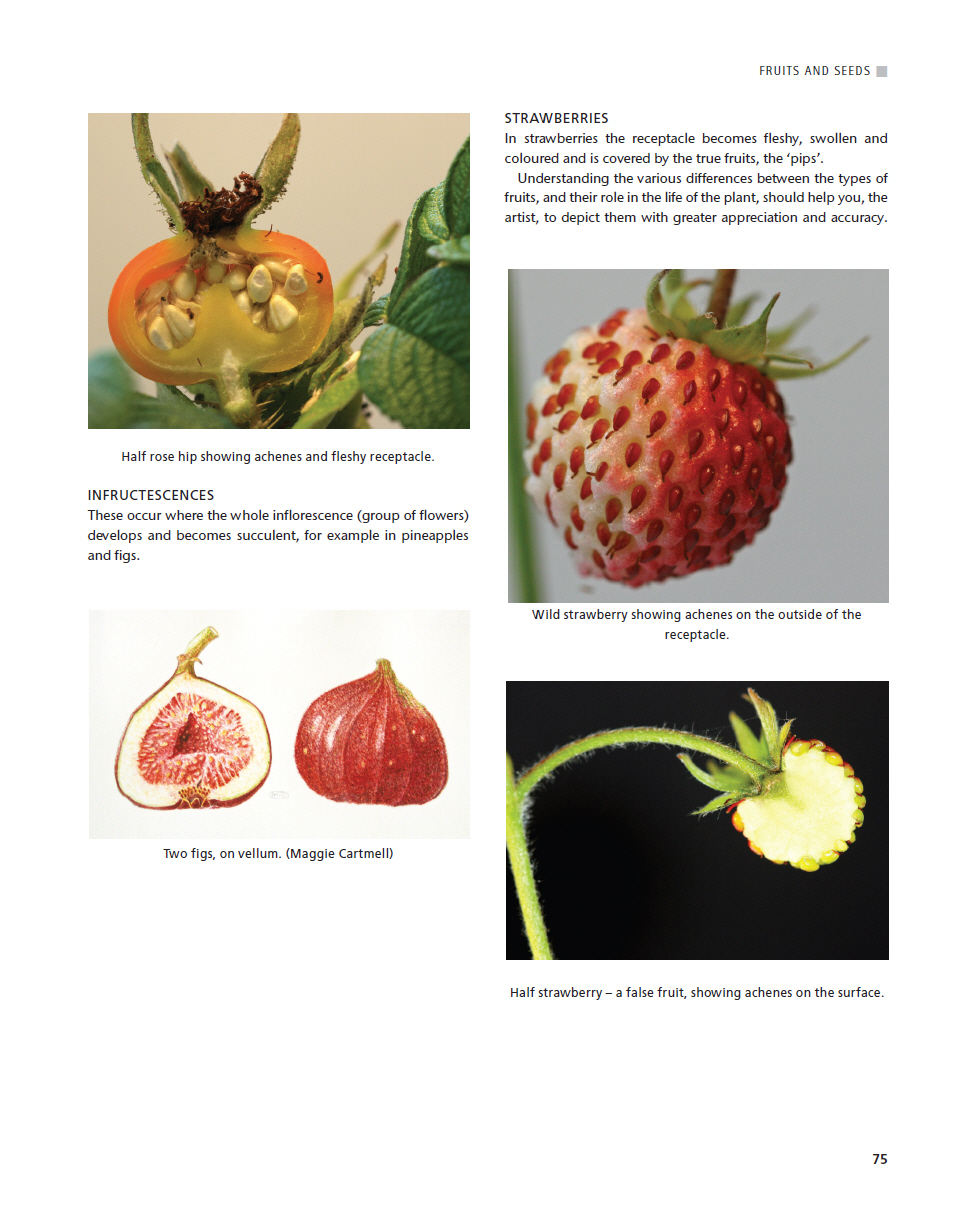
    Liz’s Thoughtful Explanations. Take, for example, Liz’s patient explanation of fruits and seeds. Liz takes her time explaining each fruit structure

    Courtesy Crowood Press. All rights reserved

    and seed dispersal mechanism. Her review is better than the usual charts and graphics encountered in a traditional botany class.

    Liz’s Review of Phyllodes, Climbing Adaptations and Roots. In Chapter 6, Liz stresses the need to observe leaves, fruit and stems carefully and for artists “to keep their wits about them to understand, and then depict and show, the links between structures and their functions.”

    Liz’s Review of Gymnosperms. In Chapter 9, artists will find descriptive photographs of different gymnosperms, a helpful table summarizing the phyla of gymnosperms and an example of how to complete Helpsheet #4 when observing gymnosperm specimens.

    Liz’s Review of Ferns, Club Mosses and Horsetails in Chapter 10, along with her illustrations and Helpsheet #5 (Ferns), ensure artists will develop a fluent understanding of these groups.

    Helpsheet #6 (Moss), in conjunction with Liz’s illustrations and photographs about the branching habits of moss and the leaf shapes of bryophytes, is sure to strengthen artists’ understanding of mosses and how they work.

    Liz’s Introduction to Fungi & Lichens will enhance artists’ understanding of where and how fungi and lichen grow. Helpsheet #7 (Fungi) is a helpful guide to collecting and observing capped fungi.

    How to Indicate Scale on a Drawing or Painting. Instructions on how to indicate scale can be found in the last chapter of Botany for Artists, along with a review of binomial names and plant-collecting equipment.

Lathyrus japonicus by Sara Bedford. Courtesy Crowood Press. All rights reserved

An explanation of the classification of plants, an introduction to the Hampton Court Palace Florilegium Society, a 297-word glossary, and a bibliography are also included in Liz’s new book.

Botany for Artists is a wonderful resource for botanical artists, as well as anyone incorporating botanical themes into creative projects who would like to learn more about plants.


Published in the UK in 2011, Botany for Artists is now available in the US and can be purchased at ArtPlantae Books. Use the coupon code presented at checkout to deduct 15% off your purchase.

Read Full Post »
Lizabeth Leech is a botanist, botanical artist, teacher and author. Liz has worked as a botanist at the Field Studies Council, taught biology in Australia, studied the flora and fauna of Australia as a postgraduate student, taught high school for 20 years and worked as a research assistant in soft fruit breeding and in a tissue culture lab growing eucalyptus and acacia trees. In the years leading to retirement, Liz began to study botanical illustration.

Since graduating from the diploma course in botanical painting at the English Gardening School in 2002, Liz has become a founding member of the Hampton Court Palace Florilegium Society, developed short courses in botany for artists and written the new book, Botany for Artists, released in the US just this morning!

Please welcome Liz Leech, the Featured Botanist for May!


A Conversation with Liz

Instead of publishing a complete interview like I normally do on the first day of the month, Liz and I will work together to lead this month’s conversation. We are slowing down our dialogue so that you can comment and ask questions as the conversation develops.

The conversation with Liz will advance every 2-3 days when I will ask our guest a new question. To comment or to ask a question at any time, click in the Comment box below and enter your comment or question. Before you click the Post Comment button, be sure to check the box next to “Notify me of follow-up comments via email”. By checking this box, you will be able to follow the conversation from your inbox.

Let’s begin!

Read Full Post »

« Newer Posts - Older Posts »