
Visit The Botany Studio
Prior to her current position as Senior Artist, Kandis earned her BA (1970) and MS (1980) degrees at the UW, and worked as a faculty assistant in the Biology Core Curriculum, prepping labs and helping to teach courses in zoology, botany, physiology and other biological subjects. During those years, Kandis (one of those “artsy” kids in grade school) was often called on to illustrate lab manuals — thus giving her experience in, and a taste for, scientific illustration.
In 1988 Kandis earned an Associate Degree of Applied Arts at Madison’s tech school, where she developed skills in preparing graphics and text for publication. When Botany’s illustrator position opened, Kandis applied for the job at once, knowing that the computer age was dawning for scientific illustration, even though she did not yet use a computer for graphics. When she was hired as the new Senior Artist, Kandis marched into the Macintosh lab at UW-computing, held up a $100 bill and yelled, “who wants to teach me this stuff?” Four hours later she had the basics of Adobe Illustrator and the rest is history.
Kandis now specializes in scientific illustration, typesetting and design. She uses her computer savvy to create educational posters, brochures, books, journal figures and information graphics for professors, students, and the occasional private client.
Please welcome March Feature Artist, Kandis Elliot!
ARTPLANTAE: When was the Botany Studio established?
KANDIS ELLIOT: I gave the studio its name when I began working here in 1988. The UW was founded in 1848, when all “natural history” departments in higher-education institutions had artists on staff. Back then, illustrations were done in pen and ink. Now illustrations are done on a Mac using a Wacom tablet and photography is done with a digital camera.
AP: Are the posters created for a specific class on campus or are they always created for a broader audience?
KE: They are created primarily for our departmental use, but work for a general audience as well. When Dr. Mo Fayyaz, the UW-Botany Greenhouses and Garden Director, wanted signage he could use with school groups and that could also be used in the college classroom, we were off and running with colorful visual posters that had a bit of botany tucked in.
We only produce about one or two posters per year because we work on these projects on our free time. The posters are printed in the studio when ordered via our website. They are printed on heavy semigloss 260-lb. paper using archival pigmented inks. Since earning First Place for Informational Graphics, we have been swamped with orders. The Botany Studio is now setting up a credit-card webstore to get past the snailmail bottleneck.
AP: The Botany Studio posts an hourly rate for non-departmental projects. Does this mean instructors from outside the University of Wisconsin can work with the Botany Studio?
KE: Yes. We have done work for our Department of Natural Resources — our “fish and game” environmental agency. We’ve also done work for wildlife groups, prairie enthusiasts, and parents of Girl Scouts. All of these projects are done on our own time or the rare free time.
AP: How many hours of free time do you set aside for the posters?
KE: About one day per week. I work four days (I’m a part-time employee) and then spend one day working on outreach projects.
AP: How long does it take to take a poster from concept to finished product?
KE: The easy ones only take a month. “Fungi” took nearly 6 months, including my crash course in fungology.
AP: How do you make a scientific illustration?
KE: When dealing with living or preserved material, we start with digital photos and/or scans. These are either retouched for clarity or completely “repainted” in Photoshop to create a more stylized figure. Often I need to make a diagram or “cartoon” with copious labels to accompany the image so that parts of, say, a micrograph, can be identified. If I don’t have excellent reference material, I take some mind-reading pills and go the science fiction route. Of course, this sort of mojo has to be fussed up to; scientific journals will not accept photos adulterated in any way unless they are send as an “illustrative concept figure.”
AP: You compose books in the Botany Lab. What types of books do you create?
KE: Textbooks, field guides and more. For example, we created a field guide for the spring woodland wildflowers for the UW-Arboretum, going out and digitizing all the flowers as they came into bloom (what a way to make a living!). We went on to make a much larger guide to prairie plants. These books are sprinkled with nifty extra tidbits about various species and esoteric but cool stories known by our faculty and staff that are normally shared only with botany students.
AP: Which software programs do you use to create the posters?
KE: I use all Adobe products–industry standard, and required by the publishers with whom we work.
AP: Do you paint or draw in your spare time?
KE: What’s “spare time?” No, seriously, I used to paint portraits of folk’s pets in the 1960’s and charge $25 per painting. It helped pay my tuition back in those knee-jerk reactionary hippy days. Over the years my vision slowly circled the drain (I was stabbed in the eye with a busted bottle when I was a kid) and could do less and less handwork. However, a giant monitor and the Wacom tablet let me keep illustrating.
AP: Do you have any advice for botanical artists who want to learn how to draw on the computer?
KE: Learn the same way I did. Glom on to someone who does it and get a couple hours of basics. Then play with Photoshop — press all the buttons, see how long it takes to crash the computer, that sort of fun. When you get a little experience, a one-day class is useful for filling in the gaps.
AP: How does working on a tablet differ from working on pen and paper? What are botanical artists most likely to notice during the first two hours of working on a tablet?
KE:
- You don’t need to apply nearly as much pressure with a stylus.
- Lots of gee-whiz feedback. The look and color of a digital drawing are the same or better, given the millions of colors available, and the multitude of effects you can do.
- You don’t experience the texture of a paper or canvas surface. You are able to draw on a tablet with your pen floating above the surface of the tablet.
- You have to get used to working without turning your tablet like you may be accustomed to turning your paper.
- Digital painting creates flat prints. The image may look great, but the physical texture of paper, canvas, paint gobs, etc., are absent. On the other hand, if you wish you had stopped painting 25 strokes ago, you can undo these 25 strokes in your History Palette. And let’s sing the praises of that “forgiveness of sins” button (CMD-Z or CTRL-Z)!
- You have more options with a digitizing tablet. You are not stuck with a static drawing. Working with a digitizing tablet is much more satisfying for artists who want to work quickly, not inhale fumes, and like to try several variations without losing any of the stages.
- And keep buying those lottery tickets so you can afford the loaded computer, tablet, camera and quality printer you’ll need for the perfect digital graphics experience.
Get Your Posters!
The Botany Studio has created ten beautiful and informative posters. Enlarged images of each poster can be viewed on the Studio’s website.
Ask The Artist with Kandis Elliot
Kandis will hold office hours this month. She will respond to readers’ questions and comments on March 4, 11, and 25. You are invited to post your questions in the comment box below and to follow the conversation as it progresses.
As always, you do not need to leave your full name. Your first name or a username will do.
 In Herbarium Amoris, Swedish photographer Edvard Koinberg photographs plants named by Carl von Linné (Linnaeus). Inspired by Linnaeus’s poetic descriptions of plant sexuality, Koinberg designed a project to bring attention to plants and their reproductive features.
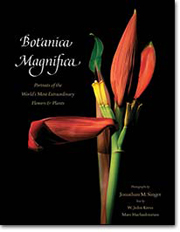 In the Introduction of Botanica Magnifica: Portraits of the World’s Most Extraordinary Flowers & Plants, Marc Hachadourian, the Curator of Glasshouse Collections at New York Botanical Garden, discusses the centuries-old association between science and art, citing specifically the relationship between a botanist and an artist. He explains that photographer Jonathan M. Singer, inspired by early botanical artists such as Walter Hood Fitch, Basil Besler, and Franz Bauer, as well as contemporary botanical artists Pandora Sellars, Anne Farrer, and Celia Rosser, set out to develop a digital photography technique that would capture a viewer’s emotions through lighting and detail and surpass “the capability of brush and paint.”


 ArtPlantae Today