Feeds:
Posts
Comments

Archive for the ‘History’ Category

New at Classes Near You > New York!


Gretchen Kai Halpert

www.gretchenhalpert.com
Gretchen Halpert is a scientific illustrator and biologist with many years of experience creating illustrations for the medical field, for scientific research, and for commercial clients. Gretchen also teaches classes in the book arts and leads journaling classes.

    Gardens and Villas of the Italian Lakes
    June 21-30, 2014
    Join Gretchen on an eight-day tour of northern Italy! Enjoy two travel days plus eight days exploring lush gardens and ancient villas in the Italian lakes region of northern Italy (plus a pop over to southern Switzerland). Visit Venice, Murano, Doge’s Palace, Giusti Giardino, Como, Lugano (Switzerland), Bellagio, Stresa, Lake Maggiore, Villa Cicogna, Isola Madre and Isola Bella. This botanical tour is presented by Botanical Travel Tours and operated by the Royal Horticultural Society in conjunction with Collette Vacations.

    Gretchen will offer botanical sketching and travel journaling tips and demos for those interested. Contact Gretchen by email or at 607-767-6936 if you have questions about this tour.

    View complete itinerary

Read Full Post »

Victoria regia by Carl Ulke. Image courtesy of Crispian Riley-Smith Fine Arts Ltd. All rights reserved.

Victoria regia by Carl Ulke. Image courtesy of Crispian Riley-Smith Fine Arts Ltd. All rights reserved.

The Art of Botanical Pictures: Still Lifes and Plants

This exhibition will be presented by Crispian Riley-Smith Fine Arts Ltd during Master Drawings and Sculpture Week, part of London Art Week (June 28 – July 5, 2013).

This exhibition of botanical art features the work of father and son artists, Carl and Henry Ulke. The art in this collection has been kept within the family for many years and is coming out onto the market for the first time.

Henry Ulke in his studio. Image courtesy Crispian Riley-Smith Fine Arts Ltd. All rights reserved.

Henry Ulke in his studio. Image courtesy Crispian Riley-Smith Fine Arts Ltd. All rights reserved.

Carl Ulke (1791-1882) was a typesetter and publisher in Germany. His son Henry Ulke (1821-1910) was a writer, a photographer and a portrait painter. Born in Germany, Henry emigrated to the United States in 1852. He is best known for his portrait painting. Henry’s painting of President Ulysses S. Grant hangs in the White House and more than 300 of his portraits are in US government and private collections. Henry was well-connected to the presidents and was one of the few eyewitnesses to the death of President Lincoln. Henry painted botanical subjects on the side and he was also an avid collector of beetles. His beetle collection was purchased by the Carnegie Museum in Pittsburgh, PA in 1900.

The Art of Botanical Pictures: Still Lifes and Plants includes 20 pieces by Carl and Henry Ulke. Also included in this exhibition are works by female Dutch artists, including Cornelia Maria Haakman and
Maria Margaretha Van Os.

All of this wonderful work and fascinating history will be on view for only one week. If you live near London or will be traveling in London during London Art Week (June 28 – July 5, 2013), stop by The Illustration Cupboard to see this exhibition.


Related

Read Full Post »

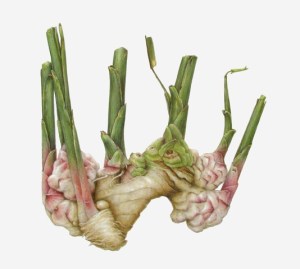
Zingiber officinale (Ginger).© Ingrid Finnan. Collection of Shirley Sherwood. All rights reserved.

Zingiber officinale (Ginger)
Oil on paper, © Ingrid Finnan
Collection of Shirley Sherwood. All rights reserved.

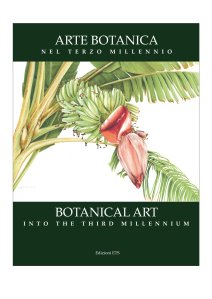
The exhibition catalog Botanical Art into the Third Millenium has arrived from Italy!

This catalog was published in conjunction with the exhibition of the same name now on view at Museo della Grafica in Pisa, Italy. This exhibition features botanical art from all over the world and will be on view through July 15, 2013.

In an announcement about the exhibition, curators Lucia Tongiorgi Tomasi and Alessandro Tosi write:

At the dawn of the third millennium, botanical painting constitutes a realm of expression of astonishing variety and vitality. In a tradition that has continued without interruption since the Renaissance, when artists such as Leonardo da Vinci and Albrecht Dürer inaugurated a new vision and a new manner of interpreting the natural world, down through the centuries with the work of such great European artists as Jacopo Ligozzi, Maria Sibylla Merian, Nicolas Robert and Pierre-Joseph Redouté, the universe of Flora has provided art with some of its most enduring and fascinating motifs.

The aim of Botanical Art into the Third Millennium is to provide an overview of the latest and most original work being produced in this genre, in a geographic dimension without limits and reflecting the unique diversity and specificity of local environments.

This unique exhibition catalog is now shipping from ArtPlantae Books.
Pre-orders are being processed and shipped. New orders will be processed in a timely manner.

Here is more information about this wonderful piece of botanical art history:

  • Paperback, 244 pages and illustrations
  • Features over 150 pieces of art
  • Each two-page spread has one page in Italian and one page in English
  • Includes the work of Margaret Stones, Rory McEwen, Margaret Mee
  • Includes contemporary botanical art from the Shirley Sherwood Collection, such as the painting of Zingiber officinale (Ginger) by Ingrid Finnan above.

7c4d2e1f4ced43b38be5553328ec3e3b
Botanical Art into the Third Millenium is available for purchase at ArtPlantae Books. Order now to save on international shipping fees. While supplies last.

Read Full Post »

Morphology Preview copy

Five members of Amicus Botanicus, a painting group formed by graduates of the 2004 Botanical Painting Diploma Course at The English Gardening School, will take part in MOR.PHOLO.O.GY: An Exhibition of Botanical Art at the Sunbury Embroidery Gallery at Sunbury-on-Thames, near London. This exhibition opens on July 2, 2013 and will be on view through July 28, 2013.

Artist Louise Young says, “The gallery is a delightful little modern gallery within a lovely walled garden in the middle of Sunbury. It is close to Hampton Court Palace where the flower show will be held in July.”

In this exhibition, artists Linda McDonald, Mary Ellen Taylor, Louise Young, Caroline Jenkins and Shirley Slocock share their views of the natural world.

Be sure to also add to your calendar the presentation about orchids in art by Dr. Phillip Cribb, former Deputy Director and Herbarium Curator at the Royal Botanic Gardens, Kew. Dr. Cribb is the co-author of A Very Victorian Passion: The Orchid Paintings by John Day, a book about orchid enthusiast, John Day (1824-1888). This very inspiring book contains a sample of the more than 2,300 orchids painted by Day that are housed at the Royal Botanic Gardens, Kew. Dr. Cribb wrote this book with Michael Tibbs in 2004.

Mor.phol.o.gy

Sunbury Embroidery Gallery
Sunbury-on-Thames, England
July 2-28, 2013

Read Full Post »

Years ago when I was teaching in grad school, the SimLife game was used as an activity in the Bio 101 labs to teach non-majors about population biology. Students had control of an assortment of variables and could watch generations of their sample population change over time. Students enjoyed the exercise and it helped them understand how the traits they assigned to their sample population resulted in either their population’s survival or eventual demise.

One of the objectives of incorporating botanical drawing into studies about the environment is to use it as a way to tell Nature’s story. Botany’s story is more than complicated terminology, labels with arrows and expensive textbooks.
In today’s column, we move beyond look-see-draw and engage in a bit of storytelling.


Botanical Illustration in the Lab

How does botanical illustration fit into a lab about population biology?

How about as a game?

Educators Erik Lehnhoff, Walt Woolbaugh and Lisa Rew explain how to do this in Designing the Perfect Plant: Activities to Investigate Plant Ecology.

What Lehnhoff et al. (2008) do first is lead students in a conversation about plant ecology. They show students photographs of whole plants, leaves, seeds, growing situations and other imagery related to plant ecology (Lehnhoff et al., 2008). They then ask students to consider the advantages and disadvantages of the growth forms, growing conditions and plant traits observed in the photographs.

Student observations become the foundation of a class conversation about plant ecology. With this conversation fresh on students’ minds, Lehnhoff et al. (2008) call upon students to design a plant with traits they think will ensure their plant’s long-term survival. Instead of creating a plant using a computer program, students are asked to draw their plant and to include in their drawing every trait they assigned to their plant. The authors ask students for a detailed drawing because they have observed that the “act of drawing the plant characteristics allowed students to better comprehend each of them, and to recognize how the plant may fit into its environment.” (Lehnhoff et al., 2008).

With their plants drawn, students then engage in a competitive game of cards. The game they play enables them to live with their plants through 10 generations. The custom deck of cards they play with contains four categories of cards. These categories are Weather, Dispersal Mechanisms, Disturbance Factors and Predation/Disease. Each card drawn exposes the carefully designed plants to conditions that could impact their survival. The cards in this custom deck each have a point value. Plants with the highest points per generation survive. Plants receiving negative points in repeated generations spiral towards extinction. After living through ten generations with their plants, students are asked to write about their plant’s fate.

This clever activity provides a way to introduce botanical illustration as a tool to learn about broad ecological concepts and to move it beyond its use as a tool to learn plant morphology. Included in this paper by Lehnhoff et al. (2008) are examples of the playing cards they use in their game.

Designing the Perfect Plant is available for purchase from the National Science Teachers Association (NSTA) at the NSTA Science Store (99¢). You can also search for this article at your local college library.


Literature Cited

Lehnhoff, Erik and Walt Woolbaugh, Lisa Rew. 2008. Designing the perfect plant: Activities to investigate plant ecology. Science Scope. 32(3): 29-35.


Related

Read Full Post »

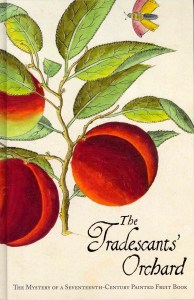
TheTradescantsOrchard There is a book about fruit that is surrounded by mystery and intrigue.

Is it a book?
Is it a catalog?
Is it a teaching tool about fruit trees?

The Tradescants’ Orchard is more catalog than book and, according to evidence of how often each painting has been handled, was also a teaching tool, according to authors Barrie Juniper and Hanneke Grootenboer.

Juniper and Grootenboer, together with the Bodleian Library, have published The Tradescants’ Orchard: The Mystery of a Seventeenth-Century Painted Fruit Book — a fascinating look at plantsman John Tradescant the elder, his son John Tradescant and their contributions to horticulture and the development of fruit orchards in 17th century Europe.

Originally called A Book of Fruit Trees with their Fruits (Juniper & Grootenboer, 2013), a photograph of this 400-year old manuscript is included in their book.

You are most likely already familiar with the Tradescants. The Spiderwort plants bear their family name (Tradescantia). Does this houseplant look familiar?

The Tradescant father and son team were responsible for introducing and raising many familiar garden plants (Juniper & Grootenboer, 2013). John Tradescant the elder was a sought-after plantsman in elite circles, operated a large nursery and, because of his extensive traveling, built an impressive cabinet of curiosities (Juniper & Grootenboer, 2013). When he died in 1638, John Tradescant the younger took over the family business and eventually became acquainted with Elias Ashmole.

This is where the story of the colorful manuscript containing 66 paintings of fruit and imaginary arthropods, frogs, birds, snails, a lizard and a squirrel gets very interesting.

Thought to be created somewhere around the 1620s or 1630s, The Tradescants’ Orchard was published when interest in growing fruit and when creating horticultural information for the public became popular (Juniper & Grootenboer, 2013).

Who commissioned the manuscript?

How did it end up at the Ashmole Museum?

What is unique about the paintings?

Much is explained in the forty-one pages of text leading up to Juniper & Grootenboer’s reproduction of The Tradescants’ Orchard. Their book is yet another wonderful chapter about the history of botanical art.


Literature Cited

Juniper, Barrie and Hanneke Grootenboer. 2013. The Tradescants’ Orchard: The Mystery of a Seventeenth-Century Painted Fruit Book. Oxford: Bodleian Library.

Available at independent bookstores. ($65)

Read Full Post »
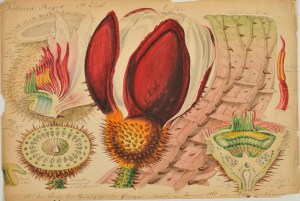
In my review of Marianne North: A Very Intrepid Painter by Michelle Payne, I ramble though calculations as I think aloud as to how Marianne North could have completed 832 paintings in 14 years. What have you discovered about how she worked that would make such an impressive accomplishment possible?

It is impressive! Calculated out it’s something like one painting every six days for fourteen years! And when we consider that the majority of this work was done on-the-spot in distant locales, the achievement becomes even more impressive. There are a few factors that made North’s project as prodigious as it was: first, and a great lesson to all, was the possession of an extraordinary work ethic. North woke early and worked through all kinds of weather, sometimes for up to twelve hours a day. She also famously preferred plants to people, and was often able to carve extra time to work by excusing herself from the many social obligations central to colonial and ex-pat community life in the places she visited. In Sarawak, for example…

Read More

Read Full Post »

« Newer Posts - Older Posts »