Feeds:
Posts
Comments

Archive for the ‘Education’ Category

This month’s featured guest, Mairi Gillies, has responded to questions about the incorporation of philosophical issues and plant ethics into her art. Read her replies in the comment section below her interview.

View Mairi’s comments

You are welcome to join in the conversation as well.

Read Full Post »

Professional graphite artist, Mike Sibley, has announced the start date of his next online drawing course at DrawSpace.com. This eight-week course is based on his excellent book Drawing From Line to Life (2006). Sample pages and reviews of this book can be viewed here.

Here is the latest at Classes Near You > England:


Mike Sibley Fine Art

www.sibleyfineart.com
Mike Sibley is the author of Drawing from Line to Life, an inspiring instructional book about creating realistic drawings in graphite. Mike teaches classes in England, the US and Canada. He is currently looking into teaching a class in Australia in 2013. He also teaches an online course and is currently creating instructional DVDs. Mike’s website is a rich resource for the graphite artist. If graphite is your preferred medium, be sure to visit!

    Drawing from Line to Life – Begins April 11, 2012. An eight-week online course based on Mike Sibley’s book of the same name. Beginners will learn fundamental drawing techniques, shading techniques and how to break a drawing down into manageable parts. Weekly homework will be assigned. Students may work towards certification or take this class as an auditing student. For additional information, including a class outline, go to the Drawing from Line to Life course page. Cost: $228 (certification), $114 (audit)

Read Full Post »

The New York Botanical Garden (NYBG) has a long history of offering classes in botanical art and natural science illustration. The number of courses they offer and their faculty roster is impressive. Upcoming learning opportunities include classes unique to NYBG. Classes such as Botanical Art Through the Centuries and several courses related to an exhibition about Monet’s Garden opening May 19 and continuing through October 21, 2012.

Below is a list of open classes at NYBG. These classes can also be found at Classes Near You > New York:


New York Botanical Garden

www.nybg.org
Two certificate programs are offered through the Garden’s Continuing Education program. One certificate program emphasizes Botanical Art & Illustration and the other, Natural Science Illustration. There are several courses from which to choose. View current course schedule.

Read Full Post »

Last week we learned how to conduct and record observations of plants in the field. Today we are treated to a reference serving as a fine example of how the life histories of plants can be written and, more importantly, introduced to a general audience.

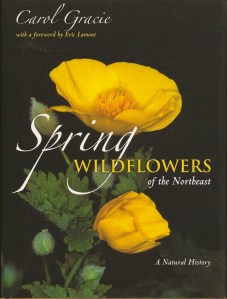
In Spring Wildflowers of the Northeast: A Natural History,
Carol Gracie shares the life histories of more than 30 spring-blooming plants growing in the northeastern United States. A seasoned writer, teacher and interpretative naturalist, Carol is able to “talk plants” to an audience whose interest may range from no interest at all to pure passion. The plant profiles Carol writes are more than a string of facts about a plant’s morphological parts and its dry taxonomic history. Each profile is a history lesson sprinkled with interesting insights into how plants work.

Using a friendly conversational tone, Carol touches upon complicated topics such as pollination ecology, species introduction, plant taxonomy, ethnobotany, horticulture, medicine and climate change without bogging readers down with the type of information that makes eyes glaze over. To maintain her easy-going storytelling approach, Carol chose not to clutter her profiles with references and footnotes. Instead, she waits until the end to cite her sources. She also went out of her way to keep her book free of the confusing technical jargon botanists speak. However, since some botanical terms cannot be translated into everyday English, Carol also provides a glossary of terms at the end of her book.

More than a guide to 30 popular plants of the northeast, this book is a guide to seeing. While reading Carol’s book, be prepared for your observation skills to improve without any effort on your part. This magical transformation occurs because of Carol’s detailed color photographs highlighting key characteristics of plants and the significant changes that occur during each plant’s life cycle. After viewing Carol’s 500+ images, you will discover you’ve developed a search image for the subtlest of details such as tiny persistent styles and the gentle arching of reflexed stamen.

I like Spring Wildflowers for several reasons. First, it doesn’t read like a textbook. It is easy to get lost in one plant profile after another. Second, it is a fascinating introduction to the plants of the northeastern US. Having lived around chaparral and coastal sage scrub all my life, there were plenty of opportunities to be surprised as I turned the pages of this book. What a treat to see the snowflake-looking flowers of the miterwort (Mitella diphylla) and its boat-shaped fruit. Not to mention the drama of an emerging skunk cabbage (Symplocarpus foetidus) and the intriguing morphology of featherfoil plants (Hottonia inflate).

What I like best about Spring Wildflowers is that it piqued my curiosity about East Coast plants. My fascination with plants and how they go about their business was greater at the bottom of page 233 than it was at the top of page 1. This is a good thing!

Published earlier this month, Spring Wildflowers is Carol’s most recent book. This book is recommended for teachers, naturalists and all plant enthusiasts in the northeastern US, armchair naturalists everywhere, and anyone striving to write interesting, easy-to-read plant profiles for a general audience.

Buy this book online from your local independent bookstore.


Literature Cited

Gracie, Carol. 2012. Spring Wildflowers of the Northeast: A Natural History. Princeton, NJ: Princeton University Press.


Related

Read Full Post »

New at Classes Near You > Virginia!


Botanical Artists for Education & The Environment

The Botanical Artists for Education & The Environment (BAEE) is a non-profit organization in Falls Church, VA created by a dedicated group of botanical artists in the Washington, DC metropolitan area.


Master Class in Botanical Art with Anne-Marie Evans

April 23-27, 2012 (10 AM – 3 PM)

Anne-Marie Evans is one of the foremost and highly regarded teachers of botanical art. Over many years, she has developed her own 6-step method for creating lovely watercolor paintings of plants. Through her six-step method, Anne-Marie concentrates on creating scientifically accurate and aesthetically pleasing paintings.

Anne-Marie prefers that students paint from live plants. Participants may select whatever plant they wish to paint. Most participants, however, will be selecting plants for the book-in-progress to be published by BAEE in late 2013.

One space is still available. If you are interested in taking this Master Class with Anne-Marie, please contact Bonnie Driggers, President, Botanical Artists for Education & The Environment. A waiting list is being created in the event a registered participant must drop out.

Drawing experience required.

Cost: $600


Related

Anne-Marie Evans Discusses Teaching, Learning & Botanical Art

Read Full Post »

Wave Hill invites you to experience their garden through the writing process.

Fine-tune your writing skills while learning how to write about plants, texture, color and design.


Wave Hill: New York Public Garden and Cultural Center

www.wavehill.org
Wave Hill is a 28-acre public garden and cultural center in the Bronx. Their mission is to establish human connections with nature through horticulture, education and the arts. Visit their website to learn more about their gardens, special collections and art classes.

    Writing in Nature
    Thursdays, April 19, 26, May 3, 10, 17, 31, 2012 (1-4 PM)
    “To learn about a tree, go to a tree,” wrote famed Japanese poet Basho many centuries ago. Guided by his advice, writing coach and former New York Times editor, Joan Motyka, works with participants to more acutely observe and write about individual plants and trees, as well as the general impact of the landscape, including color, texture and design. Reading and discussing selected nature writers enhances the experience. Cost: $180 members, $210 nonmembers. Location: Ecology Building. Details/Register

This information has been added to Classes Near You > New York.

Read Full Post »

Draw everyday.

Botanize everyday.

See what’s new at Classes Near You > North Carolina!


Botany Everyday

www.botanyeveryday.com
Marc Williams of BotanyEveryday.com is an ethnobotanist who leads an online botany class from March through December and offers many classes on plant identification, wild edibles, fermentation, food preservation, natural dyes, exotic invasive plants and various other subjects.

The next online botany class begins on March 23, 2012.
For course details, please visit Botany Everyday Online.

Read Full Post »

« Newer Posts - Older Posts »