Feeds:
Posts
Comments

Archive for the ‘Education’ Category

Newport Beach is a bustling beach town in idyllic southern California. It satisfies the TV stereotypes associated with living life in the “OC” (Orange County). Large homes, expensive cars, high-end shopping malls, surfboards, flip flops, shorts, and scantily clad suntans on Pacific Coast Highway really do exist. Newport Beach is also the last stop before urban water runoff hits the ocean. Newport Beach, like other oceanside cities, has to pay attention to what travels through its city streets on its way to the ocean. Like many cities nationwide, it works tirelessly to educate residents about water conservation and how water use (and misuse) impacts the environment. The city does a really good job delivering its message. How do they do it? They have a high-energy, forward-thinking Water Conservation Coordinator.

Shane Burckle has been the city’s Water Conservation Coordinator for over 2.5 years. As the year-round coordinator of this program, he creates outreach programs for Newport Beach and partners with interest groups to create public service announcements and special events such as the WaterMiser Workshop. The goal of the WaterMiser Workshop is to encourage Newport Beach residents to use native plants or “California Friendly” plants in their home gardens. To make this transition as easy as possible, renowned nursery Rogers Gardens provides the plants and the guidance necessary to help residents with their new approach to gardening. The WaterMiser event allows residents to learn about conservation from guest speakers and to connect with vendors specializing in products such as water harvesting tools, smart sprinkler systems, and how to wash your car without water. The first WaterMiser Workshop was held in 2009 and it was a huge success. Eighty people sent in RSVPs and 200 people showed up. This year, 120 people accepted the city’s invitation.

The city’s outreach programs also include:

  • A WaterMiser Video filmed bimonthly and streamed on to the water district’s website at www.WaterSmartNewport.org.
  • Public service announcements that are played in all Newport Beach movie theaters.
  • Water Innovation Now, a program created in conjunction with the Orange County Department of Education challenging K-12 students to create solutions addressing the Earth’s water crisis. Students are required to present their solution in a digital presentation.
  • Leaders in Environmental Action Films (LEAF) is a program targeted towards high school students challenging them to create 30-60 second “ecommercials” to raise environmental awareness about a topic of their choice.
  • The creation of a demonstration garden at city hall to enable residents to see water conservation principles applied to an urban landscape. The demonstration garden will be completed in 2012.

The city of Newport Beach serves 30,000 homes and approximately 50,000 people. As a municipal water provider that is run and managed by the city’s own Utilities department, the city functions independently from the Municipal Water District (MWD). Years ago, the city invested in ground water basins and this enables the city to use a ground water system. This makes the city less dependent on the MWD. It used to be that 78% of the water provided to Newport Beach residents came from the ground. However, now this amount has dropped to 63% because of ongoing drought conditions. Managing water use for 50,000 people with 50,000 different opinions about water conservation is a difficult task. You know what they say about bringing a horse to water.

Fortunately, the Newport Beach water district has made a plethora of educational resources available to residents. The district’s website contains tools for educators, programs for children, and many resources to encourage residents to look beyond their front door to see how the water crisis in southern California is really a worldwide water crisis. Burckle has observed that people don’t know how to conserve water and therefore do not bother to do it. The information in the Resources section of the city’s website is a step towards eliminating these barriers to action.


Question for EE Week Readers
:
What do you do to conserve water on a daily basis?


(Readers: You are invited to comment on any question presented to you this week. Look for questions at the end of most articles.)


Suggested Reading
:

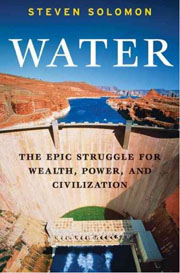
Publisher Comments: Far more than oil, the control of water wealth throughout history has been pivotal to the rise and fall of great powers, the achievements of civilization, the transformations of society’s vital habitats, and the quality of ordinary daily lives. In Water, Steven Solomon offers the first-ever narrative portrait of the power struggles, personalities, and breakthroughs that have shaped humanity from antiquity’s earliest civilizations, the Roman Empire, medieval China, and Islam’s golden age to Europe’s rise, the steam-powered Industrial Revolution, and America’s century. Today, freshwater scarcity is one of the twenty-first century’s decisive, looming challenges and is driving the new political, economic, and environmental realities across the globe.

Read Full Post »

National Environmental Education Week kicks off on Sunday. There will be many exciting things to learn during EE Week at ArtPlantae, at EEWeek.org, and at various events across the county.

You will be informed about interesting resources throughout the week here on the blog, on Twitter, and on Facebook. Remember that this site will be updated daily, so you will receive an update everyday from April 11-17.

There will be plenty of opportunity to interact with each other this week and it is hoped you take advantage of this opportunity to communicate with each other through the tools at ArtPlantae Today. Since the blog is home to us and our official gathering place, it is hoped we can establish lines of communication in this comfortable setting. If posting a comment makes you nervous, please know that you can post using just your initials and you do not have to use your full name.

ArtPlantae Books will close EE Week at the Green Scene Garden Show at the Fullerton Arboretum. This popular event will occur April 17-18. Bring your wagon!

Where else will ArtPlantae Books be this month? Visit the SoCal Bookscene website for more information.

What’s Next?

  • Meet Christine Elder
  • Learn how a science educator turned an idea into a series of popular field guides.
  • Learn how enthusiasm, a good memory, and determination created unique service-learning opportunities for kids and adults.
  • A botanical illustrator paints desert wildflowers from Calico to the Coachella Valley.
  • Plus so much more!

And as always, please share this information with others who may be interested.
Thank you!

Read Full Post »

New Hampshire has been added to Classes Near You!

Now at Classes Near You > New Hampshire:


Carolyn Payzant

Carolyn writes the Color Curriculum column for the Journal of the American Society of Botanical Artist. She is also on the Board of Directors of the American Society of Botanical Artists and is Founding President of the New England Society of Botanical Artists.

    Color Curriculum – Depending on your skill level, you will learn what your instructors know intuitively: how to make a perfect wash, how to tell the differences between biases, how to mix pigments to create that perfect match, how to limit your palette, and much, much more. A materials list will be sent on upon registration. Instruction will be arranged at a time convenient for the student and instructor. Student will receive 18 hours of instruction over a three-day period in New Castle, New Hampshire. Limit: 1-3 students per three-day session. Cost: $450. Contact Carolyn Payzant for more information.


Also See
:
American Society of Botanical Artists
New England Society of Botanical Artists

Read Full Post »

National Environmental Education Week begins on Sunday, April 11th. Special articles and learning opportunities will be coming your way. Please tell friends, students, teachers, and your favorite naturalist about the activities here at ArtPlantae and at EEWeek.org.

Here are more hints about what is to come during EE Week at ArtPlantae:

  • Contemporary botanical artists follow in the footsteps of their predecessors and document plants for future generations.
  • What’s happening at the 10th largest herbarium in the United States?
  • See what a rain garden is doing for a major public garden.
  • How did an East Coast artist capture California’s desert plants?
  • A scientific illustrator provides suggestions and answers your questions about connecting kids with nature through drawing.

Have you signed up to the RSS feed to receive daily updates during EE Week?

EE Week at ArtPlantae begins to materialize on Thursday. See you then!

Download this flyer

Read Full Post »

What’s the value of an image?

Is a picture really worth a thousand words?

Today we value the use of illustrations to convey scientific information. But in early 19th-century Britain, the use of pictures in science education was a hot topic of debate. In her article Botany on a Plate: Pleasure and the Power of Pictures in Promoting Early Nineteenth-Century Scientific Knowledge, Anne Secord reviews the debate in detail. Secord’s research focused on botanists specifically and their use of illustrations because early botanists recognized the importance of providing pleasure (appealing imagery) to their audience while imparting scientific knowledge. Secord’s research brings attention to “the role of pleasure in intellectual pursuits.”

In the 1800s, the “Diffusers of Knowledge” (i.e., experts in any given field) networked with only one objective in mind — to encourage people with an interest in nature to begin formalized study so they can become experts. The recruiters for botany took advantage of the public’s interest in color botanical plates to establish their own following of “admirers.” Botanists knew that to be successful at turning admirers into future botanists, they needed to maintain a balance between making botany an attractive science and keeping it a serious discipline. As a naturalist in 1838 proclaimed:

I conceive that the presentation of an allurement to the study of any science, is both a justifiable and a legitimate mode of procedure.

The use of illustrations as a teaching tool was a controversial topic back then because there were two schools of thought. One school felt it was perfectly legitimate to use illustrations that appealed to their audience. They recognized the need to engage their audience in conversation and the need to form a relationship with their audience. The other school, however, disagreed with this approach. They felt that by using illustrations and paintings to appeal to amateur naturalists, botanists were not really addressing the discipline of botany. According to the botanists in this second group, botany is best learned by studying written descriptions of plants and by studying actual specimens, not by looking at pictures. They felt color plates were “harmful” and merely provided “easy access” to the discipline instead of “sound knowledge” and “rational instruction.”

Let’s revisit the 1838 debate about the use of illustrations to teach natural history. Here’s a question for you…

Do color plates encourage beginners to study botany or do color plates encourage a superficial appreciation of nature?


Literature Cited
:

    Secord, Anne. 2002. Botany on a plate: Pleasure and the power of pictures in promoting early nineteenth-century scientific knowledge. ISIS. 93:28-57


Related
:

Read Full Post »

New to Classes Near You > International > England:


Rosie Sanders

http://rosiesanders.com
Create contemporary artists books with Rosie Sanders, a botanical artist in the UK who has earned five gold medals from the Royal Horticultural Society. These handmade books combine the books arts with botanical drawing and botanical painting. This course will be taught at Front House, a bed-and-breakfast in England. Participants will arrive after 4 pm on the Wednesday preceding the course.  Courses finish after lunch on Sunday. The courses are suitable for beginners and those with some experience. The groups are small (up to six people) and the atmosphere is very friendly, relaxed and welcoming. Front House is a large Georgian house situated in the market town of Bovey Tracey in Devon, on the edge of Dartmoor National park.  All bedrooms have en-suite bath or shower. View details and materials list here.

  • Wild Flowers – Thursday June 24 – Sunday June 27. Thursday to Saturday 9.30 am – 5 pm; Sunday 9.30 am – 1 pm
  • White Flowers – Thursday July 8 – Sunday July 11. Thursday to Saturday 9.30 am – 5 pm; Sunday 9.30 am – 1 pm
  • Flowers of Late Summer – Thursday August 18 – Sunday August 22.
    Thursday to Saturday 9.30 am – 5 pm; Sunday 9.30 am – 1 pm
  • Fruits and Berries – Thursday November 18 – Sunday November 21.
    Thursday to Saturday 9.30 am – 5 pm; Sunday 9.30 am – 1 pm

Read Full Post »

Art in the Park: Three-Day Nature Sketching and Journaling Workshop
Saturdays April 17, May 1 and May 8
10:00 AM – 3:00 PM
Cost: $75
This workshop series offers one full day of classroom instruction at the Quarter Path Recreation Center in Williamsburg, VA and two full days of plein air drawing at Waller Mill Park.  Linda Miller, botanical artist, Virginia Master Naturalist and a new member of the Native Plant Society, will help you see, sketch, and render the natural world. She designed this workshop using a number of traditional and creative techniques so each student (regardless of their style, sensibility, and ability) will develop their own personal approach to drawing.


Materials List
:

  • All Workshops: Sketching paper or spiral journal with blank pages appropriate for pencil or watercolor; pencils (2B & H); kneaded eraser; watercolor pencils or paint (optional)
  • Field Sketching: Comfortable chair or stool, sun protection, insect repellent, camera, binoculars or magnifying glass, your favorite field guides
  • Comforts: Water, snack and lunch. Dress for the weather.

Registration closes April 14, 2010. Please register at Waller Mill Park or by calling (757) 259-3778.

This workshop is listed at Classes Near You > Virginia, complete with links to both parks and a detailed course description.

Read Full Post »

« Newer Posts - Older Posts »