This month we will learn from graphite artist, author, and teacher, Diane Cardaci. Diane began her professional career as a natural science illustrator. She now focuses on portrait work and is a Signature member of the American Society of Portrait Artists. Diane has authored three books for Walter Foster Publishing, Inc. Two books are dedicated to rendering realistic forms and textures in graphite. Her most recent book, How to Draw from Photographs, is a handy reference about how to use reference photos to create detailed illustrations. Diane is also a co-author of two titles in Walter Foster’s Step-by-Step Studio Series. The books she co-authored are Drawing Concepts and Drawing Lifelike Subjects.
Today’s post will focus on the books Realistic Textures, How to Draw from Photographs, and Flowers & Botanicals, with a special emphasis on how botanical illustrators can benefit from these resources.
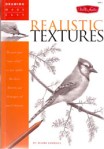 In Realistic Textures, Diane leads readers through a progression of exercises involving mark making and the creation of pencil washes using water-soluble graphite and smudging techniques. Diane’s demonstrations illustrate clearly that a pencil is more than a simple note-taking tool. While it may seem you’re playing around with pencil marks that will never be used on botanical subjects, Diane demonstrates otherwise when she shows artists how to apply tonal values and pencil marks to create form. Eight pages of Realistic Textures are dedicated to the creation of botanical textures. In this section, artists learn how Diane creates…
- The hard surface and pattern of croton leaves
- The glossy surface of holly leaves
- The thickness and textured surface of cactus pads
- The polished surface of an apple
- The bumpy texture of orange peel
- The achenes and shiny surface of a strawberry
- The rough texture of a cantaloupe
- The patterned surface of gourds
Of special interest to botanical illustrators is Diane’s eight-step demonstration in which she develops an illustration of a bellflower from line drawing to finished pencil painting. Illustrators will also find the sections about wildlife textures, landscape textures and animal textures helpful to their work.
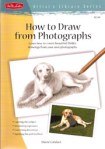 In this book, Diane provides many helpful tips, exercises, and pencil drawings to demonstrate how digital cameras can assist artists with their drawings. Diane shows artists how to recognize distortion, how to create distortion intentionally in their photographs, and how to correct for distortion in a drawing. She also demonstrates how to set up a value scale and how to identify a subject’s core value. Instruction in composition, lighting, how to work with several photo references, and how to capture details is also provided.
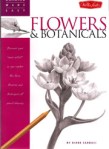 In this book about our favorite subject, Diane explains how botanical illustrators can use different techniques to create texture and values. Botanical artists will learn about graphite powder, graphite washes, and carbon pencil — tools not normally discussed in a botanical art class. Artists will also learn the value of creating a reference collection of flowers, flower heads, stems, leaves, leaf attachments, and reproductive parts for each specimen before combining these elements into a single composition. Eleven projects are presented by Diane, each one bringing attention to a different aspect of drawing. The projects and the key skills learned in each are as follows:
- Calla Lily – Blocking geometric shapes, the process of shading to create form
- Tulip – Blocking shapes, working with ellipses
- Hibiscus – Using graphite powder to create dark accents
- Heliconia – How to translate color as a tone in graphite, use of water-soluble graphite pencils
- Ornithogalum – How to approach drawing an inflorescence
- Water Lily – Using horizontal strokes to depict flatness
- Clematis – Drawing a vining plant & trellis
- Hydrangea – Using texture to create the illusion of many small florets
- Window Box Exercise – How to make plants a focal point in a scene
- Sunflower – How to simplify a drawing
- Mixed Media Exercise – Using ink washes and graphite
These titles are available at ArtPlantae Books.
Diane has so much more to teach us. Be sure to stop by on Monday!
Read Full Post »
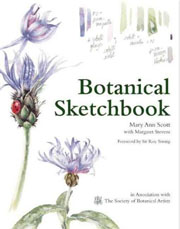 Mary Ann Scott’s Botanical Sketchbook is an open journal in which she describes her experiences as a student in the Distance Learning Diploma Course administered by the Society of Botanical Artists in the UK. Scott presents actual assignments, as well as the marks she earned for each assignment. Readers are given a front row seat to Scott’s insecurities, decisions, mistakes and successes. This book’s format is unique and provides a level of insight into the SBA diploma program that is not available anywhere else.


 ArtPlantae Today