Feeds:
Posts
Comments

Archive for the ‘Learning Opportunities’ Category

Paint on rice paper, study on your own, or choose to draw your plant specimen in any scale you desire. There are many learning opportunities for students of botanical art at Toronto Botanical Garden.

Here is the latest at Classes Near You > Canada:


Toronto Botanical Garden

www.torontobotanicalgarden.ca
A gardening education center offering classes for children and adults. Adult classes include classes in art, beekeeping, floral design, garden design and photography. View course schedule and registration information online.

  • Botanical Art for Beginners
    Wednesdays, September 12 – November 14, 2012; 6:30 – 9:30 PM.
    Learn how to build a botanical portrait from sketch to painting. Cost: $375 non-members, $300 members
  • Botanical Art Studio
    Thursdays, September 13 – November 22, 2012; 10 AM- 1 PM. Independent study with guidance from an instructor. Bring your own watercolor supplies and plant subject. Cost: $375 non-members, $300 members
  • Brushes with Serenity – Autumn Colors
    Mondays, September 17 – October 29, 2012; 10 AM – 12:30 PM.
    Paint autumns colors using bamboo brushes, ink and watercolor on rice paper. Cost: $200 non-members, $160 members
  • Colorful Autumn Leaves
    Tuesdays, October 2, 2012 – November 13, 2012; 10 AM – 1 PM.
    Paint leaves and landscapes. For beginning to advanced students in colored pencil; intermediate and advanced watercolor students. Cost: $235 non-members, $190 members

Also see the class about painting birds in acrylic!

Read Full Post »

Today the conversation turns to freelance illustration. I asked Linda Ann Vorobik if she had any professional advice for individuals entering the field of botanical illustration or natural science illustration. She replied:

Keep your day job. OR, if you are impassioned, know that you may be “suffering, if you want to sing the blues”. I was fortunate in that I followed my passion during a time when there were finances that allowed me to do so. My first job after college was supported by a grant (I worked as a technician transcribing rare plant data for The Nature Conservancy). The work was still work, but it allowed me to think about my intellectual love: botany. Later I received a fellowship that supported my graduate work. Granted I still worked half-time during my schooling, and WORKED to get my PhD, but I think it is a tougher world out there now for young people. And although I have been busy, I have never acquired an income that comes close to supporting a comfortable life. I have an interesting life, and am very grateful for it.

Another bit of advice: couple your training as a natural science illustrator with some complementary training, for example, in the sciences (like what I did), or graphic arts. Or, there is always marrying well!


Do you have any insights to share about life as a freelance illustrator?

Share your thoughts here…

Read Full Post »

Click to download


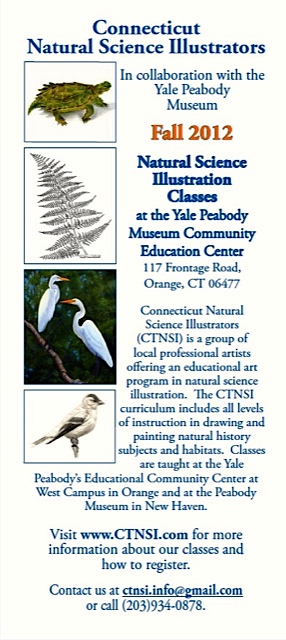
Connecticut Natural Science Illustrators

www.ctnsi.com

Connecticut Natural Science Illustrators LLC is comprised of professional artists and scientists who have developed educational programs in natural science illustration. The members of CTNSI also provide illustrations, printed material, murals and exhibits addressing environmental and biological topics. The team at CTNSI works with environmental groups, nature centers, schools, and event managers. All classes are taught at the Yale Peabody Museum Education Center/West Campus, 117 Frontage Road, Orange, CT 06477.

The Fall 2012 schedule features fourteen classes. One is a prerequisite for all other courses. The others explore topics related to botany, drawing, painting and field sketching.

Register online at www.ctnsi.com or contact ctnsi.info@gmail.com.

The Fall 2012 schedule includes:

  • Fundamentals of Natural Science Illustration I & II
    Weds, Fri, Sat, September 5 – Dec 8, 2012
  • Natural History Specimens in Watercolor and Gouache
    Fridays, September 7 – October 12, 2012
  • Drawing from the Dioramas at the Peabody Museum
    Fridays, September 7-28, 2012
  • Butterflies in Colored Pencil
    Saturdays, September 8-29, 2012
  • Field Sketching and Keeping a Personal Nature Journal
    Saturdays, September 8-29, 2012
  • Drawing and Painting Autumn Leaves and Berries
    Saturdays, October 6 & 13 and December 1 & 8, 2012
  • Field Sketching and Keeping a Personal Nature Journal
    Fridays, October 12 – November 2, 2012
  • Drawing and Painting Trees
    Fridays, October 12 – November 2, 2012
  • Oil Painting for Beginners
    Saturdays, October 13 – November 3, 2012
  • Drawing from the Dioramas at the Peabody Museum
    Saturdays, Oct. 20 & 27 and Nov. 10 & 17, 2012
  • Drawing and Painting Birds
    Wednesdays, November 7 – December 19, 2012 (no class November 21)
  • Botanical Illustration in Watercolor
    Saturdays, November 10 – December 8, 2012 (no class November 24)

Download Fall 2012 Schedule

This information has been posted to Classes Near You > Connecticut.

Read Full Post »

Botany is a discipline heavy with terminology. It is also a boring subject to many people. How can botany become more a more palatable subject for the non-botanist?

I asked featured guest Linda Ann Vorobik how she teaches botany to people who are learning about plants for the first time.

Here is what she had to say…

Read Full Post »

Botanical artist Molly O. Hoopes announces two new workshops for Fall. Here is what’s new at Classes Near You > Maryland:


Cylburn Arboretum

http://cylburnassociation.org
Located in Baltimore, Cylburn Arboretum is the home of a post-Civil War estate built as a summer home for the President of Baltimore Chrome Works and his mother. Now a center for environmental education and horticulture, the Cylburn Arboretum hosts tours, events and activities for children and adults.

The botanical art classes at Cylburn are taught by botanical artist, Molly O. Hoopes. Learn more about Molly in the ASBA Members’ Gallery. Molly is a member of the Botanical Art Society of the Northern Capitol Region and serves as Exhibits Co-Chair for this group.

    Autumn Foliage
    Saturdays, October 27 – November 17, 2012; 10 a.m. – 2 p.m.
    For the third year in a row, Molly O. Hoopes will teach botanical illustration classes in the still-very-new Greenhouse Classroom. Improve your observation skills and learn drawing, color-mixing and watercolor techniques while learning about native plants.  All skill levels welcome. Teen through adult. To register and for more information, contact Martha at Cylburn Arboretum at 410-367-2217 x 100 or
    Molly O. Hoopes.


Irvine Nature Center

www.explorenature.org
Located in the Caves Valley region of Baltimore County, the Irvine Nature Center is surrounded by 116 acres of woodlands, wetlands and meadows. They offer programs in environmental studies and the natural sciences for children and adults.

    Autumn Foliage with Molly O. Hoppes
    Sundays, October 21 – November 18, 2012; 1:00 – 4:30 p.m.
    Improve your observation skills and learn drawing, color-mixing and watercolor techniques while learning about native plants. All skill levels welcome. Teen through adult. View Details/Register

Read Full Post »

Mindy Lighthipe and Patricia J. Wynne have created a five-day sketching, drawing and painting adventure in central Florida.

Here is what’s new at Classes Near You > Florida:


Studio 16

www.botanicalartpainting.com
Custom classes, art tours, and self-published instructional books can be found at Studio 16, the classroom and art studio of natural science illustrator, Mindy Lighthipe. To register for classes, contact Mindy.

    Five-Day Botanical Art & Wildlife Workshop – October 22-26, 2012. Natural science illustrator, Mindy Lighthipe, and illustrator, Patricia J. Wynne, will lead this workshop in which participants will learn how to create field sketches and plein air paintings of flora and fauna. This workshop will be held in Gainesville, Florida. Each day of the workshop will be taught in a new location. Daily adventures include private tours of Kanapaha Botanical Garden, Lubee Bat Conservancy, Carlson Springs Conservation Sanctuary, the Butterfly Rainforest at the McGuire Center for Lepidoptera and Biodiversity, and Paynes Prairie. Cost: $750.
    View Details/Register


    Botanical Art Workshop with Mindy Lighthipe

    September 8-9, 2012; 10 a.m. – 4 p.m. Study simple flowers, fruit and vegetables in this introduction to botanical art. Learn how to create form using graphite and the techniques Mindy uses to create her award-winning watercolor paintings. Cost: $125. View Details/Register

Read Full Post »

If you were a biology student anywhere in California during the past 20 or so years, you are already familiar with the work of this month’s featured guest. You have seen her work on your desk, in the lab, on school field trips and in the dirt out in the field somewhere. You have also experienced her work weighing down your field bag.

You would already be familiar with Linda Ann Vorobik‘s work because, as a principal illustrator of The Jepson Manual: Higher Plants of California (1993), her work fills the pages of this detailed taxonomic guide to California plants.

Linda’s career as a botanical artist had its beginning in childhood. Although she was not drawing plants at the time, she spent a lot of time in her mother’s garden and had parents who gave art supplies as birthday gifts and holiday gifts.

A practicing artist from almost Day One, Linda learned from wonderful art teachers in junior high and in high school. Her experiences in college, however, were a different story.

Linda says that when she presented her first plant drawing to her college art teacher, he told her, “That’s not art.” Linda took five art classes while in college, but eventually switched from having a minor in art to a minor in math.

It wasn’t until she saw the botanical illustrations by Jeanne Janish in Vascular Plants of the Pacific Northwest did Linda think, “I want to learn how to do this.”

Linda showed Janish’s illustrations to the instructor of her systematic botany class and shared her interest in learning how to create illustrations like Janish. A couple weeks later, her instructor proposed that she create illustrations for his lab manual. Many drawings and a few months later, Linda had earned 9 credit hours creating botanical illustrations. After graduation, her instructor paid her $100 to draw four new plates for the glossary of his lab manual. Linda’s career as a professional botanical illustrator had been launched!

Later, Linda had the opportunity to learn from Jeanne Janish in person when Janish was invited to teach at Southern Oregon University. Janish was kind enough to correspond with Linda by mail after her class and provided Linda with feedback about her work.

Today Linda is a visiting scholar at the University Herbarium at UC Berkeley and at the University of Washington in Seattle. She has served as the principal illustrator for botanical works such as The Flora of North America (Grasses), The Jepson Manual: Higher Plants of California, The Jepson Desert Manual, A Flora of San Nicolas Island, and A Flora of Santa Cruz Island. Linda conducts field research and teaches botany and botanical illustration workshops in California, Oregon and Washington. She also leads a week-long orchid-painting workshop on the Big Island of Hawaii.

Linda’s illustrations appear in a long list of published work. Over the years, she has had the opportunity to learn about many species of plants. Because she is often called upon to draw many plant species for a floristic work, almost all of Linda’s professional botanical illustration work is from herbarium specimens. For this reason, she has developed the ability to transform flat, squished and crunchy plants into three-dimensional illustrations.

How does she do it?

Ask her!

Please join me in welcoming botanist and illustrator Linda Ann Vorobik, as our featured guest for August.


Readers!

Would you like to paint orchids on the Big Island of Hawaii with Linda in October? The deadline for the October workshop is August 15, 2012. View photos and additional information on Linda’s website. Or, visit Vorobik Botanical Art on Facebook.


Question #1:
When working with flat, dry herbarium specimens, how do you transfer key information about a plant from the herbarium sheet to a botanical plate? How do you add “life” to a dry, crunchy subject?


Linda
:

It is interesting to, at the age of 57, look back at my list of accumulated life-skills and know that it includes one as esoteric as being able to pull a 3-D image out of a 2-D herbarium specimen. Not the most marketable skill, but one that is essential for the scientific botanical artist (as compared with those who create floral images from live specimens or photographs). Herbarium sheets are research collections that include collection information and representative parts of a plant needed for that plant’s identification, or in museum language, that specimen’s “determination” (species, subspecies, or varietal taxonomic identity). There are a few tricks to bring botanical illustrations into 3-D, but let me first state that the style necessitates that the drawing is only partly 3-dimensional.

To a botanist, curving twisting shapes of leaves is of interest, but of more importance is the 2-dimensional shape, the margins of the leaf (whether dentate, serrate, crenulate, etc.), and the vestiture or indumentum on the leaves (“hairs”…which only animals have. Vestiture or indumentum refers to hair-like or scale like growths from the leaves). These are best shown when the subject is drawn flat. Fruits and seeds can usually be found in a non-flattened state, as they are for the most part small and preserved well on the herbarium sheet. Larger fruits and seeds are often either photographed or preserved in boxes in a separate collection space in the herbarium.

That leaves flowers, inflorescences (flowering stalks), and the overall plant habit (entire plant for small plants, or enough of the plant to show diagnostic characteristics, such as a branch or part of a branch, for larger plants). Flowers are the most difficult, and as a botanist and a photographer, I have had an advantage over many illustrators in that I am familiar with, if not the plant to be illustrated, at least members of its genus, which most often have a comparable flower form, and so I can make a life-like drawing based on extrapolating from what I have seen and or photographed already.

These drawings, combined with the pressed specimen, give me what I need to draw the inflorescence, as the specimen shows the spacing between the flower stalks (pedicels), their number, and their angle with the stem. It is merely a mental exercise to put it all together (take a Vorobik workshop to learn more!). Once all these parts have been drawn I can similarly draw the habit, showing leaves with more three-dimensionality by either referring to photographs (and on the west coast, CalPhotos, calphotos.berkeley.edu, is an excellent website) or by using artistic contrast (such as darks and lights) to create depth in illustrations.


You’re Invited

Follow this conversation as it develops. Click on the Follow link in your browser window to be notified when this website is updated. Or join in the conversation by posting a comment or question below and click the “Notify me” check box to receive new comments as they are posted.


Read Full Post »
« Newer Posts - Older Posts »