Feeds:
Posts
Comments

Archive for the ‘drawing’ Category

Save 20%

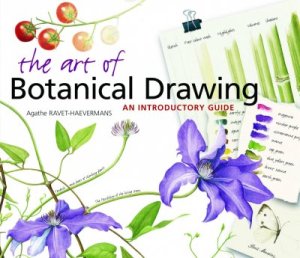
The U.S. publication of Agathe Ravert-Haevermans’ The Art of Botanical Drawing: An Introductory Guide has been delayed a bit. This title will be available about mid-February, according to publisher Timber Press.

ArtPlantae Books had the good fortune to view this book (the original French version) at Book Expo America last year. This is a charming book and we look forward to its U.S. debut.

Interested in this new title? Add your name to our Interest List. Please write RAVERT in the subject line.

Read Full Post »

9) Any advice on drawing and painting branches? I have so much trouble with this.

Wendy Hollender: Study the branches closely, first without any leaves. Winter is great for this. Draw them with all the detail you would put in a flower. Pay attention to how they change direction and thickness. Lay a branch next to a straight edge for comparison.

Rayma Kempinsky Peterson: Branches are a challenge. I usually draw them in early in the composition stage. Many of the trees in Western Canada are not brown. I draw them and leave them white for a time. Then as the painting progresses, I fill them in leaving a lot of the white. Aspen and birch barks are especially light-colored. Aspen bark is often light green. Remember that many branches and twigs have nodes as important parts of their anatomy. Often a twig will be straight in between nodes.

Louise Smith: When I have long and smoothly-curved branches or stems, I use a large French curve in my final drawing version. I will then lightly paint an outline that follows the drawn line which will serve as a “dike” once I get on with painting. Form in small spaces is likely to be drybrush and wash, wider branches may be all wash and glazing. I always use morphological information that the plant supplies to help describe form.

Return to Using Photographs

Continue to Paper

Back to Index

Read Full Post »

11) How do you like to draw veins?

Bobbi Angell: I like to draw them as accurately as possible, since they are important for identification. I doubt that is what you are asking, but once you start paying attention to patterns they become quite fascinating to draw no matter the technique.

Margaret Best: I love painting leaves period – veins are just a part of the pleasure.

Beverly Duncan: Careful observation first! One must understand the veining pattern of each specimen and how light on the specimen defines the veins.

Jean Emmons: For main veins, I save the white paper/vellum and paint around them. They always need some repair work (lifting) at the end. It’s good to remember that main veins have highlights, core darks, and cast shadows.

Sally Jacobs: I do a leaf rubbing to get an accurate picture of the venous structure. Even then, when I draw the veins, I have a real specimen in front of me to guide the drawing.

Mindy Lighthipe: I lift them out with a chisel brush.

Sherry Mitchell: I paint the veins of leaves by NOT painting them, really, at least not right away. If the vein is lighter than the majority of the leaf, then it is really “painted around,” with the vein being left out until the leaf is mostly complete. If the vein is darker than the majority of the leaf, I will block it in with a very fine brush, and then bring the paint up to it, so that it remains as an accent, adjusting the depth of colour as appropriate.

Return to Paper

Continue to Arranging Your Palette

Back to Index

Read Full Post »

You have the new workbook, now ask questions!

If you own a copy of Botanical Drawing: A Beginner’s Guide, you are invited to participate in the two-part “Ask the Artist” event scheduled for Monday, April 7, 2008, and Tuesday, April 15, 2008. To participate, submit up to three (3) questions to ArtPlantae Books at bookstore@artplantae.com on Monday, April 7th. Please write ASK WENDY in the subject line of your email message. Then return on Tuesday, April 15th, to read Wendy’s responses to your questions. All questions will be sorted by topic so that Wendy can address as many topics as possible. Please understand that Wendy is unable to respond to each question personally.

We learn more when we all participate. So tell your friends!

Read Full Post »

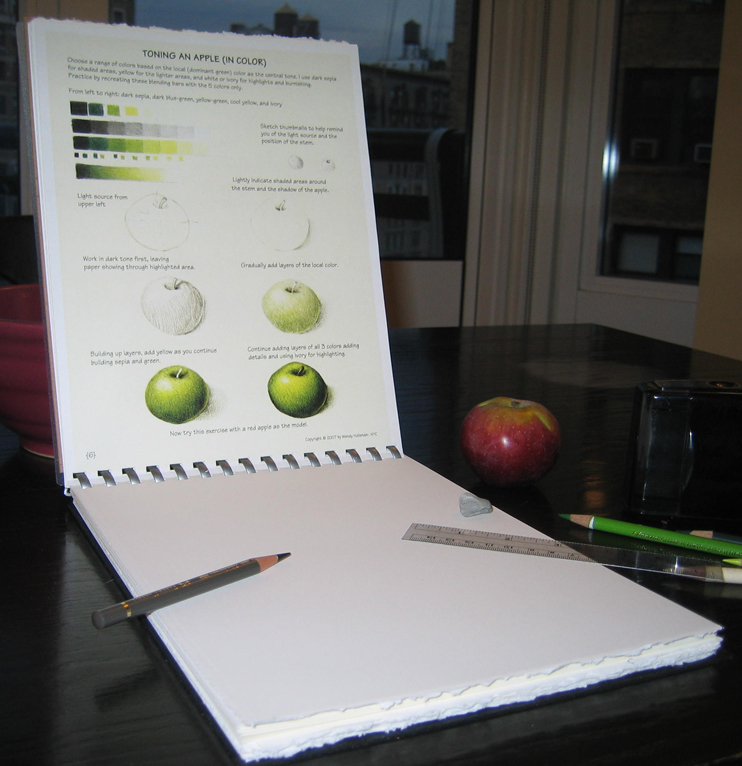
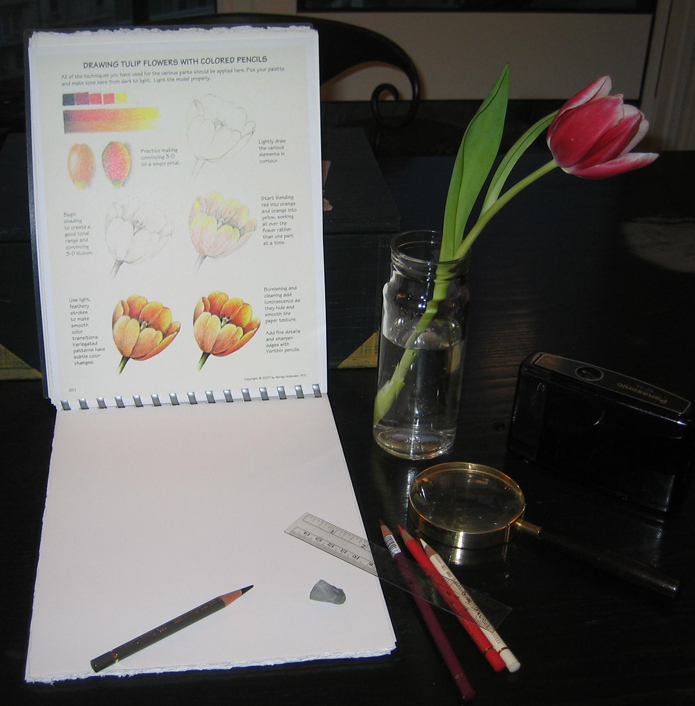
Artist/author, Wendy Hollender, has created a workbook that speaks directly to new illustrators. Novice illustrators can work with confidence as Hollender guides them patiently through each exercise. Hollender provides step-by-step instruction on how to create tone, how to draw apples & tulips, and how to apply color theory to workbook exercises.

Pre-order this book now through Monday, March 10, 2008 at ArtPlantae Books and receive a signed copy of Botanical Drawing: A Beginner’s Guide for $50, plus shipping & handling. This offer applies only to the soon-to-be-released second edition of this workbook containing acid-free drawing paper (the first edition contained drawing paper and hot press watercolor paper). In this workbook, Hollender’s instruction and demonstrations are presented on colored pages above the book’s binding with practice areas and drawing paper below the binding.

Wendy Hollender is the coordinator of the Botanical Art and Illustration program at the New York Botanical Garden. She teaches botanical art at the New York Botanical Garden, Brooklyn Botanic Garden, Westchester Arts Workshop, and leads workshops in exotic locations such as Trinidad, Block Island, and Hawaii.

Pre-order this book now at ArtPlantaeBooks.com and you will be able to participate in the “Ask The Artist” event on Monday, April 7, 2008. Select Books > Art > Pre-order event

Event Timeline

  • Feb 14: Pre-order opportunity announced
  • Mar 10: Last day to pre-order Botanical Drawing
  • Mar 11: An interview with Wendy Hollender at ArtPlantae Today
  • Mar 15 – 22: Second edition of Botanical Drawing is published; Wendy Hollender feverishly signs pre-ordered workbooks; workbooks shipped to ArtPlantae
  • Week of March 24: Signed workbooks shipped to ArtPlantae customers
  • April 7: “Ask the Artist” event; submit questions
  • April 15: Wendy Hollender responds to questions at ArtPlantae Today

Pre-Order Terms & Conditions:
All pre-orders to be mailed to a US address must be processed through the website of ArtPlantae Books at ArtPlantaeBooks.com. ArtPlantae Books is a verified Authorize.net merchant. Authorize.net safeguards customer information by utilizing the highest level of transaction processing security.

Mailing Suggestions:
We suggest selecting US Priority Mail as your mailing option during checkout if you want to have a chance to review your workbook before the “Ask the Artist” event. Delivery time for US Priority Mail is 2-3 days after your order has been processed and shipped. If you choose US Media Mail, delivery time is 3-9 days after your order has been processed and shipped. Longer to Hawaii and Alaska.

International Customers:
Please visit our Customer Care page to learn how international orders are processed. Because international orders have longer processing times and longer delivery times, you will not receive your signed workbook before the “Ask the Artist” event. You will, however, be able to benefit from the information generated by this event by visiting ArtPlantaeToday.com.

Read Full Post »
« Newer Posts