Feeds:
Posts
Comments

Archive for the ‘drawing’ Category

The City College of Glascow announces botanical illustration classes for Fall and early Spring 2013. Here’s the latest at Classes Near You > Scotland:

Botanical Drawing & Painting

  • Botanical Drawing – Thursdays, 10 weeks, beginning September 6, 2012; 6-9 PM. Beginning artists will learn how to draw and paint flowers, fruit and vegetables. Cost: £96. For more information, contact Clare Crines. View course schedule to register.
  • Botanical Drawing – Thursdays, 10 weeks, beginning November 29, 2012; 6-9 PM. Beginning artists will learn how to draw and paint flowers, fruit and vegetables. Cost: £96. For more information, contact Clare Crines. View course schedule to register.
  • Botanical Drawing – Thursdays, 10 weeks, beginning March 7, 2013; 6-9 PM. Beginning artists will learn how to draw and paint flowers, fruit and vegetables. Cost: £96. For more information, contact Clare Crines. View course schedule to register.

Read Full Post »

Featured guest, Heeyoung Kim, shares how she collects field data:


After you locate a plant in the field, how do you approach recording the plant’s information? Do you begin with a written description of its identifying characteristics or do you prefer to think visually and create a sketch first?


Heeyoung
:

When I am introduced to a new plant either with help from my “plant scout” or through a book, I can usually see it from its blooming season. I do start sketching parts of the plant, but I prefer working with the whole composition after I see its full life cycle in the next year.

Both written and graphic records are essential for a proper description, I believe. I usually start measuring botanically distinctive features of the plant with the metric system first. I then draw them from different angles and in various stages with color notes or sample coloring with colored pencil or watercolor. I know we are used to inch and feet in America, but in most other countries they use the metric system and they require you to write scales in centimeters and millimeters when you do scientific illustration and write a plant legend. For color notes, sometimes I just write down the paint tube names I will probably use to paint the plant. I find this works very well for me, as I can directly envision the painting process while I am looking at the plant.

I record all of my notes on one large paper, which I always have with me whenever I go out for sketch.


Join this conversation already in progress

Read Full Post »

Let’s say your normal teaching assignment involves introducing adult audiences to plant morphology and botanical illustration. Then one day, you are invited to teach the same subjects to children under the age of five.

Easy enough, you think.

However, when you start sifting through your notes, you realize you talk too much and that it has been a while since you’ve had a conversation with a three-year-old. How do you transform an adult activity about botanical illustration and plant morphology into one suitable for children with a very short attention span?

Many books have been written about early childhood science education. Many children’s books have also been written about the botany of flowers, seeds, leaves, trees and plants.

But let’s say you need help NOW and are looking for one good resource to help you rework your usual lesson plan. Consider reading the paper The Early Years: First Explorations in Flower Anatomy by preschool science teacher and author, Peggy Ashbrook.

In her paper, Ashbrook (2008) provides detailed instruction about how to lead a flower morphology lesson that uses drawing as a learning tool.

Probably the biggest difference between interacting with children, compared with adults, is the extent to which you have to model behavior. Conducting a demonstration or a desk-side show-n-tell comes pretty easily to adults. But modeling is more deliberate and requires a bit of forethought. To do this successfully, Ashbrook (2008) recommends teachers talk about the specimens under observation when modeling how they want students to observe. She recommends teachers say things such as, “Look at the tiny petals on this flower. The stamen has a yellow dust on it called pollen. Do all flowers have pollen?” (Ashbrook, 2008). Modeling, of course, does not end here because teachers then need to act out each step of the activity. They need to draw the same flowers students draw, explain how sketches or “first tries” (Ashbrook, 2008) don’t ever look like the actual specimen, and so on.

Ashbrook’s plant morphology lesson relies heavily on drawing. She has students drawing up to 5 varieties of flowers, recording differences between flowers, and describing each flower’s color either visually or in a written statement. She also has students pulling flowers apart so they can view, draw and describe each flower’s innermost structures.

And just like in any botanical illustration class, students gather at the end to share their drawings with classmates. For this closing activity, Ashbrook (2008) groups drawings by flower type to make sure the class discussion focuses on flower diversity and not on the quality of her young artists’ drawings.

If you lead young children in botanical art-related activities, consider adding Peggy Ashbrook’s article to your reference library.


Literature Cited

Ashbrook, Peggy. 2008. The early years: first explorations in flower anatomy. Science and Children. 45(8): 18-20.

To obtain a copy of The Early Years: First Exploration in Flower Anatomy, search the stacks at your local college library or read this article online here. [accessed on Google Docs June 28, 2012]


Related

Read Full Post »

Yesterday an exciting thing happened for the team at The Sketchbook Challenge. A book based on their wildly popular website was published by Potter Craft.
Written by Sketchbook Challenge founder, Sue Bleiweiss, the book The Sketchbook Challenge: Techniques, Prompts, and Inspiration for Achieving Your Creative Goals is a collection of themes, techniques, and art that will inspire first-time artists and experienced artists alike.

Bleiweiss’ introduction to paper, sketchbook formats, mark-making tools, paints, adhesives, and loosening-up exercises is followed by twelve chapters of themes and specific instruction about thirteen techniques. The techniques receiving special attention by Bleiweiss are: screen printing, stenciling, digital printing, thread sketching, painted papers for collage, hand-carved stamps, hand-dyed fabric, soy wax resist, image transfers, foiling, silk fusion, moldable foam stamps, and a 4-step drawing technique.

While these techniques are presented in a special “spotlight” feature, this book is really about several techniques and features a rich selection of examples of how these techniques are used by the 21 artists who have contributed their knowledge and artwork to this mixed media guide for sketchbooks.

The Sketchbook Challenge is a wonderful resource for anyone who lets a blank sketchbook, with its white pages, suppress their creative urges. If this is you, then I encourage you to browse through several pages of this book online.


Join the Celebration!

To celebrate the publication of their new book, the artists at The Sketchbook Challenge website are hosting a blog hop and giving away over $1,200 worth of prizes. Learn more about this 10-day event and how you can win one of the prizes at The Sketchbook Challenge Blog Hop.


Did You Know…

  • That Jane La Fazio, ArtPlantae’s Featured Artist for January 2011, is a regular contributor to The Sketchbook Challenge?
  • Artists from all over the world share pages from their sketchbook on the Sketchbook Challenge Flickr page?

Read Full Post »

Clarity
Research
Drawing
Design

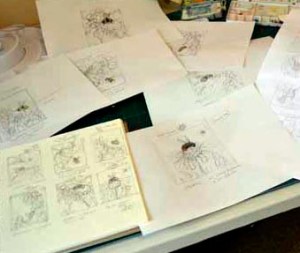
These are the four guiding principles by which Valerie Littlewood works. Today Valerie discusses her creative process and shows us how she plans her projects.

Join this conversation already in progress

Read Full Post »

Here is what else you’ll find at Classes Near You > England:


Bay Tree Cottage

www.btcworkshops.co.uk
A center offering workshops celebrating country living. Located in rural Northamptonshire, Bay Tree Cottage works collaboratively with The National Trust at Canons Ashby.

  • Botanical Drawing (Summer) – June 26, 2012. Enjoy the gardens at Canons Ashby and learn how to draw colorful foliage and flowers.
    Cost: £60.00. View Details/Register
  • Botanical Drawing (Fall) – September 25, 2012. Enjoy the gardens at Canons Ashbys and learn how to draw colorful foliage and flowers.
    Cost: £60.00. View Details/Register

Read Full Post »

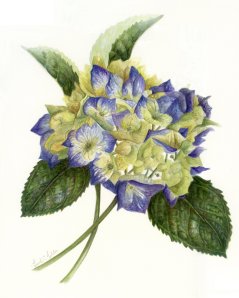
Blue Hydrangea, watercolor. © 2012 by Linda C. Miller. All rights reserved

Hydrangea Watercolor Workshop
August 21-23, 2012
9:30 AM – 3:00 PM

Create a botanical portrait working from the three varieties of hydrangeas at The Elizabethan Gardens in Manteo, NC. Participants will “discover” their specimen, leaf-by-leaf and petal-by-petal. Learn basic drawing skills, observation, and tea wash watercolor technique to create a botanical painting. Work at your own pace while while receiving individual assistance from artist in residence, Linda C. Miller.

Cost: $115 (two-day workshop) or $140 (three-day workshop).
Limit: 10.
To register, contact Nancy Harvey, (252) 473-3234.


About Linda C. Miller

http://lindacmiller.blogspot.com
Linda is a botanical artist from Virginia and the artist in residence at The Elizabethan Gardens in Manteo, NC. Learn more about this special honor. Visit Linda’s blog, Botanical Art Today, and her new online store where you can purchase prints of Linda’s traditional and whimsical botanical paintings.

This information can also be found at Classes Near You > North Carolina.

Read Full Post »

« Newer Posts - Older Posts »