Feeds:
Posts
Comments

Archive for the ‘botany’ Category

Know your veggies.
Eat your veggies.
Draw your veggies.

Making vegetables and plants irresistibly interesting to the next generation is the goal of Botany on Your Plate: Investigating the Plants We Eat, a ready-to-use curriculum written by Katharine D. Barrett, Jennifer M. White and Christine Manoux.

The eight interdisciplinary lessons in this book written for K-4 students are based on the Grocery Store Botany program taught at the UC Botanical Garden Berkeley. Each lesson includes a materials list and instruction on how to lead students to an understanding of plants through inquiry. Drawing is an essential part of each lesson and clearly enhances student observation skills and student understanding of plants and how they grow. Here is a summary of each lesson:

  • Lesson 1: Let’s Become Botanists! – During this lesson, teachers will determine students’ prior knowledge about plants and learn about the plants their students eat. Students create the botany journal they will use throughout the unit and learn about the “plant snack process”. A recurring feature, the “plant snack” activity encourages students to “taste and describe” the fruit and vegetables they are learning about.
  • Lesson 2: Roots – Students learn about roots and their function through observation, dissection and drawing. Suggestions about how to relate this lesson to math, nutrition, cooking, social science, language arts and plant propagation are provided.
  • Lesson 3: Stems – Students learn about stems and how water and nutrients travel through plants while dissecting and drawing stems. Students learn about the scientific process while conducting an experiment and learn about products made from stems. Suggestions about how to relate this lesson to math, nutrition, cooking, social science and language arts are provided.
  • Lesson 4: Leaves – Leaf structure and photosynthesis are the focus of this lesson. Dissection and drawing again play an integral role. Suggestions about how to relate this lesson to math, nutrition, social studies and language arts are provided.
  • Lesson 5: Flowers – Students study flowers and learn about pollinators while dissecting flowers and drawing floral structures in their botany journals. Suggestions about how to relate this lesson to math, nutrition, pollination ecology, cooking, social science and language arts are provided.
  • Lesson 6: Fruit – A study of two types of fruit leads to discussion about seeds and seed dispersal. Suggestions about how to relate this lesson to math, nutrition, ethnobotany, social science, cooking and language arts are provided.
  • Lesson 7: Seeds – In this lesson, students explore seeds in more detail. They learn about a seed’s function through dissection and drawing. Suggestions about how to relate this lesson to math, nutrition, cooking, gardening, social science, and language arts are provided.
  • Lesson 8: Plants – Top to Bottom – A recap of the many elements in this unit, students end the eight-lesson series drawing and writing about plants in their journals.

Background information about plant biology is provided for teachers, as are copies of the handouts required for each lesson. A helpful glossary is also included.

Botany on Your Plate: Investigating the Plants We Eat is an invaluable resource that should be in every classroom or at least in every school library.


Literature Cited

Barrett, Katharine D. and Jennifer M. White and Christine Manoux. 2008. Botany on Your Plate: Investigating the Plants We Eat. Burlington, VT: National Gardening Association.


Related Topics
Read Full Post »

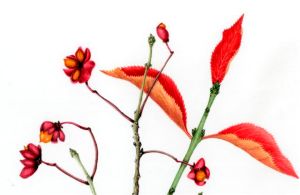
Euonymus europaeus. © Liz Leech. All rights reserved

Questions for You!

This morning Liz has questions for readers who own a copy of Botany for Artists. Liz’s book was released in the UK in November and was released in the US on May 1. Liz has specific questions about reader’s experiences with her new book.

Reader comments about the book have begun to appear in your ongoing conversation with Liz. This is perfect timing because today Liz has questions for all of you.

See what Liz is asking readers.

Join this conversation already in progress…

Read Full Post »

Sempervivum arachnoideum. © Liz Leech. All rights reserved

Ask Liz!
Liz and I hope you have enjoyed learning about her approach to teaching botanical artists about plants. Today Liz and I would like to open up the conversation. Do you have any questions you would like to ask Liz?

Click here to join the conversation

Read Full Post »

Liz Leech’s new book, Botany for Artists, has been adopted by the English Gardening School as a recommended text. It joins other helpful references written for students of botany and botanical art. Which references do you like to use?

Teachers, which resources have you found most helpful while teaching?

Students, which resources do you like to use in your studies?

Find out why Botany for Artists has been called an “essential reference book” by teachers and students in the UK.

Join this conversation already in progress..

Read Full Post »

After Liz identified a need for botany instruction, she was encouraged to write her book. She explains:

I finally decided to write my book in October 2009, having toyed with the idea for the previous 4 years or so. The final impetus came when I met Valerie Oxley who had just published her wonderful book “Botanical Illustration” with the Crowood Press. I mentioned that I intended to write a book on botany for botanical artists and wondered if she too thought there was a need. She was suitably enthusiastic and pointed me in the direction of her publisher with the words “Get on with it”.

Join this conversation already in progress…

Read Full Post »

Today, guest Liz Leech shares with us the moment she realized botany classes for artists were necessary. She says she knew botany classes would be helpful when…

A couple of fellow students on the diploma course produced wonderful paintings marred by obvious botanical errors (e.g. one had put in a leaf to make the composition better but had upset the natural leaf pattern on the branch, and could not “see” anything wrong with her painting). Others had on-going problems understanding the structure of some flowers and how the parts related to each other. Various fellow students then started to ask me questions and to ask for help with their botanical concerns. Once we founded the Florilegium, over time, I was asked to do a range of sessions on botanical topics for my fellow members. I also started to teach botany-based courses for artists at West Dean College, a new idea at the time. This in turn lead to my “distilling” information in the form of a series of notes to be handed out after I had delivered workshops, using lots of plant material, on different topics – starting with floral structure, fruits, ferns, fungi etc. Anything of interest or considered difficult.

Join this conversation already in progress…

Read Full Post »

I asked this month’s featured guest, Liz Leech, to identify the aspect of plant biology she finds to be most unfamiliar to the public. She replied…

The most unfamiliar aspect of plant biology, and the greatest barrier, seems to me to be the ability to distinguish plant characteristics and therefore to differentiate between plants within generally recognizable broad groupings such as trees, grass, ferns, moss, flowers, seaweed etc. Most people can put typical examples into these rather loose “groupings” of plants but are lost as soon as they have to be more specific and have to look more closely at less obvious examples. For instance, I have found that most high school students, when faced with assessing how many different species there are in a patch of lawn, only recognized the existence of lawn daisies if the flowers were still left on! After mowing they gave 100% grass! Smaller plants and different grasses were certainly not “seen”.

Join this conversation already in progress…

Read Full Post »

« Newer Posts - Older Posts »