It is the beginning of a new school year. Today I asked Linda Ann Vorobik if she had any advice about how K-12 teachers can make their lesson plans about plants more exciting for students.
Here is her reply.
What do you think?
Posted in botany, Special Articles & Interviews, Special Events, Teaching & Learning on August 10, 2012|
It is the beginning of a new school year. Today I asked Linda Ann Vorobik if she had any advice about how K-12 teachers can make their lesson plans about plants more exciting for students.
Here is her reply.
What do you think?
Posted in botany, Education, general botany, Learning Opportunities, Special Events on August 6, 2012|
Botany is a discipline heavy with terminology. It is also a boring subject to many people. How can botany become more a more palatable subject for the non-botanist?
I asked featured guest Linda Ann Vorobik how she teaches botany to people who are learning about plants for the first time.
Posted in botany, Teaching & Learning, teaching and learning on July 27, 2012|
Writer, producer, photographer, and educator, Anna Laurent, connects people with plants through her writing, research, and design work.
A native of New England and Harvard graduate, Anna moved to Los Angeles four years ago. Soon after, she became
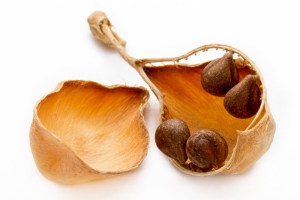
Isomeris arborea (Bladderpod). © Anna Laurent. All rights reserved
fascinated with the diversity of plants that could be found in California. Anna says it took moving to L.A. for her to notice plants.
And notice plants she has!
In 2008, Anna launched a personal project in which she began to collect seed pods (seeds and fruits) in her Hollywood neighborhood. Curious observers would occasionally ask her what she was doing. As Anna explained the seed pods she was collecting, she developed an interest in their diverse forms and universal functions. Her audience always appreciated the information she shared with them. That same year, Anna was approached by Print magazine to write a column. She chose to write a column about the form and function of seed pods and the role they play in a plant’s life cycle. She named the column Botany Blueprint and published articles about seed pods from September 2010 through June 2012. Her seed pod articles are now published on her website. Anna’s goal is to tell the stories of 100 seed pods and then publish this information, plus much more, in her new book, The Form and Function of Seed Pods (expected in 2013). The project’s geographic range has grown as she’s been partnering with botanic gardens and arboretums across the country, including Harvard’s Arnold Arboretum, Genna Walska’s Lotusland, the Hawaii Tropical Botanic Garden, and Queens Botanical Garden.
Increasing public knowledge about plants is at the heart of everything Anna does. In addition to collecting seed pods and writing for Botany Blueprint, Anna writes two weekly columns for Garden Design magazine. Her Art + Botany column focuses on plant-related art themes and her Botanic Notables column brings attention to a wide range of interesting stories about plants. Other projects she’s pursuing include a digital field guide to botanical gardens that gardens can use to teach visitors about plants and their respective collections.
I recently had the opportunity to speak with Anna about how she educates the public about plants through her creative projects.
ARTPLANTAE: How did you come to realize that botanical literacy was something you wanted to dedicate yourself to?
ANNA LAURENT: My projects now are a culmination of my previous work. I studied literature and biological anthropology in college, in particular, evolutionary mechanisms and behaviors. I spent the next years photographing, writing, and working on documentary media projects. Finally, when I moved to L.A., my interest in the natural world returned.
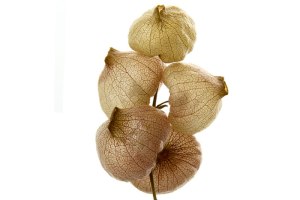
Salazaria mexicana (Paperbag Bush). © Anna Laurent. All rights reserved
The diversity of plant life in southern California — species native to tropical, desert, temperate, and riparian (water) regions – blew my mind. I realized how little I knew about the plants around me, and that didn’t seem right. So I began taking lots of walks and hikes and just looking at plants. I was fascinated by the diversity of structures — flowers and seed pods — that work in different ways to accomplish the same ends; namely, attracting pollinators, repelling predators, and dispersing seeds. I also observed the way they interact with our built environment, and with each other. One of my favorite relationships was in front of my apartment – a wisteria vine embedded around a fig tree. They were battling it out through a gap in the pavement; neither had been planted by human hand. Both plants are really strong, which was fascinating, and appropriate. It was a tableau of botanic heavyweights. Plants are quiet and slow, so finding the drama requires a bit of patience, but it’s there. Botanic gardens are a fantastic place to learn about plants, of course, and I also love observing plants in the wild – observing species that make their way through sidewalk cracks, that populate disturbed areas, that crawl over fences in abandoned spaces. It’s so thrilling when you begin to notice it all.
AP: In what ways do you hope to promote botanical literacy?
AL: Every plant has a story, and I hope to encourage people to ask questions that begin to unravel that story. How did this individual plant happen to germinate at this particular location (e.g. Did the seed float by on a breeze?, Was it carried by an unwitting animal?)? When were the seeds of the species introduced into the region? What behaviors and structures has the plant evolved in its native habitat? What are the plant’s ethnobotanical uses? How has the plant been culturally referenced — have authors employed it as a metaphor, have countries adopted it as a national symbol?
Learning about plants offers a unifying perspective on history and space.
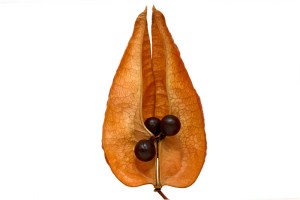
Koelreuteria paniculata (Golden Rain Tree). @Anna Laurent. All rights reserved
By following the historical arc of a plant’s evolution, and its cultural associations, we build unity between the modern era and our past. And plants also unify our disparate geographies. When I traveled to Iraqi Kurdistan last year, it was fascinating to see hollyhocks and oleander — plants I associate with southern California gardens — growing wild in the mountains and to learn about how people perceive them. Kurdistan is a pastoral region, which means that human settlements have evolved closely with plants. Knowledge is passed through generations, and plants are deeply embedded in the culture. I was told that the First Lady of Iraq was named for the hollyhock, and I heard a folk story about an early village that wielded oleander poison to defend against invasion. The oleander is still highly regarded today.
In the United States, there is a luxurious buffer between people and plants. We generally live amidst cultivated plants that don’t pose a significant threat, and we have pharmacies and markets that have packaged our plant-derived plants, so botanical literacy isn’t all that necessary for survival. At the same time, plants are nonetheless embedded in our lives, and it’s so important to understand how they behave, and what stories they carry with them.

Acacia podalyriifolia (Pearl-Wattle). @Anna Laurent. All rights reserved
In my seed pod project, I examine seeds and fruits, asking questions such as: Why is this seed red? (Often because birds are the plant’s preferred dispersal agent), Why does the seed pod stay attached to the parent plant for so long? (This often occurs in vines and plants that tend to grow on sloping areas, so when the seeds mature, they have a little momentum when they hit the ground, and will travel farther). After I collect the specimens, I photograph them and write about their form and function. I am thrilled to have partnered with botanic gardens, receiving permission to collect at their gardens. I then put together an exhibit of the photographs to promote the garden’s collection and educational mission.
AP: Your mobile field guide app project is very interesting. Can you describe briefly what you would like to accomplish with your guide?
AL: I wanted people to have access to the stories behind each plant. When you visit a botanical garden, you see a plant in a single cycle of its life,
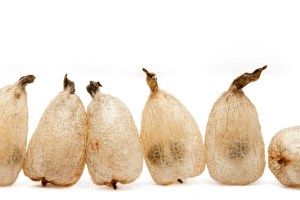
Astragalus fasciculifolius (Milkvetch). © Anna Laurent. All rights reserved
and there is rarely room for more than a name label. The digital field guide will enable visitors to view all aspects of a plant’s life cycle and to learn more about the plant. Plants can be identified through a map of the garden, but the app can also be used off-site to browse plant profiles. I find botanic field guides to be lovely bedtime reading.
AP: How did you get started in journalism?
AL: I’ve always been a writer, and writing has been a significant component of everything I’ve worked on — companion content for photojournalism essays, grants for documentary films, typeface reviews for Print magazine. My writing now is really no different, I am just doing a lot more of it, and I am able to focus on one broad topic that I love. I’m really enjoying figuring out how to describe plants in new ways, and the process of writing about them inevitably gives me a greater appreciation of the species in particular and the plant world in general.
AP: What have you been working on lately?
AL: For the past year, I’ve been working on a documentary media project, The Iraqi Seed Project. Looking at the agricultural landscape in modern-day Iraq and Kurdistan, it asks why farming is disappearing in the land where it was born. We bring into focus the region’s botanic legacies and current efforts to restore the Fertile Crescent. We just launched a website with clips from three years of filming. The video player is poised over a farm with seeds of the region’s historically major crops. We call the site a collective garden; every time a video is watched, a plant grows a little bit. The idea is that by learning about Iraq’s farmers and plants, we are helping their crops grow anew. It’s a nice metaphor.

Aristolochia fimbriata (White-Veined-Dutchman’s-Pipevine). © Anna Laurent. All rights reserved
Links updated 8/22/19
In Memoriam – Anna Laurent (1979 – 2024)
Posted in botanical art, botany, Education, general botany, Learning Opportunities on July 18, 2012|
Here is only a hint of the botany and botanical art classes one can take at the North Carolina Botanical Garden.
See what’s new at Classes Near You > North Carolina:
North Carolina Botanical Garden
www.ncbg.unc.edu
Through the Garden’s courses in botany and botanical art, anyone interested in plants and how to draw and paint them will receive a well-rounded education enhancing their scientific understanding of plants, their knowledge of visual arts theory, and how to approach drawing and painting plant portraits. Upcoming botany and botanical art classes include:
Posted in botanical art, botany, drawing, Teaching & Learning on June 29, 2012|
Let’s say your normal teaching assignment involves introducing adult audiences to plant morphology and botanical illustration. Then one day, you are invited to teach the same subjects to children under the age of five.
Easy enough, you think.
However, when you start sifting through your notes, you realize you talk too much and that it has been a while since you’ve had a conversation with a three-year-old. How do you transform an adult activity about botanical illustration and plant morphology into one suitable for children with a very short attention span?
Many books have been written about early childhood science education. Many children’s books have also been written about the botany of flowers, seeds, leaves, trees and plants.
But let’s say you need help NOW and are looking for one good resource to help you rework your usual lesson plan. Consider reading the paper The Early Years: First Explorations in Flower Anatomy by preschool science teacher and author, Peggy Ashbrook.
In her paper, Ashbrook (2008) provides detailed instruction about how to lead a flower morphology lesson that uses drawing as a learning tool.
Probably the biggest difference between interacting with children, compared with adults, is the extent to which you have to model behavior. Conducting a demonstration or a desk-side show-n-tell comes pretty easily to adults. But modeling is more deliberate and requires a bit of forethought. To do this successfully, Ashbrook (2008) recommends teachers talk about the specimens under observation when modeling how they want students to observe. She recommends teachers say things such as, “Look at the tiny petals on this flower. The stamen has a yellow dust on it called pollen. Do all flowers have pollen?” (Ashbrook, 2008). Modeling, of course, does not end here because teachers then need to act out each step of the activity. They need to draw the same flowers students draw, explain how sketches or “first tries” (Ashbrook, 2008) don’t ever look like the actual specimen, and so on.
Ashbrook’s plant morphology lesson relies heavily on drawing. She has students drawing up to 5 varieties of flowers, recording differences between flowers, and describing each flower’s color either visually or in a written statement. She also has students pulling flowers apart so they can view, draw and describe each flower’s innermost structures.
And just like in any botanical illustration class, students gather at the end to share their drawings with classmates. For this closing activity, Ashbrook (2008) groups drawings by flower type to make sure the class discussion focuses on flower diversity and not on the quality of her young artists’ drawings.
If you lead young children in botanical art-related activities, consider adding Peggy Ashbrook’s article to your reference library.
Literature Cited
Ashbrook, Peggy. 2008. The early years: first explorations in flower anatomy. Science and Children. 45(8): 18-20.
To obtain a copy of The Early Years: First Exploration in Flower Anatomy, search the stacks at your local college library or read this article online here. [accessed on Google Docs June 28, 2012]
Related
Posted in botany, Education, general botany, Learning Opportunities, Reference on June 15, 2012|
Ask and they will see.
In What Do You See?, professors Julianne Maner Coleman and M. Jenice “Dee” Goldston explain how to implement questioning strategies to enhance visual literacy in students.
What is visual literacy?
Visual literacy has to do with the ability to interpret the diagrams, charts, tables and illustrations that accompany text. Science textbooks contain many photographs, graphics and scientific illustrations. But do readers really understand them? Do they even look at them? Do teachers spend time discussing them?
After reviewing the teacher’s guide to a popular K-6 science textbook series, Coleman and Goldston (2011) concluded that teachers were probably not spending much time discussing the diagrams in their science textbooks. During their review, they found that the teacher’s guide provided little instruction about how to incorporate textbook diagrams into conversations about content. In their paper, Coleman and Goldston (2011) offer a solution to this problem and show how teachers can use “purposeful questions” (Coleman and Goldston, 2011) to enhance visual literacy and student learning.
The authors present their solution in a vignette in which a 4th grade teacher guides her student’s review of a plant cell diagram. The diagram students analyze is a cutaway diagram showing the structure of a plant cell and its contents. In the vignette presented by Coleman and Goldston (2011), the teacher guides her students’ review of the cell by asking questions such as:
These questions spark much discussion about what the students see in the cutaway diagram. It becomes clear that students understand the authors of their textbook included this particular diagram because they wanted students to learn what plant cells look like and what’s inside of them.
Because of their teacher’s thoughtful questioning, students make insightful observations about how the artist used a line to mark the cell’s edges and used different colors to make it look three dimensional. The teacher supports her students’ observations by explaining how artists use shading, lines and other techniques to present information that is otherwise not easy to see (Coleman & Goldston, 2011).
In the vignette, this conversation is followed by an activity in which students use microscopes to observe onion cells, Elodea cells, and then compare these live cells to the diagram in their book.
In What Do You See?, the dialogue between the teacher and her students is written out in detail and clearly demonstrates how purposeful questioning can support student understanding of diagrams and other graphics used in science textbooks.
In their paper, Coleman and Goldston (2011) provide three tools teachers can use to enhance the visual literacy of their students. These tools are:
What Do You See? is recommended reading for anyone with an interest in visual literacy and the role images play in science education.
This paper can be purchased online (99¢) from the National Science Teachers Association. Alternatively, you can search for a copy of this article at your local college library.
Literature Cited
Coleman, Julianne Maner and M. Jenice “Dee” Goldston. 2011. What do you see? Science and Children. 49(1): 42-47.
Related


Botanists and illustrators strive to document conifers around the world.
 ArtPlantae Today