Feeds:
Posts
Comments

Archive for the ‘botany’ Category

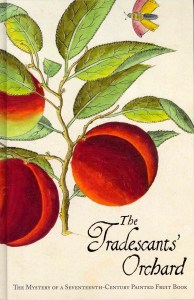
TheTradescantsOrchard There is a book about fruit that is surrounded by mystery and intrigue.

Is it a book?
Is it a catalog?
Is it a teaching tool about fruit trees?

The Tradescants’ Orchard is more catalog than book and, according to evidence of how often each painting has been handled, was also a teaching tool, according to authors Barrie Juniper and Hanneke Grootenboer.

Juniper and Grootenboer, together with the Bodleian Library, have published The Tradescants’ Orchard: The Mystery of a Seventeenth-Century Painted Fruit Book — a fascinating look at plantsman John Tradescant the elder, his son John Tradescant and their contributions to horticulture and the development of fruit orchards in 17th century Europe.

Originally called A Book of Fruit Trees with their Fruits (Juniper & Grootenboer, 2013), a photograph of this 400-year old manuscript is included in their book.

You are most likely already familiar with the Tradescants. The Spiderwort plants bear their family name (Tradescantia). Does this houseplant look familiar?

The Tradescant father and son team were responsible for introducing and raising many familiar garden plants (Juniper & Grootenboer, 2013). John Tradescant the elder was a sought-after plantsman in elite circles, operated a large nursery and, because of his extensive traveling, built an impressive cabinet of curiosities (Juniper & Grootenboer, 2013). When he died in 1638, John Tradescant the younger took over the family business and eventually became acquainted with Elias Ashmole.

This is where the story of the colorful manuscript containing 66 paintings of fruit and imaginary arthropods, frogs, birds, snails, a lizard and a squirrel gets very interesting.

Thought to be created somewhere around the 1620s or 1630s, The Tradescants’ Orchard was published when interest in growing fruit and when creating horticultural information for the public became popular (Juniper & Grootenboer, 2013).

Who commissioned the manuscript?

How did it end up at the Ashmole Museum?

What is unique about the paintings?

Much is explained in the forty-one pages of text leading up to Juniper & Grootenboer’s reproduction of The Tradescants’ Orchard. Their book is yet another wonderful chapter about the history of botanical art.


Literature Cited

Juniper, Barrie and Hanneke Grootenboer. 2013. The Tradescants’ Orchard: The Mystery of a Seventeenth-Century Painted Fruit Book. Oxford: Bodleian Library.

Available at independent bookstores. ($65)
Read Full Post »

Click for directions

Click for directions

Add this plant to the mural at ArtPlantae at Aurea Vista!

Tomorrow we begin decorating one side of ArtPlantae’s display area with a small mural inspired by you and the plants you love. Visit Aurea Vista tomorrow evening any time from 6:00 – 8:30 PM during ArtsWalk to make your mark. Drawing materials will be provided.

This activity will occur at the section dedicated to plant-based education, botany and botanical art on the lower level. Enjoy the start of summer by visiting Aurea Vista and other ArtsWalk venues.

View list of ArtsWalk venues and restaurants


Related

End of School Year Sale Continues at Aurea Vista.
Huge savings. Look for the blue dot!

Read Full Post »

You have mentioned that the Marianne North Gallery mobilized botanical knowledge. Were there particular kinds of knowledge that North hoped to cultivate?

Yes, absolutely. There are several running themes in North’s work that are telling of the kinds of stories she wanted to capture and put on display. First among these was the sheer abundance and variety of botanical nature. North rarely painted the same thing twice, and opted instead to…

Join the conversation with featured guest, Katie Zimmerman

Read Full Post »

Teach a person to see any one thing, just as it is, in form and color, and as it stands related to other objects around, and you accomplish much.

— Lewis P. Clover (1861)

As Marianne North painted habitat studies, plant portraits and botanical still life paintings while traveling the world, she had an educational objective in mind. Because she was alarmed at how little people knew about plants, North drew and painted plants so that others could learn about them.

Learning about nature and the world through the drawing process is the subject of a presentation Lewis P. Clover made to the State Teachers’ Institute in Quincy, Illinois in 1860. His presentation was reprinted in The Crayon in 1861 and it is this reprint we’ll take a look at today.

An advocate for “educating the eye” (Clover, 1861), Clover makes a case for drawing to become a core requirement in all schools. He makes his case in Drawing, as Connected with the Common and Higher Pursuits of Life.

Clover (1861) argues that there is not a pursuit in life that does not benefit from the act of drawing. He explains how botanists, geologists, machinists, physicians, carpenters, builders, architects, mechanics and even lawyers can benefit from knowing how to present information visually. He also argues that anyone can learn the principles of drawing, learn how to measure distances between objects, and learn to see (and appreciate) nature in a new way.

In his paper, Clover agrees with philosopher John Locke and states that drawing instruction in the school system should not be about creating master artists. It should instead be about equipping students with the skills to “represent tolerably on paper anything (one) sees.” (Locke, as quoted in Clover, 1861).

Clover argues that students need to be taught to see and to learn through drawing so they can have “awakened thoughts” (Clover, 1861) about the world and other things that would otherwise go unnoticed. Clover’s plea to teachers is best summarized in this statement:

Make drawing a branch of study in the schools, and you adopt the most successful mode of teaching pupils to discriminate.

— Lewis P. Clover (1861)

To get a copy of Clover (1861), search the stacks at your local college library.


Literature Cited

Clover, Lewis P. 1861. Drawing, as connected with the common and higher pursuits of life. The Crayon. 8(4): 73-77


More About Marianne North

This month we will learn more about Marianne North from featured scholar,
Katie Zimmerman. We’ll learn about North’s work and her contributions to botany. I hope you take advantage of the opportunity to learn from Katie directly and to ask her questions.

Join the conversation

Read Full Post »

The Eastern Metropolitan Regional Council (EMRC)
www.emrc.org.au
Provides environmental services, waste and recycling services, and other management services in Perth, Australia. Host of Bush Skills for the Hills, free community workshops connecting people to their natural environment. This program includes classes such as:

  • Native Tree Decline – May 18, 2013; 9:30 am – 12 pm. Learn about keystone species Corymbia calophylla, a woodland and urban tree whose numbers are declining. How will the loss of this tree affect the local ecosystem?
  • Botanical Drawing – August 3, 2013; 10 am – 12 pm. Learn how to create and maintain a nature journal and how to make observations in the field. For individuals with little or no experience in drawing.
  • Secret Life of Plants – October 16, 2013; 7-9 pm. Hidden secrets. Interesting characteristics.Learn about the secret life of plants!
  • Bushtucker Walk – October 19, 2013; 10 am – 12 pm. Learn about food plants and traditional hunting and gathering techniques.
  • Native Grasses: Walk and Talk – October 26, 2013; 9 am – 12 pm. Lean about local native grasses and how to tell them apart from introduced species.
  • Native Grasses Advanced – Bring your hand lens and take an in-depth look at native grasses.

View all workshops in the Bush Skills program.

Pre-registration for these free workshops is required. Contact EMRC to register.

This information has also been posted at Classes Near You > Australia.

Read Full Post »

This month the featured resource is YOU!

During March, our focus will be on the comments and suggestions that came up during January while readers completed the Reader Survey.

Readers completing the survey provided helpful feedback. This month I want to take some time to cultivate the type of community resources readers are asking for on this site. While reading through the survey, it became clear that publishing a single announcement about what readers are asking for wouldn’t be enough to put into action the changes readers are requesting. A single announcement would have been pushed down below the fold and would’ve scrolled off the bottom of the page in only a few days. So let’s take some time with this.

Before we begin, I want to make a couple of announcements.

A quick comment about commenting. Some readers have told me they do not comment because they don’t want to use their real name. I understand this completely. Please know that when commenting, you only need to use your first name or enter a screen name. You do not need to enter your first and last name. Hopefully this makes you a little more comfortable. The community conversation readers are asking for can only happen if readers communicate with each other, so I hope you will consider participating in the conversation when you feel comfortable.

Beginning next week, I will begin to post topics in which readers have expressed an interest. If you would like to suggest a topic of your own, please suggest a topic for discussion or pose a question to peers by dropping a note in the
new Suggestion Box. I will compile a list of topics and questions and will post a new topic or question for discussion each week (or as topics/questions are submitted).

As this month progresses, I hope our conversations will establish the momentum to take us well beyond March and into a new era of learning here at ArtPlantae.

Classroom teachers, what would you like to ask artists?

Artists, what do you want to ask naturalists?

Naturalists, what do you want to ask fellow naturalists, artists and teachers?

Drop a Note in the Suggestion Box


UPDATE: Join the Conversation


Read Full Post »

See the new tools for naturalists and artists.

See the new tools for naturalists and artists.

Natural science illustrators use many tools to create their informative drawings and paintings. One of the most important tools they use are magnifiers. ArtPlantae Books now carries a selection of magnifying devices often used by illustrators. These magnifiers will help you study plants in the field and in the studio.

These new tools can be purchased individually or in bulk quantities for classrooms, summer camps or nature center programs.

See what’s new at ArtPlantae Books!

Read Full Post »

« Newer Posts - Older Posts »