Feeds:
Posts
Comments

Archive for the ‘botanical art’ Category

After Liz identified a need for botany instruction, she was encouraged to write her book. She explains:

I finally decided to write my book in October 2009, having toyed with the idea for the previous 4 years or so. The final impetus came when I met Valerie Oxley who had just published her wonderful book “Botanical Illustration” with the Crowood Press. I mentioned that I intended to write a book on botany for botanical artists and wondered if she too thought there was a need. She was suitably enthusiastic and pointed me in the direction of her publisher with the words “Get on with it”.

Join this conversation already in progress…

Read Full Post »

Today, guest Liz Leech shares with us the moment she realized botany classes for artists were necessary. She says she knew botany classes would be helpful when…

A couple of fellow students on the diploma course produced wonderful paintings marred by obvious botanical errors (e.g. one had put in a leaf to make the composition better but had upset the natural leaf pattern on the branch, and could not “see” anything wrong with her painting). Others had on-going problems understanding the structure of some flowers and how the parts related to each other. Various fellow students then started to ask me questions and to ask for help with their botanical concerns. Once we founded the Florilegium, over time, I was asked to do a range of sessions on botanical topics for my fellow members. I also started to teach botany-based courses for artists at West Dean College, a new idea at the time. This in turn lead to my “distilling” information in the form of a series of notes to be handed out after I had delivered workshops, using lots of plant material, on different topics – starting with floral structure, fruits, ferns, fungi etc. Anything of interest or considered difficult.

Join this conversation already in progress…

Read Full Post »

Click to download flyer

The Wellesley College Friends of Horticulture has changed its name to Friends of Wellesley College Botanic Garden. The Friends’ listing in the Classes Near You section has been updated.

Here is what you’ll find at Classes Near You > Massachusetts:


Friends of Wellesley College Botanic Gardens
Certificate Program in Botanical Art and Illustration

www.wellesley.edu/wcbgfriends
This program offers several weekly and two- or three-day classes on botanical art and scientific illustration with Sarah Roche and Jeanne Kunze and seminars with visiting instructors including Susan Fisher, D. L. Friedman, Kathie Miranda, Carol Ann Morley, Kate Nessler, Elaine Searle, Catherine Watters and more. The courses offered through this program cover all aspects of botanical art. The following is only a glimpse of what this program offers:

  • Foundations of Botanical Drawing and Painting
  • Techniques of Botanical Drawing and Painting
  • Plant Drawing for the Petrified
  • On Location: Daylilies with Sarah Roche
  • Fruit from the Orchard
  • Botanical Painting on Vellum
  • Flowers as They Grow
  • Playing with Transparency: Colored Pencil on Mylar
  • View current schedule & instructor bios


Additional Learning Opportunities

Daylilies at Collamore Field Gardens – July 17-19, 2012; 9:30 AM – 3:30 PM. Learn about daylilies at Collamore Field Gardens, an American Hemerocallis Society Display Garden featuring over 650 varieties of daylilies. Sketch lilies in the garden during peak bloom and learn how to transform your sketch into a watercolor painting in the studio. Botanical artist and instructor, Sarah Roche, will show you how! Cost: WCFG Friends Members $225, Non-members, $275. To register, contact wcbgfriends@wellesley.edu or call (781) 283-3094.

Read Full Post »

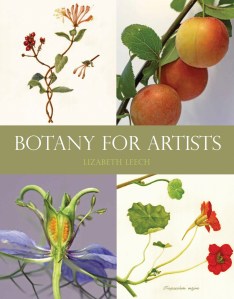
Botanist and botanical artist, Lizabeth Leech, has written a comprehensive introduction to botany for both artists and non-artists alike. In Botany for Artists, Liz does more than simply rattle off facts about plants. She teaches readers how to observe and record information about the plant specimens before them, as well as any fungi or lichen that may have taken their breath away.

Liz teaches readers how to see with “helpsheets” — worksheets designed to help artists see carefully, the morphological features of different plant groups. Blank helpsheets for flowers, winter twigs, gymnosperms, ferns, moss, and fungi are provided in the appendix and are easy to copy for personal use.

Each chapter of Liz’s book has information that will help artists navigate the plant world from an artist’s perspective. Sections of special note are:

    Liz’s Explanation of the Floral Formula. Helpsheet #2 (Recording Flower Details While Sketching and Annotating) found in Chapter 2, provides a helpful breakdown of the floral formula. This sheet will make recording data in the field easier and, most importantly, reliable! With this helpsheet completed, artists shouldn’t have too much of a problem keying out a plant back in the studio or keying out a plant at some later date.

    Labeled Line Drawings. Informative line drawings can be viewed throughout the book. Good examples are grass (Chapter 3), an orchid flower (Chapter 4), a winter twig (Chapter 8), and moss (Chapter 11).

    Liz’s Thoughtful Explanations. Take, for example, Liz’s patient explanation of fruits and seeds. Liz takes her time explaining each fruit structure

    Courtesy Crowood Press. All rights reserved

    and seed dispersal mechanism. Her review is better than the usual charts and graphics encountered in a traditional botany class.

    Liz’s Review of Phyllodes, Climbing Adaptations and Roots. In Chapter 6, Liz stresses the need to observe leaves, fruit and stems carefully and for artists “to keep their wits about them to understand, and then depict and show, the links between structures and their functions.”

    Liz’s Review of Gymnosperms. In Chapter 9, artists will find descriptive photographs of different gymnosperms, a helpful table summarizing the phyla of gymnosperms and an example of how to complete Helpsheet #4 when observing gymnosperm specimens.

    Liz’s Review of Ferns, Club Mosses and Horsetails in Chapter 10, along with her illustrations and Helpsheet #5 (Ferns), ensure artists will develop a fluent understanding of these groups.

    Helpsheet #6 (Moss), in conjunction with Liz’s illustrations and photographs about the branching habits of moss and the leaf shapes of bryophytes, is sure to strengthen artists’ understanding of mosses and how they work.

    Liz’s Introduction to Fungi & Lichens will enhance artists’ understanding of where and how fungi and lichen grow. Helpsheet #7 (Fungi) is a helpful guide to collecting and observing capped fungi.

    How to Indicate Scale on a Drawing or Painting. Instructions on how to indicate scale can be found in the last chapter of Botany for Artists, along with a review of binomial names and plant-collecting equipment.

Lathyrus japonicus by Sara Bedford. Courtesy Crowood Press. All rights reserved

An explanation of the classification of plants, an introduction to the Hampton Court Palace Florilegium Society, a 297-word glossary, and a bibliography are also included in Liz’s new book.

Botany for Artists is a wonderful resource for botanical artists, as well as anyone incorporating botanical themes into creative projects who would like to learn more about plants.


Published in the UK in 2011, Botany for Artists is now available in the US and can be purchased at ArtPlantae Books. Use the coupon code presented at checkout to deduct 15% off your purchase.

Read Full Post »
View details for each course and read about the program’s successful outcomes below and at Classes Near You > New York.


Cornell University Department of Horticulture

http://hort.cals.cornell.edu/
The Department of Horticulture at Cornell University has expanded their schedule of online courses to include an advanced techniques course in botanical illustration. The Cornell University Department of Horticulture now offers a certificate in botanical illustration through the Office of Continuing Education. This certificate program is composed of the following courses: Botanical Illustration I: Basic Drawing Techniques, Botanical Illustration II: Working with Watercolor and Botanical Illustration III: Advanced Techniques.

    Botanical Illustration I: Basic Drawing Techniques
    June 4 – July 21, 2012
    Students will work in pencil and pen-and-ink. Topics include: observing nature, drawing, composition, perspective, foreshortening, and how to use light to give botanical drawings three-dimensional form. Cost: $500. Limit: 15 students.
    View syllabus and register

    Botanical Illustration II: Working with Watercolor

    June 4 – July 21, 2012
    In this introductory course about color, students will continue their study of plants. Emphasis will be on simpler subjects such as a single-stem flower, fruit, and vegetables. Cost: $500. Limit: 15 students.
    View syllabus and register

    Botanical Illustration III: Advanced Techniques

    June 4 – July 21, 2012
    In this class, students will explore various media and develop a portfolio of work. Students will develop a proficiency in botanical drawing using pastels, colored pencil, pen and ink, pencil and chalk. Cost: $400. Limit: 15 students. View syllabus and register

A Botanical Illustration Certificate of Completion from the Department of Horticulture, Cornell University, will be awarded upon the successful completion of all three botanical illustration courses.

View Cornell University’s horticulture distance learning courses


Program News

Cornell’s Winter 2012 classes in botanical illustration produce successful student outcomes. Read More

Read Full Post »

Originally trained in botany, Alison Day transitioned into a more creative lifestyle by training at Goldsmiths College and The London Metropolitan University. A former photographer, Alison returned to drawing after an accident left her studio bound for a considerable time.

An artist for over 20 years, Alison’s drawings and paintings reflect a love for, and understanding of, the natural environment. Her work speaks to her process of looking, reflecting and communicating the essence of plants. Alison explains:

This work takes time and a meditative patience. Some have commented that the process must be therapeutic, which it is. But then doesn’t artistic practice by its very nature perform this function? The work attempts to imbue the viewer with the same feeling of meditative peace. As an artist, I invite the viewer to take time to look, not something we often give ourselves the pleasure of doing.

Interested in learning more about botanical illustration?

A “taster session” for those interested in botanical art will be held on Saturday, May 27, 2012 from 1:00 – 2:30 PM. All are welcome. Please bring your own drawing or painting materials.


About The Gallery London

The Gallery London promotes the creative expressions of local artists. They provide both established and emerging artists the opportunity to work in a creative environment and the opportunity to promote and exhibit their work. The Gallery hosts art classes for children and adults, as well as a cafe and a vintage boutique. The Gallery is located at 132 Hither Green Lane, SE13 6QA. For more information, contact Larissa at The Gallery London.

Read Full Post »

Many new exhibitions have been added to the Exhibits to Visit section. So many in fact, it is necessary to create an announcement to bring attention to all of them.

Some exhibitions are already open and others will open this week, such as the exhibition at the Northbrook Public Library in Northbrook, IL featuring the award-winning botanical art of Heeyoung Kim. On view will be the collection of paintings for which Heeyoung was awarded a gold medal by the Royal Horticultural Society earlier this year.

Here is what’s new:

Read Full Post »

« Newer Posts - Older Posts »