Feeds:
Posts
Comments

Archive for the ‘botanical art’ Category

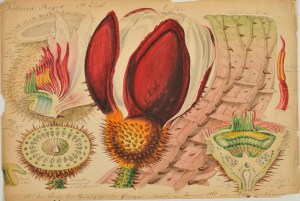
Victoria regia by Carl Ulke. Image courtesy of Crispian Riley-Smith Fine Arts Ltd. All rights reserved.

Victoria regia by Carl Ulke. Image courtesy of Crispian Riley-Smith Fine Arts Ltd. All rights reserved.

The Art of Botanical Pictures: Still Lifes and Plants

This exhibition will be presented by Crispian Riley-Smith Fine Arts Ltd during Master Drawings and Sculpture Week, part of London Art Week (June 28 – July 5, 2013).

This exhibition of botanical art features the work of father and son artists, Carl and Henry Ulke. The art in this collection has been kept within the family for many years and is coming out onto the market for the first time.

Henry Ulke in his studio. Image courtesy Crispian Riley-Smith Fine Arts Ltd. All rights reserved.

Henry Ulke in his studio. Image courtesy Crispian Riley-Smith Fine Arts Ltd. All rights reserved.

Carl Ulke (1791-1882) was a typesetter and publisher in Germany. His son Henry Ulke (1821-1910) was a writer, a photographer and a portrait painter. Born in Germany, Henry emigrated to the United States in 1852. He is best known for his portrait painting. Henry’s painting of President Ulysses S. Grant hangs in the White House and more than 300 of his portraits are in US government and private collections. Henry was well-connected to the presidents and was one of the few eyewitnesses to the death of President Lincoln. Henry painted botanical subjects on the side and he was also an avid collector of beetles. His beetle collection was purchased by the Carnegie Museum in Pittsburgh, PA in 1900.

The Art of Botanical Pictures: Still Lifes and Plants includes 20 pieces by Carl and Henry Ulke. Also included in this exhibition are works by female Dutch artists, including Cornelia Maria Haakman and
Maria Margaretha Van Os.

All of this wonderful work and fascinating history will be on view for only one week. If you live near London or will be traveling in London during London Art Week (June 28 – July 5, 2013), stop by The Illustration Cupboard to see this exhibition.


Related

Read Full Post »

The Botanical Artists Guild of Southern California (BAGSC) will lead educational activities and conduct botanical art demonstrations at the J. Paul Getty Museum in conjunction with the exhibition Gardens of the Renaissance, now on view in the North Pavilion.

Visitors will learn about plants and have the opportunity to try botanical art techniques themselves. Look for the interactive BAGSC tables in the Getty’s Central Garden between 12:30 – 2:30 PM on the following dates:

  • Sunday, July 7, 2013
  • Sunday, July 21, 2013
  • Sunday, August 4, 2013
  • Sunday, August 11, 2013

See what else is happening at The Getty on these days and through the rest of the year. Check out the Getty Event Calendar.

Read Full Post »

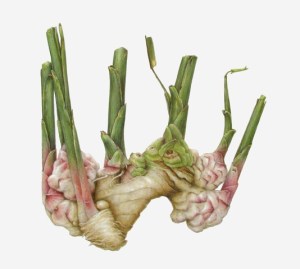
Zingiber officinale (Ginger).© Ingrid Finnan. Collection of Shirley Sherwood. All rights reserved.

Zingiber officinale (Ginger)
Oil on paper, © Ingrid Finnan
Collection of Shirley Sherwood. All rights reserved.

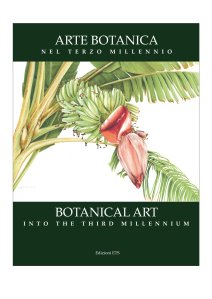
The exhibition catalog Botanical Art into the Third Millenium has arrived from Italy!

This catalog was published in conjunction with the exhibition of the same name now on view at Museo della Grafica in Pisa, Italy. This exhibition features botanical art from all over the world and will be on view through July 15, 2013.

In an announcement about the exhibition, curators Lucia Tongiorgi Tomasi and Alessandro Tosi write:

At the dawn of the third millennium, botanical painting constitutes a realm of expression of astonishing variety and vitality. In a tradition that has continued without interruption since the Renaissance, when artists such as Leonardo da Vinci and Albrecht Dürer inaugurated a new vision and a new manner of interpreting the natural world, down through the centuries with the work of such great European artists as Jacopo Ligozzi, Maria Sibylla Merian, Nicolas Robert and Pierre-Joseph Redouté, the universe of Flora has provided art with some of its most enduring and fascinating motifs.

The aim of Botanical Art into the Third Millennium is to provide an overview of the latest and most original work being produced in this genre, in a geographic dimension without limits and reflecting the unique diversity and specificity of local environments.

This unique exhibition catalog is now shipping from ArtPlantae Books.
Pre-orders are being processed and shipped. New orders will be processed in a timely manner.

Here is more information about this wonderful piece of botanical art history:

  • Paperback, 244 pages and illustrations
  • Features over 150 pieces of art
  • Each two-page spread has one page in Italian and one page in English
  • Includes the work of Margaret Stones, Rory McEwen, Margaret Mee
  • Includes contemporary botanical art from the Shirley Sherwood Collection, such as the painting of Zingiber officinale (Ginger) by Ingrid Finnan above.

7c4d2e1f4ced43b38be5553328ec3e3b
Botanical Art into the Third Millenium is available for purchase at ArtPlantae Books. Order now to save on international shipping fees. While supplies last.

Read Full Post »

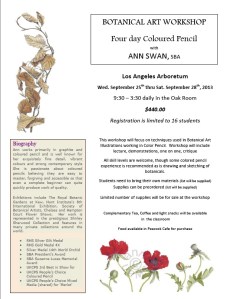
flier_AnnSwan_LA Arbortuem Botanical artist Ann Swan will lead a four-day colored pencil class at the Los Angeles County Arboretum and Botanic Garden September 25-28, 2013.

Known for her elegant colored pencil work, Ann will discuss and demonstrate the colored pencil techniques used in botanical illustration. This class is almost full, so reserve a spot today if you would like to attend.

Ann Swan has received many awards for her colored botanical illustrations, has shown her colored pencil paintings in many exhibitions and has work in the Shirley Sherwood Collection.

Ann is also the author of Botanical Portraits in Colored Pencil.

Limit: 16 students
Cost: $440

Download flier and registration form


UPDATE 7/1/13
:
This workshop is now full. Download registration form to add your name to the waiting list.

Read Full Post »

Morphology Preview copy

Five members of Amicus Botanicus, a painting group formed by graduates of the 2004 Botanical Painting Diploma Course at The English Gardening School, will take part in MOR.PHOLO.O.GY: An Exhibition of Botanical Art at the Sunbury Embroidery Gallery at Sunbury-on-Thames, near London. This exhibition opens on July 2, 2013 and will be on view through July 28, 2013.

Artist Louise Young says, “The gallery is a delightful little modern gallery within a lovely walled garden in the middle of Sunbury. It is close to Hampton Court Palace where the flower show will be held in July.”

In this exhibition, artists Linda McDonald, Mary Ellen Taylor, Louise Young, Caroline Jenkins and Shirley Slocock share their views of the natural world.

Be sure to also add to your calendar the presentation about orchids in art by Dr. Phillip Cribb, former Deputy Director and Herbarium Curator at the Royal Botanic Gardens, Kew. Dr. Cribb is the co-author of A Very Victorian Passion: The Orchid Paintings by John Day, a book about orchid enthusiast, John Day (1824-1888). This very inspiring book contains a sample of the more than 2,300 orchids painted by Day that are housed at the Royal Botanic Gardens, Kew. Dr. Cribb wrote this book with Michael Tibbs in 2004.

Mor.phol.o.gy

Sunbury Embroidery Gallery
Sunbury-on-Thames, England
July 2-28, 2013

Read Full Post »

Now at Classes Near You > Massachusetts!


Massachusetts College of Art and Design

massart.edu
Professor Saúl Nava teaches the life sciences and biology at the Massachusetts College of Art and Design (MassArt). He also teaches summer programs about art and biology. One program is called Field BIO+ART: Collaborative R.N.A. (Research in Nature and Art). The other program is about natural history and biological art and is an introduction to visualizing plants, animals and natural forms. This second class begins soon. Sign-up today!

    Natural History and Biological Art
    Monday-Wednesday, July 8 – July 31
    9:30- 1:00 PM

    This course provides an introduction to visualizing and exploring the diversity of wildlife, habitats, and biological forms of plants and animals through art and direct observation in the field. Through careful examination, illustration, microscopy, and photography, participants will study and visualize anatomical, behavioral, and ecological similarities and differences between species. Participants will use various media but will focus on classical observation and drawing/painting techniques in the field. This course involves travel to various locales, field sites and The Harvard Museum of Natural History. View the blog from the 2012 course at http://naturalhistorybiologicalillustration.blogspot.com.
    View Details/Register

Read Full Post »

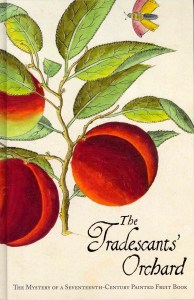
TheTradescantsOrchard There is a book about fruit that is surrounded by mystery and intrigue.

Is it a book?
Is it a catalog?
Is it a teaching tool about fruit trees?

The Tradescants’ Orchard is more catalog than book and, according to evidence of how often each painting has been handled, was also a teaching tool, according to authors Barrie Juniper and Hanneke Grootenboer.

Juniper and Grootenboer, together with the Bodleian Library, have published The Tradescants’ Orchard: The Mystery of a Seventeenth-Century Painted Fruit Book — a fascinating look at plantsman John Tradescant the elder, his son John Tradescant and their contributions to horticulture and the development of fruit orchards in 17th century Europe.

Originally called A Book of Fruit Trees with their Fruits (Juniper & Grootenboer, 2013), a photograph of this 400-year old manuscript is included in their book.

You are most likely already familiar with the Tradescants. The Spiderwort plants bear their family name (Tradescantia). Does this houseplant look familiar?

The Tradescant father and son team were responsible for introducing and raising many familiar garden plants (Juniper & Grootenboer, 2013). John Tradescant the elder was a sought-after plantsman in elite circles, operated a large nursery and, because of his extensive traveling, built an impressive cabinet of curiosities (Juniper & Grootenboer, 2013). When he died in 1638, John Tradescant the younger took over the family business and eventually became acquainted with Elias Ashmole.

This is where the story of the colorful manuscript containing 66 paintings of fruit and imaginary arthropods, frogs, birds, snails, a lizard and a squirrel gets very interesting.

Thought to be created somewhere around the 1620s or 1630s, The Tradescants’ Orchard was published when interest in growing fruit and when creating horticultural information for the public became popular (Juniper & Grootenboer, 2013).

Who commissioned the manuscript?

How did it end up at the Ashmole Museum?

What is unique about the paintings?

Much is explained in the forty-one pages of text leading up to Juniper & Grootenboer’s reproduction of The Tradescants’ Orchard. Their book is yet another wonderful chapter about the history of botanical art.


Literature Cited

Juniper, Barrie and Hanneke Grootenboer. 2013. The Tradescants’ Orchard: The Mystery of a Seventeenth-Century Painted Fruit Book. Oxford: Bodleian Library.

Available at independent bookstores. ($65)

Read Full Post »
« Newer Posts - Older Posts »