Feeds:
Posts
Comments

Archive for the ‘botanical art’ Category

Kick-off the new year with a tropical adventure!

Here is what’s new on the Classes Near You pages for Florida and Massachusetts.


Friends of Wellesley College Botanic Gardens at The Kampong

Certificate Program in Botanical Art and Illustration
http://www.wellesley.edu/wcbg/wcbg_friends

    Join Sarah Roche at the National Tropical Botanical Garden in Florida to enjoy five days of botanical art! Learn how to create easy field sketches on the grounds of the stunning Kampong historic home and garden. Explore rudiments of form from live specimens as you create graphite studies, then learn how to add color in watercolor. Take home a journal filled with field sketches useful for future projects and filled with memories of a unique tropical experience.


    Botanical Art at The Kampong with Sarah Roche

    Wellesley College Botanic Garden in collaboration with
    The Kampong, National Tropical Botanical Garden
    January 20-24, 2014
    9:30 AM – 3:30 PM

    Cost: WCBG Friends or Kampong Members, $495; Non-members $595

    Fee includes class instruction, two half-day visits to local botanical gardens, and a Thursday evening lecture by Sarah Roche.

    Travel, accommodations, food and other expenses are not included. Dormitory accommodations at The Kampong may be arranged on a first-come basis. For those arriving on Sunday, January 19, 2014, a get-acquainted gathering will be arranged. Contact the WCBG Friends office for more information.
Read Full Post »

Here is the latest news at Classes Near You > Australia:


David Reynolds

http://botanicart.wix.com/davidreynolds#!
David is a botanical artist based in Melbourne, Australia who specializes in Australian native plants and exotic plants. Go to Botanic Art TV to view the video for the Dookie Art Attack 2014 and to view David’s other videos.

    Botanical Art with David Reynolds
    Glasson Art World
    Dookie Campus Shepparton Victoria
    May 24-26, 2014

    David Reynolds invites you join him for a three-day workshop during the Dookie Art Attack to be held on the Dookie campus of the University of Melbourne. The subject for 2014 will be a beautiful magnolia with very bright and showy flowers and textured bark. Beginners through to advanced students welcome.

    To join David for a fun and relaxing workshop, contact Glassons Art World, Shepparton on (03) 5822 0077 or email Glassons Art World.

    Cost: $450 AUD

    View Details/Register

Read Full Post »


Jennifer, twice in your dissertation you bring attention to students’ indifference towards plants. In one instance you observe that one of the two exercises in which student performance was the lowest, was an exercise about drawing plants. You share a student’s comment about plants being “kind of dull to draw” (Landin, 2011). You also share that during the plant lab, students did not work in their Lab Workbooks and paid little attention to the teaching assistant. You also mention that some students viewed the plant lab as not being very important. Do you have any thoughts or hunches about what might be contributing to student indifference towards plants?

Jennifer:

That is an excellent question.

I have three ideas (just opinions really): 1) a majority of students in the biology program are planning on health careers so they tend to be very focused on humans; 2) a general human-centric focus of society; 3) a lack of knowledge about plants.

I think all three conditions could be addressed by a better understanding of plant biology. It’s interesting that biology classes about a hundred years ago were more equally focused on plants and animals. Now though, even with the increase in understanding of cell biology (which is so similar between plants and animals), we teach mostly about animals. If you consider the decrease in agricultural pursuits, society has really lost a ton of awareness about plants.

It’s too bad because plants are incredibly fascinating in defense mechanisms, competitive behaviors and symbiotic relationships. There’s so much ACTION in plants, but it’s mostly chemical rather than physical.

I would strongly encourage teachers to use more plants in their lessons – they’re easy to grow in a classroom, students can have a sense of “ownership” when they care for a plant, and there are so many great topics to cover using plants (history of agriculture & society, medicine, biological competition, experimental design, where food comes from, etc.).


Readers, have you encountered student indifference towards plants in your own classroom?

Share your stories

Read Full Post »

Designing a research project requires an incredible amount of thoughtful and methodical planning. Nothing could possibly go wrong.

Did all go smoothly for Jennifer Landin during her investigation of the use of perceptual drawing in the classroom? Did she encounter any problems?

I asked her. She replied:

Did I ever! I come from a science background – research on plants, animals or cells is SO much easier than research on people! It was a real learning experience for me.

The biggest issue involved conducting research in an actual class. Many educational researchers do this – it’s the most convenient approach. But I think I’d conduct individual testing in the future. By simplifying the activity, I could control more variables, monitor individual behaviors better, and end up with much better data.

The most unexpected event was…

Read More

Read Full Post »

On Monday Jennifer Landin told us how she collected data for her research. Did the data collected through testing tools, her Observational Skills Assessment, interviews and weekly observations support her hypothesis?

Well, yes and no. In the case of content knowledge, the students who drew did perform slightly better on the assessment. But there was only a tiny difference in their class grades. Considering that students were only drawing for ~5-10 minutes per week, though, the differences I saw between the groups were incredibly interesting.

For Attitude-Toward-Biology, I ran into an unexpected problem…

Find Out More

Read Full Post »

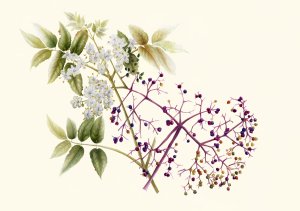
Berries for Nana's Jam, watercolor. © 2013 by Linda C. Miller. All rights reserved.

Berries for Nana’s Jam, watercolor. © 2013 by Linda C. Miller. All rights reserved.

Every year the Herb Society of America selects a plant of the year. This year the chosen plant is the elderberry bush. Williamsburg botanical artist, Linda Miller, painted this heirloom plant for the 2013 Mid-Atlantic Gathering program.

The elderberry plant is a native of North America. Its flowers and fruits may be used to create jams, syrups, pie and wine. Linda worked from a specimen at The Williamsburg Botanical Garden in Freedom Park.

This month Linda has two print-signing events. The first event will occur this weekend at The Gallery at York Hall on September 14 and 15 from 10 AM – 2 PM. The second signing will occur at The Williamsburg Botanical Garden during their Art in the Garden event and plant sale on Saturday, September 28 (8 AM – 2 PM).

You are invited to celebrate the 2013 Herb of the Year, to see Linda’s original painting and to learn more about botanical art.

Read Full Post »

What kind of data did Jennifer Landin collect in her studies about the use of perceptual drawing in the classroom?

I measured knowledge of biology with a pre- and post-test (kind of like a short final exam). I also asked students to take an Attitude-Toward-Biology test and my Observational Skills Assessment. I supplemented these tests with interviews, questionnaires and weekly observations of student behaviors.

All of the students had the same lecture class and same lab activities. So, as much as possible, all the experiences the students had in class were the same. The only difference was a “Journal” randomly assigned to each student. Some students had drawing activities to complete, others had writing tasks.

More About Our Conversation with Jennifer Landin

Read Full Post »

« Newer Posts - Older Posts »