Feeds:
Posts
Comments

Archive for the ‘botanical art’ Category

The botanists and botanical illustrators who have worked tirelessly to document rare plants in the Grand Canyon will share their work with the public beginning Friday July 2, 2010. Fifty drawings and paintings will be on view at Kolb Studio on the Canyon’s South Rim.

This exhibit is already receiving a lot of attention. It can be found in the Travel section of the Arizona Republic newspaper and is online at azcentral.com. It is also in the Summer 2010 issue of the South Rim Guide, one of the newsletters published by the U.S. National Park Service. An article about the Grand Canyon’s herbarium is also in the current issue of The Guide. This article provides insight to the accomplishments of former park botanists and links their accomplishments to the research projects of current botanists and botanical illustrators.

The Phemeranthus validulus (Tusayan Flameflower) by botanical artist, Joan LaMoure, is the signature piece for the exhibition. This painting, as well as the drawings and paintings of other participating artists, will illustrate a new edition of a field guide dedicated to the special status plants of the Grand Canyon.

Grand Canyon’s Green Heart: The Unsung Legacy of Plants will be at the Kolb Studio from July 2 – August 31, 2010. Admission is free. Kolb Studio is open daily.


Related

Researchers and Artists Document Grand Canyon’s Plant Jewels

Read Full Post »

Friend, Trudy. 2002. Drawing Problems and Solutions. David & Charles. ISBN: 9780715324035 ($22.99)
Feel the need to hide away and draw peacefully off in a corner somewhere? Be sure to take this book with you. You will learn a lot about sketching and drawing in pencil. This book is a must-have for any journaler’s backpack. Friend demonstrates how to use marks to create: trees & woodland, landscapes & skies, water in landscapes, buildings in landscapes, village houses & cottages, gardens, plants & flowers, vegetables, textures, pets, horses & ponies, and portraits.

Friend’s Drawing and Solutions books are very helpful because she takes the time to identify and explain common problems and presents a solution for each problem. When demonstrating how to draw leaves and stems, for example, she identifies the following as common problems:

  • No clear idea about how veins connect to the stem.
  • A lack of understanding of how much (or how little) of a leaf can be seen at certain angles.
  • A lack of understanding about how to place shadows.
  • The creation of shadows that do not follow a leaf’s form.
  • The creation of a stem that widens more dramatically than it does on the live specimen.

Other problems Friend addresses that pertain to botanical illustration include:

  • The placement of petals.
  • How to relate leaves to a stem.
  • Veins drawn as lines with no consideration for form.
  • Stems drawn at wrong angles.
  • The placement of buds and leaves without consideration of structure.
  • The placement of a leaf extending towards the viewer.
  • The placement of lines without regard to the relationship between negative and positive shapes.
  • Not using directional strokes to one’s advantage.
  • The hasty placement of lines to represent the gills of a mushroom.
  • The creation of line drawings in which tone was added without any consideration of form.

Drawing Problems and Solutions is available primarily as a used book.

Watch Trudy Friend at work!


Related

Investigating the Drawing Process

Read Full Post »

In the class, What’s Your Flower?, participants will research a plant’s meaning and its history. They will then blend this history into their final composition. The workshop will be taught at the Lewis Ginter Botanical Garden in Virginia. Here what’s new at Classes Near You > Virginia:


Lewis Ginter Botanical Garden

www.lewisginter.org
In 1884, Lewis Ginter purchased some property and built a gathering place for Richmond bicyclists. One hundred years later, the Lewis Ginter Botanical Garden is established on this same piece of property and soon becomes one of the top five destinations in Virginia. It is also home to Artbase a searchable database containing 2,500 botanical watercolor paintings by Alexandre Descubes. The Adult Education program at the garden includes workshops in botanical drawing and painting. Complete course descriptions and registration information are available here. Courses include:

  • Botanical Illustration Workshop with Juliet Kirby (Hydrangeas) – July 20, 22, 27, 29, 2010
  • How to Draw (More) Stuff in the Garden – July 15, 17, 22, 24, 29, 31, 2010
  • What’s Your Flower? – August 17, 19, 24, 2010
  • Plants and Pollinators for Botanical Artists – September 8, 15, 22, 29, 2010

Read Full Post »


When asked about the title of her upcoming solo exhibition, Eva-Maria Ruhl explains:

I am aiming to show that a botanical can be abstract, modern, dramatic and elegant. A plant suspended, magnified, isolated, frozen in time is indeed in suspense. I love the ordinary. A leaf, a seed, something from the vegetable bin…all great subjects. People don’t really “see” and I love to show them what they overlook on a daily basis.

Twelve years ago, Eva-Maria launched her botanical art career after reading an article about Jessica Tcherepnine (ASBA) in a home magazine. She says, “I went straight to the next art store and bought everything identifiable on the photograph, including the magnifying glass.” Today Eva is a graduate of the Botanical Art & Illustration program at Corcoran School of Art + Design. Her work has been shown in art galleries and at the U.S. Botanic Garden. Her illustrations can also be seen in Paradise Under Glass by Ruth Kassinger (April 2010).


Related Links

Eva-Maria’s Blog
Botanical art at the Corcoran School of Art + Design
American Society of Botanical Artists (ASBA)

Read Full Post »

Updated information at Classes Near You > California:


Julie Schneider Ljubenkov, Art Nature Education

www.artnatureeducation.com
Julie is an artist, author, educator, naturalist, and native plant consultant. Read the Summer 2010 issue of Julie’s Art & Nature Newsletter to learn more Julie, her limited edition prints, and her projects.

  • Watercolor Painting for Kids – Friday afternoons; June 25 to August 13, 2010; 3:30 – 4:30. Ages 8 – 13. This 7-week course costs $59, plus $30 for watercolor supplies. No class 7/2/10.
  • Gardening & Landscaping with California Native Plants – Mira Costa Community College Community Services, Oceanside campus. Mondays, June 14 to June 28, 2010. Field trip on Saturday July 17. Class hours are 3 p.m. to 5 p.m. (Room 7001). To register, call (760) 795-6820.
  • Gardening & Landscaping with California Native Plants – City of Escondido, Community Services. Fridays, June 25 – July 16, 2010 (no class on 7/2/10). Field trip on Saturday July 17. Class hours are 5:30 – 7:30 p.m. To register, call (760) 839-4691.

Read Full Post »

Botanical artist, Debra Kopka, has announced she will continue to offer private lessons in botanical art through the summer. Debra provides customized instruction for artists wanting help with a project and provides instruction for homeschool students as well.

The following information has been updated at Classes Near You > Ohio:


Debra Kopka, DK Designs

www.dkdesigns.org
Botanical illustrator, Debra Kopka is the principal artist at DK Designs. Debra licenses her artwork, creates illustrations for publishers, and teaches botanical art classes through her design studio. Unless otherwise specified, all workshops are taught at Edgerton Art in Perrysbury.

  • Botanical Drawing I: Graphite – Mondays (10 weeks); April 12-June 21, 2010 (no class May 31); 6:30-9:30 PM. Learn natural science illustration techniques and create graphite drawings with graceful compositions. Demos and lots of practice during each class meeting. Special projects will be discussed. Limit: 7. Register Now (PDF)
  • Botanical Drawing II: Colored Pencil – Fridays (10 weeks), April 16-June 18, 2010; 9:00 Am – 12:00 PM. Learn how to shade, blend, and create layers of color using colored pencils. Complete a colored pencil painting by the end of this ten-week workshop. Limit: 7.
  • Private Lessons – Receive personalized attention in a customized learning environment. Request Information
  • Schedule a Workshop for Your Organization! Request Information
  • NEW! See schedule of summer classes at Edgerton Art (PDF). Deborah will resume her classes at Edgerton in Fall 2010.
  • NEW! – Download the June 2010 issue of Botanically Speaking, the quarterly newsletter of DK Designs.

Read Full Post »

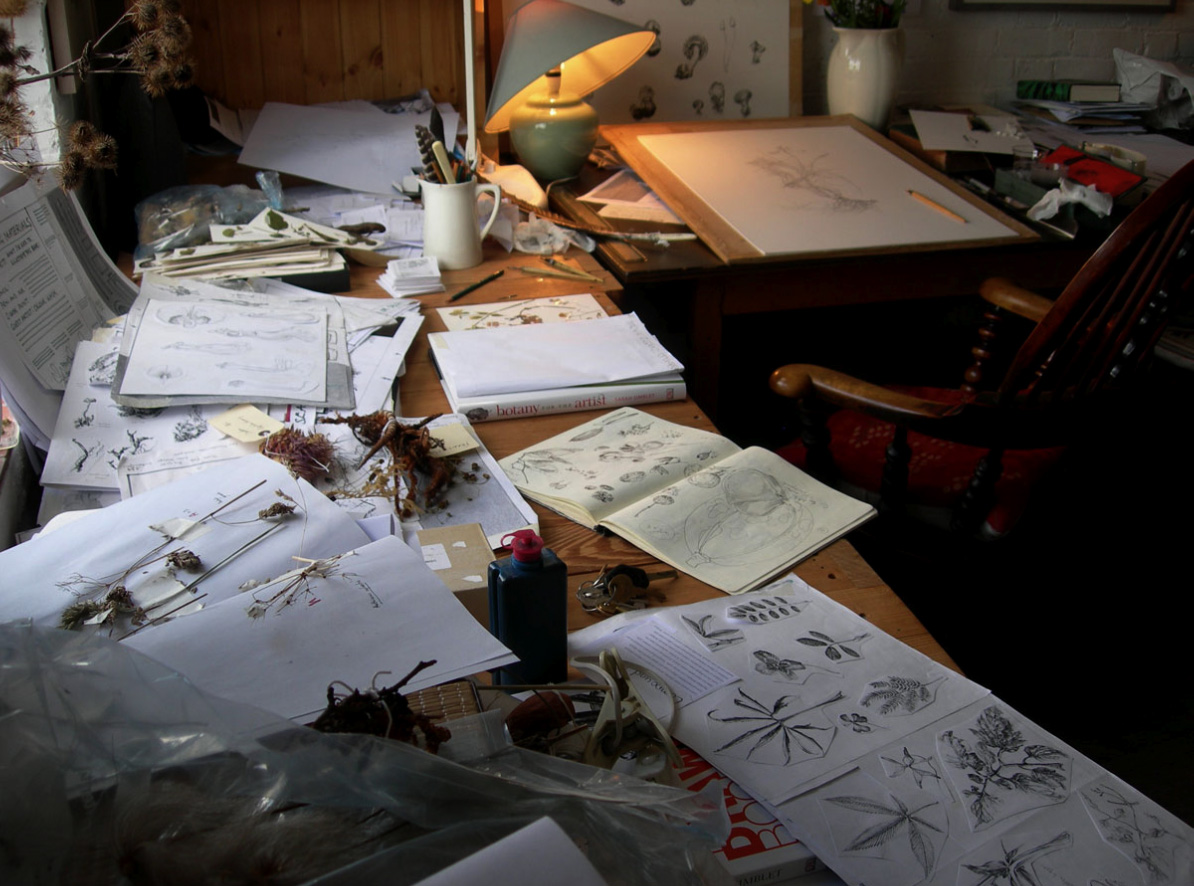
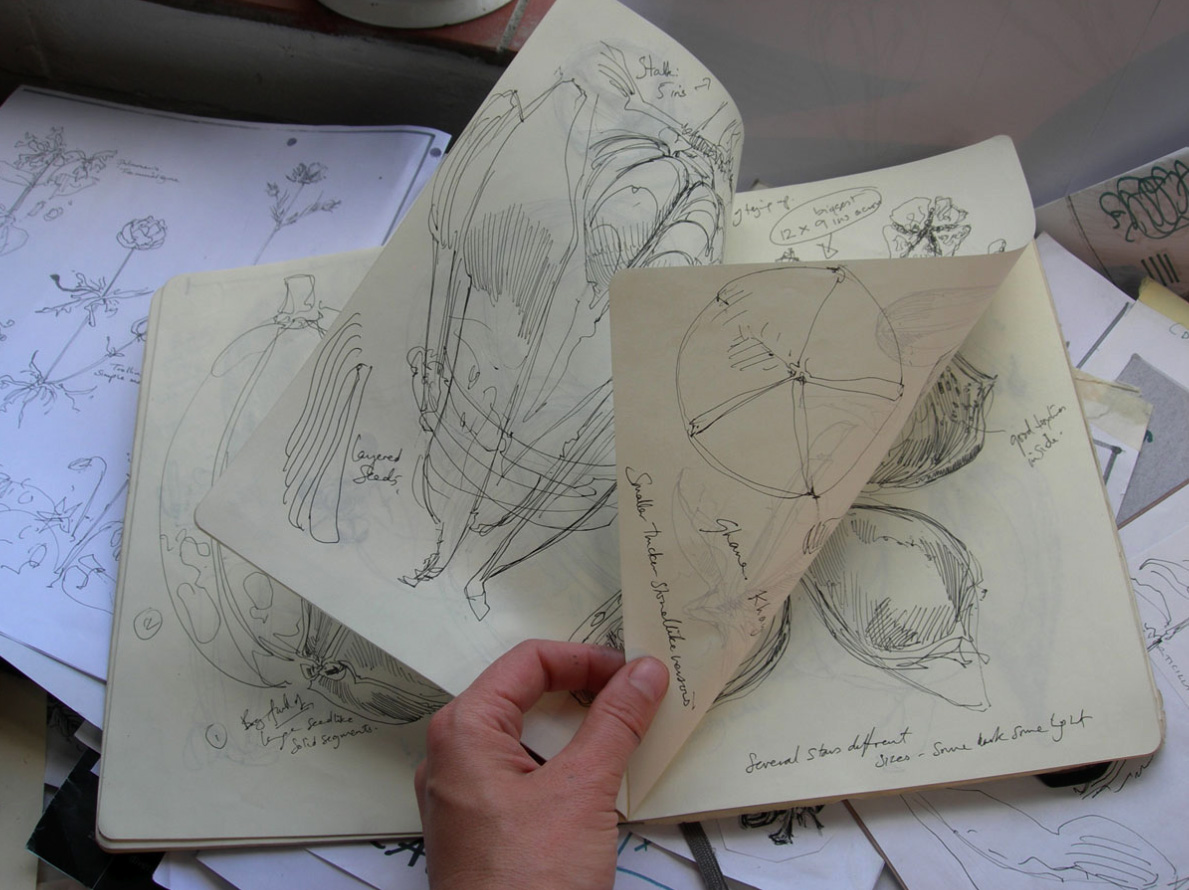
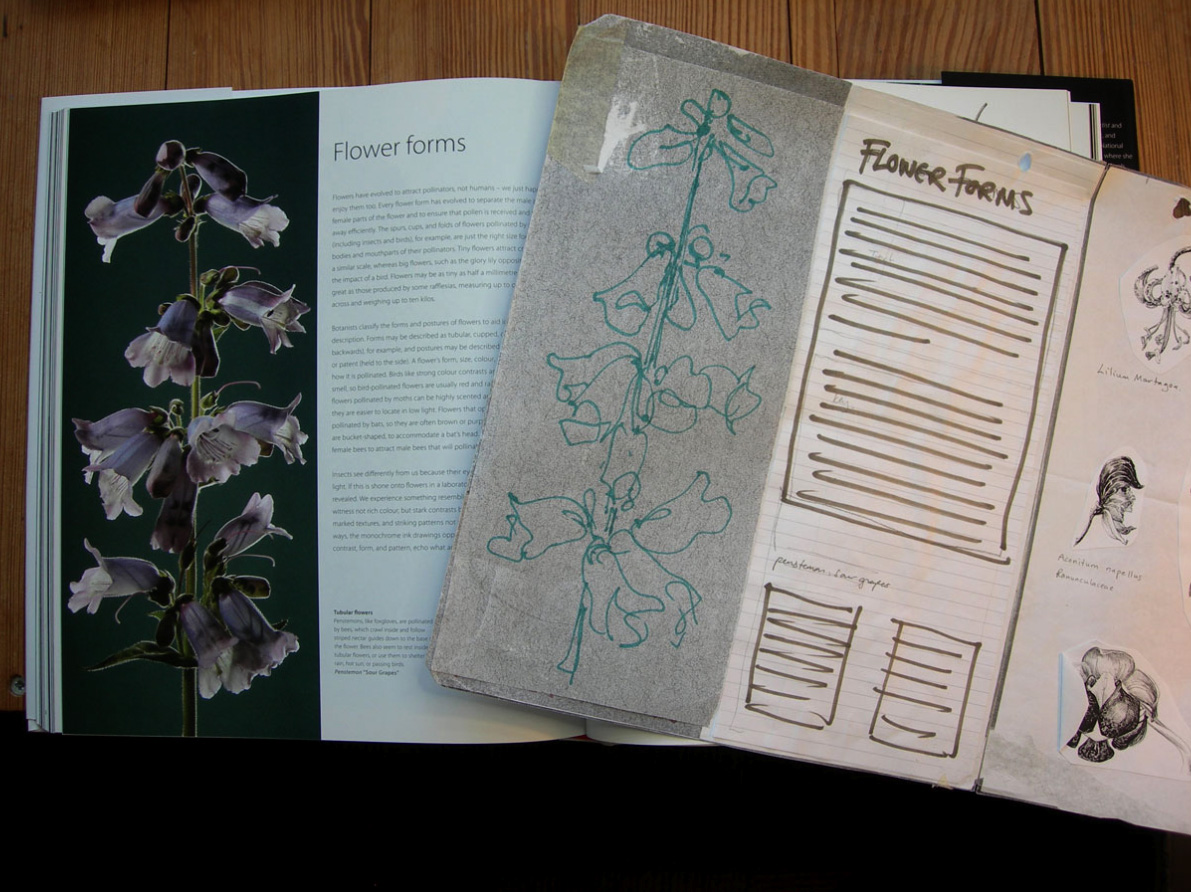
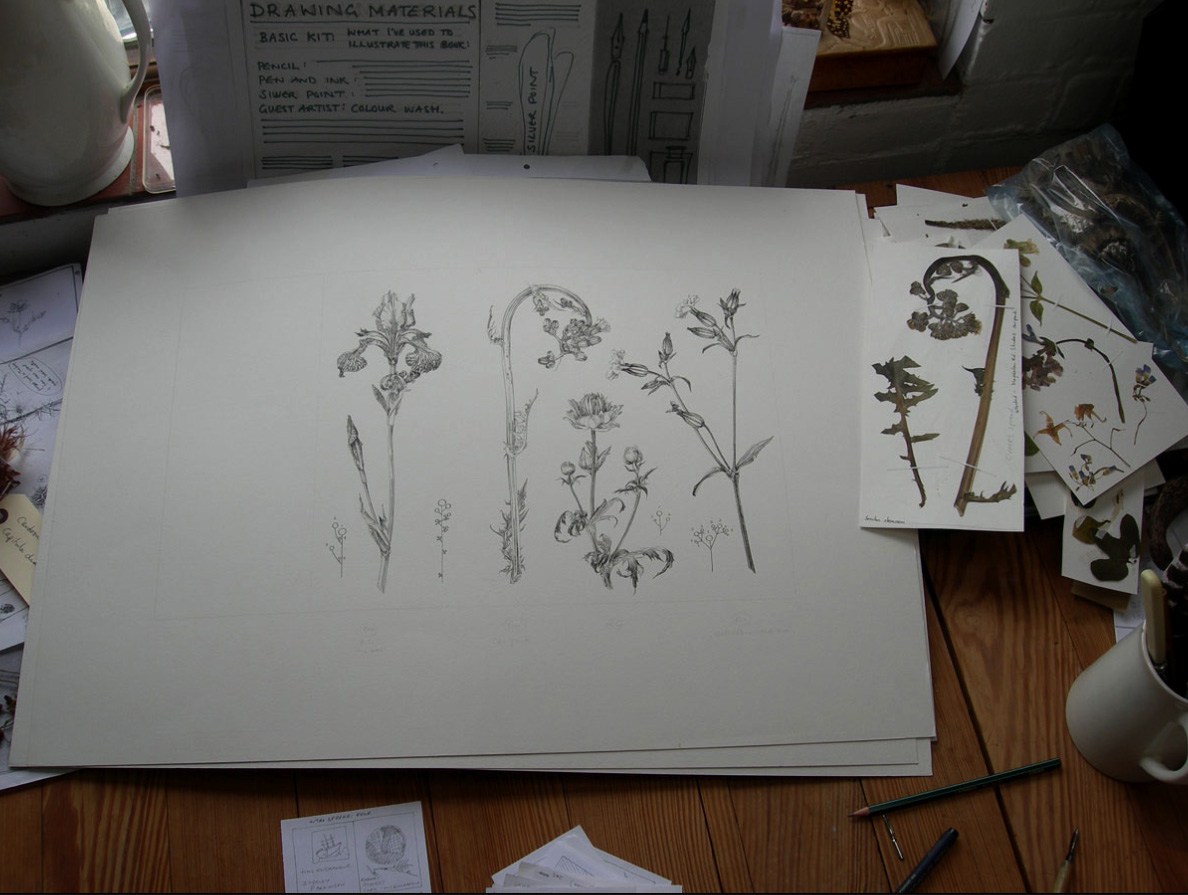
Author and artist, Sarah Simblet, stopped by for a visit last week. She took artists on a behind-the-scenes tour of the production of Botany for the Artist and what a tour it was!

Sarah shared every step of the process with us. She described how she prepared thumbnail sketches of each idea and how these ideas were transferred to special cards she makes to keep herself organized. The ideas on the cards that were most likely to become part of the book were then transferred to sheets of 8.5″ x 11″ paper. Each sheet represented an entry into the book and these sheets were then taped to her studio wall.

The page layouts covering her walls were incorporated into the big storyboard she drew by hand. This hand-drawn storyboard eventually became a miniature copy of the book, complete with color photographs, text, and illustrations.

Sarah designed her presentation around the questions submitted in advance by those who registered to attend this special author event. She answered follow-up questions at the end of her presentation as well. From the feedback received, artists enjoyed this opportunity to interact with Sarah and to learn in the company of other artists.

This is what Sarah’s studio looked like during the production of “Botany for the Artist”.

The illustrations in “Botany” began as sketches.

The placement of illustrations and photographs was discussed often throughout the project.

This is an example of Sarah’s finished sketches.

Get the rest of the story. Purchase a copy of Sarah’s book here.

Read Full Post »

« Newer Posts - Older Posts »