Feeds:
Posts
Comments

Archive for the ‘botanical art’ Category

Welcome to EE Week 2011!

National Environmental Education Week (EE Week) is organized by the National Environmental Education Foundation to connect K-12 teachers and their students to environmental resources informing the public about environmental issues affecting all of us. ArtPlantae is proud to once again serve as a national partner for EE Week.

This year’s theme inspires us to discover our oceans and to become more aware of the many ways we are connected to them, even though we may live miles and miles away. This year, like last year, I have had the opportunity to work with enthusiastic individuals committed to helping ArtPlantae show connections between plants, art, and the theme for EE Week. Please join me in welcoming each contributor as they are introduced.

We will discuss several interesting topics this week and learn a lot.

Let’s begin!

Read Full Post »

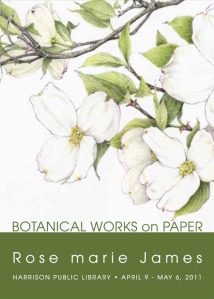
A Solo Exhibition by Rose Marie James
Harrison Public Library Gallery
Harrison, NY
April 9 – May 6, 2011

Rose Marie James is a New York botanical artist working in watercolor and colored pencil. When discussing the value of botanical art and how she works, Rose Marie states:

“I believe botanical art has the unique ability to bring the viewer’s attention to all the physical details of a growing plant – the shape of its leaves, the color of its petals, it’s growth processes. It also endeavors to illustrate the intangible – its manner, its stance, its aliveness, its beauty.

I collect specimens from my garden, from the roadside and woodlands, preserving them in pots and water jars, cooling them in my refrigerator or sunning them on my sun porch.

I start with detailed pencil line drawings on tracing paper, studying the live specimen and taking photographs to create a reference. Using a magnifying glass or printer’s loop to study details, I may dissect significant components that I want to add to the drawing, or I might unearth the plant to reveal its root system. I finally do a series of color studies to determine matches to the live specimen; the color mixes are notated for consistency and future reference. Finally the process of rendering begins. Working with watercolor paint, or watercolor pencils with colored pencils on Fabriano Artistico paper, I strive to bring the drawing to life, to illuminate the forms and colors – and the intangibles – so the viewer will see the plant anew and pronounce it beautiful.

I shall forever be a student studying with other botanical artists. I find that each artist has different skills and knowledge to offer. Along with studying and creating new work, I also teach classes in botanical illustration for the New York Botanical Garden.”


You’re Invited!

You are invited to meet Rose Marie James at the artist reception that will be held for her in the Main Library on Monday, April 11th, 7:00 – 8:45pm. All are welcome. Click on the image to download the postcard.

Rose Marie’s work can be viewed in the Members Gallery of the American Society of Botanical Artists.

Read Full Post »

Carol Creech of CCreech Studio is a part-time artist who works in pen & ink, colored pencil, and graphite. She is a member of the American Society of Botanical Artists and the Guild of Natural Science Illustrators. She is also a business woman and has generously offered to discuss her use of Zazzle.com, a service that enables designers to create one-of-a-kind products featuring their designs and artwork.

Please welcome Carol Creech!


ARTPLANTAE: Thank you for participating in a conversation about the business of art with ArtPlantae readers. How do you balance time spent on business-related activities with time spent drawing and painting?

CAROL CREECH: Hello and thanks for having me! To answer your question, it can be challenging to balance drawing time with business activities, especially when I am currently just working part-time. The To-Do list is long on both sides! But as much as I enjoy doing the artwork, it’s equally exciting to get things uploaded and “out there” on Zazzle. I have spent a good bit of time over the last few months getting my storefront up and running. Not only is my work available to the world at large, but I can order small quantities of my own products (note cards, or other items) to use as promotional donations locally, as well as personal gifts to family and friends. It’s a great tool.


AP: On your website, you show examples of the wonderful house portraits you have completed for homeowners. Do you create illustrations for commercial home builders as well? How long have you been illustrating homes?

CC: I have not ventured into illustrations for commercial home builders. The house portraits can be time consuming to do as I tend to be very detailed in my style. It’s what people love about them, and what I love to focus on when I draw them, but doing that on a regular basis would be more involved than I have time for at the moment.


AP: When creating your animal portraits, do you visit with the star subject for a while to get a sense of his/her personality (e.g., see camel)? How do you know when you’ve captured “personality” in a drawing?

CC: Interestingly, I usually create the animal portraits only from photographs. If I have a chance to take the photos myself (e.g., the camel) then I can tell when I have captured the right view of the animal for a good portrait. The key to any good animal portrait is usually the eyes. If you can render the eyes, which I always do first, and capture the essence of the animal there the rest of the portrait will fall into place.


AP: How did you learn about Zazzle.com? When did you open the CCreech Studio Store on Zazzle?

CC: I opened my store back in 2009, but just recently started working on building it up since last October. I had heard of Zazzle on one of the art lists I follow. I am embarrassed that I can’t remember which one! I did some additional research online, and it seemed like a good option. I had wanted to find a way to get good quality note cards of my work printed in small quantities, and I have to say that Zazzle’s cards are fantastic in their quality. I love how my artwork looks on them!


AP: You feature 23 product categories in your store. How many product categories are possible through Zazzle? How did you decide upon the product categories you have chosen?

CC: There are currently 45 product categories listed, but within each category there are often multiple options. For example, within the tote bag category you can choose from six different styles, and within each style, a variety of different colors. Plus, Zazzle is always coming up with more product categories, most recently adding keychains, necklaces and coasters. I decided on my product categories by choosing ones that I thought would look good with my drawings, many of which are botanical subjects. So, obvious products like cards, buttons, and stickers work well, but also items like aprons, mousepads, and letterhead. Bottom line is that you never know what might appeal to someone, so give it try and see how it looks!


AP: How many pieces of artwork have you used on Zazzle products?

CC: I think about 25. I also have done some simple enhancements by adding digital borders and backgrounds to a few pieces and that has been a great way to expand my offerings.


AP: What types of artwork works best on Zazzle products? Are there specific media or colors that reproduce better than others?

CC: So far, all of the media I have used seems to reproduce really well! I am a big fan of pen and ink and have been very pleased with how my ink and colored pencil combination drawings have reproduced. Although I have to say that the drawings using colored pencil alone look just as great! I think as long as you upload digital images that are of an appropriate resolution and make sure that they look good on the products you are designing, then you will be very happy with the results. One area that I am careful with is the T-shirt category as they have so many different color combinations available for customers. Some of my artwork only looks right on lighter colored shirts. Fortunately, Zazzle allows me to choose that as a limit, so I can assure that potential customers only see my work at it’s best.


AP: What types of plant images sell better — images more in line with traditional plant portraits or stylized botanical images?

CC: I know that Zazzle has many designers offering floral work, whether traditional photos, drawings or paintings, as well as stylized graphic designs of botanicals. I’m really not sure which sells better. I tend to prefer the traditional style and my work reflects that, so I am hoping that with some additional marketing I can draw in (no pun intended) people who appreciate the simple beauty of a single, well-drawn flower or plant. We shall see!


AP: Have you tried making prints or posters of your work? If so, how did your prints &/or posters turn out?

CC: I have not yet ventured into prints or posters. That is one of the things on my To-Do list! Zazzle does offer great quality prints and posters, so I’d like to explore that further.


AP: Is Zazzle easy to use? Briefly describe the designing process.

CC: Zazzle is very easy to use, in my experience. To start, you choose Create from the navigation bar at the top of the Zazzle page and follow the buttons and prompts to upload the image you want to use. There is a design view that lets you adjust the size of the image by reducing or enlarging it, dragging it around the product template until it fits properly. You can then choose to add text, customize font style and size, and even add background colors and borders, depending on the product. Then you can choose to order your product yourself, or post it for sale in the marketplace. When you post for sale, you select up to two subject categories, and add a title, descriptions and keywords so that potential customers can find your item. It’s surprisingly straightforward and easy to do.


AP: Does Zazzle allow sellers to keep selected items as on-site inventory so they can have products for sale at their studio for events such as studio tours?

CC: Absolutely! This is one of the things I love about Zazzle. You can order your own products, with a seller discount and possibly quantity discount depending on how much you order, and keep them in your studio or have them to sell at an art show, etc. I have ordered sets of my own note cards for blog giveaways as well as a couple of local fundraising events that I donated to recently. It’s a wonderful way to get high-quality products of your own work without having to invest in large print runs.

Thank you, Carol, for telling us about Zazzle and about your experiences with the service.


Would you like to ask Carol a question?
Please post your question below.

Click on the image to see Carol’s complete line of greeting cards.

Read Full Post »
A quick reminder that EE Week begins on Sunday and, like last year, I will post to this site everyday during EE Week. This means I will post daily through Saturday April 16, 2011.

This year’s EE Week theme is Ocean Connections. The generous and enthusiastic contributors to EE Week 2011 have made it possible to link plants, art, and the ocean in support of this year’s theme. I hope you enjoy learning from them as much as I have.

You are invited to participate in a live conversation with author Glynis Ridley on the Facebook page on April 16th. Glynis will discuss her new book, The Discovery of Jeanne Baret: A Story of Science, the High Seas, and the First Woman to Circumnavigate the Globe. The story of Jeanne Baret is fascinating and Glynis conducted several layers of research to piece together Baret’s story. You don’t want to miss this conversation. Mark your calendar and please join us on the Discussion page at 11 am (PST) / 2 pm (EST) on April 16.

If you’re in southern California, consider kicking off EE Week with ArtPlantae at the Spring Fair & Art Festival at Tucker Wildlife Sanctuary this weekend, April 9-10 (9 AM – 4 PM, daily). There will be live music, art & craft demonstrations, guided nature hikes, and more. Tucker Wildlife is operated by the College of Natural Sciences and Mathematics at California State University, Fullerton.

Can’t kick-off EE Week with a Spring festival? Then consider ending EE Week at the 25th Annual Avocado Festival in downtown Fallbrook in north San Diego County. ArtPlantae will on the Avenue of the Arts during this one-day festival occurring on Sunday April 17 from 9 AM – 5 PM. The Avocado Festival brings in about 70,000 people each year, so come early, bring your walking shoes, and your appetite!


And don’t forget your map…

Read Full Post »

Joyce Westner, President, NESBA

For the first time, the Annual Meeting and Conference of the American Society of Botanical Artists (ASBA) will be held in scenic New England. The local chapter, the New England Society of Botanical Artists (NESBA), is planning to make the October conference memorable! To help botanical artists decide whether they would like to attend, or what they might do if they’re already planning to attend, NESBA has created a Boston ASBA 2011 blog. Subscribe to this new blog to find out about the terrific instructors, wonderful classes, field trips, forums and demonstrations that will define this memorable experience.

During the conference, the public is invited to view the Small Works exhibit at the Boston Marriott Newton, Oct 27-29, 2011. While small works are required to be no larger than 9″ x 12″, the magnitude of the art itself will be limited only by the artist’s imagination and skill.

The New England Society of Botanical Artists is a chapter of the ASBA and has 120 members. Members’ work is featured annually at the Boston Flower and Garden Show and other venues throughout New England. Most NESBA members live in six New England States and a few mid-West states as well.

Learn more about NESBA online at http://www.nesbaartists.blogspot.com.

Read Full Post »

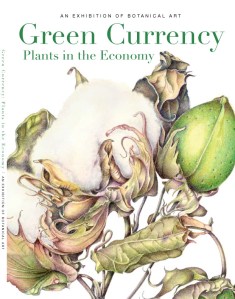
Green Currency: Plants in the Economy, a juried exhibition of original contemporary botanical art depicting plants of economic significance, opens April 20, 2011 and runs through July 31 at The New York Botanical Garden (NYBG). Forty-three pieces of art featuring plants used for medicine, food, clothing and shelter will be on display as part of this exhibition organized and hosted by The New York Botanical Garden and curated by the American Society of Botanical Artists.

The NYBG Institute of Economic Botany (IEB) has focused research on the relationship between plants and people since its founding in 1981, so the selection of economic botany as the theme for the first botanical art exhibition organized by the Garden was fitting. The ASBA with its headquarters located at the Garden has over 14 years experience curating juried international exhibitions making the partnership between the two organizations on Green Currency a natural.

Green Currency capitalizes on the beauty of nature and the mastery of today’s most skilled botanical artists to portray plants upon which people depend for basic necessities and which fuel commerce around the world. ASBA member artists from the United States and 6 other countries, a number of whom are widely collected, are represented in the show. Works in watercolor, gouache, colored pencil, graphite, acrylic, oil, aquatint, and copperplate engraving demonstrate the variety of media employed by contemporary botanical artists, who create art that is both beautiful and botanically accurate.

An audio tour, interpretive material and a catalog have been produced to accompany the exhibition. Using their cell phones, “visitors will be able to listen to what each artist has to say about their experience in capturing that plant” explains Woodin. Signage throughout the Garden ties the living collection to plants featured in the exhibition. The catalog which has “a bit of an interesting story about each plant in the show, artists’ bios and bios for all the jurors” continues Woodin, will be available at the NYBG Shop in the Garden.

Featured on the catalog cover, Esther Klahne’s contemporary watercolor portrayal of cotton (Gossypium herbaceum), contrasts the delicate brittleness of the dried leaves with the fluffy softness of the ball of fibers, and captures reflected light and color throughout the composition. A graduate of the Rhode Island School of Design, she earned a Certificate in Botanical Art through the Wellesley College Friends of Horticulture Botanical Art Program in Massachusetts. According to the International Cotton Advisory Committee (ICAC), cotton fibers are used to make textiles for clothing, furniture and upholstery, medical applications such as bandages and swabs, and pulp for paper. In fact much of the paper on which botanical art is done is 100% cotton rag. Cotton seeds are used as animal feed, to condition soils, and in the production of cottonseed oil. The USDA reports that the United States produced 12.4 million bales (480 pounds/bale) of cotton in 2009 with the largest harvests coming from Texas, Georgia and Arkansas. The U.S. is the third largest producer behind India and China and the largest exporter according to the ICAC.

Inquiries regarding the purchase of artwork should be directed to asbaexhibitions@aol.com.

The New York Botanical Garden is located at Bronx River Parkway and Fordham Road, Bronx, New York.

Read Full Post »

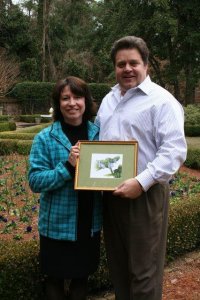
Linda Miller with Executive Director, Carl V. Curnutte, III.

A Special Honor
Botanical artist Linda C. Miller has been named the first “Artist in Residence” at The Elizabethan Gardens in Manteo, NC in recognition of her dedication and history with the Garden. In 2009, Linda launched the Garden’s botanical art classes and has been praised for both her teaching skills and the way she encourages students.

Linda has exhibited her work in the Mid Atlantic Region and in the Northeast. Her artwork has also appeared in national publications. An exhibition of Linda’s work will be on display at The Elizabethan Gardens in the Reception Hall through April.

The Garden’s Executive Director, Carl V. Curnutte III said, “We are thrilled to have Linda Miller be our first of many ‘Artists in Residence’ for The Elizabethan Gardens. Her work is outstanding and we are privileged to have her join us as the first of, hopefully, many artists.”

Of her appointment, Miller said, “I am so honored with the first appointment of  ‘Artist In Residence’ for I love the garden and its people.  The entire team is very special and (has) so much energy – positive, can do, lets-get-it-done energy.  I know that their vision and their talents are going to grow the garden in so many ways and I am so happy to play a part at this time.” 

The public is invited to meet with Linda at The Elizabethan Gardens when she launches her residency on Tuesday April 5, 2011 (10 AM – 2 PM). On this special day, Linda will begin a series of ten original paintings for the Garden.

Linda’s botanical art classes can be viewed on her website and in the Classes Near you sections for Virginia and North Carolina. Linda’s upcoming schedule of classes includes:

  • History of Botanical Art: An Artist’s Perspective – Tuesday, April 12, 2011; 1:30 – 2:30 PM. Embark on a visual history of botanical art from the earliest surviving artifacts to today’s contemporary artists. Lecture will be hosted by the Herb Society and held at Fellowship Hall of Our Saviour’s Lutheran Church, 7479 Richmond Road, Norge, VA. This event is free and open to the public.
  • Botanical Watercolor Workshop with Linda Miller – April 28 – 30, 2011; 9:30 AM – 3:30 PM. Learn how to preserve and interpret the flowers and plants of The Elizabethan Garden. Participants will be lead on a tour of the Garden to select their specimens. They will then learn how to observe, draw, and paint their chosen subject. All levels of artist welcome. Workshop fees include admission to the Garden. This workshop can be taken as a 2-day class or a 3-day class. View course details and fees
  • Art in the Garden: A Botanical Art Workshop for Children – Saturday, May 21, 2011; 10 AM – 12 PM. Freedom Park, Williamsburg, VA. Free for children 10 & older. Contact Williamsburg Botanical Garden for more information.

Read Full Post »

« Newer Posts - Older Posts »