Feeds:
Posts
Comments

Archive for the ‘botanical art books’ Category

Would you like to take a class with botanical artist, author and teacher
Reinhild Raistrick? Reinhild is a British botanical artist and the author of African Violets. The Greystoke Cycle Cafe is looking into possibly hosting a workshop with Reinhild. If this learning opportunity interests you, contact the cafe today!

The Greystoke Cycling Cafe hosts workshops on a variety of interesting topics. Their botanical art classes are posted at Classes Near You > England.

Visit this section and here is what you’ll find:


Greystoke Cycle Café & Tea Garden

www.greystokecyclecafe.co.uk
You may remember learning about the Greystoke Cycle Café & Tea Garden during an interview with Billy Showell. This rest stop for cyclists not only provides everything a cyclist needs, it also provides a full schedule of workshops taught by artists and other professionals. The 2012 schedule includes botanical art classes and wildlife painting classes such as:

  • Botanical Illustration in Watercolor with Gouache – March 5
  • Wildlife Illustration in Watercolor with Gouache – March 6
  • Botanical Illustration in Watercolor – June 13-14
  • Painting in the Botanical Style of Charles Rennie Macintosh – July 18

View these classes and the entire 2012 course schedule here.

Read Full Post »

In addition to conversing with you and the many inspirational guests who visit with us, such as the members of the Institute for Analytical Plant Illustration, I get to meet many wonderful people and families at book fairs, garden shows and festivals. This year promises to be a busy year on the road.

The first three tour dates are coming up quickly. All are community events, one benefits a local school district and two benefit Planet Earth.

The 5th Annual Family Book Festival is sponsored by the Citizens for Kids Foundation and is the only event in southern California’s Inland Empire to bring together authors, illustrators, families and various educational resources for a day of fun and learning. Proceeds benefit the Chino Valley Unified School District. This festival will be held on Sunday, February 26, 2012 from 9 AM – 3 PM at Brinderson Hall at the Chino Fairgrounds. Admission is free. Parking $5. View map

The 4th Annual WaterMiser Workshop is hosted by the City of Newport Beach, CA. This annual event brings together residents, water conservation experts, and exhibitors specializing in water conservation, landscape design and various aspects of environmental education. This workshop will be held at the Newport Beach Central Library on Thursday, March 8, 2012 from 6-8 PM. Admission is free. Please RSVP if you plan to attend. www.watersmartnewport.org


The Los Angeles Environmental Education Fair
will once again be held at the Los Angeles County Arboretum & Botanic Garden in Arcadia, CA. This year’s theme is Going Green Together. This event is always well-attended as it connects teachers, parents and students with various educational resources. Hands-on activities, ready-to-use lesson plans, workshops, entertainment, crafts, and storytelling are only some of the events planned for the day. Join the fun on Saturday, March 10, 2012; 9 AM – 4 PM. Free with Arboretum admission. www.Arboretum.org


Related

Outreach Programs Eliminate Barriers to Understanding Water Crisis

Read Full Post »

Many years ago, I came across a reference to a book by botanist and illustrator, Michael Hickey, about how to draw plants in pen and ink. I began a diligent search for this book and couldn’t find it anywhere. I decided to take a chance and write to Mr. Hickey to ask about his book. To my surprise, he wrote back. He told me that while his book Drawing Plants in Pen and Ink was no longer in print, he had an extra copy lying around the house. He told me he would send it to me. Not long afterward, the book arrived. What was before a unique hard-to-find book became a one-of-a-kind treasure because of Mr. Hickey’s generosity and thoughtfulness.

Many of you are familiar with Mr. Hickey’s botany books. I have written before about the book he wrote with Clive King (The Cambridge Illustrated Glossary of Botanical Terms), and several of you are familiar with Mr. Hickey’s Botany for Beginners and Botany for Beginners II. Each of these publications are invaluable references for anyone interested in drawing plants.

This month, I have the honor of introducing you to the Institute for Analytical Plant Illustration, an institute founded by Mr. Hickey specifically to “encourage collaboration between botanists and illustrators” and to “encourage members to develop their skills in scientific illustration and to increase their botanical knowledge.”

Please welcome IAPI Chairperson, Sue Nicholls, and all members of the Institute for Analytical Plant Illustration, the Feature Group for February!


ARTPLANTAE
: Sue, thank you for introducing the group this month. Please tell us more about IAPI’s history.

SUE NICHOLLS: IAPI was founded in 2004, by Michael Hickey, to encourage the scientific illustration of flowering and non-flowering plants. He was also concerned that though there is a great interest in botanical art and illustration, the interest tends to be towards botanical art rather than scientific illustration and I think Michael wanted to raise the profile of botanical knowledge within the botanical art and illustration world.

Michael circulated an invitation to as many people as he could identify who might be interested, to attend a meeting in Cranborne Village Hall one Saturday in December 2004. Cranborne is a village in the Cotswolds, near Michael’s home. This meeting became the inaugural meeting of IAPI.

Unfortunately, Michael was taken ill very soon after that meeting, and was unable to take any further active part in its development. He died in summer 2005. Fortunately, there were enough interested people who shared Michael’s aims and ideals to take them forward.

IAPI prospered and in November 2009, which was five years since the foundation of the Institute, we held our first Michael Hickey Memorial Lecture, in Cambridge Botanical Garden, with which Michael had had a long relationship. IAPI continues to grow and develop in relation to current circumstances but also with Michael’s aims very much in mind and we maintain our connection with his family.

It is my regret that I was unable to attend the founding meeting, and so I cannot count myself a Founder Member, and in fact, I never met Michael.


AP
: How many members does IAPI have? Are all members from the UK? Will you accept members from other countries?

SN: IAPI is a comparatively small society at the moment. We currently have 45 members, all of whom are based in the UK. One of the strengths of IAPI is that membership is open to artists of all levels who are interested in scientific illustration and to botanists who are interested in illustration. Many members are also members of, and represent other botanical art or illustration societies.

Our membership is currently drawn mainly from those who can attend at least some meetings, though those who cannot attend meetings are also welcome. Meetings are held every two months, most often in Birmingham because of its central location, but we try to use other venues around the UK to accommodate as many people as possible. It will probably sound surprising to those who are not based in the UK that our geography can be limiting! The meetings programme usually includes lectures on topics of current interest, workshops on technical issues, field trips and visits to institutions of botanical or historical interest.

We have a bi-monthly newsletter, produced in months between meetings, to include members who cannot for whatever reason get to meetings. Nowadays it is easy to distribute this by email so any members overseas would not be at a disadvantage. Not only does the newsletter remind members of forthcoming meetings and other events of interest to IAPI, but it also serves as a record of past meetings, of equal value to those who attended and to those who were not able to attend.

We are currently looking at an affiliation scheme to enable us to formalise relationships with other societies.

IAPI would be delighted to accept members from other countries. It would be really interesting to collaborate with people from overseas.


AP
: In November, Anne Bebbington and Mary Brewin contributed to an article about their new curriculum, Botany for Botanical Artists. Now that the first 10-week course has been taught and feedback has been received, what is next for this exciting new program?

SN: I am interested that you find the Botany for Botanical Artists course exciting.

Since the inception of IAPI, the University Certificate Courses at Birmingham and Sheffield in Botanical Illustration which included botany, have been discontinued and there are now very few formal botany courses that can be accessed by illustrators.

Following Anne and Mary’s course, the IAPI Education Subcommittee is attempting to provide help to encourage tutors of equivalent expertise to run similar courses, and is seeking the recognition by a respected academic agency of the achievements made by the students on such courses. This is so that students will be able to convey their acquired expertise to others.


AP
: I have read all available issues of Eryngium, the journal of the Institute for Analytical Plant Illustration, and thoroughly enjoyed immersing myself into each issue. This is my kind of journal! The plant profiles are very informative and the how-to articles about illustration techniques contain the type of information any botanical illustrator would want to keep at their fingertips. Has the IAPI ever considered publishing a book that expands upon the journal’s format?

SN: It’s an interesting thought, but no I don’t think we have thought of that, though we are quite proud of our Journal. Eryngium itself is available to members as part of their membership, though we do have some back issues available and we are thinking of making back issues available via our website.

You mention keeping information at your fingertips, and this is something we have taken on by producing TipCards, laminated cards, A5 size, on topics that illustrators often want to keep to hand, with the drawing materials. Our bestseller is on how to make scale bars, something that illustrators often find difficult at first; and we have others on topics such as illustrating leaves, habit drawings, and some individual plant families. These are available for purchase by members and non-members and there is a list available on the IAPI website.


AP
: You and other IAPI members work a lot with botanists. Does the group work with members of the public as well? If so, how does IAPI work with the public?

SN: It’s not that IAPI members work with botanists, the IAPI membership includes botanists as well as artists and illustrators, though of course, we do also work with other botanists.

We have not yet looked at working directly with the public, though you could say that the Botany for Botanical Artists course represents an initiative to work with members of the public. We have regular exhibitions and demonstrations at BSBI (Botanical Society of the British Isles) exhibition meetings. We are also intending to publish a couple of small publications, based on previous illustration projects that will have a general appeal. Two members have recently published books, Lizabeth Leech’s Botany for Artists and Val Oxley’s Botanical Illustration.


AP
: The IAPI is dedicated to enhancing individuals’ knowledge about plants. I often ask people how they think people learn about plants best. I would like to turn this question around a bit and ask, drawing upon your experiences as a teacher and illustrator, what aspect of plant life do people seem to know the least about?

SN: This seems to be the knowledge of plant construction. It is of course dependent upon understanding the botanical (evolutionary) relationships which botanists of the past have spent so long establishing. The only way into this understanding is through the terminology and techniques of botany.

What about lower plants? I reckon the general public knows little about moss and fern life cycles, why they don’t have flowers, how they reproduce instead, or indeed how to identify them.

I think it is also important not to take plant life for granted; to keep a sense of wonder and a spirit of enquiry. It is tempting to assume we know enough about something and not be prepared to find out more. We so often seem to grow out of this spirit of enquiry, to look without actually seeing, and to not question what it is that we are looking at. I’d like to encourage everyone to look more closely, and to go on learning…


AP
: I enjoyed reading about the group’s project illustrating all methods of attachment used by British climbing plants. Has the group selected a project for the new year?

SN: Since completing work on the climbing plants project we’ve been engaged on a project to illustrate ‘nuts’, from Brazil nuts to walnuts and everything in between. The term ‘nut’ has a precise meaning botanically, and not everything that we are familiar with in the kitchen is a nut in that proper sense. Many of them are completely unrelated. It’s quite interesting exploring the relationships between all the different things we call nuts, and or course its quite important when we consider the development of various allergies to nuts.


Ask The Artist

IAPI Members Ask YOU Questions!

The IAPI wanted to begin their Ask the Artist session with readers by beginning the conversation a bit differently this month. This time, our guests are asking readers questions, first.

Consider these questions…

    1. How much do you need to understand a plant in order to illustrate it accurately?

    2. Some botanical art has departed from the process of being a totally scientifically reliable depiction, obeying rules and restrictions imposed by the botanical requirements, should it be judged now solely as an art-form?

    3. Traditionally, watercolour has been the medium considered most appropriate for accurate illustration of plant material. In the modern age, is watercolour still the best choice?

You are invited to participate in a casual month-long conversation with members of the Institute for Analytical Plant Illustration. Members are ready to discuss their new botany curriculum for artists and all aspects of botanical art and illustration. Visit the IAPI website to view members’ work and to learn more about IAPI members and their professional projects.

Tell your friends and colleagues about this learning opportunity by using the “Share This” buttons below.

Read Full Post »

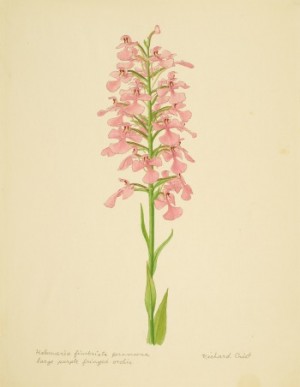
Habenaria fimbriata peramoena, Large purple fringed sic orchis Platanthera peramoena (A. Gray) A. Gray, purple fringeless orchid, Orchidaceae (orchid family), watercolor on paper by Richard Crist (1909–1985), HI Art accession no. 6615.309. © 2012 Richard Crist Estate. All Rights Reserved


Native Pennsylvania,
A Wildflower Walk

Hunt Institute
Carnegie Mellon University
March 2 – June 29, 2012

The Hunt Institute for Botanical Documentation and the Botany department at Carnegie Museum of Natural History will celebrate the native wildflowers of Pennsylvania in a collaborative exhibition opening in March.

Native Pennsylvania, A Wildflower Walk allows visitors to take a virtual walk through a southwestern Pennsylvania growing season and become more familiar with some of the native wildflowers that are integral to so many relationships. Information about Pennyslvania’s many parks, woodlands and wetlands is provided throughout the exhibition. Visitors are encouraged to follow their visual walk with a physical one in many of the state’s wildflower habitats.

Thirty-six wildflower watercolors by Richard Crist (1909–1985) from the Institute’s collection illustrating the simplicity and beauty of Pennsylvania’s native species will be on view. Coupled with Carnegie’s significant herbarium specimens, these pieces combine to create a visual wildflower walk through Pennsylvania’s blooming seasons with a focus on endangered, rare and threatened species within Pennsylvania. Additional watercolors by artists Lyn Hayden and Andrey Avinoff (1884–1949) also underscore the exhibition’s emphasis on the importance of herbaria and their contributions toward research, education and conservation.

Thoughout spring and early summer, visitors can learn more about Pennsylvania’s native plants through a series of public talks that will occur at the Hunt Institute on Sunday afternoons. All talks are free and begin at 2 PM. Plan ahead to attend the presentations below:

  • Why Do Plants Bloom When They Do? Spring Ephemerals and Other Seasonal Flowering Patterns – March 18; Steve Grund, botanist
  • Pressing and Mounting Specimens for a Personal Herbarium – March 25; Jeanne Poremski, landscape designer/botanist
  • Wildflowers of Pennsylvania – April 15; Dr. Mary Joy Haywood, botanist and plant pathologist
  • Wildflowers in the Home Garden – April 22 (Earth Day); John Totten, landscape architect
  • Gallery tour of Native Pennsylvania, A Wildflower Walk (in conjunction with Carnegie Mellon commencement ceremonies), May 20
  • Rare Plants of Pennsylvania – June 24; Bonnie Issac, collections manager at Carnegie Museum of Natural History and exhibition co-curator. This presentation will be held in conjunction with the Hunt Institute’s Open House.
  • Early Pennsylvania in Writing and Images – June 25; Angela Todd, Hunt Institute Archivist. This presentation will be held in conjunction with the Hunt Institute’s Open House.

The exhibition will be on display on the 5th floor of the Hunt Library building at Carnegie Mellon University and will be open to the public free of charge.

Hours: Monday–Friday, 9 a.m.–noon and 1–5 p.m.; Sunday, 1–4 p.m. (except 11 March, 6–8 April, 6 and 27–28 May). The library’s hours of operation are occasionally subject to change, please call or email before your visit to confirm their hours. For further information, contact the Hunt Institute at 412-268-2434.


About the Hunt Institute

The Hunt Institute for Botanical Documentation, a research division of Carnegie Mellon University, specializes in the history of botany and all aspects of plant science and serves the international scientific community through research and documentation. To this end, the Institute acquires and maintains authoritative collections of books, plant images, manuscripts, portraits and data files, and provides publications and other modes of information service. The Institute meets the reference needs of botanists, biologists, historians, conservationists, librarians, bibliographers and the public at large, especially those concerned with any aspect of the North American flora.

Read Full Post »

Award-winning botanical artist and teacher, Valerie Oxley, has announced her teaching schedule for 2012. See what’s new at Classes Near You > England:


Valerie Oxley

Valerie Oxley is a qualified teacher, Fellow of The Higher Education Academy, Member of the Society of Botanical Artists, and Vice-President of the Northern Society for Botanical Art. She developed the Diploma in Botanical Illustration at the University of Sheffield’s Department of Adult Continuing Education. Her own artwork has been exhibited widely and the Royal Horticultural Society has awarded her medals for her illustrations. Valerie is Chairman of the Florilegium Society at Sheffield Botanical Gardens whose aim is to record the planting in the Gardens for an historical archive. Valerie enjoys meeting and teaching students on residential courses throughout the country, she is the art editor of ‘Wild Flowers of the Peak District’ published by the Hallamshire Press and author of ‘Botanical Illustration’ published by the Crowood Press.


University of Cambridge, Madingley Hall

www.ice.cam.ac.uk

  • Illustrating Insects: Butterflies, Bees, Moths and Exotic Beetles
    May 11-13, 2012. Illustrate native and exotic insects. Details
  • The Glory of the Garden – Painting Plant Portraits
    July 13-15, 2012. Draw and paint herbaceous borders, meadows and lakeside plants using watercolor and colored pencil. Details
  • Drawing & Painting Autumn Flowers, Fruits and Fungi
    October 26-28, 2012. Learn how to create the tints and hues of autumn colors. Details


Higham Hall College

www.highamhall.com


West Dean College

www.westdean.org.uk

  • Illustrating Wildflowers & Butterflies – June 25-29, 2012. Explore a variety of watercolor techniques as you learn to illustrate flowers and butterflies. Details


Cambridge University Botanic Garden

www.botanic.cam.ac.uk

  • Botanical Illustration in Pen and Ink – April 25-27, 2012. A relaxing three-day course for anyone interested in learning how to draw plants using pen and ink techniques. Details
  • Botanical Illustration in Watercolor – June 13-15, 2012. Introductory course for beginners. Open to anyone who enjoys flowers and gardens and desires to record them in detail. Details


Farncombe Estate Centre

www.FarncombeEstate.co.uk

  • Botanical Illustration for Beginners and Improvers
    June 8-10, 2012. A fun class for enthusiastic beginners. No experience necessary. Details


Denman College

National Federation of Women’s Institutes
www.denmancollege.org.uk

  • Add an Insect: Illustrating Moths & Butterflies
    March 30 – April 1, 2012. Create detailed drawings of butterflies and moths. Learn color theory, color matching and dry-brush watercolor technique. Details
  • Exotic Fruits & Flowers in Colored Pencil – July 4-6, 2012. Learn how to create interesting textures and surface finishes in colored pencil. Details

Read Full Post »

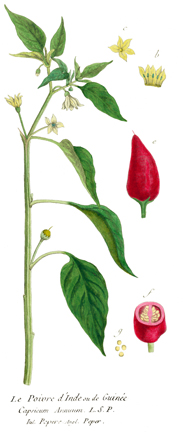
Image courtesy of the Lloyd Library and Museum


Peppers in Image and Word

Lloyd Library and Museum
January 14 – April 13, 2012

The Lloyd Library and Museum in Cinncinnati, OH celebrates Capsicum annuum (the chili pepper) in an exhibition that will feature books from the 16th through 21st centuries, the photography of Eduardo Fuss and the work of Jean Andrews, David Carangilo, Amal Naj, Jeff Schickowski and W. Hardy Eshbaugh.

An opening reception will be held this Saturday, January 14, from 4-7 PM.

Arrive early to learn from pepper expert, W. Hardy Eshbaugh, who will discuss the chili pepper in a special presentation titled,
Some Like It Hot: The Little Known World of Chili Peppers.

Eshbaugh’s lecture begins at 4:30 PM.

Map to Lloyd Library and Museum

Read Full Post »

Wild Green Things: The Art of Anne Ophelia Dowden
Andersen Horticultural Library
Minnesota Landscape Arboretum
January 18 – May 2, 2012

Anne Ophelia Todd was born in Denver and grew up in Boulder, Colorado spending her early years roaming the foothills of the Rockies. Dowden says, “I collected and drew any living thing that came my way, especially insects and flowers, and the study of nature was my absorbing hobby.”

© 2008 Hunt Institute for Botanical Documentation. All Rights Reserved.

After graduated with an art degree from Carnegie Institute of Technology, the artist moved to New York City in 1930, and taught drawing for more than 15 years. During that time, she married fellow artist Ray Dowden. Dowden began her botanical illustration work in the early 1950s, when magazines began to use her artwork on their covers and in their articles. She was in her 50s when she wrote, designed and illustrated her first book, Look at a Flower.

After 60 years in New York City, Dowden moved back to Boulder in the early 1990s to be near family and her beloved mountains. She set up her studio and published her last book, Poisons in Our Path: Plants That Harm and Heal, in 1994, when she was 87 years old. Dowden died in 2007 at the age of 99.

Anne Ophelia Todd Dowden’s artwork will be on view in the Andersen library, the Snyder Building lobby and the skyway ramp between the Visitor Center and Snyder Building. There also will be works in an Oswald Visitor Center display case.

A special insiders look at the art of Anne Ophelia Todd Dowden by exhibit curator, Lucie Taylor, will occur when Wild Green Things opens next week. Visitors will have the opportunity to view Dowden’s books, original sketches and original paintings during a one-hour presentation scheduled for Wednesday January 18 from Noon – 1 PM in the Snyder Building. Limit: 30. Cost: $7.50 members, $10 non-members. Register Online

The Minnesota Landscape Arboretum is located in Chanhassen, Minnesota on State Hwy 5, nine miles west of the intersection with I-494. The largest public garden in the Upper Midwest, the Arboretum is part of the University of Minnesota College of Food, Agricultural and Natural Resource Sciences. Open 363 days a year, admission is $9 adults; free for members and ages 15 & under.

Read Full Post »

« Newer Posts - Older Posts »