 The Art of Botanical Painting
Only 4 copies remain! Lessons in botanical art by members of the Society of Botanical Artists in the UK.
Sale $19.95 (reg. $29.95)
Table of Contents
Chapter 1 – Introduction
Chapter 2 – Materials
Chapter 3 – Plant Anatomy for a Painter
Chapter 4 – Drawing Techniques
Chapter 5 – Working with Colored Pencils
Chapter 6 – Watercolor Painting Techniques
Chapter 7 – Foliage Color
Chapter 8 – Flower Library
Chapter 9 – Composition
Chapter 10 – Flower Portraits in Watercolor
Chapter 11 – Painting in Gouache
Chapter 12 -Working in the Field
Chapter 13 – Painting Fruit
Chapter 14 – Painting Vegetables
Chapter 15 – Photography As An Aid
Chapter 16 – Flowers In The Garden
Chapter 17 – Botanical Illustration
Chapter 18 – Presentation and Framing
Chapter 19 – Exhibiting and Selling
Archive for the ‘botanical art books’ Category
Going Once… The Art of Botanical Painting
Posted in ArtPlantae Books, botanical art, botanical art books, Special Announcements on May 24, 2010|
Letters to a Friend Become Classic Work in Botanical Art
Posted in botanical art, botanical art books on April 22, 2010|
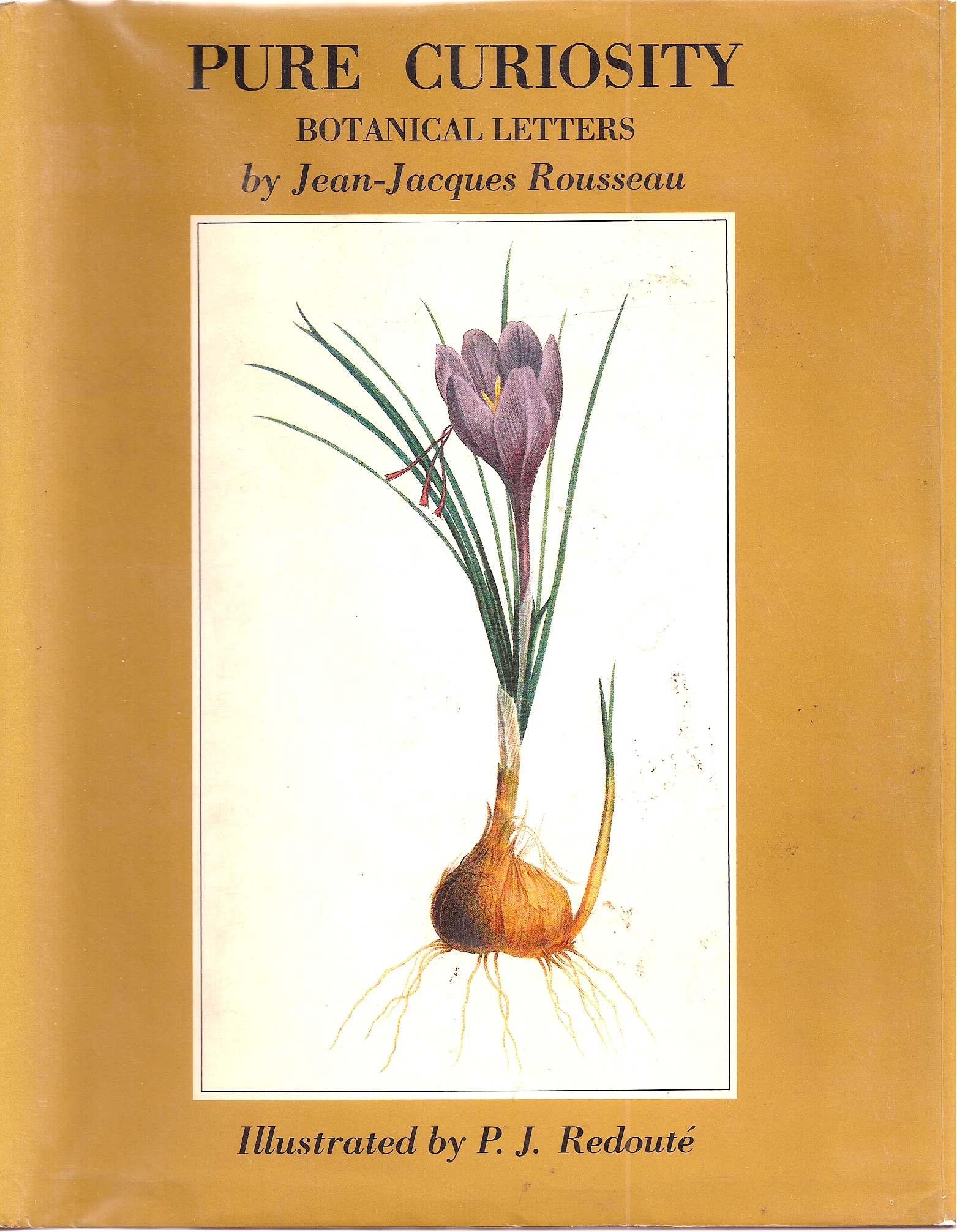 Philosopher Jean-Jacques Rousseau always had an interest in botany. His knowledge and passion for plants were captured in a series of letters he wrote to a friend between 1771 and 1773.
Rousseau wrote a series of eight letters to a friend who was teaching her four-year old daughter botany. In Letter One, he describes the parts of a flower. Letter Two is filled with descriptions about the characteristics of the Cruciferae (Brassicaceae; Mustard family). In Letter Three, Rousseau urges his friend to learn only from “the book of nature” and then continues to describe the plants in the pea family (Fabaceae). Letter Four is dedicated to the Laminaceae (Mint family) and the Scrophulariaceae (Figwort family). The Umbelliferae (Apiaceae; Carrot family) are the focus of Rousseau’s writing in Letter Five. The Asteraceae (Sunflower family) are described in Letter Six. Rousseau’s commentary about fruit trees (Letter Seven) and pressed plant collections (Letter Eight) close this series of educational and enlightening letters.
Rousseau’s letters were so educational, in fact, they were circulated in the intellectual salons that were popular at this time. Botany was very fashionable back then and bound collections of Rousseau’s letters were in high demand. His letters were first published in a collection of his work in 1782, five years after his death. The letters were then published separately in 1800 and 1802. In 1805, sixty-five color plates by Pierre Joseph Redouté were added to Rousseau’s collection of letters, which had by then become known as La Botanique. The book above, Pure Curiosity: Botanical Letters and Notes towards a Dictionary of Botanical Terms is a facsimile based on the third edition of La Botanique (1821).
When Rousseau died, he left behind drafts of what appears to be a dictionary of botanical terms. He was writing a dictionary so the layman could make sense of the terminology used by botanists. A portion of this dictionary is included in Pure Curiosity. Botanical terms are arranged alphabetically in English, with the French words used by Rousseau in parentheses. Redouté’s work is also featured in this section of the book.
Pure Curiosity is still available on the used book market and comes with a strong recommendation for anyone with an interest in botanical art history or an interest in informal science education.
Literature Cited
Rousseau, Jean-Jacques. 1712-1778. Pure Curiosity. Translation of La botanique de J.J. Rousseau. Copyright © 1979 by The Felix Gluck Press Limited.
ISBN: 0-448-22920-X
Related
- Lessons for a Young Botanist
- Redouté: The Man Who Painted Flowers (childrens book)
Henry R. Mockel Paints California’s Desert Wildflowers
Posted in botanical art, botanical art books, History, Special Articles & Interviews, tagged Henry Mockel, note cards, serigraphs, Twentynine Palms on April 17, 2010|
This article was published originally in the November 2004 issue The Southern California Botanical Artist which was the newsletter of the Botanical Artists Guild of Southern California. It has been updated and is reprinted below with permission.
East Coast Artist Taken with California’s Desert Wildflowers
Henry R. Mockel paints the desert landscape
By Tania Marien
Impressed with what she saw during a visit to California to attend a nursing conference, Beverly Mockel returned to Cooperstown, New York to talk her husband, artist Henry R. Mockel, into moving to the Golden State. When she succeeded at this task, they moved to the town of Calico in the Mojave Desert in 1958. While residents of Calico, the Mockel’s often took trips to Joshua Tree National Park to see the wildflowers. They made frequent stops so Henry could paint flowers along the way. Eventually they decided they should move closer to the flowers, so they moved themselves and their 47-foot house trailer to Twentynine Palms in 1961. After settling into their new home, Henry and Beverly opened the Pioneer Art Gallery in what is now the Historic Plaza. One can only imagine that this new exciting desert lifestyle was quite a change for Henry, a former bookbinder, farmer and cattle rancher.
Henry Mockel was not an artist when he immigrated to the United States from Germany in 1923. His interest in art did not begin until after he moved to New York where he first studied engineering at City College. He then studied art at Grand Central School of Art and continued his art studies for 15 years. His specialty was etching and woodblock printing. Unfortunately, a studio fire destroyed his work and his equipment. Only a few of his etchings survived. After the fire, Henry began creating serigraphs. His original serigraphs are available for purchase at Henry R. Mockel’s – the business that distributes Mockel’s note cards and prints.
What are serigraphs? Serigraphs are screen prints. The fine art version of screen prints, that is, not the T-shirt type of prints. A drawing is made into a stencil and ink is forced through the stencil onto paper. Each color in a serigraph is its own print. Some of Mockel’s plant portraits are the result of 45 separate printings!
Taken with the desert and its flora and fauna, Mockel spent many days studying plants and drawing them in the field. He studied botany and took copious notes on his desert adventures with Beverly. The culmination of 14 years’ worth of observations resulted in a book they co-wrote in 1971 titled, Mockel’s Desert Wildflower Notebook. This book contains illustrations, photographs and descriptions of 133 desert plants. Mockel’s renderings of these plants were done as watercolors, scratchboard, or serigraphs. The Mockels wanted to create a reference that could be understood by anyone with an interest in plants, so they deliberately avoided the use of technical language in their plant descriptions. While no longer in print, this book can be viewed at the following locations: Theodore Payne Foundation, Blaksley Library at the Santa Barbara Botanic Garden, UC Davis’ Shields Library, the California Academy of Sciences, UCLA’s Biomed Library, UC Riverside’s Science Library, and the Riverside County Library System. Check your local library to see if this book is available near you.
Very little is printed about Henry Mockel as a person or an artist. According to Rosemary Brockway, owner of Henry R. Mockel’s and friend of the late Beverly Mockel, Beverly kept Henry protected so that he could focus on his artwork. As a result, the residents of Twentynine Palms knew very little about him. Fortunately, Henry did share some of himself and his interests in the books he wrote with his wife and in the articles he wrote for Desert Magazine. Henry wrote five articles for the magazine from 1961–1965. In these articles, he shares with readers that the first desert flower he ever painted grew in Mule Canyon in the Calico Mountains. He also gives readers a glimpse of how hazardous botanizing can be at times:
The Hole-in-the-Sand (Nicolletia occidentalis) we discovered while proceeding on tip-toe on a short-cut from Pioneer Town to Big Bear. The road was recommended to us as being scenic. We had to build only one bridge, while the rest of the time, as occasion demanded, a short hasty prayer sufficed (Mockel, 1963).
In the Desert articles, Mockel does not describe in detail how he sketched desert flowers. He did, however, mention that he drew his plant portraits only from living plant specimens and he never broke the stems of any plant he drew (Mockel, 1965). He also mentioned he spent many hours in the field sketching next to his subjects. Mockel printed limited editions of 100 of each piece he created. He then destroyed the stencils upon the completion of each printed series.
The Borrego Desert Nature Center has an exhibit of Mockel’s work. Originally scheduled to end in June 2004, this exhibit is on-going (although not always available for viewing). Approximately 20 serigraphs are featured in the exhibit and they are for sale as prints at $100 each (members of the nature center receive a 15% discount). An additional 30 serigraphs are in storage, so if you are looking for something in particular, be sure to ask for help. The Borrego Desert Nature Center is located in Borrego Springs in the Imperial Valley west of the Salton Sea. It is run by the Anza-Borrego Desert Natural History Association.
Mockel’s work is included in the Botanical Art Collection at the Hunt Institute for Botanical Documentation at Carnegie Mellon University in Pittsburgh, PA. The Hunt has 47 pieces of Henry’s artwork in the following media: serigraph (paper), serigraph (illustration board), scratchboard, pencil on tracing paper, watercolor (paper), watercolor (illustration board). Henry had three pieces of artwork accepted into the 2nd Annual International Exhibition of Botanical Art & Illustration at the Hunt in 1968.
Mockel’s artwork has also been seen in local publications. Two of Henry’s plant portraits were featured on the cover of Lasca Leaves in Autumn 1963 and Summer 1964. Lasca Leaves is a periodical that used to be published by the, then, California Arboretum Foundation of the Los Angeles County Arboretum and Botanic Garden. The Arboretum gift shop also sold a special collection of note cards featuring twelve plants and shrubs that Mockel painted at the Arboretum.
Henry R. Mockel died on May 3, 1981 in Joshua Tree, CA. His wife Beverly continued to sell Henry’s work at their gallery. Two years before she died, Beverly sold the business and it is now operated under the name Henry R. Mockel’s. Beverly passed away in March 1990.
To learn more about Henry R. Mockel first-hand through his own words, see the following resources:
- Mockel, Henry R. 1961. An Eastern artist discovers the Mojave. Desert Magazine. 25: 22-23 (June)
- Mockel, Henry R. 1961. Our Eastern artist settles on the Mojave. Desert Magazine. 25: 14 (September)
- Mockel, Henry R. 1963. An Eastern artist finds the desert’s real treasure. Desert Magazine. 27: 19-21 (February)
- Mockel, Henry R. 1964. The story of the date. Desert Magazine. 28: 47 (March)
- Mockel, Henry R. 1965. Artist reveals desert’s real treasure. Desert Magazine. 29: 27-29, 36 (March)
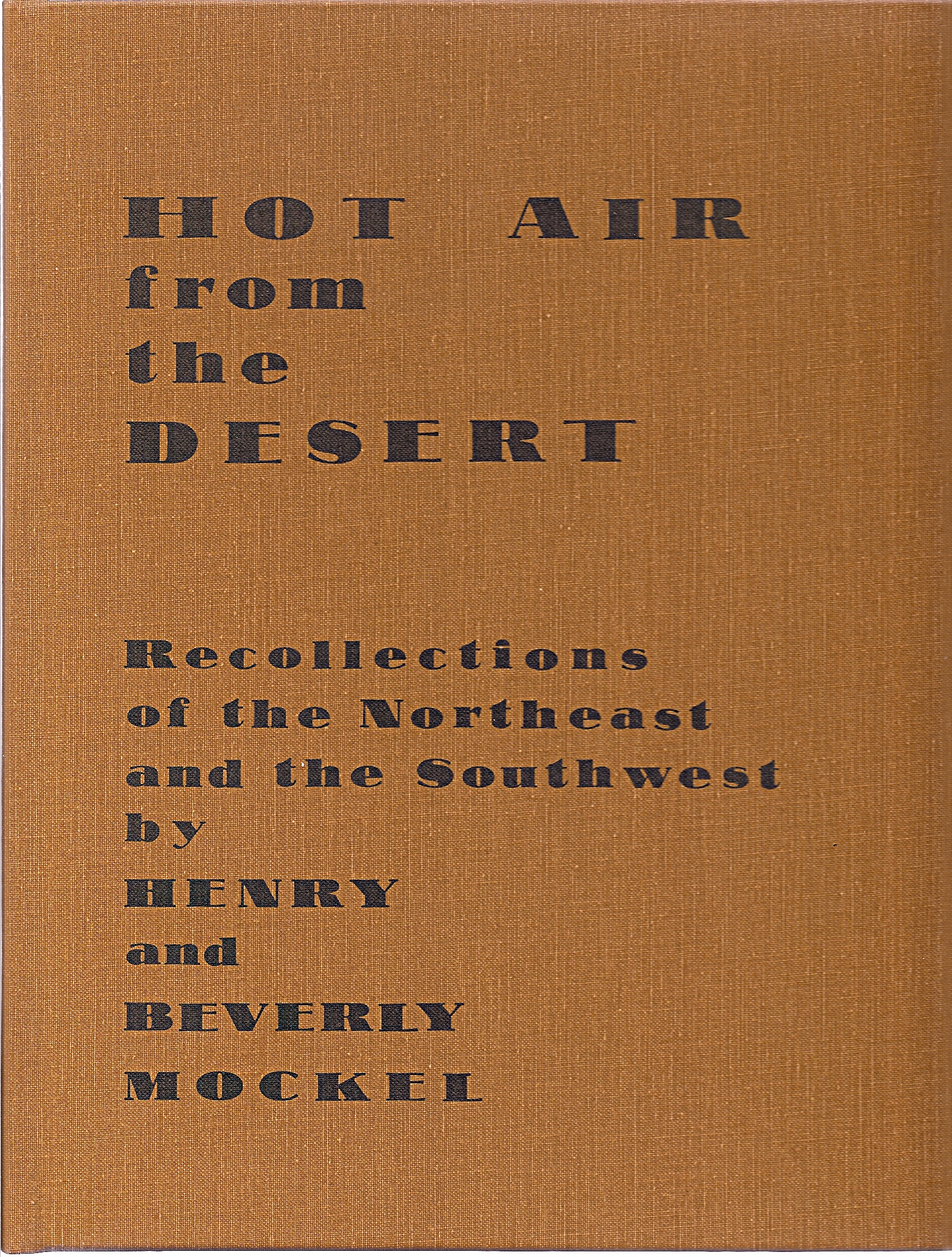
- Mockel, Henry R. and Beverly Mockel. 1968. Hot Air from the Desert – Recollections of the Northeast and the Southwest. Self-published. Twentynine Palms, CA.
- Mockel, Henry R. and Beverly Mockel. 1971. Mockel’s Desert Flower Notebook. Self-published. Twentynine Palms, CA.
*Note cards can be ordered from Henry R. Mockel’s in Twentynine Palms, CA. Request an order form by writing to: Henry R. Mockel’s, P.O. Box 726, Twentynine Palms, CA 92277 or call (760) 361-4832.
Related
UPDATE (March 2014):
Journalist Ann Japenga learns more about Henry Mockel. She writes about her discoveries in Henry Mockel: The Philosopher of Flowers at California Desert Art.
Water Conservation Workshop Features Speakers, Tools, Awareness
Posted in botanical art, botanical art books, Special Announcements, Special Events on March 4, 2010| 2 Comments »
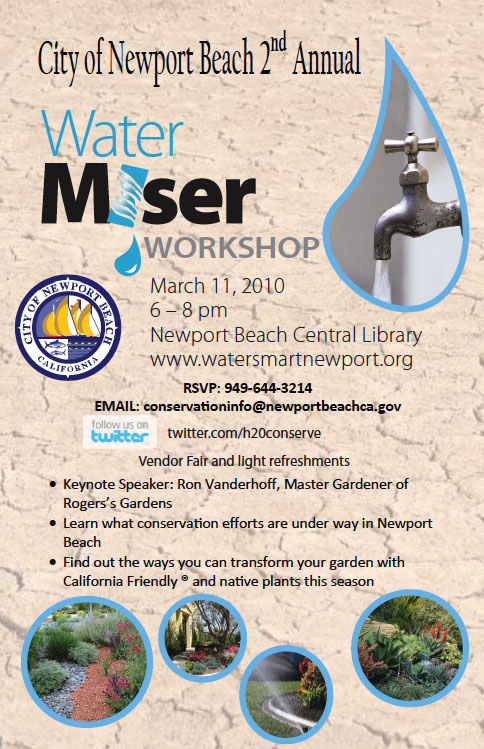
On March 11th, ArtPlantae will participate in the 2nd Annual WaterMiser Workshop hosted by the City of Newport Beach. This successful event is for Newport Beach residents and brings awareness to water conservation issues facing not only the local community, but the global community as well. Presentations and practical how-to instruction are the foundations of this event.
This year, the Botanical Artists Guild of Southern California and ArtPlantae will be in the Exhibitors Courtyard to bring special attention to the plants in our world. Cards, prints, and books will be available for purchase.
Visitors to the Exhibitors Courtyard will also be able to learn wonderful new skills such as how to harvest rainwater, how to wash a car without water, and how to create a water-wise landscape.
Hope to see you next week!
Related Info:
ArtPlantae Books in New Bookseller Directory
Posted in ArtPlantae Books, botanical art books, Special Announcements, Uncategorized on November 2, 2009|
ArtPlantae Books is one of 700 booksellers and auction houses listed in the 2010 Fine Books Compendium & Bookseller Directory published by Fine Books & Collections magazine. Books, books, and more books!
Click here for more information and for links to the magazine and other interesting items.
Stirring Botanical Art in ‘Botanica Magnifica’
Posted in ArtPlantae Books, botanical art books, Photography on October 19, 2009|
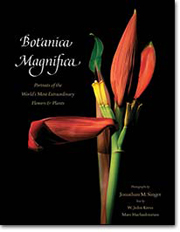 In the Introduction of Botanica Magnifica: Portraits of the World’s Most Extraordinary Flowers & Plants, Marc Hachadourian, the Curator of Glasshouse Collections at New York Botanical Garden, discusses the centuries-old association between science and art, citing specifically the relationship between a botanist and an artist. He explains that photographer Jonathan M. Singer, inspired by early botanical artists such as Walter Hood Fitch, Basil Besler, and Franz Bauer, as well as contemporary botanical artists Pandora Sellars, Anne Farrer, and Celia Rosser, set out to develop a digital photography technique that would capture a viewer’s emotions through lighting and detail and surpass “the capability of brush and paint.”
Singer has definitely accomplished his objective. Botanica isn’t simply a book of nice photographs that you browse through. It is a collection of plant portraits that pulls viewers into each image to study what is there. The act of browsing never crosses your mind. Singer’s portraits make you pause and make you feel compelled to experience the graceful movement of petals, the fragility of exposed stamen, the withering of a style past its prime, the order of patterns, the density of spines, and the beauty of dissected leaves.
The baby elephant folio of Botanica Magnifica is comprised of five volumes. Each volume begins with a foreword by either Marc Hachadourian or W. John Kress who is the Curator of Botany and Research Scientist at the National Museum of Natural History at the Smithsonian Institute. Each volume ends with an appendix of large thumbnails featuring the plants in a given volume, along with a caption detailing each plant’s place of origin, its unique characteristics, and/or its history. The five volumes in this collection are:
- Orchidaceae – A collection of representatives in the orchid family, with a forward providing an overview of this plant family.
- Florilegium – A diverse collection of flower images, with a foreword about the evolution of plants.
- Proteus – A collection of plant forms with a foreword about plant adaptations and plant diversity.
- Zingiberaceae – A tribute to the ginger family.
- Botanicus – A collection of flowers and plants collected or being studied by Smithsonian botanists.
This magnificent collection of plant portraits is the work of podiatrist Jonathan Singer, whose lifelong interest in photography became more of a central focus in his life when he was diagnosed with Parkinson’s disease. View an interview with Singer on CBS News by clicking on the link below. In this interview, you will also see the large double elephant folio of Botanica Magnifica that is now in the rare book collection at the Smithsonian.
Would you like to view a copy of Botanica Magnifica yourself? ArtPlantae will be displaying a copy of Singer’s work at The Women’s Conference on October 26-27, 2009. Orders for the baby elephant edition of this book will be taken at this time. This book can also be ordered online at ArtPlantae Books. The special pre-publication price of $135 has been extended. The post-publication price for Botanica Magnifica will be $185.
Abbeville Press has announced a book tour for Botanica Magnifica and The Weeping Goldsmith a book by W. John Kress. Check the Abbeville Press website for complete details. As of this moment, the touring schedule looks like this:
- Sunday, November 1, 2009 – Westwood Art Gallery, Westwood, NJ
- Saturday, November 7, 2009 – Denver Botanic Garden, Denver, CO
- Monday, November 9, 2009 – Collected Works Bookstore, Santa Fe, NM
- Wednesday, November 18, 2009 – Alabama Booksmith (Sponsored by the Birmingham Botanical Garden), Birmingham, AL
- Friday, March 19, 2010 – Chicago Botanic Garden, Chicago, IL
- Thursday, May 13, 2010 – Garden Club of America Annual Conference, New Brunswick, NJ
Related
The Creation of 18th-Century Botanical Illustrations
Posted in botanical art, botanical art books, Education, Learning Opportunities on September 14, 2009|
Note: The following was first published in the June 2007 issue of Artists’ Botany. This publication was ArtPlantae’s original newsletter and the predecessor of this educational site. It was published from February 2005 – October 2007. Selected articles from Artists’ Botany will be reprinted here and added to our searchable resource.
 Draughtsmen, Botanists and Nature: The Construction of Eighteenth-Century Botanical Illustrations is a dissertation-turned-book written by Kärin Nickelsen of the University of Bern, Switzerland. It is a fascinating look into the time, effort, patience and planning that went into the creation of botanical illustrations between 1700 and 1830. Nickelsen discusses observable links between illustrations of this time period and provides information about Georg Dionysius Ehret, Carl Linneaus and other influential individuals of the 18th century.
Nickelsen studied 137 scientific plant drawings representing ten species of plants in order to decipher the actual process of how plant images were produced and who produced them. She offers insight into how botanists communicated with their draughtsmen and how botanists critiqued the plant drawings that were created for them. Nickelsen describes the painstakingly detailed and tedious work completed by the engravers and the colorists who added color to printed drawings. She also offers insight into the stressful lives of 18th-century publishers and project managers and their handling of botanists, authors, draughtsmen, engravers and the private individuals who funded botanical works such as Christoph Jacob Trew’s Plantae Selectae (1750-73).
During the course of her research, Nickelsen determined that 18th century illustrations were not created as exact copies of nature. Instead, they were often derived works originating from the existing illustrations of botanists and draughtsmen whose work had already been accepted by the scientific community. It appears that draughtsmen copied elements from existing illustrations and incorporated them into their own work. Nickelsen goes to great detail to describe this practice by pointing out “copying links” in the plant drawings that were the focus of her research.
Draughtsmen is truly an academic read complete with detailed footnotes, a Materials & Methods section, and a Reference section brimming with 231 references spanning three centuries. Get out your pencil. You will be jotting down notes in the margin of almost every page of this book.
Citation
Nickelsen, Kärin. 2006. Draughtsmen, Botanists and Nature: The Construction of Eighteenth-Century Botanical Illustrations. Archimedes – New Studies in the History and Philosophy of Science and Technology. Volume 15. Springer.
View Illustrations Online
The images that were the focus of Nickelsen’s research can be viewed online. Click here to learn more about a special online presentation of this project. This online presentation is titled The Dynamics of Botanical Illustrations of the 18th-Century by Kärin Nickelsen and GerdGraßhoff. Also available on this site is Nickelsen’s Ph.D. dissertation (in German), as well as selected references that were consulted for this project.
(Update 12/6/13: These links are no longer valid)
Draughtsmen Contents in Review
- General Overview of Project
- The Making of Botanical Illustrations
- The Content of Botanical Illustrations
- The Role of Botanical Illustrations
- The Language of Botanical Illustrations
- Links with Tradition (learn how draughtsmen copied elements from previous works)
- The Construction of Botanical Illustrations
Draughtsmen, Botanists and Nature can be purchased at Springer Link in its entirety or as individual chapters.
Update 10/24/16
Also view this article online at ResearchGate:
Nickelsen, Karin. 2006. Draughtsmen, botanists and nature: Constructing eighteenth-century botanical illustrations. Studies in History and Philosophy of Science Part C Studies in History and Philosophy of Biological and Biomedical Sciences. 37(1):1-25.
-

I’m curious about…
What Readers Are Reading Now
Plants & You

Featured Guests
Global Impact

Botanists and illustrators strive to document conifers around the world.
Nature Near You
 ArtPlantae Today