Feeds:
Posts
Comments

Archive for the ‘book review’ Category

Last week we learned how to conduct and record observations of plants in the field. Today we are treated to a reference serving as a fine example of how the life histories of plants can be written and, more importantly, introduced to a general audience.

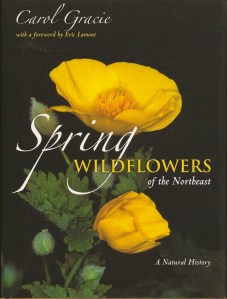
In Spring Wildflowers of the Northeast: A Natural History,
Carol Gracie shares the life histories of more than 30 spring-blooming plants growing in the northeastern United States. A seasoned writer, teacher and interpretative naturalist, Carol is able to “talk plants” to an audience whose interest may range from no interest at all to pure passion. The plant profiles Carol writes are more than a string of facts about a plant’s morphological parts and its dry taxonomic history. Each profile is a history lesson sprinkled with interesting insights into how plants work.

Using a friendly conversational tone, Carol touches upon complicated topics such as pollination ecology, species introduction, plant taxonomy, ethnobotany, horticulture, medicine and climate change without bogging readers down with the type of information that makes eyes glaze over. To maintain her easy-going storytelling approach, Carol chose not to clutter her profiles with references and footnotes. Instead, she waits until the end to cite her sources. She also went out of her way to keep her book free of the confusing technical jargon botanists speak. However, since some botanical terms cannot be translated into everyday English, Carol also provides a glossary of terms at the end of her book.

More than a guide to 30 popular plants of the northeast, this book is a guide to seeing. While reading Carol’s book, be prepared for your observation skills to improve without any effort on your part. This magical transformation occurs because of Carol’s detailed color photographs highlighting key characteristics of plants and the significant changes that occur during each plant’s life cycle. After viewing Carol’s 500+ images, you will discover you’ve developed a search image for the subtlest of details such as tiny persistent styles and the gentle arching of reflexed stamen.

I like Spring Wildflowers for several reasons. First, it doesn’t read like a textbook. It is easy to get lost in one plant profile after another. Second, it is a fascinating introduction to the plants of the northeastern US. Having lived around chaparral and coastal sage scrub all my life, there were plenty of opportunities to be surprised as I turned the pages of this book. What a treat to see the snowflake-looking flowers of the miterwort (Mitella diphylla) and its boat-shaped fruit. Not to mention the drama of an emerging skunk cabbage (Symplocarpus foetidus) and the intriguing morphology of featherfoil plants (Hottonia inflate).

What I like best about Spring Wildflowers is that it piqued my curiosity about East Coast plants. My fascination with plants and how they go about their business was greater at the bottom of page 233 than it was at the top of page 1. This is a good thing!

Published earlier this month, Spring Wildflowers is Carol’s most recent book. This book is recommended for teachers, naturalists and all plant enthusiasts in the northeastern US, armchair naturalists everywhere, and anyone striving to write interesting, easy-to-read plant profiles for a general audience.

Buy this book online from your local independent bookstore.


Literature Cited

Gracie, Carol. 2012. Spring Wildflowers of the Northeast: A Natural History. Princeton, NJ: Princeton University Press.


Related

Read Full Post »

A steward of the environment, especially California’s Sierra Nevada, John Muir Laws, has dedicated himself to revealing the natural world through art and science.

John (Jack) Laws has been an environmental educator for 30 years. He recently collaborated with the California Native Plant Society and with English instructor, Emily Breunig, to create a wonderful curriculum integrating art, science and the language arts.

I am thrilled to introduce John Muir Laws and Opening the World Through Nature Journaling, the Feature Curriculum for December.

John has kept a sketchbook since elementary school. Challenged by dyslexia, he found that keeping a journal was the easiest way to record his experiences. Drawing and sketching helped him see things he had never noticed before. John’s mom gave John his first sketchbook. One year during a family trip, John and his family met a woman who was keeping a wildflower sketchbook. John’s mom noticed how he followed this woman and her sketchbook throughout their trip. On the next family vacation, John’s mom gave him a sketchbook and colored pencils so he could document their vacation. Little did she know that years later, John would use sketchbooks as a teaching tool.

While working as a naturalist group leader at Walker Creek Ranch in northern California, John led activities designed to connect children to nature. He decided to incorporate journaling into his activities to help students slow down and focus in the same way his own journals helped him to slow down and become a better observer. He soon began to notice differences between his journaling audience and the groups of children who ran through the ranch without stopping to see what was really there. John began to expand upon his journaling exercises. The Marin County Outdoor School at Walker Creek Ranch became a great testing ground. It took about four years for John to develop his activities. He wrote up his observations, began sharing them with other naturalists and teachers, and over a period of 10-15 years, his activities were tested hundreds of times and refined. This collection of journaling exercises eventually became Opening the World Through Nature Journaling.

The response to Opening the World Through Nature Journaling has been “amazing”, according to John. He says “(the curriculum) has been well-adopted in California and across the country. Teachers get this is authentic student-driven education.”

While John was developing and testing journaling activities, he was also launching the program Following Muir’s Footsteps and working on his book, The Laws Field Guide to the Sierra Nevada (2007).

Following Muir’s Footsteps is a conservation project for schools in the Sierra Nevada region whose aim is to encourage local youth to become citizen stewards of the Sierra. Encompassing an eighteen-county area around the Sierra Nevada, Following Muir’s Footsteps connects youth to nature through firsthand experiences and journaling. Through this program, John provides in-service training for teachers about how to use field guides and how to use science journals in their classrooms. He also sponsors one mentor teacher from each school so they can attend the Sierra Nevada Teacher Institute, a summer program where teachers learn about the biodiversity of the Sierra Nevada. School libraries also benefit from this fantastic program. The library of each participating school receives 25 copies of The Laws Field Guide to the Sierra Nevada.

The idea to create his comprehensive field guide to the Sierra Nevada was hatched when John was in high school. One day, while hiking the John Muir Trail and juggling many field guides, he thought how wonderful it would be to have all of his field guides packaged into one portable book. By the time he finished high school, John says he could visualize the pages, the layout — everything. John’s grandmother encouraged him to begin working on his dream. At about this same time, he came across a poem by Mary Oliver called The Journey. The first line of this poem read:

One day, you finally knew what you had to do, and began.

So John quit his job and says he “filled my backpack with paper and granola.” He spent the next six years documenting the flora and fauna of the Sierra Nevada. In the early stages of this full-time project, he drew whatever he encountered. At the end, he went into the field with species lists. John says the last few species on his list were a particular challenge and that locating them was a true “scavenger hunt.”

How did John take on the expansive Sierra Nevada? He started at the lower elevations in the south and, as plants bloomed in the Spring, he followed the bloom hopping back and forth between the west side and the east side. Every 1-2 weeks, John hiked out to pick up fresh supplies, get more paper, bathe and shave.

In The Laws Field Guide to the Sierra Nevada, you will find descriptions of over 1700 species and 2,700 watercolor paintings. John drew each plant from life and each illustration was started and completed in the field. Illustrations of birds, insects and mammals began as quick gesture sketches in the field. They were then finished in the studio after a careful study of museum skins, reference materials, and the collections at the California Academy of Science.

When asked how it is he can make so many big things happen, John says none of his programs were launched as big complete packages. He explains, “It was an accumulation of a lot of little pieces coming together organically. This is what makes it possible to do something big.”


Ask The Artist with John Muir Laws

John received a Bachelor of Science in Conservation and Resource Studies at UC Berkeley and a Master of Science in Wildlife Biology at the University of Montana. He is also a graduate of the scientific illustration program founded at UC Santa Cruz, that is now taught at California State University Monterey Bay. In 2011, John received the TogetherGreen fellowship from Audubon/Toyota and this enabled him to deliver the Following Muir’s Footsteps program to 10 schools in the Sierra Nevada. This month, we have the extraordinary opportunity to discuss art, science and education with John.

To take advantage of this opportunity, post your questions or comments in the comment box below. John will respond to questions throughout the month of December.

Teachers, do you know of other teachers who might like to join in the conversation? Please send them the link to this article. The conversation will happen right here on this page.


Request a copy of Opening the World Through Nature Journaling

To request your own copy of the nature journal curriculum written by John Muir Laws and Emily Breunig in collaboration with the California Native Plant Society, click here.


Drawing Plants: Tutorials by John Muir Laws

John recently posted tutorials about how to draw plants on his website. These tutorials were created specifically for teachers. The demonstrations are easy for teachers to recreate in their own classrooms. Leaf and flower templates are available for download. View John’s instructional videos in the Nature Drawing section of his website.


Get “The Laws Field Guide to the Sierra Nevada”

Read Full Post »

Inspiration for the Holidays

It is the diaries that speak the loudest in the empty library at night.

— Susan Snyder

Diarist, Susan Snyder, has compiled a moving and engrossing collection of diaries in Beyond Words: 200 Years of Illustrated Diaries. The featured diarists recorded their thoughts, secret wishes, To Do lists and illustrations in diaries they referred to as their “journals”, “field notes” and “logs”. The unknown writers provide an insider’s perspective of significant world events and invaluable insight into what nature looked like during their lifetimes.

Most of the diaries in this book are from the Bancroft Library at the University of California, Berkeley where Snyder works as a librarian and researcher. The diaries in this book are not all by famous people, although you may recognize the products they created and the organizations they established. The featured diarists were (and are) travelers, mothers, inventors, explorers, naturalists, children, poets and soldiers — including a 16 year-old soldier of the Mexican-American War whose interest in botany was greater than his interest in fighting.

In Beyond Words, you will find journals written between 1776 and 1981. With each turn of the page, years pass, journal pages become less fragile, penmanship becomes more modern, and advances in technology (think typewriter) and advances in photography become evident.

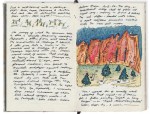
Each 24″-wide, two-page spread allows the reader to view each diarists’ words and illustration up close. These visual treats and the warm colors, eye-pleasing fonts and clean layout of each page create a soothing reading experience for readers.

Heyday Books has provided us an opportunity to view pages inside this wonderful new book. Click on the image to peek into the diaries of John Muir and others.


Beyond Words: 200 Years of Illustrated Diaries

Order this book online from your local independent bookstore.

Read Full Post »

Why are plants important?

A teenager asked me this question one day at an environmental education fair. I explained how plants are important because they are our source of food, medicine and clothing and picked examples that might strike a chord with her. I don’t think it worked. All I received in return was a blank stare and a polite nod.

This experience made me realize that I need to prepare a better answer, especially for this age group. It left me feeling compelled to record every encounter with a plant and plant by-product for the rest of my life. Fortunately, I found a wonderful resource that will help me articulate the value of plants to both young audiences and adult audiences alike.

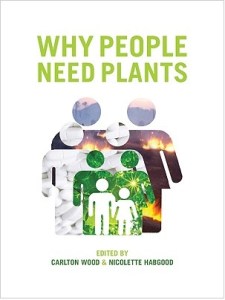
Why People Need Plants by Carlton Wood and Nicolette Habgood (2010) is a thorough reference that is sure to resonate with any audience. Here is what I like about this book:

  • It is written for a general audience and not loaded with statistics and scientific terminology.
  • Instead of saying, “We need plants for food”, Wood & Habgood (2010) provide a historical backdrop beginning with how our dependence upon agriculture began 11,000 years ago. They combine data from research studies with historical accounts to describe the botanical sources of food crops, nutrients and popular drinks such as tea, coffee, cocoa and cola. In their discussion about plants and health, they provide a great visual of “The Eatwell Plate”, the UK’s version of the USDA Food Pyramid that, quite frankly, does a better job at showing how two-thirds of the human diet should come from plants. They also make the excellent point that the dairy products we so enjoy are derived from animals dependent upon plants, reinforcing the role plants play at all levels of the food chain.
  • Instead of saying, “We need plants for wood to build homes”, the authors explain the properties plants possess that make them valuable sources of wood and many other products. For example, they explain how the cellular structure of wood makes it a good insulator, why cork’s properties makes it a good source for flooring and engine gaskets and not just plugs for wine bottles. Wood and Habgood (2010) describe the four sources of fiber found in plants and how fiber has been used to make everything from rope for sailing ships to fishing line to flexible paper for money and tea bags. They even explain how plants are used by Mercedes Benz to make automobile parts.
  • Instead of saying, “We need to save plants just in case they have medicinal value,” Wood & Habgood (2010) confirm the world’s reliance on plants for medicine by beginning their chapter about medicinal plants with a statistic from the World Health Organization indicating that “80% of the world’s population still rely on plants for their primary source of medicines” (Wood & Habgood, 2010). They go on to discuss the history of medicinal plants, the globalization of Chinese medicine, the discovery of aspirin, the discovery of the cancer drug taxol, and take a look at ethnopharmacology — the study of medicinal plants and the ethnic groups who use them — and the implementation of revenue-sharing agreements between drug companies and the communities where source plants are found.
  • Instead of saying, “We need plants for fuel,” Wood and Habgood (2010) describe the types of fuel that can be derived from plants. They explain why grass is a good source for biofuel and explain the differences between biodiesel and bioethanol using easy-to-follow graphics showing how both fuels are produced and used.
  • Wood and Habgood (2010) discuss how plants help forensic botanists solve crimes. Given the apparent popularity of crime shows, the inclusion of this information gives plants a modern edgy look even though the field of forensic botany has existed for 76 years. Pollen profiles, spore profiles and the growth habits of plants can provide valuable information when solving crimes. Broken branches and their “corrective growth” (Wood and Habgood, 2010) can reveal the route taken by criminals, pollen and spores can provide unique snapshots of an area, and plant DNA can be traced to crime scenes.
  • Wood and Habgood (2010) look at the big picture. Interesting and informative chapters about micropropagation, genetically modified plants, methods of natural plant protection, human impacts on the planet, plant conservation, and what the future of plants looks like given the need to feed a growing human population, provide a firm foundation from which to explore each of these topics in greater detail.

Citing stories taken from current news headlines, Why People Need Plants is an invaluable resource providing a succinct and comprehensive look at the relationship humans have with plants.

Why People Need Plants is available at your local independent bookstore.


Related Articles

Read Full Post »

Saturday’s wonderful Facebook author event with Glynis Ridley has been posted below. This version has been reformatted so that the links appear in the appropriate places. I have omitted our encounter with technical difficulty. You can read the original version online.

Looking for an adventure with which to kick-off your summer reading? Look no further than Jeanne Baret’s journey on the Bougainville expedition! The Discovery of Jeanne Baret can be purchased online from independent bookstores at IndieBound.


AP
: Welcome to our conversation with author Glynis Ridley! 
Allow me to introduce to you Glynis…

Glynis Ridley is an Associate Professor at the University of Louisville in Kentucky. Her research interests are in 18th-century studies, the history of rhetoric, and animal studies.

Glynis was awarded the Institute of Historical Research Prize (University of London) for her book, Clara’s Grand Tour: Travels with a Rhinoceros in Eighteenth-Century Europe. Please welcome Glynis Ridley!

GR: Thanks for the kind introduction. I’m delighted to be here.


AP
: Glynis, I have thoroughly enjoyed your book and am excited to have the opportunity to discuss it with you. Here is my first question…

You first learned of Jeanne Baret from your husband who was preparing a paper about French explorers Louis-Antoine Bougainville and Jean-Francois de Galaup, comte de La Perouse. You mentioned you found almost nothing documented about Baret. Where did you begin your research? How long before you had enough information to articulate this biography of Baret’s life?

GP: My husband introduced me to Baret back in 2001, showing me the single paragraph in Bougainville’s journal that mentions her. When I realized the implications of Bougainville’s journal entry – that a woman disguised as a man had apparently remained undetected on board an sailing ship for a year and a half until frightened into revealing herself by the natives of Tahiti – I was just suspicious. It seemed improbable that a woman could successfully maintain her disguise in the close quarters of a sailing ship – a view only reinforced when I found out the dimensions of the ship she sailed on. The Étoile was 102 feet long and 33 feet wide with a compliment of 116 men. So when I was thinking about a new book project back in 2008, I kept coming back to Baret’s story as something that intrigued me. I began by reading everything I could find published about her (which is not much). Then I read the published accounts of the expedition – these have been collected and reprinted by various French publishers in the last two decades. They made me realize that Baret’s story was also the story of the first French circumnavigation of the globe, and I began to think that a book might be possible. The book was contracted at the end of 2008, on the basis of a 40-page synopsis (so the contours of Baret’s story had already emerged for me during that year). I completed research – and writing the first draft – across 2009. Then the first half of 2010 was devoted to editing – at which stage I had to take out any speculations I didn’t have good evidence for. You’ve just made me realize that’s 3 years of trying to find solutions to puzzles about Baret’s life and about the expedition.


AP
: Only eight written accounts of Bougainville’s expedition exist. One account belongs to expedition volunteer, Charles-Felix-Pierre Fesche. The journal of Charles-Felix-Pierre Fesche contains a lot of flowery, period-specific language. I am assuming all the journals were written in this way. How did you decipher the language of the 1700’s?

GR: Some of Fesche’s style is distinctively his – some is period convention. For example, this was an age when men and women with literary aspirations often peppered their writing with classical allusions in an attempt to show they knew their stuff. Travel narratives (both fiction and non-fiction) were very popular in the 18th century and Fesche undoubtedly toyed with the idea of publication. This may help to explain some of his literary flourishes. I’ve been specializing in study of the 18th century since I was an undergraduate and, since I read 18th century writers for work and pleasure, their language probably sounds less strange to me than to someone reading such writing for the first time. I promise you that if you were immersed in it for even a few weeks, it would start to seem perfectly normal!


AP
: Have you had the opportunity to view each handwritten account of Bougainville’s expedition?

GP: Yes. But I couldn’t have done this without my husband. Let me explain. He is a professor of French and, like me, he is also an 18th century scholar. When I realized that there was more material I needed from particular archives, I could always split the work with him: armed with a digital camera, he has spent many hours on my behalf taking pictures of some of the handwritten accounts. (I should stress that this was always with the agreement of the relevant museum or library.) The result is that, sitting at my laptop right now, I’m a couple of clicks away from images of the manuscript pages of Bougainville’s notebook and Commerson’s herbarium, among other texts. Between the two of us, we’ve seen and/or taken digital photos of all the main texts referred to in the book.


AP
: Pierre Duclos-Guyot was the son of the captain of the Boudeuse, one of Bougainville’s ships. Pierre traveled on the other ship (the Étoile) with Commerson and kept a joint journal with him. You mention this joint journal is now known for the watercolor paintings it contains. Are Commerson’s paintings of newly discovered plants and animals available for viewing, either in-person or online? (pg. 7)

GR: Let me address that previous question from before I lost the feed. Commerson’s papers are housed at the Muséum national d’histoire naturelle in Paris. Let me make a distinction between his manuscript notebooks, the herbarium he complied as a teenager, and illustrations and paintings he made in his expedition notebooks (or instructed Paul de Jossigny to make on Mauritius). All of these can be viewed in person at the Muséum though, as is common in all institutions that care for such unique historical artifacts, Muséum curators will want to know your reasons for needing to see the collection, and will want to satisfy themselves that you can handle them appropriately. Only a handful of images from Commerson’s expedition notebooks have been reproduced in books; even fewer have been digitized. That’s a great pity because it would be wonderful to be able to access this material online. When I was thinking about illustrations for the book, I found that only two pages from his teenage herbarium were circulating on the web, and only a single image he instructed Jossigny to make on Mauritius was available. The Muséum national d’histoire naturelle made three images from Commerson’s herbarium available to me but only one (showing pressings of hyssop and marshmallow) was finally used in the book. Unfortunately, color plates increase the cost of a book so the images in the book are reproduced in black and white. I’d love to see more images from the expedition available on the web in their full color glory.


AP
: The Wikipedia entry for Commerson states he was clueless about Baret’s sex. How often is it written that he was as shocked as everyone else that Baret was a woman?

GR: This story is everywhere. If you put ‘Jeanne Baret’ into your search engine of choice, you’ll end up finding a very short list of all the books that discuss her, in addition to my own. I’m the only person who has written on Baret to suggest that it is simply preposterous to believe that she concealed her identity for eighteen months before she revealed herself on Tahiti. Of course, when Commerson says that he was as shocked as everyone else, this could be – strictly speaking – true. If everyone suspected that Baret was a woman within a few days of the store ship leaving port, then Commerson was as shocked as everyone else because no one was shocked at all! But I digress. Let me illustrate the prevalence of the Wikipedia information in a different way. A couple of years ago, my husband was at a conference on French maritime history. In one of the coffee breaks, he found himself talking to a retired French naval officer who was familiar with details of the Bougainville expedition. My husband explained to the group that had gathered around them that I was working on a biography of Baret, and that I thought Commerson and Bougainville should not be believed when they claimed not to have known that Baret was a woman before the expedition landed on Tahiti in April 1768. The naval officer was not impressed and insisted upon the truth of the standard version of events i.e. the Wikipedia version. I was astonished to hear about this exchange – but an alternative version of events is clearly still too awkward to contemplate for many people. And there’s a lot of recycled and inaccurate information on the web.


AP
: While reading your book, I kept cross-referencing the people and events in your book to people and events related to botanical art. Your references to Jean-Jacques Rousseau prompted me to pull Rousseau’s Pure Curiosity: Botanical Letters off the shelf. The more history I read, the more I am surprised by who knew whom and how intertwined the lives of the big names in history seem to be. When researching a subject, how do you decide which cross-reference to explore? When do you know when to stop?

GR: I wanted to be able to give the reader enough context to be able to understand the importance of a particular character or to appreciate the relevance of certain information. Since you’ve mentioned Rousseau, and his interest in botany, let’s take him as one example in this discussion. He is an intriguing character – not to mention a major figure in 18th century France. Personally, I’m fascinated by his interest in projecting botanical images on magic lantern slides – the magic lantern was a sort of primitive projector. What it projected onto a big screen was typically an image painted on a glass slide. Rousseau enjoyed this as a solitary pleasure, but magic lantern shows were generally popular entertainments for groups in both public and private gatherings. But, you see, I’m already in danger of wandering off topic – I could spend a couple of pages describing magic lantern shows and Rousseau’s interest in them. I could talk about his well-documented interest in botany. But the aspect of Rousseau’s life story that best helps illuminate aspects of Jeanne Baret’s life and experience is the fact that Rousseau had a long term relationship with a woman considered his social inferior, and he persuaded her to give up their five children to the Paris Founding Hospital. Readers need to be able to see the relevance of information to the central character or central storyline. I might want to share my interest in Rousseau and botany, but I have to be aware that readers might be thinking, ‘why is Rousseau important to Baret’s story?’ Fortunately, writers don’t have to make these judgment calls on their own. The first draft of a manuscript might contain a lot of cross-references and apparent tangents. Editors bring a fresh perspective to a text and suggest where information can be cut – and also where it needs to be added. For me, it was helpful to keep reminding myself that I needed to put Baret’s experience at the center of things – in so far as this was possible.


AP
: If taxonomy was an obscene topic for women in 1768 (per William Smellie’s comments on page 9), when or how did it become fashionable?

GR: A lot of academics have asked the same question fairly recently and there’s an excellent book on the subject by Ann B. Shteir called Cultivating Women, Cultivating Science: Flora’s Daughters and Botany in England, 1760 to 1860 (1996). We need to distinguish between the ability to talk about the beauty of nature – which was always a fashionable accomplishment for middle and upper class women in the 18th and 19th centuries, and the pursuit of botanical knowledge, including an understanding of the principles of the Linnaean classificatory system. It was only at the end of the 18th century that books aimed at women readers started to take their potential interest in taxonomy seriously. Before this time, it’s possible to find women such as Lady Margaret Cavendish Bentinck, Duchess of Portland (1715-1785) corresponding with Rousseau about Linnaean taxonomy but she was an exception rather than the rule.


AP
: I have a book called The Little Botanist (1835) that celebrates a conversation between a mother and her young daughter. In this conversation, the mother teaches her daughter botany. This book was published 69 years after Bougainville began his expedition. When did female botanists stop being “a breach in the natural order of things”?

GR: When The Little Botanist was published, a woman called Marianne North was only five years old. In the course of her life, she would spend fifteen years crossing five continents to illustrate the world’s flora. Anyone who visits Kew Gardens in London – or who checks out their website – will find the North Gallery displays a selection of her watercolors. So the 19th century was a period of greater acceptance of women’s ability to engage with botany. And women’s interest in botany was undoubtedly stimulated by books on the subject aimed at young female readers. From the end of the 18th century, there are Charlotte Smith’s Rural Walks (1795) and Rambles Farther (1796). When the women who read these became mothers and grandmothers, they were better placed to provide instruction in botany than previous generations of women had ever been.


AP
: In your teacher’s guide to The Discovery of Jeanne Baret, you include a question about female botanical illustrators and 19th-century women travelers. The question you ask is, “Why do you think these women are not better known?” 


At the risk of oversimplifying things, I think there are two reasons why they are not better known — 1) During their lifetime, they challenged people’s assumptions about who they should be, and 2) I suspect they evoked a “Who does she think she is?” response from their peers. As a result, people were not motivated to learn more about these adventure-seeking women or to tell others about them. Is the explanation really this simple? How might a historian begin to answer your question?

GR: Your answers are really good ones in terms of thinking about responses to these women during their own lifetimes. But in suggesting this question in the teacher’s guide, I suppose I was thinking that a teacher might ask a class to consider not only the reception of these women by their contemporaries, but their treatment by successive generations of historians. Today, scholars who would define themselves as working from a feminist perspective might say that women like Baret have languished in historical obscurity because of both their gender and their humble social origins. It’s not just Baret’s contemporaries who showed a stunning lack of interest in her story – no 19th or early 20th century writers tried to investigate her achievement. A teacher might ask a class to consider the rise of women’s suffrage movement and the resistance it encountered, with women being told they lacked certain capacities and were somehow inferior. It’s harder than it should be to challenge such views if there are few histories of remarkable women around. Now there are women’s studies departments in colleges that ask students to think about how and why women’s histories have become an accepted part of publishing and teaching. A lot of students who take courses in women’s writing or women’s history today don’t realize how relatively recently these subjects have gained academic respectability.


AP
: Glynis, thank you for telling Jeanne Baret’s story and for speaking with us today. 

While I was reading your book and thinking about cross-references to this and to that, it made my yearning for a floor-to-ceiling whiteboard on a really, really long wall that much stronger. I enjoyed reading your book and I find I am relating other events to the year 1766.

To all of you who have followed our conversation, thank you for joining us. 

I would also like to thank everyone who has followed ArtPlantae during National Environmental Education Week.

Glynis, thank you for your time today and for teaching us so much.

GR: Thank you so much, Tania. Apologies for the glitch in the middle of the interview but I’m pleased we got it going again. Thanks for inviting me to discuss Jeanne Baret’s story and share it with more people. She deserves to be better known and celebrated and events like this will hopefully help with that.


You May Also Enjoy…

Read Full Post »
During Monday’s Ask The Artist with Bruce Lyndon Cunningham, Bruce introduced us to his user-friendly guide to North American gymnosperms. While the guide created by Dr. Elray S. Nixon and Bruce can be used by beginning and experienced naturalists, what about the very youngest of naturalists? Are there books just for them? A teacher in the audience asked these questions on Monday.

Three books were shared with webinar participants.
Here are quick reviews of each…

Trees, Leaves, and Bark (Take-Along Guide)
Author: Diane L. Burns
Illustrator: Linda Garrow

An introduction to some of the trees growing in prairies, woodlands, swamps, and mountains. Each tree profile has information about how to find a tree, background into the tree’s lifespan and uses, and information about a tree’s leaves, bark, and seeds. The following activities are included in this book: Make a Leaf Mobile, Make a Pinecone Snackbar, Grow Your Own Tree, Make a Bark Rubbing.
Grade: 4-6, Age: 9-11

The Tree Book: For Kids and Their Grown-ups
Author: Gina Ingoglia
Illustrator: Gina Ingoglia

What goes on inside cones? Where does fruit come from? How do trees eat and drink? The answers to these questions can be found in this comprehensive resource created by Gina Ingoglia, the author of 80 childrens books, a landscape designer, and the vice president of the Brooklyn Botanic Garden Florilegium Society. After introducing young naturalists (and their grown-ups) to tree biology and tree identification, Ingoglia profiles 33 trees that are easily observed in neighborhoods, botanical gardens, or the local arboretum. Each tree profile is composed of background information about a tree, its growth, and the proper pronunciation of its scientific name. Like the plant names in our pocket dictionary, each species name is written out phonetically. Tree profiles also include a whole plant illustration and illustrations of leaves, flowers, fruit, leaf buds, needles, bark, and branches. If a characteristic is important to a tree’s identification, Ingoglia includes an illustration of this characteristic.
Grade: 3-4, Age: 8-9

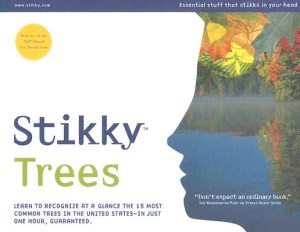
Stikky Trees
Laurency Holt Books
This clever introduction to trees lives up to the philosophy of “teach less, better.” Authors propose a four-step approach to becoming familiar with 15 trees commonly found in the United States. Actually, the “steps” are learning sequences, each dedicated to a specific topic and each building upon what was learned in the previous sequence. This book is fun for both children and adults. View an interactive demo on the publisher’s website.


Do you have a favorite book about trees?

Teachers, tell us what you use in your classroom.
Parents, tell us how you have introduced your children to trees.
Fellow Plant Enthusiasts, which helpful books about trees do you have in your library?

Read Full Post »

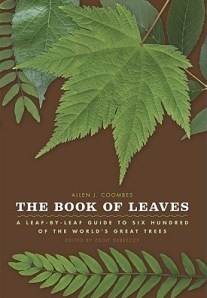
The Book of Leaves: A Leaf-by-Leaf Guide to Six Hundred of the World’s Great Trees
Coombes, Allen J. 2010. University of Chicago Press. ISBN: 9780226139739

If you have a recurring daydream about having a labeled leaf collection composed of perfect leaves that never wilt, dry, and get crunchy, stop dreaming. You can now take one step closer to making your dream a reality. Author Allen J. Coombes (Coordinator of Scientific Collections at the Herbarium and Botanic Garden of the University of Puebla, Mexico) and editor Zsolt Debreczy (Research Director of the International Dendrological Research Institute in Boston) have created a glorious collection of leaves.

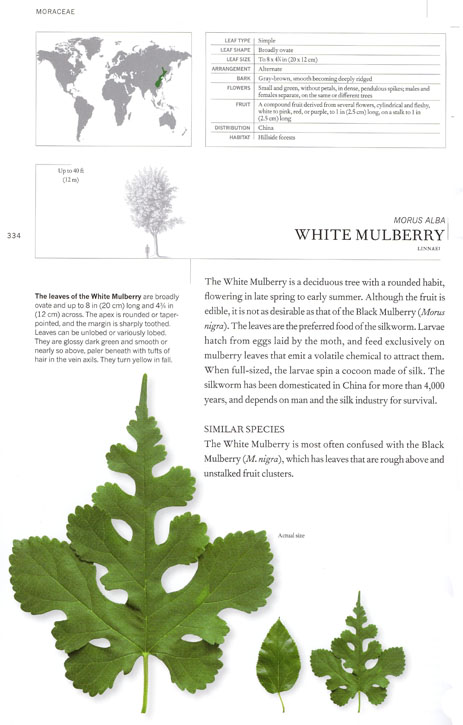
Each leaf is actual size. Leaves are arranged by family, genus, and then species. Coombes and Debreezy provide an overview of leaf morphology and teach readers how to look at leaves and how to arrange them systematically. Each entry is accompanied by a description of a leaf’s type, shape, size, and arrangement along a stem. A summary about each tree’s bark, flowers, fruit, distribution, and habitat is also included. Information about each tree’s growth pattern, observable changes in leaf appearance, ethnobotanical use, and similarity to other trees is provided as well. Of interest to plant enthusiasts and botanical illustrators in particular, is the section in which the authors arrange leaves by their position along a stem, their overall shape, the type of margin they have, and the status about their evergreen or deciduous nature. Categories in this section are labeled as “Alternate, Simple, Lobed, Deciduous” and “Opposite, Pinnately Compound, Entire Leaflets, Deciduous” and contain corresponding photographs of leaves.

Not only is this book an informative reference, it is a great way for botanical illustrators to study venation patterns and leaf margins. One look at this book and you’ll be reaching for your 0.2 mm mechanical pencil!


The Book of Leaves
is available at your local independent bookstore ($55).


Images used with permission from The University of Chicago Press

Read Full Post »

« Newer Posts - Older Posts »