Feeds:
Posts
Comments

With spring and Earth Day fast-approaching, here is a resource you’ll want to refer to the next time you need to talk about plants with preschool children. It will also help you introduce young audiences to the subjects of inheritance and traits.

In Plants, Alike and Different professor Kathy Cabe Trundle and doctoral students Mandy McCormick Smith and Katherine N. Mollohan explain how they use a learning cycle involving play, exploration, and discussion to teach students how plants and insects are alike and different. Below is a general overview of their process. For a thorough review that includes the prompts they use in class and how they bridge one activity with another, read their enlightening paper.

During the Play Phase of the learning cycle, Trundle et al. (2013) provide children with unstructured playtime in a play area that has been stocked with silk flowers and plants. The authors state they often observe children pretending to pick flowers and pretending to plant a garden. Trundle et al. (2013) explain that unstructured playtime with plants gives children time to think about plants and to ask questions about them. Instructor-guided learning begins later in this phase and begins with a conversation about how humans are similar and different. This then leads to a conversation about how plants are similar and different (Trundle, et al., 2013).

During the Exploration Phase, students compare two types of marigolds, two types of pansies and two types of coleus plants to make observations about flower size, flower number, leaf shape, leaf color, textures, stem length and stem shape (Trundle, et al., 2013). Children document observations by drawing them, by creating leaf rubbings and by tracing leaves. The visual data recorded by children are then shared, much like how works-in-progress are shared at the end of a botanical illustration workshop. The sharing of data enables students to more easily see patterns in color, shape, size etc.

This visual information created during the Exploration Phase is paired with detailed discussion during the Discussion Phase of the learning cycle. Student observations are grouped and then arranged in a graphic organizer (i.e., chart). This chart helps students compare traits for each plant they studied.

The process of observing similarities and differences described above helps establish a foundation for more detailed conversations about traits and inheritance, concepts that are the focus of Part II of this activity by Trundle, et al. (2013). A link to their activity about inheritance is included in their paper.

Also included in their paper is a link to the rubric the authors use to evaluate student drawings and assess student understanding. The rubric serves as a checklist of objectives and targeted behaviors and is based on a project about helping children draw and sketch from observation from Illinois Projects in Practice at the University of Illinois at Urbana-Champaign.

Published just this week, Trundle et al. (2013) can be purchased online for 99¢.


Literature Cited

Trundle, Kathy Cabe, and Katherine N. Mollohand and Mandy McCormick Smith. 2013. Plants, alike and different. Science and Children. 50(6): 52-57


Related Resources

  • Look Once, Look Again – Fruit and Seeds by David M. Schwqrtz and Dwight Kuhn
  • Look Once, Look Again – Plant Leaves by David M. Schwartz
  • Secrets of the Garden: Food Chains and the Food Web in Our Backyard by Kathleen Weidner Zoehfeld and Priscilla Lamont
  • Trait-based Learning with Trading Cards
Have you ever wondered about how to become an artist-in-residence?

I asked featured guest Ruth Ava Lyons about how one becomes a resident artist. She replied:

There are several ways artists approach residencies. There are online resources like CaFÉ (www.callforentry.org) that announce residencies for all levels of artists. Artist Communities (www.artistcommunities.org) is wonderful for looking at programs in specific countries as well as res artis. Sometimes its simply interacting with artists who share unique experiences at residencies and garner your interest with their firsthand experience. At this point in my life, I am thinking about places that I am specifically interested in, however there are a lot of things to consider. For instance, there is an arctic circle residency that I would love to participate in, but it requires a significant monetary contribution. Some residencies are for long periods of time that would be hard on my family. Some residencies require active interaction with the public through a lecture or workshop. I am very protective of my studio and I am not willing to open it while work is in progress, so if a residency involves allowing studio visits, that will be very difficult for me to accommodate.

What else would you like to know? Ask here…

Plants have a presence in each of the paintings created by Ruth Ava Lyons.
I asked Ruth why she chose plants to connect viewers to nature.

Ruth replied:

I like a field-based approach to my subject matter. I wander in various environments and study and synthesize and translate and interpret my impressions of the natural world. Artists like me vacillate between our direct experiences in nature and the solitary studio setting. We follow the work of biologists, botanists, ecologists, and naturalists to inform and strengthen our visions with their findings, so there is a lot of cross-cultural personal research that takes place as well. It is always challenging for me to attempt to capture the essence of plant imagery while…

Read More

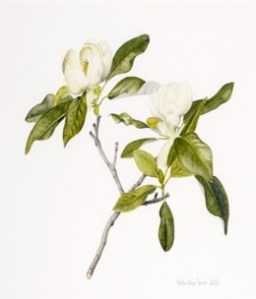
Magnolia virginiana painted by Keiko Tarver, a member of the Philadelphia Society of Botanical Artists. The magnolia is one of the American plants sent to England by John Bartram whose garden was and is still in Philadelphia.

Magnolia virginiana painted by Keiko Tarver, a member of the Philadelphia Society of Botanical Artists. The magnolia is one of the American plants sent to England by John Bartram whose garden was and is still in Philadelphia. Used with permission.

The Philadelphia Flower Show opens in only a few weeks. The world’s longest-running and largest indoor flower show will be held March 2-10, 2013 at the Pennsylvania Convention Center.

In honor of the show’s theme “Brilliant!”, the Philadelphia Society of Botanical Illustrators will present “Her Majesty’s Bouquet”, a botanical art exhibition featuring the flowers of Great Britain. Included in the exhibition will be paintings of hollyhocks and peonies, hellebores and daffodils — all flowers found in Great Britain. Many of the plants and flowers that will be on view were sent originally to England by Philadelphia naturalist, John Bartram.

Members of the Philadelphia Society of Botanical Illustrators (PSBI) will be at the show daily from 10:00 am to 6:00 pm to conduct demonstrations, distribute coloring sheets to children, and to discuss the more than 50 paintings that will be on view during the show. These paintings were selected from more than 80 that were submitted. Three judges from the fields of horticulture, botany and art chose the final pieces for this exhibition.

Botanical art is an ancient art form whose original purpose was to accurately depict the herbs and flowers important to medicine. Today it continues to aid botanists, horticulturalists, and pharmaceutical scientists with their identification of new plant species. Contemporary botanical artists celebrate nature with not only precision, but also an appreciation of its beauty and intricacy. As Virginia Fitzpatrick, president of PSBI, says, “We combine intellectual knowledge of plants and experience with art materials into our paintings and drawings.”


About the Philadelphia Society of Botanical Illustrators

The Philadelphia Society of Botanical Illustrators was formed 15 years ago and has over 75 members. The Society exhibits throughout the Delaware Valley. Past venues include The Station Gallery outside Wilmington, the Friends Hospital in Northeast Philadelphia, and the Jenkins Arboretum in Devon. Their focus is “to bring botanical illustration to the attention of many audiences”.

For more information, contact Sarah Maxwell.

A three-part series in plant identification begins this weekend at the Fullerton Arboretum.

Here’s the latest from Classes Near You > Southern California:


Fullerton Arboretum

www.fullertonarboretum.org
Located on the campus of California State University Fullerton, the Fullerton Arboretum was established in 1979 and is the largest botanical garden in Orange County.

    Introduction to Plant Identification
    Study the characteristics botanists use to classify, identify, and recognize major groups and families of plants. Examine fresh plant material, preserved specimens, photographs, and published references to learn plant parts and functions. Each class will build on the next, but they can be taken individually. Each class meets from 9 AM to 1 PM.
    To register, please call (657) 278-3407.
    Cost (a la carte): $25 members, $30 nonmembers
    Cost (full series): $70 members, $85 nonmembers

    Intro to Plant ID (Part I) – February 9, 2013
    Intro to Plant ID (Part II) – March 23, 2013
    Intro to Plant ID (Part III) – April 13, 2013

Feature guest Ruth Ava Lyons paints in oil and prefers oil over acrylic. She also applies other media to her paintings. I asked what is it about oil that captures her attention. She replied:

Oil is a very seductive medium. It has a richness of palette that is hard to simulate in acrylic which sometimes sends a visual clue that it is man-made/plastic/synthetic. In my youth, I studied the old masters and became very fond of their techniques with oil…

Ruth discusses her use of oil, metal leaf, gold leaf and more

Ruth Ava Lyons is an artist living in Charlotte, North Carolina. The botanical images she creates are not like those found in botanical art, yet they make the same connections between plants, people and nature that botanical artists hope to establish with their audience.

Ruth’s images are vibrant, emotional and pull you into Nature’s landscape. She has completed several artist residencies. Most recently in the Everglades National Park Artist in Residence Program in Florida. This year she will travel to the Great Barrier Reef in Australia to complete an artist residency at the Heron Island Research Station, supported with a Regional Artist Project Grant. This project was made possible through the support of the North Carolina Arts Council, a state agency, the Blumenthal Endowment, and the arts councils in Cabarrus, Cleveland, Gaston, Iredell, Mecklenburg, Rowan, Rutherford, Union, and York (South Carolina) counties. Ruth is represented by Hidell Brooks Gallery in Charlotte, NC.

Ruth has graciously agreed to spend time with us this month to discuss her art and her experiences as an artist in residence.

Please welcome Ruth Ava Lyons as this month’s special guest!